[Case Review] Breast Reduction Liposuction After Excisional Breast Reduction
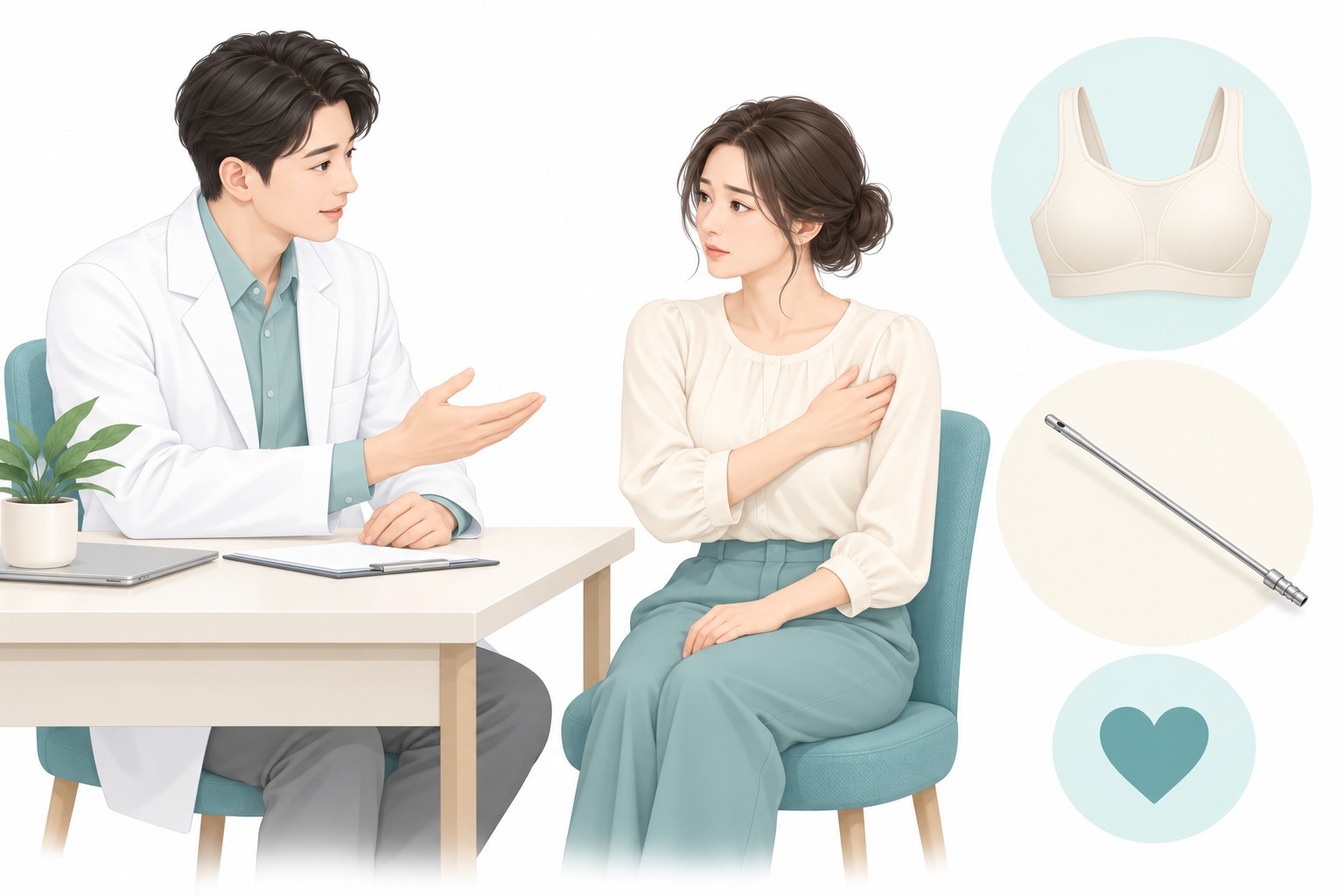
In consultations, we often hear patients say, "I had breast reduction surgery before, but the fat around my armpits and the sides of my chest is still there, and my breasts feel heavy again. Is it all right to have surgery again on breasts that have already been operated on?" Because the breasts already have scars, many people hesitate to have them touched again, and many worry that they will need another surgery that cuts the skin.
Today I would like to introduce the case of a patient who had previously undergone excisional breast reduction and then had a further breast reduction with liposuction. Based on textbooks and published papers, I will explain why liposuction is still possible after excisional surgery, the fat of the accessory breast, armpit, and side of the chest that remains after excisional surgery, and the differences between the excisional method and liposuction.
Liposuction Is Possible Even After Excisional Surgery
Operating on the same area a second time falls into two categories. One is revision surgery, which is done to fix a problem from the first operation (such as depressions or unevenness). The other is secondary liposuction, which is done when the first operation went well but the patient wants a further reduction in size or a better body contour[6]. Liposuction removes fat by making tunnels through the fat layer with a thin cannula. Because the fat layer and fibrous tissue that protect the skin and carry its blood supply must be preserved, part of the fat layer always remains after the first operation. That is why the remaining fat layer can be reduced once more with secondary liposuction even after tumescent liposuction, and ultrasound measurements at Venus Clinic also showed that secondary liposuction reduced the remaining fat layer again by a proportion similar to that of the first operation[6]. As the volume decreases and the skin contracts, sagging may also improve.
The same applies to the breasts. Just as having an excisional breast reduction does not mean the first operation was a failure, having liposuction afterward is less a revision surgery to fix problems from the first operation and closer to a secondary operation that goes one step further from a successful first surgery. Even in breasts that have already been reduced once with excisional breast reduction, suctioning the remaining fat can achieve an additional reduction in size.
The Same Principle Seen in Buttock Revision Surgery
Let me take the volume-up buttock liposuction that we often perform at Venus Clinic as an example. Patients whose buttocks look relatively large or noticeably saggy after previous thigh liposuction have additional buttock liposuction to improve both size and sagging. When the fat in the lower buttocks is reduced, the skin contracts, so the buttocks become smaller and the lower buttock line appears to rise. The key technique for encouraging as much skin contraction as possible is superficial liposuction.
The same principle applies to the breasts. When liposuction reduces breast volume, the skin that has been evenly suctioned up to the superficial layer contracts, and the breasts change in a direction in which sagging also improves. A paper reporting 475 breast reductions performed with liposuction alone also records that, in all patients, the skin contracted thanks to the reduced volume and superficial liposuction of the skin[3]. The same paper also records that six patients who had previously undergone a traditional excisional reduction said that recovery from the liposuction reduction was easier[3].
Having Had Excisional Surgery Does Not Rule It Out
Even if you have had an excisional breast reduction, if fat remains in and around the breasts, you can expect an additional reduction in size with liposuction. However, the method of the previous surgery and the amount of remaining fat differ from person to person, so during the consultation we first examine the breasts by touch to check how much fat remains.
Fat Around the Breasts Remains Even After Excisional Surgery
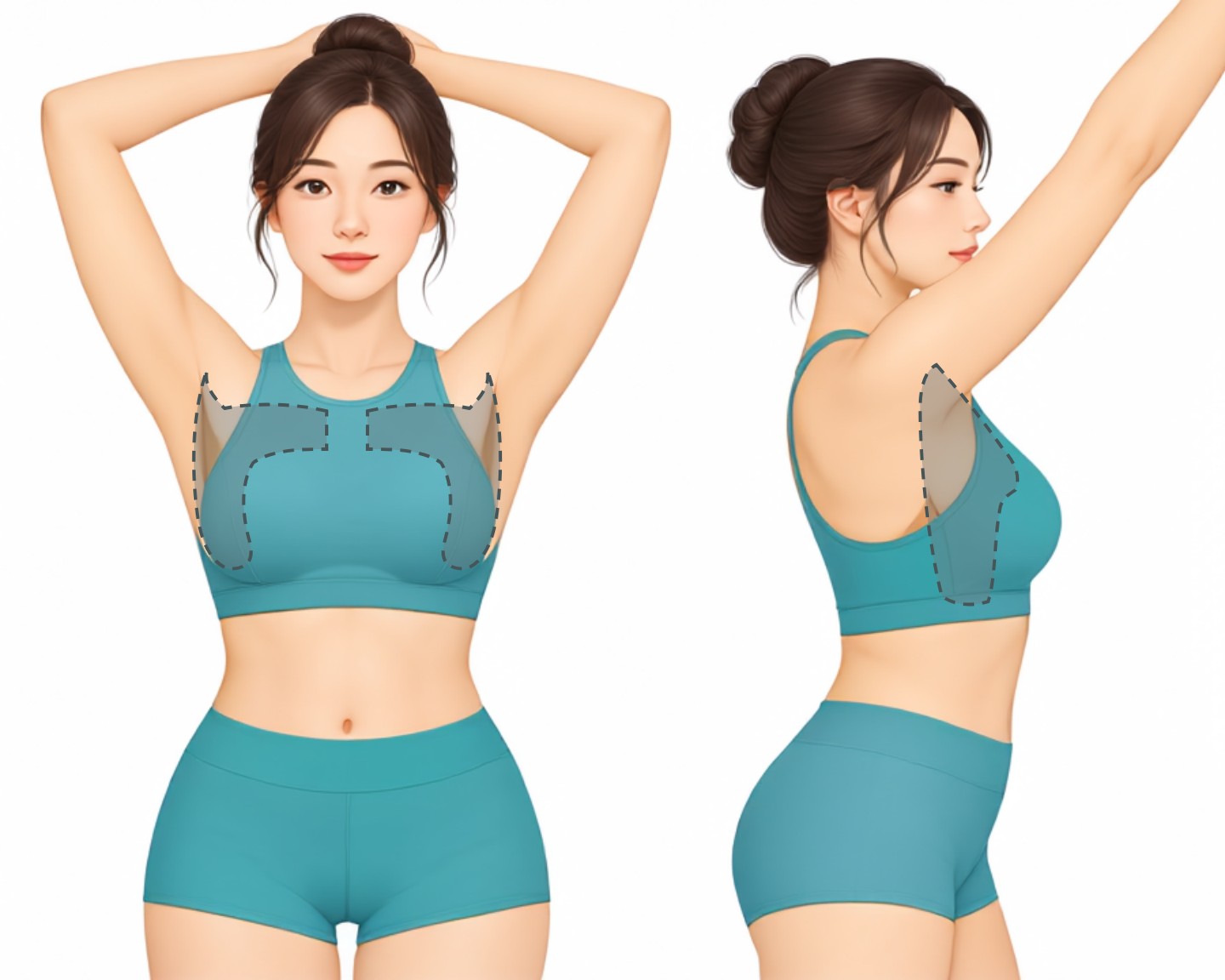
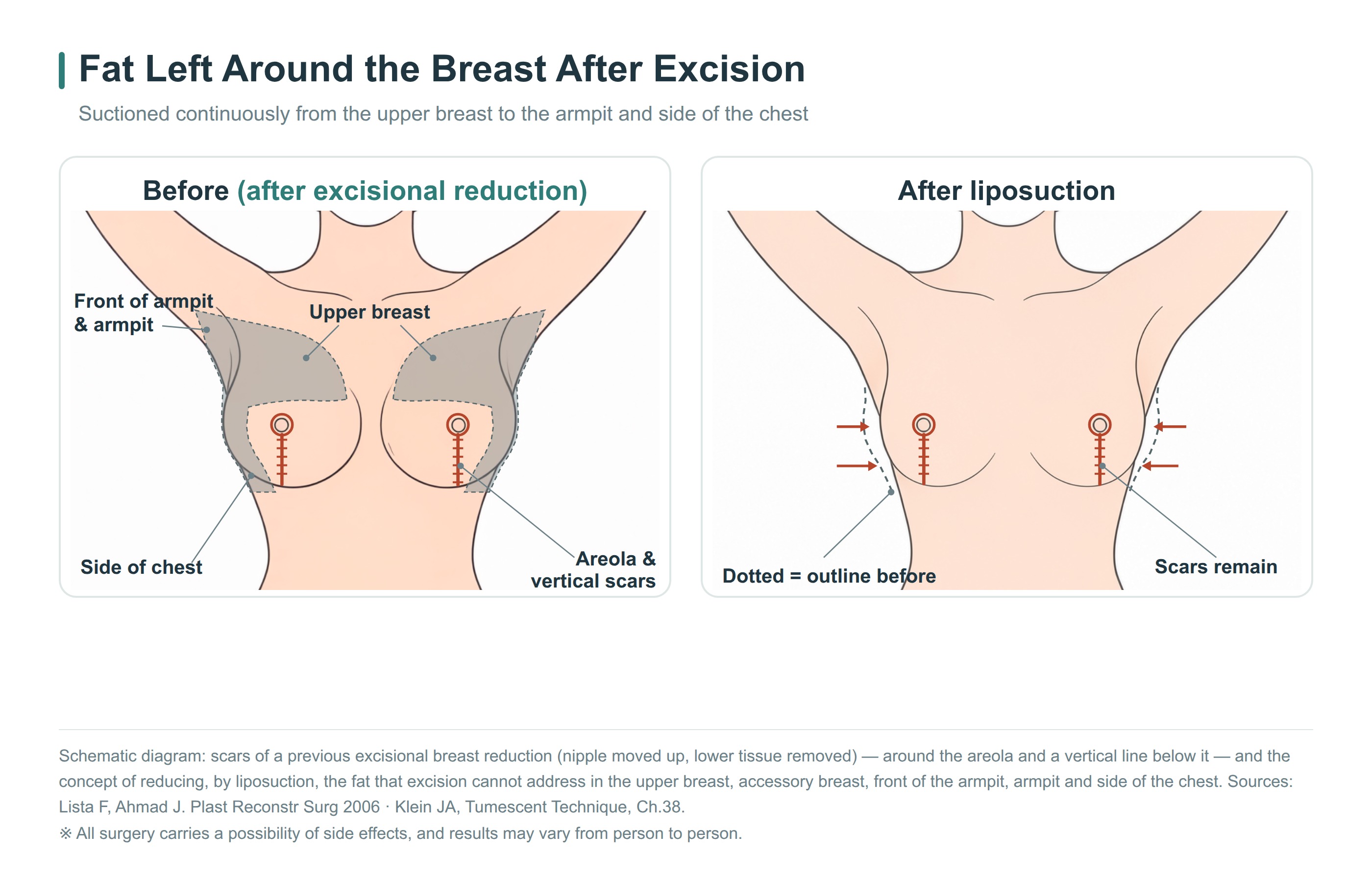
Excisional breast reduction is surgery that removes skin, glandular tissue, and fat from the lower and central parts of the breast and moves the nipple upward to reshape the breast. However, the boundary of the breast does not end at the round part seen from the front. Fat continues into the upper part of the breast extending below the collarbone, the accessory breast and front of the armpit, and the side of the chest below the side line of the bra. Because these areas cannot be cut away with the excisional method, fat often remains in them after surgery.
According to a paper reporting 250 cases of vertical scar breast reduction, the nipple and areola are moved upward while kept attached to the upper (or inner) tissue, and the skin, fat, and glandular tissue of the lower breast are removed in one piece before the wound is closed. As a result, the scar remains around the areola and as a vertical line running below it. The same paper explains that, after excision, the breast toward the armpit, the side of the chest, and the upper half of a fatty breast are reduced separately with liposuction when needed[7]. In other words, liposuction takes care of the areas that are difficult to handle with excision.
The Farther Out on the Breast, the Higher the Proportion of Fat
According to a textbook on tumescent liposuction, the proportion of fat in the female breast is about 67% in the central part, about 87% in the outer (lateral) part, and about 84% at the front of the armpit (the accessory breast area)[1]. This means that the outer part and the accessory breast area that remain after excisional surgery actually contain more fat than the central part that excisional surgery mainly deals with, and these areas are well suited to being reduced with liposuction. A paper on breast reduction with liposuction alone also cites the fact that the lateral breast and the accessory breast area are more than 70% fat as the basis for liposuction reduction being possible[3].
If the Surrounding Tissue Remains, the Shape Can Look Unnatural
If excisional surgery makes only the lower and central parts of the breast smaller while the volume of the upper part of the breast, the accessory breast and front of the armpit, and the side of the chest remains, the flesh outside the breast may appear to bulge out separately from the front, and from the side the volume toward the armpit may stand out, making the boundary between the breast and its surroundings look awkward. Liposuction can suction the fat of the upper part of the breast, the accessory breast and front of the armpit, and the side of the chest together with the breast as one continuous line, so it helps to create an additional reduction in size along with a shape whose boundary with the surrounding area looks natural. This is how liposuction can make up for these drawbacks of excisional surgery.
Differences Between the Excisional Method and Liposuction
The question people considering breast reduction ask most often is, "What is the difference between the excisional method and liposuction?" Summarizing the differences described in textbooks and papers as they are, they are as follows.
| Category | Excisional breast reduction | Breast reduction liposuction |
|---|---|---|
| How it reduces | Skin, glandular tissue, and fat are cut away together, and the nipple-areola is moved upward to reshape the breast | A thin suction tube (cannula) is inserted through small incisions to suction fat between and around the glandular tissue[1] |
| Incision lines | Depending on the method, incision lines remain around the areola, as a vertical line below the areola, and along the fold under the breast | Only incisions a few millimeters in size are used, so no long incision lines remain[1][2] |
| Nipple sensation | Reduced sensation of the nipple and areola is a known complication[1] | Because the nipple-areola is not detached and moved, it is advantageous for preserving nipple sensation[3] |
| Breastfeeding | Interference with future breastfeeding is a known complication[1] | Damage to the glandular tissue is small, so it is not expected to interfere with breastfeeding during a later pregnancy[1] |
| Tissue around the breast | The upper part of the breast, accessory breast, front of the armpit, and side of the chest cannot be excised, so fat tends to remain | Fat in and around the breast is suctioned together, connecting the boundary naturally |
| Anesthesia and recovery | Usually performed under general anesthesia, with a relatively long recovery period[2] | Performed under tumescent local anesthesia, with relatively little pain and a relatively quick return to daily life[1][2] |
| How much it can reduce | The breast can be greatly reduced depending on how much is cut away | Up to about 50%, and breasts with little fat show a smaller reduction[1][2] |
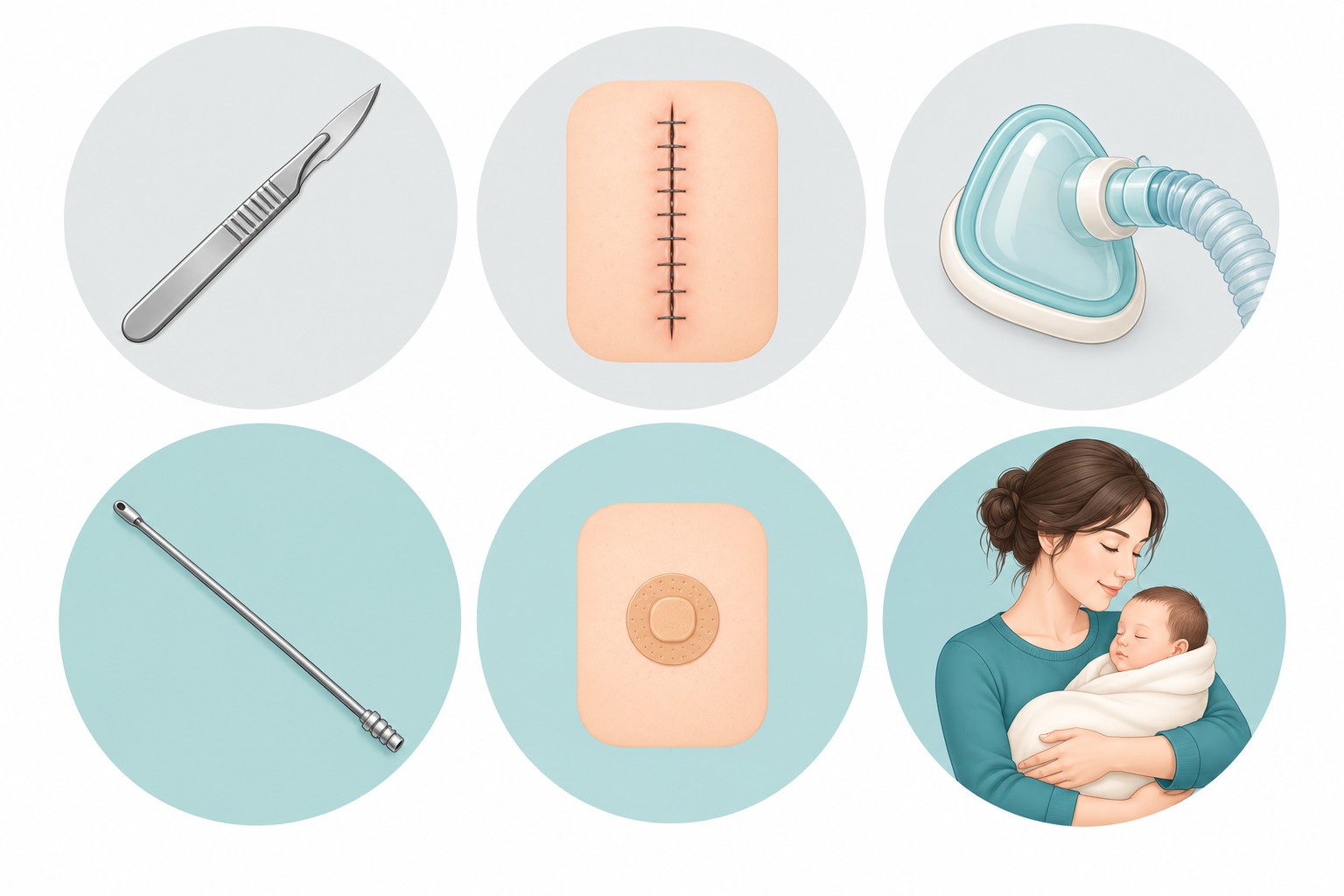
Both methods are operations that relieve the discomfort caused by heavy breasts, and each has cases for which it is suitable. A paper on breast reduction with liposuction alone reports that symptom relief was similar to that of traditional surgery while scarring and complications were reduced[3]. Venus Clinic does not perform reduction surgery that excises the skin; instead, we perform surgery that reduces the breasts and the area around them together with liposuction.
Why We Recommend Liposuction for Young Women Who Have Not Given Birth
The first thing we ask in a breast reduction consultation is, "Do you have any plans for childbirth and breastfeeding in the future?" For a young woman who has not yet given birth, this question comes before everything else.
You Can Choose It Without Worrying About Breastfeeding Function
Textbooks list reduced sensation of the nipple and areola and interference with future breastfeeding as complications of excisional breast reduction[1]. In contrast, tumescent liposuction causes little damage to the glandular tissue and postoperative mammogram findings are normal, so it is not expected to interfere with breastfeeding during a later pregnancy[1]. Another textbook reports that 16 young patients who had breast reduction or lifting with ultrasound-assisted liposuction later breastfed their babies regularly[5], and a paper on breast reduction with liposuction alone also notes that some women breastfed after surgery[3]. Although this has not yet been settled by large-scale studies[5], because the glandular tissue is not cut away and the nipple is not moved, I can say that it is a method that even those who plan to have children can choose without worrying about breastfeeding function.
No Long Incision Lines Remain
According to textbooks, tumescent liposuction can reduce breast volume by up to about 50% while leaving hardly any noticeable scars, and without the long recovery period that comes with traditional excisional reduction[1][2]. The incisions are a few millimeters in size and are placed in inconspicuous spots such as the fold under the breast or the armpit crease, so no long incision lines remain around the breast or below the areola. The vertical scar below the nipple seen in the preoperative photos of this case is a trace of the previous excisional surgery. The younger the woman, the more important it becomes as a criterion for choosing not to leave scars she will carry for a long time to come.
It Is Advantageous for Preserving Nipple Sensation
With the excisional method, reduced sensation may occur in the process of detaching the nipple-areola and moving it upward[1]. Because liposuction does not cut out and move the nipple, it is advantageous for preserving nipple sensation, and the report of 475 breast reductions with liposuction alone also records that there were no cases of diminished nipple sensation[3].
The Tissue Around the Breast Can Be Contoured at the Same Time
Large breasts in young women often contain a high proportion of fat. Textbooks also explain that fatty breasts, mainly in young women, can be reduced in volume with liposuction and that mild sagging can be corrected through skin contraction[4]. If the fat of the accessory breast, armpit, and side of the chest is also suctioned at the same time, the boundary between the breast and its surroundings connects naturally from both the front and the side.
Liposuction Can Be Considered Even If There Is Sagging
Many people think that only incisional surgery is possible if there is sagging, but when liposuction reduces volume, the skin that has been evenly suctioned up to the superficial layer contracts, and the breasts change in a direction in which sagging also improves. That is why, at Venus Clinic, we consider liposuction first even for those with sagging. The degree to which sagging improves varies from person to person depending on skin elasticity.
Surgical Method and Limitations
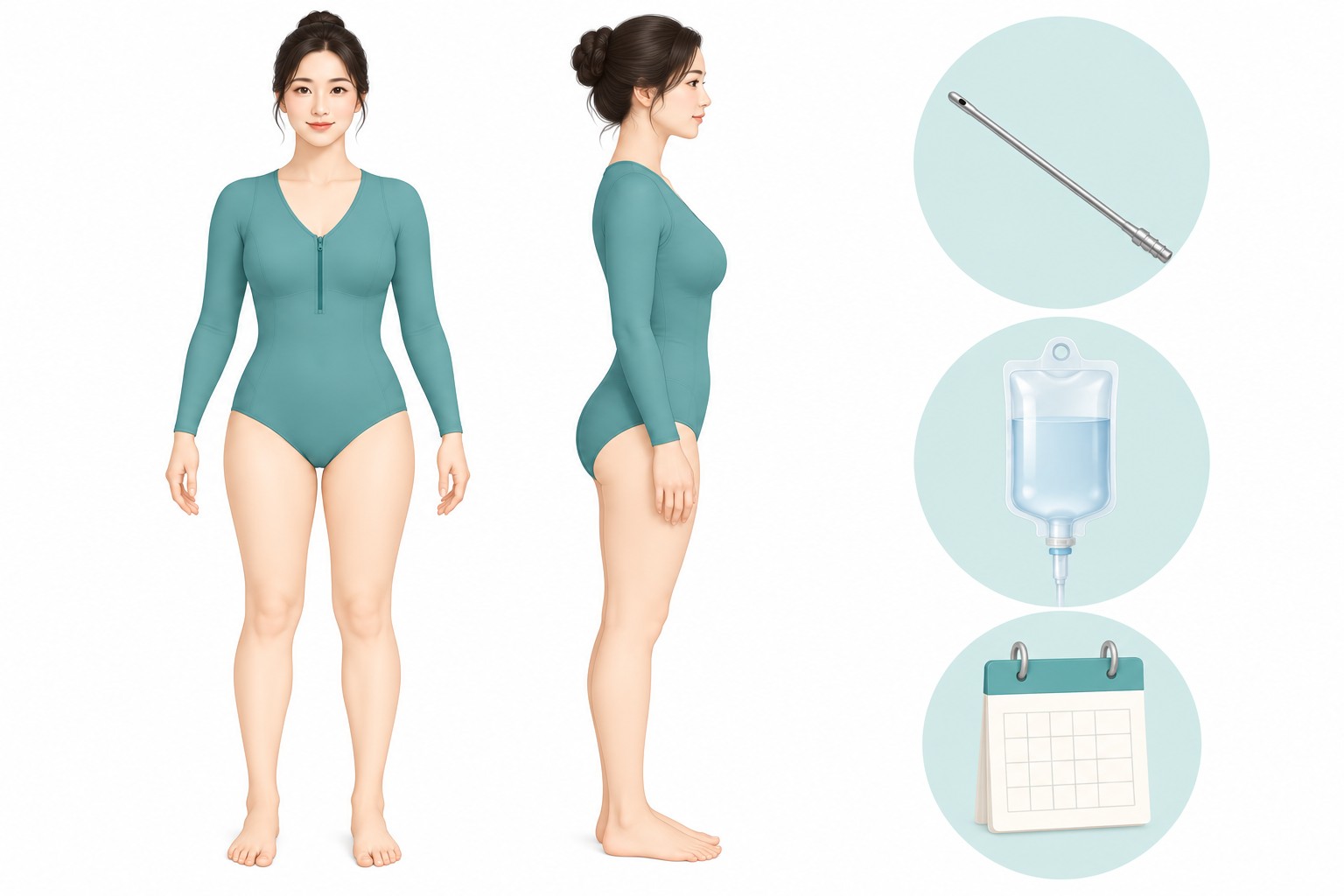
The surgery is performed under tumescent local anesthesia. After the tissue is sufficiently expanded with the anesthetic solution, a thin microcannula is inserted through small incisions in the fold under the breast and the armpit crease, and the fat is suctioned without interruption as one continuous line together with the breast, from the upper part of the breast through the accessory breast and front of the armpit to the armpit, as well as the side of the chest[1]. The area from the upper part of the breast to the armpit is where Venus Clinic always removes fat as well when performing breast reduction liposuction. Not only the deep layer but also the superficial layer close to the skin is suctioned evenly to encourage skin contraction. At Venus Clinic, we remove the fat that needs to be removed as thoroughly as possible and smooth the contour so that it is not uneven. After surgery, you wear a compression garment that presses the breasts, arms, and armpits together. Insufficient compression can make bruising worse, so textbooks also treat postoperative compression as important[1].
Some Breasts Cannot Be Reduced With Liposuction
What liposuction can reduce is the fatty component of the breast. Textbooks state that liposuction reduction may not be suitable when a reduction of well over 50% is needed or for breasts with almost no fat[1]. Those who have already had excisional surgery may have little fat left in the breast itself, so the reduction may appear larger in the surrounding tissue than in the breast. Also, liposuction is not a surgery that removes the scars of the previous excisional surgery, so the existing scars remain as they are.
Sagging Changes Gradually and Differs From Person to Person
Skin contraction does not appear immediately after surgery but gradually over the months during which the swelling subsides, and when skin elasticity is greatly reduced, some sagging or wrinkles may remain. If you gain weight after surgery, the remaining fat cells can grow and the breasts may become larger as well, so weight management is necessary.
About Breast Screening
The paper on breast reduction with liposuction alone requires a mammogram before surgery for patients aged 40 or older[3]. The textbook author writes that he has not seen calcifications on mammograms after tumescent liposuction but that they could occur in some cases[1], so when you have a breast screening after surgery, it is a good idea to let the examiner know that you have had liposuction.
References
- Klein JA. Tumescent Technique: Tumescent Anesthesia & Microcannular Liposuction. Mosby; 2000. Chapter 38 (Female Breasts).
- Klein JA. Tumescent Technique: Tumescent Anesthesia & Microcannular Liposuction. Mosby; 2000. Chapter 27 (Microcannulas).
- Gray LN. Lipoplasty-only breast reduction. Aesthet Surg J. 2001;21(3):273–276.
- Mastopexy (Breast Lift) with Ultrasound-Assisted Liposuction. In: Shiffman MA, Di Giuseppe A, eds. Liposuction: Principles and Practice. Springer; 2006. Chapter 36.
- Ultrasound-Assisted Liposuction for Breast Reduction. In: Shiffman MA, Di Giuseppe A, eds. Liposuction: Principles and Practice. Springer; 2006. Chapter 62.
- Venus Clinic. Why Secondary Liposuction Is Sometimes Needed. https://en.myvenus.co.kr/column/38999
- Lista F, Ahmad J. Vertical scar reduction mammaplasty: a 15-year experience including a review of 250 consecutive cases. Plast Reconstr Surg. 2006;117(7):2152–2165.
Before-and-After Photos
The photos below compare, from four directions, a patient who had previously undergone excisional breast reduction and then had liposuction of the breasts, accessory breasts, sides of the chest, and armpits at Venus Clinic. All postoperative photos were taken one week after surgery (on the 8th day after surgery). This patient also had arm liposuction during the same operation, but this article describes only the changes around the breasts. Bruising and swelling still remain at this stage, so these are not the final results, and the shape will change somewhat further as the swelling subsides and the skin contracts.
Photo 1 — Front
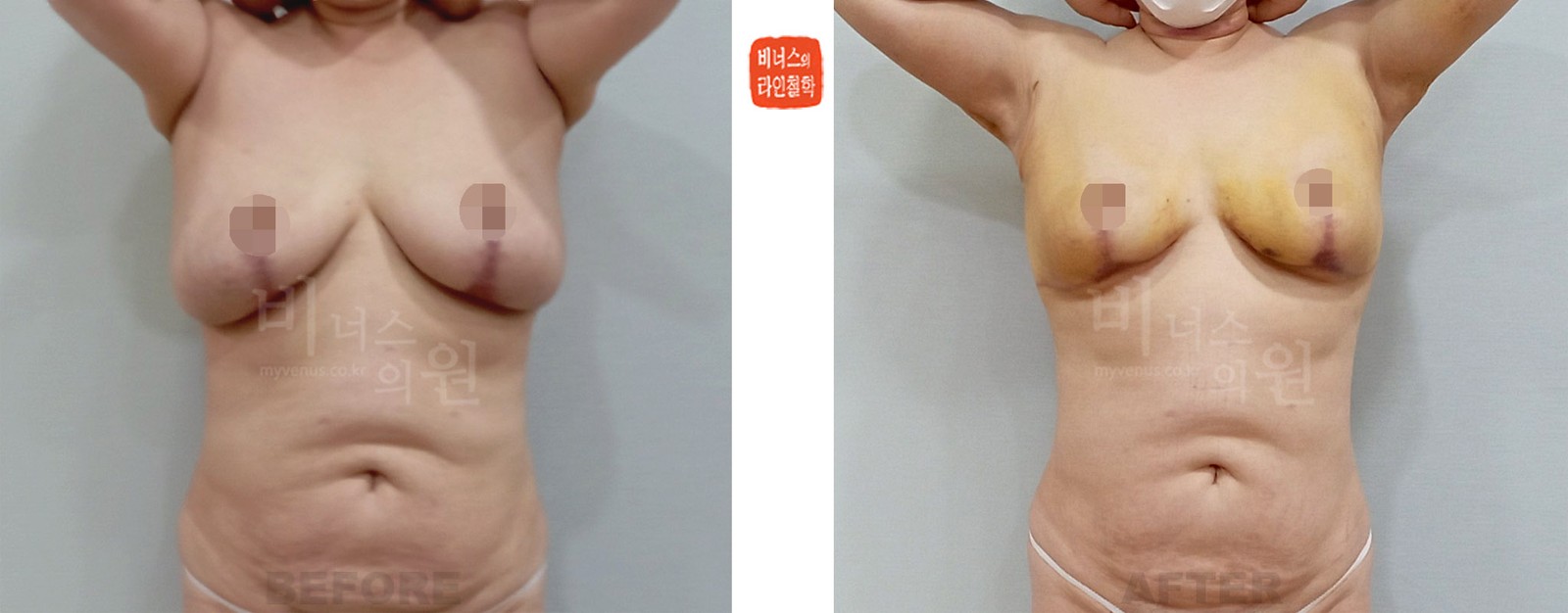
This is a case of previous excisional breast reduction. In the preoperative photo, vertical excision scars running from just below both nipples down to the fold under the breast can be seen; these are traces of the previous excisional breast reduction. There was sagging of the breasts, and volume remained at the sides of the breasts, the armpits, and the accessory breast areas. One week after surgery, bruising and a yellowish tint remain, but you can see that the volume of the breasts, the sides of the breasts, and the armpit area has decreased.
In the before-and-after photos, the scars on the breasts have been covered to protect personal information. Therefore, the location of the vertical scar from the previous excisional breast reduction and the extent of the upper part of the breast, accessory breast, front of the armpit, and side of the chest, which cannot be reduced with the excisional method, are shown in the schematic diagram below. The scar runs vertically from below the nipple toward the lower part of the breast, and the liposuction reduced the fat that remained outside this scar without touching the scar itself.
| Information on the Posted Liposuction Before-and-After Photos | |||
|---|---|---|---|
| - Same person | Surgery performed at Venus Clinic; same person | - Date taken | Taken around 3/2023; comparison at 1 week after surgery |
| - Same conditions | Edited to the same posture and size as closely as possible | - Side effects | https://en.myvenus.co.kr/should_know/38861 |
Photo 2 — Right Side
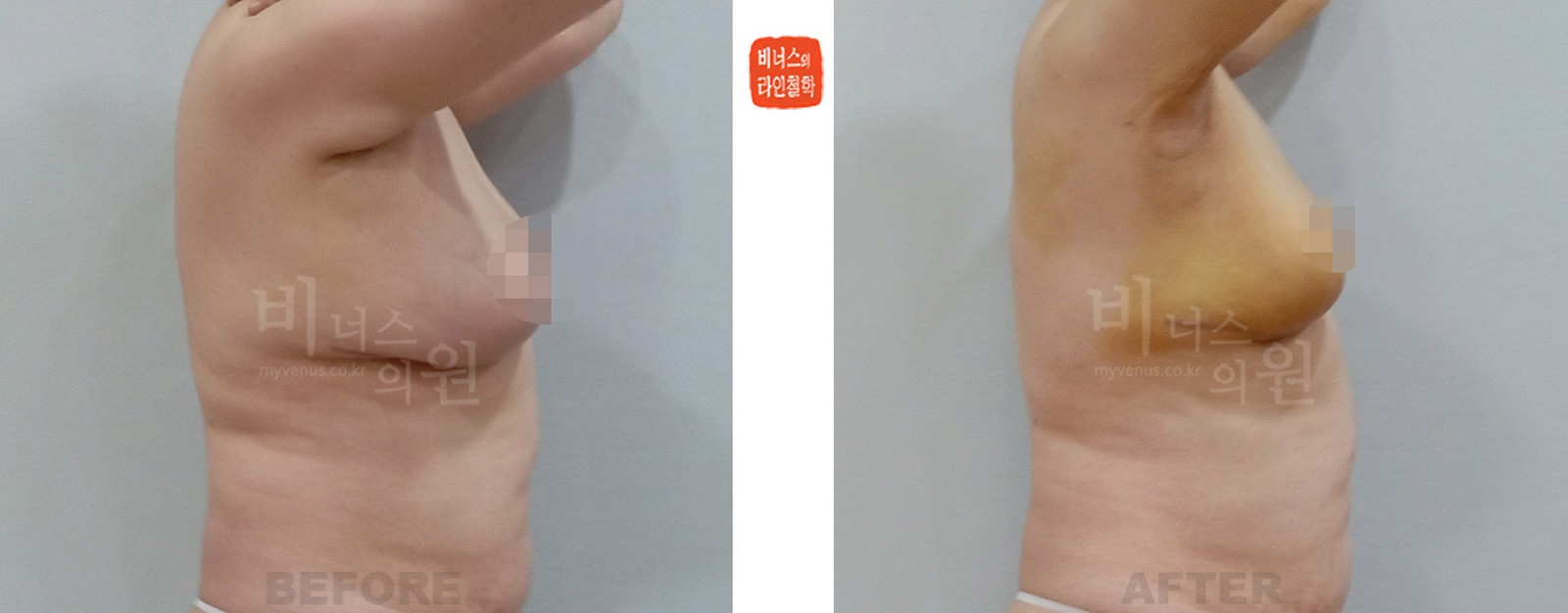
This is a case in which the fat remaining at the sides of the breasts and the armpits after the excisional method was suctioned. In the preoperative photo taken from the side, the breasts projected forward and volume remained at the sides of the breasts and toward the armpits. One week after surgery, the projection of the breasts has decreased and the volume of the armpits and the sides of the breasts has decreased, showing an additional reduction in size.
| Information on the Posted Liposuction Before-and-After Photos | |||
|---|---|---|---|
| - Same person | Surgery performed at Venus Clinic; same person | - Date taken | Taken around 3/2023; comparison at 1 week after surgery |
| - Same conditions | Edited to the same posture and size as closely as possible | - Side effects | https://en.myvenus.co.kr/should_know/38861 |
Photo 3 — Left Side
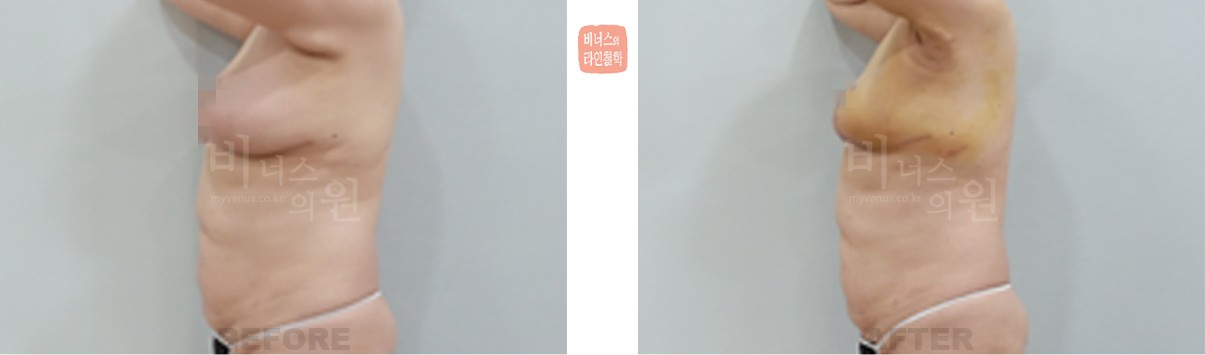
This is a case in which the fat remaining at the sides of the breasts and the armpits after the excisional method was suctioned. On the opposite, left side as well, the projection of the breasts and the volume at the sides of the breasts and the armpits were visible before surgery, and one week after surgery, while some bruising remains, the projection of the breasts and the surrounding volume have decreased.
| Information on the Posted Liposuction Before-and-After Photos | |||
|---|---|---|---|
| - Same person | Surgery performed at Venus Clinic; same person | - Date taken | Taken around 3/2023; comparison at 1 week after surgery |
| - Same conditions | Edited to the same posture and size as closely as possible | - Side effects | https://en.myvenus.co.kr/should_know/38861 |
Photo 4 — Left Oblique
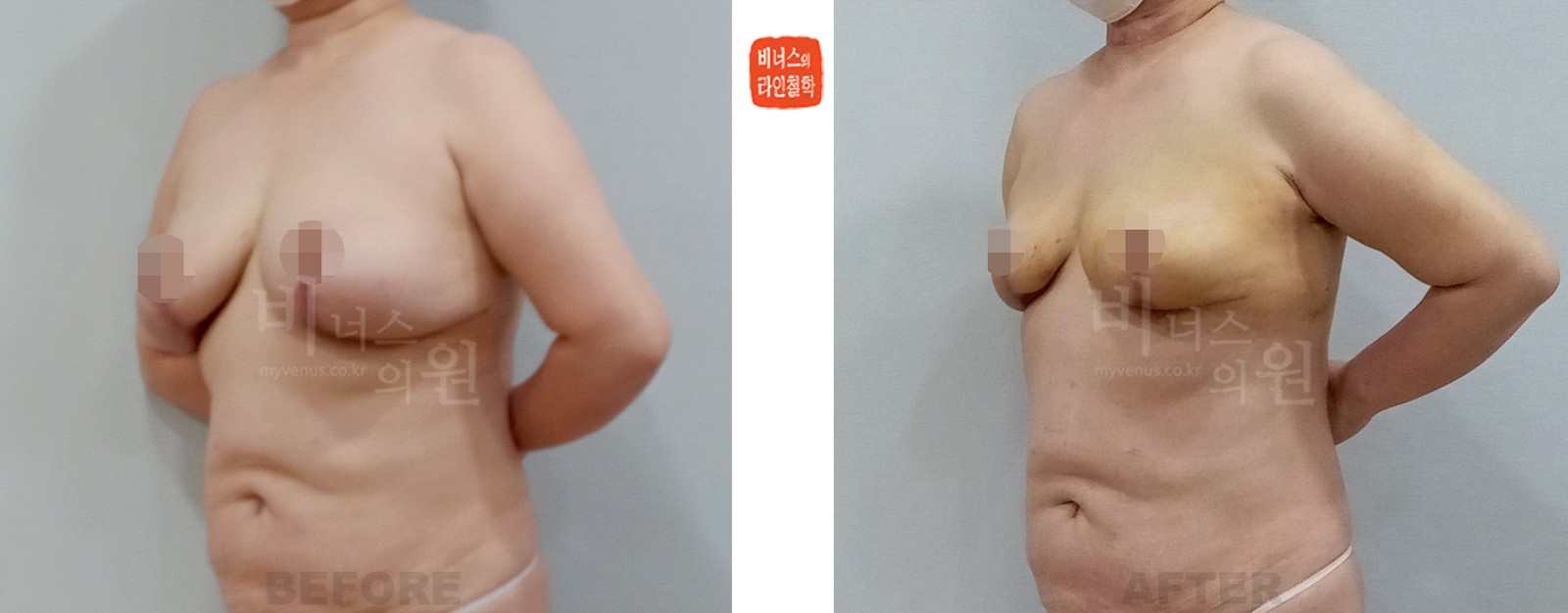
This is a case in which the fat of the accessory breasts and the sides of the chest was suctioned after the excisional method. In the preoperative photo taken at an angle, the volume of the outer breasts and toward the armpits stood out separately from the breasts. One week after surgery, the volume of the breasts, the sides of the breasts, and the armpit area has decreased together, and the boundary around the breasts connects more naturally than before.
| Information on the Posted Liposuction Before-and-After Photos | |||
|---|---|---|---|
| - Same person | Surgery performed at Venus Clinic; same person | - Date taken | Taken around 3/2023; comparison at 1 week after surgery |
| - Same conditions | Edited to the same posture and size as closely as possible | - Side effects | https://en.myvenus.co.kr/should_know/38861 |
In Closing
Even if you have had an excisional breast reduction, if fat remains in the upper part of the breast, the accessory breast and front of the armpit, and the side of the chest, which the excisional method cannot address, you can expect an additional reduction in size along with a shape whose boundary with the surrounding area looks natural through liposuction. And if you are a young woman who has not yet given birth, I recommend first considering liposuction, which does not cut away the glandular tissue or move the nipple, so you can choose it without worrying about breastfeeding function, and which leaves no long incision lines. At Venus Clinic, we view not just the breasts but the breasts and the area around them as one continuous line and contour them together.
References: Why Secondary Liposuction Is Sometimes Needed Volume-Up Buttock Liposuction How Liposuction for Buttock Sagging Works Liposuction for Correcting Breast Asymmetry Breast Reduction Liposuction for Breasts That Sag After Childbirth
Dr. Hakjun Kim, Director, Venus Clinic