Fat Grafting - Breast Fat Grafting
Adding breast volume with your own fat instead of implants
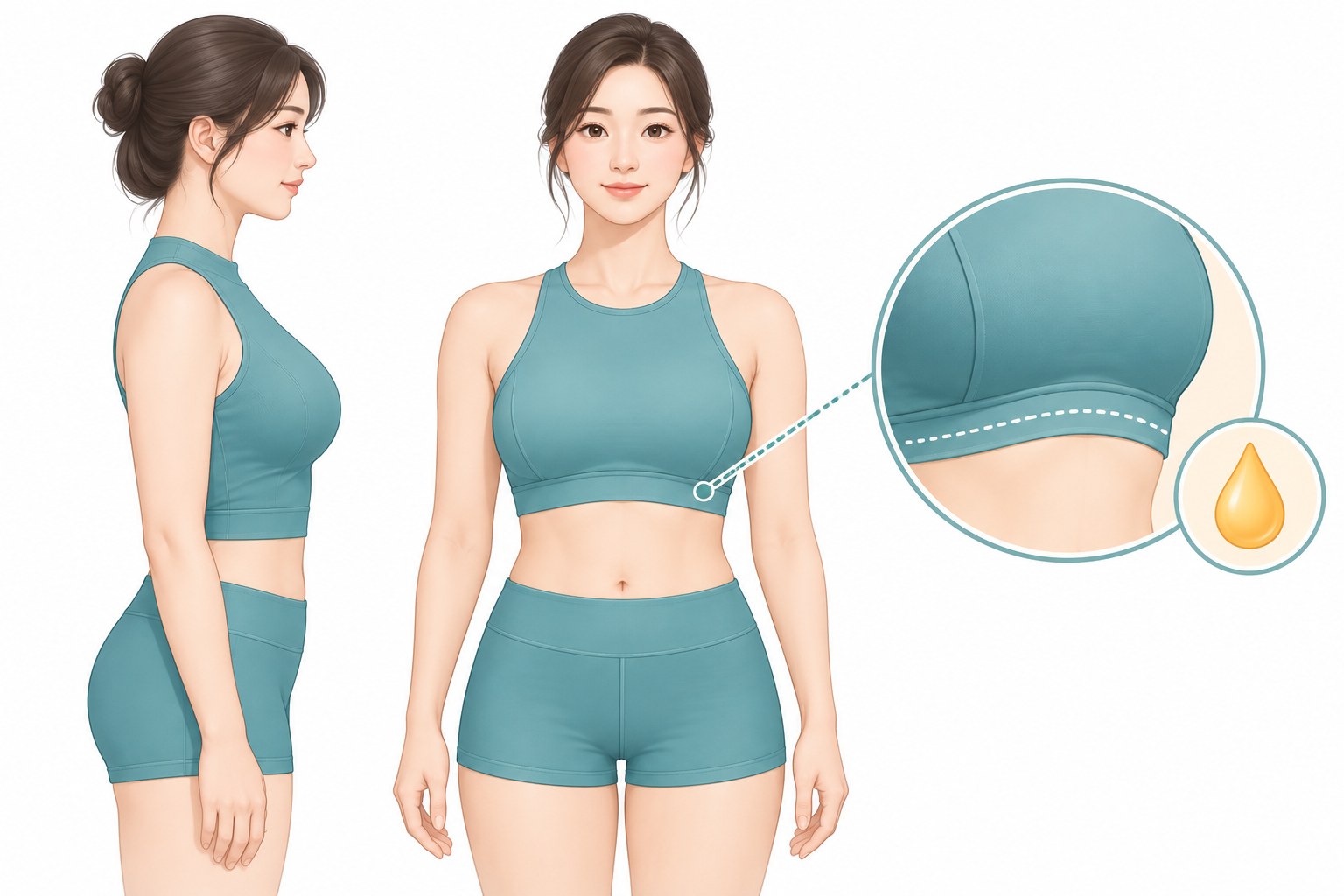
This illustration was created with AI to aid understanding and does not show an actual surgical result.
Breast fat grafting purifies your own fat, harvested from the abdomen, thighs or flanks, and transfers it to the breasts to improve volume and shape. No implant is used and no incision is made on the breast other than small entry points, so the feel and shape remain natural, and the donor areas are contoured at the same time.
On the other hand, the amount of enlargement possible in one session is limited, and how much of the grafted fat survives differs from person to person. A randomized study found that fat grafting looked more natural than implants, but implants maintained volume better and fat grafting required an average of two sessions. We therefore begin by matching the size you want with a realistic range of change.
Breast Fat Grafting at a Glance
- What it is — A breast augmentation method in which your own fat, harvested by liposuction from areas such as the abdomen or thighs and then purified, is distributed into several layers of the breast to add volume and improve shape.
- Without implants — It is performed through small entry points without cutting the breast, and the areas where fat is removed are contoured at the same time.
- Volume and sessions — In a randomised trial, the first session averaged about 180 mL per breast, and close to half of the participants had a second graft.
- Good to know — How much fat survives varies widely between individuals, and lumps or calcification can develop, so you should tell the radiologist about the fat graft at breast screening.
Who May Consider It
- Those with a hollow upper chest or overall lack of breast volume
- Those who want to improve differences in breast size or shape
- Those who have concerns about implants, or want to restore volume after implant removal
- Those who want both body contouring of the abdomen or thighs and more breast volume
- Those who prefer a natural change rather than a large enlargement
How the Procedure Is Performed
STEP 1 · Consultation and design
We assess breast shape, skin laxity and asymmetry, and plan how much to fill in the upper, outer and lower breast. A breast ultrasound or other examination may be recommended before surgery.
STEP 2 · Fat harvesting
Under tumescent local anesthesia, fat is harvested with a fine cannula from areas with ample fat. Following the liposuction approach Venus Clinic has practiced for 20 years, the contour of the donor area is refined at the same time.
STEP 3 · Purification
Blood, anesthetic fluid and free oil are removed to prepare the fat for grafting.
STEP 4 · Injection
Through small, inconspicuous entry points such as the breast fold, fat is distributed evenly in small portions into the subcutaneous layer and around the breast tissue using a blunt cannula.
Safety Principles
1. Never concentrated in one spot.
When fat is placed as a lump, its center may not survive, which can lead to lumps (fat necrosis), oil cysts or calcification. Distributing fine threads of fat across multiple layers and directions is important for both graft survival and safety.
2. Breast examinations before and after surgery.
Lumps after fat grafting are reported to be mostly benign and distinguishable by ultrasound. Please let your doctor know about the fat grafting when you have routine breast screening, and tell us about any history of breast disease during consultation.
3. Additional grafting only after the result settles.
The amount of surviving fat varies widely with measurement methods and individuals, so we cannot promise a single number. Once the volume has settled several months after the first surgery, additional grafting is considered if needed.
What the Research Shows: Breast Fat Grafting
We have summarised studies published in international journals on the questions patients ask most often in consultation. Study populations and methods differ, so the figures are for reference only, and results vary from person to person.
| Topic | Findings |
|---|---|
| Compared with implants | In a trial that randomly assigned 185 women to implants or fat grafting and followed them for an average of 4 years, volume maintenance was rated higher for implants and naturalness of shape higher for fat grafting. Source: Aesthetic Plastic Surgery, 2025 |
| Sessions and volume | Of the 90 women in the fat grafting group, 50 (56%) needed only one session and 40 (44.5%) had a second graft. The first session averaged 180 mL per breast (range 80–280 mL). Source: Aesthetic Plastic Surgery, 2025 |
| Graft volume | In a study of 105 patients, an average of 205 mL (120–250 mL) was injected per breast; in thin patients who received less than 150 mL per side because there was not enough fat to harvest, the change was not obvious. Source: Annals of Plastic Surgery, 2014 |
| Retention (graft survival) | Breast fat graft survival is said to vary widely, from 10% to 50%. A review of 12 studies (1,337 patients) found that reported figures differed with the measuring tool (MRI, 3D scanning, etc.) even for the same technique, and one study using pre-expansion reported 82% by MRI. Source: Chinese Medical Journal, 2019 |
| Lumps | Among 256 patients seen for lumps after fat grafting, ultrasound classified them as cystic 31%, complex 25%, solid 19% and calcified 23%; they were treated by aspiration, liposuction or excision according to type. Source: Plastic and Reconstructive Surgery Global Open, 2017 |
| Screening and breast cancer | Imaging has been reported to distinguish benign from malignant calcification, and a study that followed 181 patients for 10 years found no new cancers. However, anyone with a history of intraepithelial lesions such as ductal carcinoma in situ (DCIS) should receive a separate explanation before surgery. Source: Archives of Plastic Surgery, 2015 |
Frequently Asked Questions
Q. How much larger will my breasts become in one session?
Because the volume that can be injected and the volume that survives differ between people, we cannot promise a cup size. In the literature, about 200 mL per breast was common, and changes were small with less than 150 mL. The amount of fat available for harvest is also taken into account.
Q. Does it interfere with breast screening?
Changes after fat grafting are reported to be distinguishable on imaging in most cases. However, please tell the examiner that you have had fat grafting so the images can be read accurately.
Q. Is it possible if I am slim?
The first question is whether enough fat can be harvested for the breasts. We examine whether fat can be gathered from several areas, and if it is insufficient, we adjust the expected range of change together.
Q. How many sessions of breast fat grafting will I need?
Because there is a limit to how much can be grafted at once, it is often divided into two sessions. In a randomised trial, 56% of the 90 women who received fat grafting finished after one session and 44.5% had a second graft. Additional grafting is considered after the volume has settled following the first operation.
Q. How much of the grafted fat survives?
Reported figures range from the 10% range to the 80% range depending on the study. Because the numbers change with the measuring method (MRI, 3D scanning, etc.), we cannot promise a single figure, and the remaining volume is judged once it has settled after a few months.
Q. What should I do if I feel a lump in the breast after surgery?
If part of the grafted fat does not survive, lumps, oil cysts or calcification can form. Most are reported to be benign, but if you feel a lump you should be examined so that its nature can first be checked by ultrasound and treated accordingly.
Q. How is it different from implant augmentation?
Implants are better for making the breast clearly larger and keeping that size, while fat grafting gives a natural feel and shape and contours the donor areas, but the increase per session is smaller. The right method depends on the size you want and your body type.
Recovery
Swelling, bruising and tightness may occur in the breasts and donor areas, and a compression garment is worn over the donor areas as after liposuction. Avoid strong compression or massage of the grafted breasts, and resume underwear and exercise gradually as instructed.
References
- Breast Implants or Lipofilling in Augmentation Mammoplasty? A Randomized, Open-Label, Controlled Trial — Aesthetic Plastic Surgery (2025) PMC12992393
- Breast Augmentation With Autologous Fat Injection — Annals of Plastic Surgery (2014) PMC4219534
- Methods used for evaluation of volume retention rate in autologous fat grafting for breast augmentation: a systematic review — Chinese Medical Journal (2019) PMC6797153
- Ultrasound Diagnosis and Treatment of Breast Lumps after Breast Augmentation with Autologous Fat Grafting — Plastic and Reconstructive Surgery Global Open (2017) PMC5889454
- Breast Lipofilling: A Review of Current Practice — Archives of Plastic Surgery (2015) PMC4366692