Fat Grafting - Facial Fat Grafting
Filling hollow areas of the face with your own fat
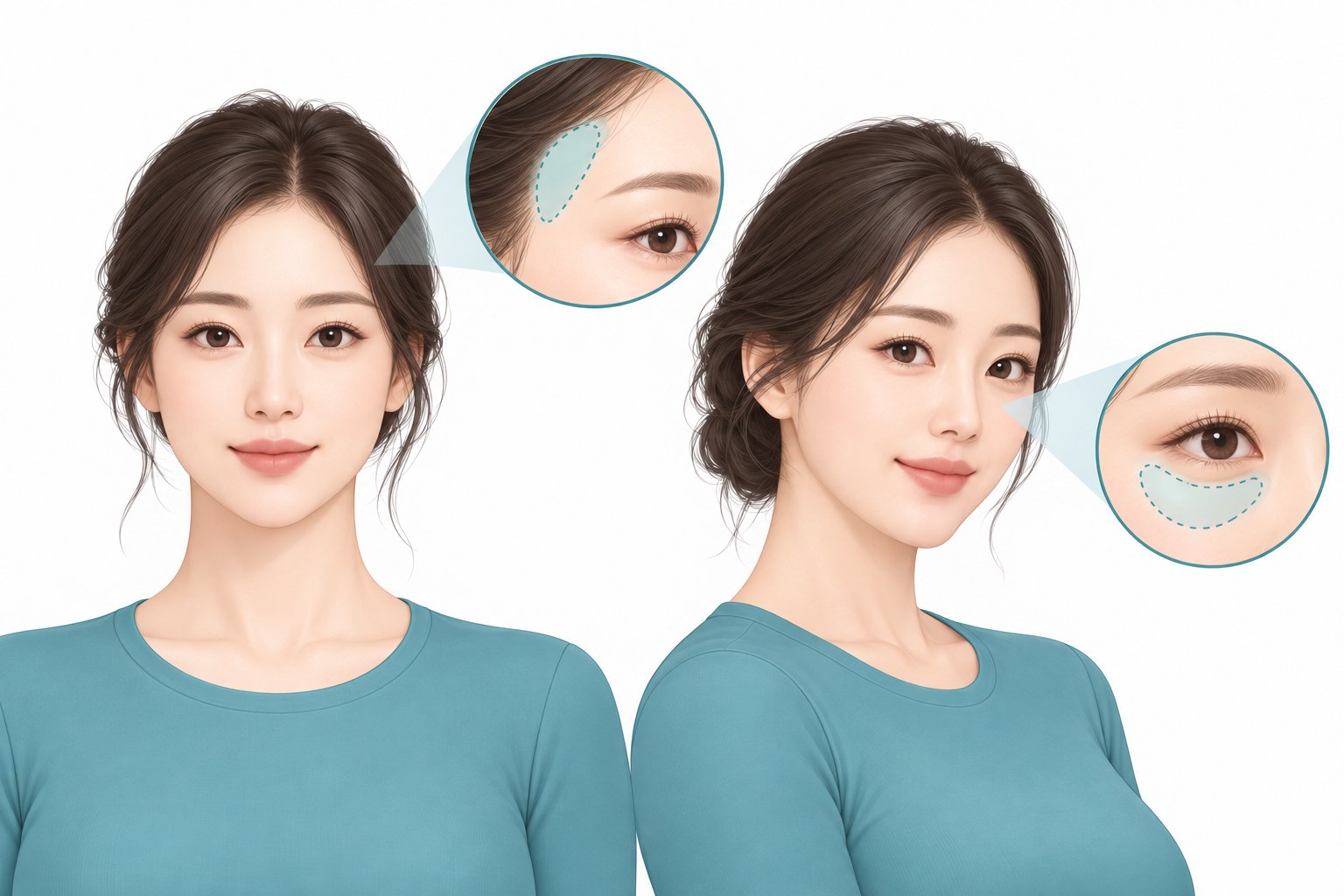
This illustration was created with AI to aid understanding and does not show an actual surgical result.
With age, the facial fat and the tissue around the bones gradually decrease: the forehead and temples become hollow, shadows appear under the eyes and along the nasolabial folds, and the cheeks look flat. Facial fat grafting harvests fat from areas with a surplus, such as the abdomen or thighs, purifies it, and transfers it in small portions to areas that have lost volume.
Because your own tissue is used, there is little foreign-body sensation, and the fat that takes hold remains together with the surrounding tissue. However, not all of the transferred fat survives and the amount varies from person to person, so additional grafting is planned when needed.
Facial Fat Grafting at a Glance
- What it is — An operation in which your own fat, harvested from areas such as the abdomen or thighs and purified, is placed in very small amounts in several layers into hollow areas such as the forehead, temples, under the eyes, nasolabial folds and cheeks.
- How much survives — In a review of 43 studies (4,577 patients), the average volume retention of fat grafted without supplements was 41.63%. The amount that survives varies greatly between individuals.
- Volume — In the same review, the average volume injected into the face in one session was 16.9 mL. It is a procedure of placing small amounts in divided portions rather than a large volume.
- Good to know — Rarely, fat entering a blood vessel can cause serious complications such as loss of vision, so fat is injected slowly in small amounts at low pressure with a blunt cannula.
Who May Consider It
- Those whose forehead and temples are hollow, making the side profile look uneven
- Those who are told they look tired because of under-eye hollows or shadows along the nasolabial folds
- Those whose cheeks look flat or whose face looks gaunt after weight loss
- Those who want to naturally correct small defects of the chin or facial contour
- Those who prefer to restore volume with their own tissue rather than repeating fillers
How the Procedure Is Performed
STEP 1 · Consultation and design
We check hollow areas and asymmetry from the front, side and oblique views and plan the amount needed for each area, considering the balance of the whole face.
STEP 2 · Fat harvesting
Under tumescent local anesthesia, the required amount of fat is harvested from the abdomen or thighs with a fine cannula. On the same principle as liposuction, the donor contour can be refined at the same time.
STEP 3 · Purification
Blood, anesthetic fluid and free oil are removed, leaving only the fat to be grafted, without applying excessive force that could damage fat cells.
STEP 4 · Injection
Using a fine blunt cannula, very small amounts are placed in multiple layers and directions. Spreading the fat rather than clumping it helps new blood vessels grow into the graft.
Safety Principles
1. Little by little, in multiple layers.
The widely accepted standard for facial fat grafting is to place purified fat in small portions across multiple layers with a blunt cannula. Placing a large amount in one layer can leave the center without blood supply, leading to absorption, lumps or cysts.
2. Avoiding the course of blood vessels.
The literature reports rare cases in which fat entered a blood vessel, causing visual impairment or cerebrovascular complications, and severe complications have been reported most often in the forehead and temple. We therefore consider the course of facial vessels, use blunt cannulas and inject slowly with low pressure.
3. Never overfilling at once.
Studies report that on average around 40% of facial fat grafted without enhancement remains. Rather than overfilling in anticipation of absorption, we graft within a natural range and consider additional grafting after two to three months if needed.
What the Research Shows: Facial Fat Grafting
We have summarised studies published in international journals on the questions patients ask most often in consultation. Study populations and methods differ, so the figures are for reference only, and results vary from person to person.
| Topic | Findings |
|---|---|
| Retention | A systematic review of 43 studies (4,577 patients) found a weighted average volume retention of 41.63% for fat grafted without supplements (average follow-up 13.9 months). The midface was the most common site (53%). Source: JPRAS Open, 2019 |
| Common problems | In the same review, 104 complications (2.27%) were reported, most often asymmetry (74 cases) and skin irregularity. Source: JPRAS Open, 2019 |
| Around the eyes | A meta-analysis of 39 studies (4,046 cases) of eyelid and periorbital fat grafting reported a complication rate of 7.9%, mainly swelling, chemosis and contour irregularity. Source: PLoS ONE, 2021 |
| Rare serious complications | A review of 22 reports of complications after cosmetic facial fat grafting included serious cases such as 11 of hemiplegia and 7 of vision loss, and 53% of serious cases occurred in the forehead and temple. The cause is fat embolism, in which fat enters a blood vessel. Source: Plastic and Reconstructive Surgery Global Open, 2024 |
| Late lumps | A Korean study of 27 patients with periorbital lipogranuloma found that symptoms appeared an average of 13.6 months (2–153 months) after injection; they were treated with injections or excision, and some resolved on their own. Source: Korean Journal of Ophthalmology, 2016 |
| PRP and stem-cell supplements | A review of 27 studies of supplemented grafts found that 13 of 22 studies reported better volume retention, but most were of low quality, and it concluded that the benefit of supplements is not yet clear. Source: Aesthetic Surgery Journal, 2022 |
Frequently Asked Questions
Q. Will my face look bigger?
Because only the amount needed is placed in hollow areas, we consider the size and proportions of the whole face when planning each area. The face may look fuller immediately after surgery due to swelling, but it settles as the swelling subsides.
Q. How is it different from fillers?
Fillers inject a material that is absorbed over time, whereas fat grafting transfers your own fat, which remains as tissue once it takes hold. On the other hand, fat must be harvested, and because part of the transferred fat is absorbed, additional grafting may be needed.
Q. What happens if I lose or gain weight after grafting?
Transferred fat may respond to weight changes like fat in its original location. Avoiding large weight changes after surgery helps maintain the shape.
Q. How much of the fat grafted into the face survives?
A review of 4,577 patients found an average volume retention of 41.63%. Because individual variation is large, rather than overfilling at once, additional grafting is considered where needed after the volume has settled.
Q. What is the most important complication to watch for in facial fat grafting?
Although rare, it is fat embolism, in which fat enters a blood vessel. More than half of the serious cases reported were in the forehead and temple. We therefore inject very small amounts at low pressure with a blunt-tipped cannula, and if you notice blurred vision, a severe headache or weakness in an arm or leg after surgery, you should contact us immediately.
Q. Can a lump appear around the eyes months later?
Rarely, a lump called a lipogranuloma can form, and in studies it sometimes appeared a little over a year later on average. If you feel a lump, you should be examined so that appropriate treatment such as injection or excision can be decided.
Q. Does adding PRP or stem cells make more fat survive?
Reports of improvement and of no difference are mixed, and most studies are of low quality, so there is not yet enough evidence to recommend it clearly. We explain the pros and cons in consultation.
Recovery
Swelling and bruising of the face may be noticeable for several days after surgery and usually subside over one to two weeks. Early volume includes swelling, so the final appearance settles over several months. We will advise you not to press or massage the grafted areas firmly.
References
- A systematic review of the effectiveness and complications of fat grafting in the facial region — JPRAS Open (2019) PMC7061561
- Efficacy, safety and complications of autologous fat grafting to the eyelids and periorbital area: A systematic review and meta-analysis — PLoS ONE (2021) PMC8016360
- Complications Associated with Facial Autologous Fat Grafting for Aesthetic Purposes: A Systematic Review of the Literature — Plastic and Reconstructive Surgery Global Open (2024) PMC10803033
- Periorbital Lipogranuloma after Facial Autologous Fat Injection and Its Treatment Outcomes — Korean Journal of Ophthalmology (2016) PMC4742640
- Supplementation of Facial Fat Grafting to Increase Volume Retention: A Systematic Review — Aesthetic Surgery Journal (2022) PMC9750673