Fat Grafting - Hip Fat Grafting
Filling hip dips for a continuous side line
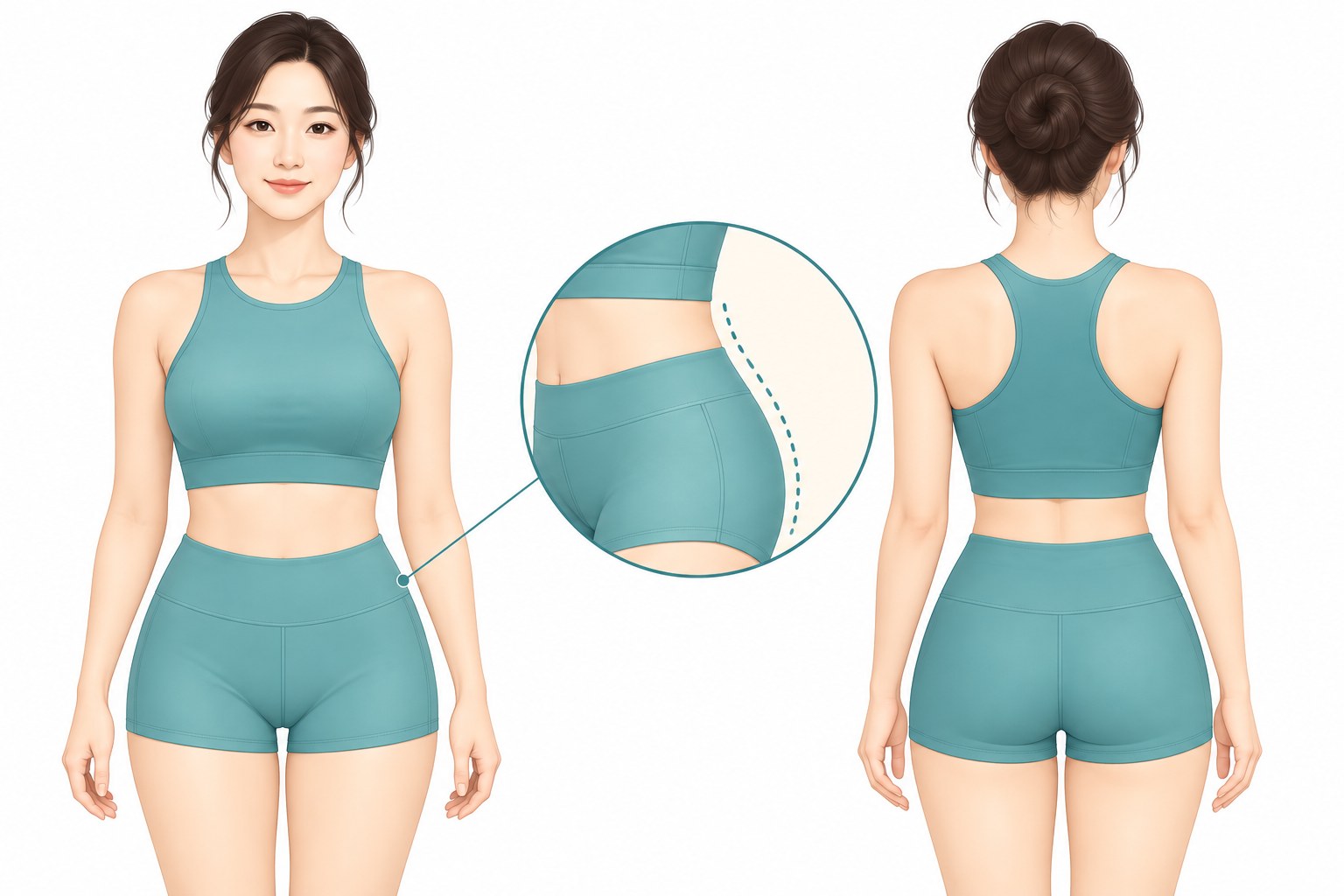
This illustration was created with AI to aid understanding and does not show an actual surgical result.
A hollow on the side of the pelvis, between the buttock and the outer thigh, that makes the side line look interrupted is often called a hip dip. It is usually caused by the shape of the bones, muscles and the way fat is distributed, so it may not change with exercise or diet alone.
Hip fat grafting purifies fat harvested by liposuction from the waist, flanks or thighs and transfers it to this hollow to smoothly connect the side line from the waist through the hips to the thighs. When the waist is contoured at the same time, the waist-to-hip proportion changes as well.
Hip (Hip Dip / GFD) Fat Grafting at a Glance
- What it is — An operation that fills the hip dip — the hollow at the side of the hip below the top of the thigh bone (greater trochanter) — with your own fat obtained by liposuction, placed in the subcutaneous layer, to create a continuous line from the waist through the hips to the thighs. Because the hip dip is medically called gluteofemoral depression (GFD), it is also known as «GFD fat grafting».
- Why it occurs — It is created by the structure where the greater trochanter and several muscles attach, combined with a constitution with well-defined muscles or with skin laxity and shifting fat due to aging. Exercise alone rarely changes it.
- Remove and fill — The approach of reducing the protruding flanks and outer thighs by liposuction and filling the hollow has been reported in journals since 1992.
- Good to know — Most studies summarise the experience of a single surgeon, and almost no study has separately measured how much fat transferred to the hips survives.
Who May Consider It
- Those with a visible hollow below the pelvis in side view
- Those whose side curve looks flat because the waist is wide and the hips look narrow
- Those who want to refine the side line together with waist and flank liposuction
- Those concerned about differences between the left and right hips
How the Procedure Is Performed
STEP 1 · Consultation and design
In a standing position, we mark the extent and depth of the hollow and any asymmetry. Because hollows caused by bone shape can only be filled to a limited degree, we explain this as well.
STEP 2 · Contouring with liposuction
Under tumescent local anesthesia, fat is harvested from the waist, flanks and thighs while the waistline is contoured.
STEP 3 · Purification
Only fat suitable for grafting is prepared.
STEP 4 · Subcutaneous injection
Centered on the deepest point of the hollow, fat is placed in multiple layers within the subcutaneous layer above the muscle, parallel to the skin, using a blunt cannula.
Safety Principles
1. Never into the muscle.
The side of the pelvis is continuous with the buttocks. As with the safety guidelines for buttock fat grafting, fat is injected only into the subcutaneous layer, not the muscle, in a direction parallel to the skin. A study analyzing more than 1,000 patients also reported injecting into the subcutaneous layer under this principle.
2. Respecting the limits of bone shape.
Hollows caused by the shape of the pelvic bones themselves are difficult to eliminate completely with fat. Overfilling can increase lumps, calcification and absorption, so our goal is a naturally continuous contour.
3. Graft survival varies.
How much of the transferred fat remains differs from person to person, so additional grafting is considered, if needed, after the volume has settled.
What the Research Shows: Hip (Hip Dip / GFD) Fat Grafting
We have summarised studies published in international journals on the questions patients ask most often in consultation. Study populations and methods differ, so the figures are for reference only, and results vary from person to person.
| Topic | Findings |
|---|---|
| What a hip dip is | A hip dip is the hollow on the outer buttock below the greater trochanter (trochanteric depression), formed by the bone and the attachments of several thigh and buttock muscles. It becomes more noticeable with well-defined muscles or when aging loosens the skin and fat gathers lower down. Source: Skin Health and Disease, 2024 |
| A hollow liposuction cannot fix | This paper pointed out that even after protrusions are reduced by liposuction, a hollow caused by bone and muscle remains, and reported 12 patients in whom about 30–150 cc of fat per side was injected into the hollow in divided layers from the deep to the superficial fat, together with liposuction. Source: Aesthetic Plastic Surgery, 1992 |
| Large experience | In 1,125 patients who had hip fat grafting together with abdominoplasty, an average of 493 mL (both sides) was injected with a 3 mm blunt cannula into the subcutaneous layer, parallel to the skin and avoiding the muscle. Fat necrosis occurred in 0.9% and infection needing oral antibiotics in 1.7%, and pulmonary embolism in 0.3% (3 patients, 1 of whom died — before preventive anticoagulants were used routinely). These figures include the abdominoplasty. Source: Plastic and Reconstructive Surgery Global Open, 2024 |
| Designing the waist curve | In 1,999 cases in which the transition from waist to hips was divided into zones and shaped by liposuction or fat grafting, the median graft volume was 480 mL for both sides. Including cases with other procedures, infection occurred in 1.20%, hematoma in 0.20% and pulmonary embolism/deep vein thrombosis in 0.20%. Source: Plastic and Reconstructive Surgery Global Open, 2026 |
| Subcutaneous layer only | In 293 patients whose buttock and hip line was filled only in the subcutaneous layer with a 5 mm blunt cannula (women average 557 mL, 300–800 mL), no deaths, seromas or sciatic nerve complications were reported. Source: Indian Journal of Plastic Surgery, 2025 |
Frequently Asked Questions
Q. Is it possible if I am slim?
The key is where and how much fat can be obtained to fill the side of the hips. We first check the available donor areas and amounts through examination.
Q. Can it be combined with buttock fat grafting?
The sides of the hips and the buttocks are continuous, so they are often planned together. The principle of placing fat only in the subcutaneous layer, not the muscle, applies to both areas.
Q. Can a hip dip (GFD) be removed by exercise?
Hip dips are often caused by the structure where bone (the greater trochanter) and muscles attach, and as muscles develop with exercise they can even look more pronounced. Contouring the surrounding area by liposuction and filling the hollow can be considered, but there is a limit to how much a hollow caused by bone shape can be filled.
Q. How much fat is injected into the hips?
It depends on the size of the hollow. Studies have reported from about 30–150 cc per side up to an average of about 500 mL for both sides when combined with other operations. We decide after checking how much fat can be harvested and the condition of the skin.
Q. How much of the grafted fat survives?
Almost no study has separately measured how much fat transferred to the hips survives. In the adjoining buttocks, an average of 66% was reported to survive by ultrasound, but individual variation is large, so additional grafting is considered if needed after it settles.
Recovery
Swelling and bruising may occur at the hips and donor areas, and a compression garment is worn over the donor areas. We will advise you not to lean on the grafted area or lie on your side for long periods.
References
- Hip dips technique: Filling lateral depressions with hyaluronic acid of large particles — Skin Health and Disease (2024) PMC11608902
- Correction of Deep Gluteal Depression by Autologous Fat Grafting (C. M. Lewis) — Aesthetic Plastic Surgery 16:247–250 (1992)
- Abdominoplasty Combined with Hip Expansion by Fat Grafting: An Evolution in Waistline Contouring — Plastic and Reconstructive Surgery Global Open (2024) PMC11315588
- The Surgical Waist: Defining the Zones of the Waist via Selective Liposuction or Fat Grafting to Improve the Female Silhouette — Plastic and Reconstructive Surgery Global Open (2026) PMC13574408
- Safety and Efficacy of Subcutaneous Buttock Augmentation in Indian Population: A Retrospective Analysis — Indian Journal of Plastic Surgery (2025) PMC12755954
Related page: Buttock Fat Grafting