Fat Grafting - Buttock Fat Grafting
Reducing where needed and filling where needed for a better hip line
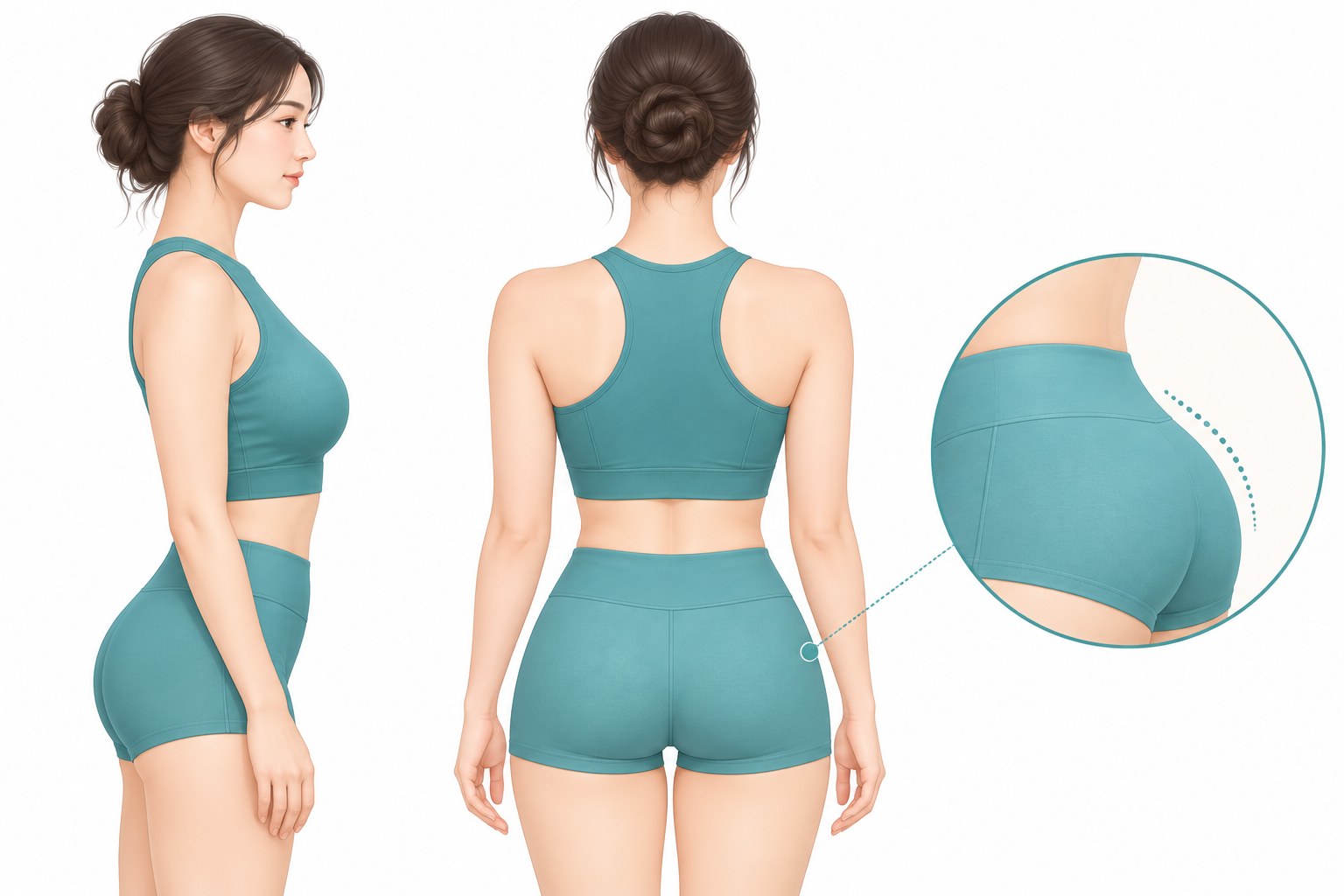
This illustration was created with AI to aid understanding and does not show an actual surgical result.
Buttock fat grafting contours the waist, flanks, back and thighs with liposuction, then purifies that fat and transfers it to hollow parts of the buttocks to create volume and curves. Because the surrounding areas are reduced while the buttocks are filled, the line from the waist to the buttocks changes as well.
Venus Clinic has long planned both reduction and filling of the buttocks in its buttock volume-up liposuction. Buttock fat grafting extends that approach, and above all we prioritize following the safety guidelines.
Buttock Fat Grafting at a Glance
- What it is — An operation in which fat from the waist, flanks, back and thighs is removed by liposuction, purified and transferred to hollow areas of the buttocks. It is also called a Brazilian butt lift (BBL).
- Key rule — Fat is placed only in the subcutaneous layer above the muscle, never inside the muscle, using a large blunt cannula. This follows the recommendations of an international society task force.
- How much survives — A study measuring with ultrasound reported that on average 66% of the transferred fat survived. Individual results vary.
- Good to know — Although rare, pulmonary fat embolism has been reported with this operation, and the risk does not become zero even when the rules are followed.
Who May Consider It
- Those whose upper buttocks look flat or lack volume
- Those whose buttocks appear to sag
- Those whose waist and buttocks are poorly defined because of fat on the waist and flanks
- Those whose side line looks interrupted by a hollow on the side of the buttocks
- Those who want volume with their own fat rather than implants
How the Procedure Is Performed
STEP 1 · Consultation and design
We assess the proportions of the waist, buttocks and thighs in standing and side views and mark the areas to reduce and to fill. The amount of fat available for harvest is also estimated.
STEP 2 · Contouring with liposuction
Under tumescent local anesthesia, liposuction is performed on the waist, flanks, back and thighs as needed. This step is itself a contouring procedure that makes the buttocks stand out.
STEP 3 · Purification
The harvested fat is purified so that only fat suitable for grafting remains.
STEP 4 · Subcutaneous injection
Using a large-bore blunt cannula, fat is placed only in the subcutaneous fat layer above the gluteal muscles, distributed in multiple directions.
The Most Important Principle — Subcutaneous Layer Only, Never the Muscle
Although rare, buttock fat grafting is a procedure in which pulmonary fat embolism — fat entering large blood vessels — has been reported. The Aesthetic Surgery Education and Research Foundation (ASERF) Task Force reported that this risk rises greatly when fat is injected deep into the muscle and recommended the following:
- Inject only into the subcutaneous layer above the muscle, not into the muscle
- Use a large-bore blunt cannula rather than a fine one
- Do not angle the cannula tip downward (toward the deep layers)
Venus Clinic follows these principles and places fat only in the subcutaneous layer. Even so, the risk does not disappear completely, so we explain it before surgery and monitor carefully during and after the procedure.
What to Know Before Surgery
A study using ultrasound measurements reported that on average about 60% of the fat transferred to the buttocks remained, but this varies between individuals. Rather than forcing a large volume at once, we place the amount needed in the subcutaneous layer and consider additional grafting if needed.
What the Research Shows: Buttock Fat Grafting
We have summarised studies published in international journals on the questions patients ask most often in consultation. Study populations and methods differ, so the figures are for reference only, and results vary from person to person.
| Topic | Findings |
|---|---|
| Size of the risk | In a survey by the Aesthetic Surgery Education and Research Foundation (ASERF), 692 plastic surgeons reported 32 fatal pulmonary fat embolisms among 198,857 cases, and mortality was estimated at 1 in 6,214 to 1 in 2,351. Source: Aesthetic Surgery Journal, 2017 |
| Injection layer | In the same survey, surgeons who reported injecting into the deep muscle layer had a 403% higher risk of embolism, while those who reported injecting into the subcutaneous layer had a 63% lower risk. Source: Aesthetic Surgery Journal, 2017 |
| Cannula | Blood vessels in the subcutaneous layer are about 1 mm across, whereas deep gluteal veins are 7.6–13.7 mm. It is therefore recommended to inject only into the subcutaneous layer with a blunt cannula of 4 mm or more, moving continuously at low pressure, and where possible to confirm the layer with ultrasound. Source: JPRAS Open, 2026 |
| Retention | In a prospective controlled study using ultrasound and photographs, an average of 287 mL (70–550 mL) was injected per side, and the calculated average graft survival was 66% (average follow-up 5.8 months). Source: Plastic and Reconstructive Surgery Global Open, 2016 |
| Common complications | In 185 patients who received fat only in the subcutaneous layer under ultrasound guidance (average 596.75 mL), the complication rate was 7.03%; seroma (fluid collection) at 5.41% was the most common, and all resolved with treatment. Source: Journal of Clinical Medicine, 2024 |
Frequently Asked Questions
Q. How much can be added in one session?
It depends on the amount of fat that can be harvested and how much the skin and subcutaneous layer of the buttocks can accept. We plan within the safety guidelines, using the proportion of waist to buttocks rather than size as the goal.
Q. Can I sit after surgery?
While the grafted fat settles, it is best not to put prolonged weight on the buttocks. Sitting posture and duration are explained individually depending on the extent of surgery.
Q. I have heard buttock fat grafting is dangerous.
Research has shown that the risk of pulmonary fat embolism rises greatly when fat is injected deep into the muscle, so current guidelines recommend injecting only into the subcutaneous layer. Venus Clinic follows these guidelines and also explains before surgery that the risk cannot be eliminated completely.
Q. How much of the fat grafted into the buttocks survives?
A study measuring with ultrasound reported that 66% survived on average. However, it was a small study with short follow-up and results vary, so additional grafting is considered if needed after the volume has settled.
Q. Why is fat not injected into the muscle?
Large veins run within the gluteal muscle, and if fat enters them a pulmonary fat embolism can occur. In a large survey, injection into the muscle greatly increased the risk of embolism and subcutaneous injection reduced it. That is why we inject only into the subcutaneous layer.
Q. Does following the rules remove the risk completely?
No. These methods greatly reduce the risk, but rare accidents have been reported even with subcutaneous injection, so it is not zero. We provide a thorough explanation before surgery and monitor carefully during and after the operation.
Recovery
For the first few weeks, adjust your sitting posture so that your weight does not rest on the buttocks for long periods, and wear a compression garment over the liposuction areas. Swelling and bruising subside over several weeks, and the contour settles over several months.
References
- Report on Mortality from Gluteal Fat Grafting: Recommendations from the ASERF Task Force — Aesthetic Surgery Journal (2017) PMC5846701
- Cannula characteristics and mortality risk in Gluteal Lipofilling: does diameter and tip design matter? A narrative review — JPRAS Open (2026) PMC13572163
- Prospective Controlled Study of Buttock Fat Transfer Using Ultrasound and Photographic Measurements — Plastic and Reconstructive Surgery Global Open (2016) PMC4995709
- Buttock Augmentation with Ultrasonic Liposuction and Ultrasound-Guided Fat Grafting: A Retrospective Analysis Based on 185 Patients — Journal of Clinical Medicine (2024) PMC10970832
Related page: Hip (Hip Dip) Fat Grafting