Diet First, or Liposuction First? — Why the Result Can Be Disappointing After You Have Already Lost the Weight
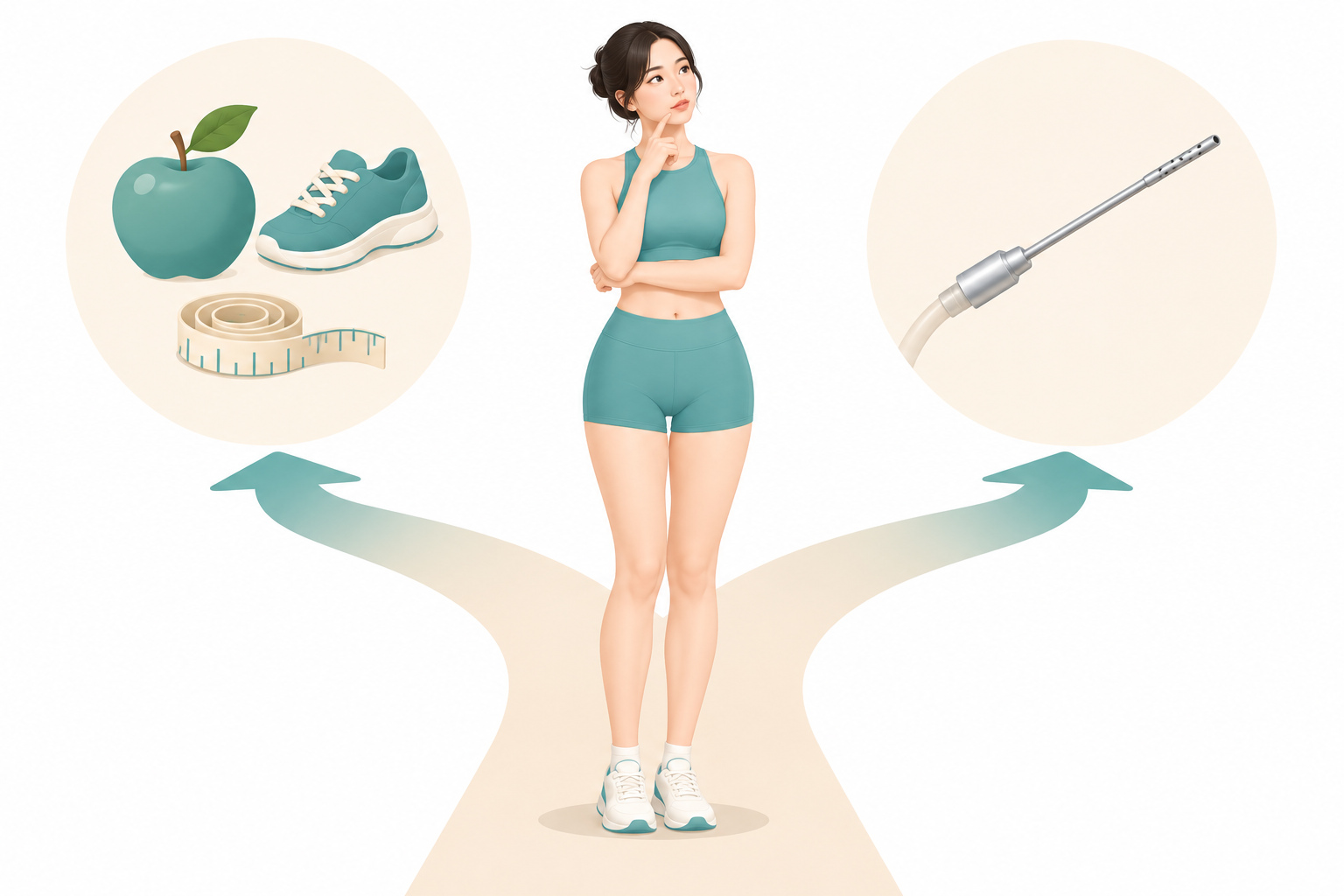
In the consultation room, I hear these questions very often: “I was told to lose some weight first. Do I have to?” and “Isn't it better to lose weight through dieting before having surgery?” Others tell me, “I also heard it is better to have surgery first and manage my weight afterward, and I don't know which is right.” Because the order can change the result, it is natural to be unsure.
Today I would like to talk about the order of dieting and liposuction. Unless your weight is changing a great deal, I will explain why having surgery while some fat is still present may be more favorable for contour and skin retraction than waiting until you have lost all the weight, and also when weight loss for the sake of your health should come first.
Dieting and Liposuction Have Different Purposes
First, I would like to make clear that the two do not do the same job. Dieting and exercise are ways to manage body weight, while liposuction is a surgery that refines the contour of the body. Liposuction is not a surgery for losing weight, and obesity itself has been reported not to be an indication for liposuction[2]. In the same vein, it is stated that before surgery patients should be told that liposuction cannot replace healthy lifestyle habits and is a procedure for correcting body contour[6].
Subcutaneous Fat Has Two Layers
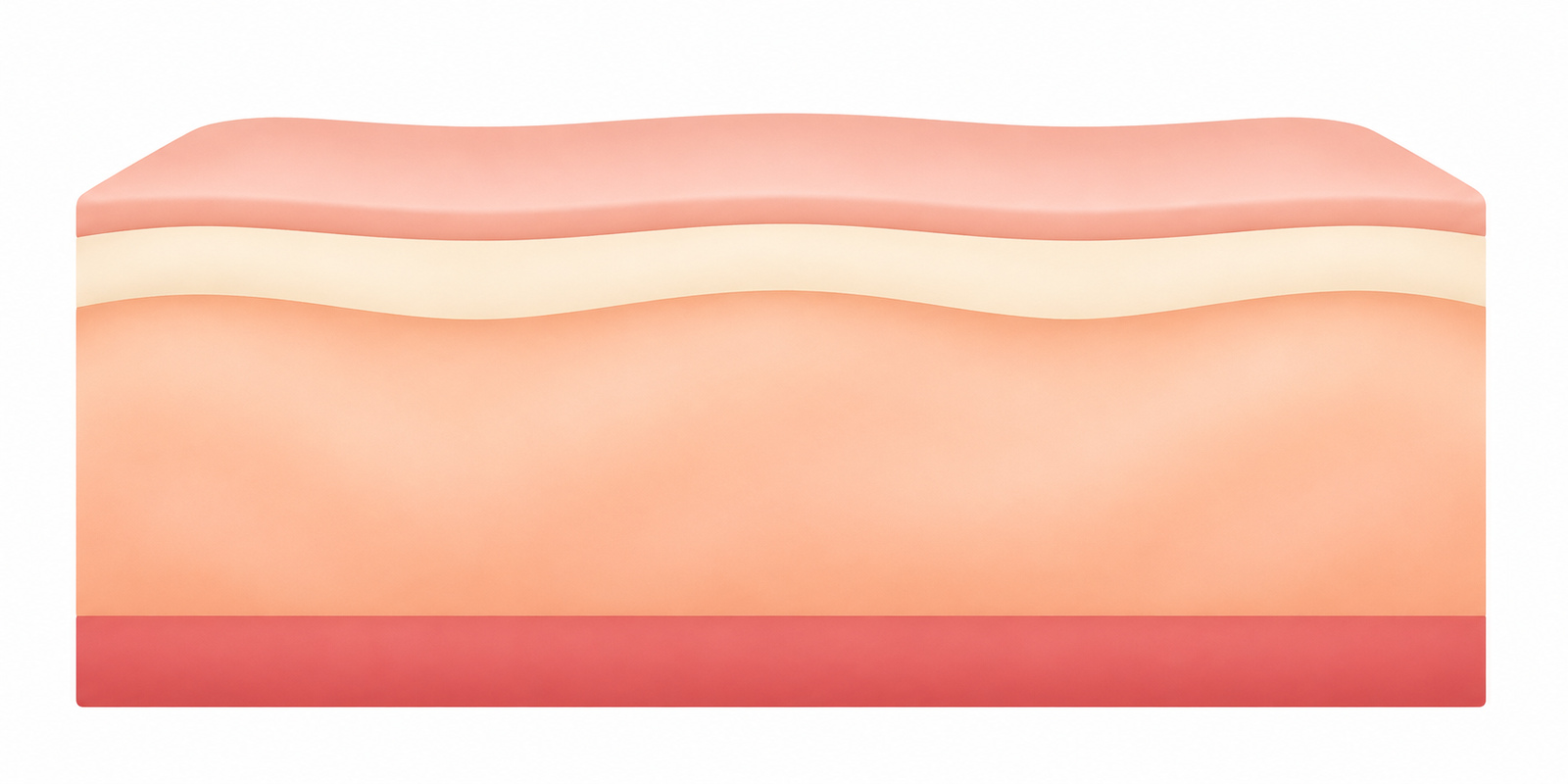
The fat beneath the skin can be divided broadly into two layers: a relatively firm superficial layer (areolar layer) just under the skin, and a looser deep layer (lamellar layer) below it. The superficial layer changes little when weight goes up or down, whereas the volume of the deep layer varies greatly with body weight[1][7]. When you diet, it is mainly the volume of this deep layer that decreases considerably.
Dieting Makes Fat Cells Smaller; Liposuction Reduces Their Number
When weight is lost, fat cells tend to shrink in volume without decreasing in number, and the proportion of fibrous tissue in such areas becomes relatively higher[2]. For this reason, even after you have lost weight through dieting, the contour of areas where fat had gathered, such as the thighs or lower abdomen, may not change as much as you had hoped. Liposuction is different in that it reduces the number of fat cells in the area itself, regardless of their size[7].
Why Surgery After Losing All the Weight Can Be Disappointing
It is natural to think, “If I lose the weight first, surgery will be easier and the result will be better.” However, the literature reports the opposite. Weight loss before surgery is not recommended and in some cases may even be a contraindication, and it is said that liposuction performed after moderate or greater weight loss gives a poorer aesthetic result because the tissue has become soft[1].
When Tissue Is Soft, It Is Hard to Smooth the Superficial Layer Evenly
After a large weight loss, the skin and the tissue beneath it tend to sag rather than stay firm. When the tissue is soft, it is difficult to work on the superficial layer just under the skin, and it also becomes hard to keep a thin cannula at the same depth[1]. The superficial layer is a layer that hardly shrinks with dieting. For the skin to retract smoothly, this layer needs to become thinner, but losing weight alone does not bring about that change. This is explained as the main reason the skin looks loose after a large weight loss[1].
The Fat Cells in the Deep Layer Are Already Smaller
If surgery is done after dieting, the fat cells in the deep layer are already smaller, so it may be difficult to adequately suction the areas that actually need it[7]. There are also reports that liposuction in people who were previously obese tends to give a less impressive final result than when it is done at their maximum weight, and that working on tissue with more fibrous content takes more effort[2].
| Item | Surgery after a large weight loss | Surgery while some fat is still present |
|---|---|---|
| Deep-layer fat | The cells have become smaller, so it may be hard to suction them adequately[7] | It may be easier to work adequately on the deep-layer fat that is still enlarged[7] |
| Tissue condition | The tissue is soft, so it is hard to smooth the superficial layer evenly[1] | The tissue is firm, which may be favorable for refining at a consistent depth[1] |
| Skin retraction | Skin that is already loose may have little room left to retract[7] | Reducing the fat just under the skin may be favorable for encouraging retraction[1] |
Create the Contour While Fat Is Present, Then Maintain It With Diet and Exercise
So what order makes sense? Unless your weight is changing a great deal, I explain that it may be more favorable for the result to first create the contour and encourage skin retraction with liposuction while some fat is present, and then maintain it with diet and exercise.
The Skin Follows When the Fat Right Under It Is Refined
The literature reports that when superficial liposuction, which refines the fat right under the skin, is performed before dieting, the fat beneath the skin is addressed before the deeper fat decreases, which can help skin retraction and allow the later weight loss to proceed in a more harmonious way[1]. It is also our long-standing experience at Venus Clinic that skin retracts well when surgery is done while the fat is full and taut, and that there is little room for retraction when the fat is already scant after weight loss[7]. We remove the fat that needs to be removed as thoroughly as possible, and we refine the line smoothly so that it is not bumpy.
Skin Retraction Takes Time
Right after surgery there is swelling, and skin retraction happens gradually over several weeks. We advise that the final result can be judged only after at least two months have passed since surgery[4]. I would like you to know in advance that how you look right after surgery is not the final result.
Surgery Is the Start; Maintenance Comes From Lifestyle
It has been reported that if your eating and exercise habits do not change after liposuction, your weight may return to its pre-surgery level[3]. Even if surgery reduces the number of fat cells, the remaining cells can grow larger if you gain a lot of weight, so diet and exercise management should continue after surgery as well.
When the Order Changes — When Weight Loss for Your Health Comes First
Saying that it can be favorable to go first while fat is present does not apply to everyone. If you have severe obesity, weight loss for your health comes first.
The Risks of Surgery Increase With Severe Obesity
Obesity itself has been reported as a factor that raises the risk of perioperative complications[5]. Morbid obesity is regarded as a relatively strong contraindication to liposuction, and there is also a position that a request for liposuction from a person with obesity should not be regarded as an indication for large-volume liposuction[2]. One overseas source states that it sets the criterion for liposuction and body contouring at a body mass index of 30 or below[6]. In such cases, it is appropriate to first lose weight to a medically suitable level and then discuss surgery.
Limitations — Things You Should Be Sure to Know
If you have lost a large amount of weight and your skin is already quite loose, liposuction alone has limits, and depending on the degree of sagging, other methods may need to be considered together. There is also a report that people who have lost a large amount of weight before and whose skin has become loose are not good candidates for liposuction[1]. Stretch marks that are widespread are also not all resolved by surgery. The degree of skin retraction varies greatly from person to person depending on age, skin elasticity, and the thickness of the fat layer. In addition, if you do not continue lifestyle habits such as diet and exercise after surgery, your weight may increase again and the result may change[3].
A Delicate Topic in the Consultation Room
To be honest, this is a topic I am careful about raising during consultations. When I tell someone to have liposuction while fat is present, some people misunderstand it as an attempt to push surgery, that is, as if I were just trying to make a sale. So before recommending surgery, I first ask about your recent weight changes, your health, and your plans, and if I judge that weight loss for your health should come first, I tell you so. I hope today's column is a chance to calmly explain this topic that is hard to discuss in the consultation room.
References
- Shiffman MA, Di Giuseppe A (eds). Liposuction: Principles and Practice. Springer; 2006. Chapter 39 (p. 267 of the original).
- Klein JA. Tumescent Technique: Tumescent Anesthesia & Microcannular Liposuction. Mosby; 2000. Chapter 28 (pp. 263–264 of the original).
- Klein JA. Tumescent Technique: Tumescent Anesthesia & Microcannular Liposuction. Mosby; 2000. Chapter 25 (p. 221 of the original).
- Shiffman MA, Di Giuseppe A (eds). Liposuction: Principles and Practice. Springer; 2006. Chapter 10 (p. 69 of the original).
- Shiffman MA, Di Giuseppe A (eds). Liposuction: Principles and Practice. Springer; 2006. Chapter 58 (p. 391 of the original).
- Duncan et al. Enhanced Liposuction. 2022. Chapter 2, Chapter 9.
- Venus Clinic Doctor's Column (Korean). 지방흡입은 살이 쪘을때 하는것이 좋다? 2008. myvenus.co.kr/column/719.
In Closing
To sum up, unless your weight is changing a great deal, it may be more favorable for the result to create the contour and encourage skin retraction with liposuction while some fat is present, rather than coming in after you have lost all the weight, and then to maintain it with diet and exercise. However, if you have severe obesity, weight loss for your health comes first. At Venus Clinic, in deciding this order, we look at the current condition of your body before the question of surgery, and help you decide after a thorough consultation.
References: Liposuction When You Have Gained Weight About Losing Weight Before Surgery The Difference Between Dieting and Liposuction
Dr. Hakjun Kim, Director, Venus Clinic