Thigh Liposuction and Buttock Liposuction: Surgical Areas and Cost
In consultations, we often hear questions such as "Is it enough to treat only the thighs?" and "Why do buttock liposuction and thigh liposuction cost differently?" Even under the single name "thigh liposuction," there are actually several surgical areas, and which areas are treated changes both the shape of the result and the surgical cost.
In this article, we divide the surgical areas of thigh liposuction and buttock liposuction one by one with color-coded illustrations, and explain why the cost differs depending on the surgical area and what you should check carefully before surgery.
Thigh Liposuction Surgical Areas: Divided into Nine Areas
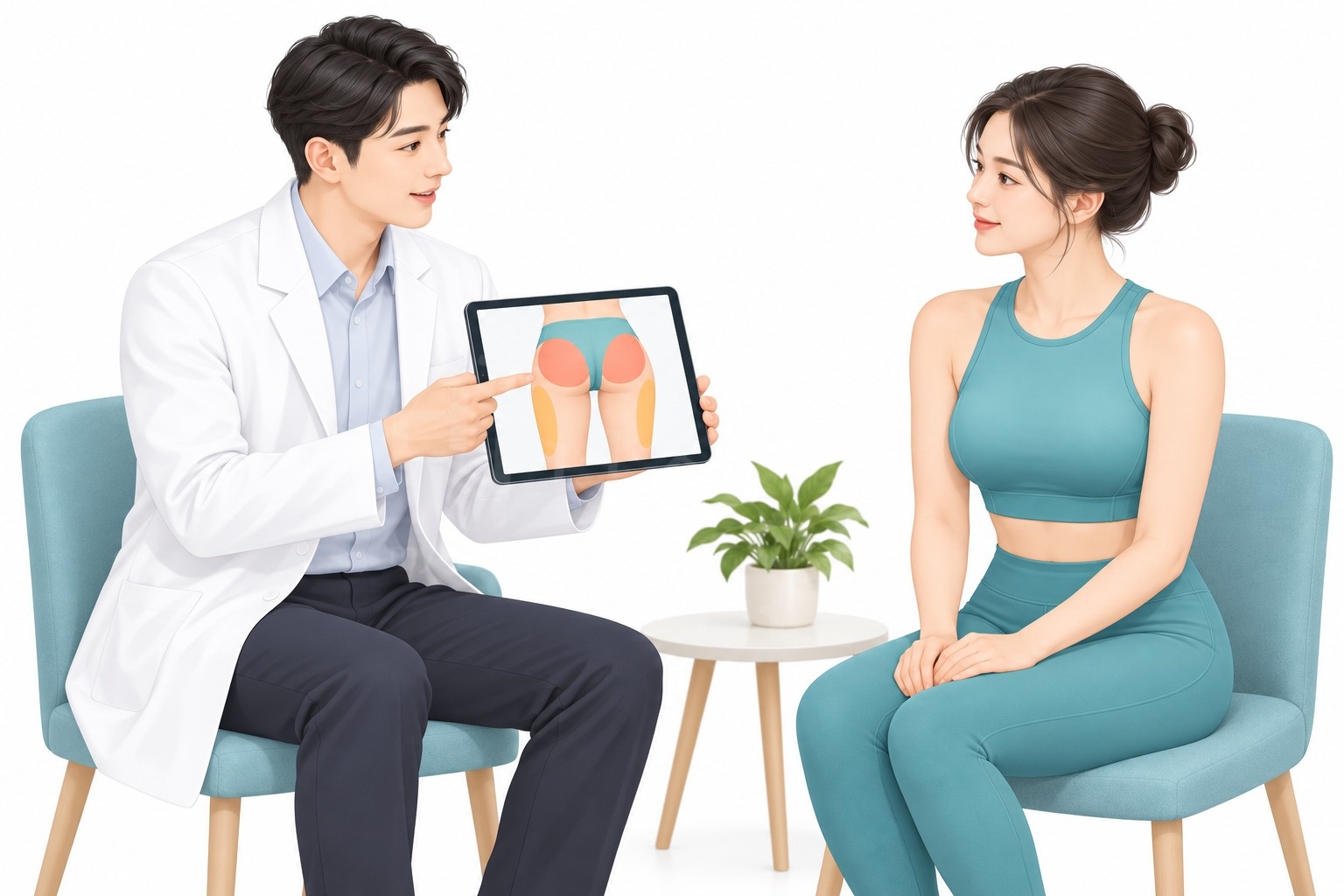
The thigh is cylindrical, so the front, side, back, and inner parts are all connected. For this reason, at Venus Clinic we divide the lower body as shown in the illustration below, into hips, buttocks, saddlebags, lateral thigh, anterior thigh, medial thigh, posterior thigh, above the knee, and medial knee, when we hold consultations.
The colors are translucent so that the outline of the body remains visible. The same number marks the same area in the front, side, and back views.
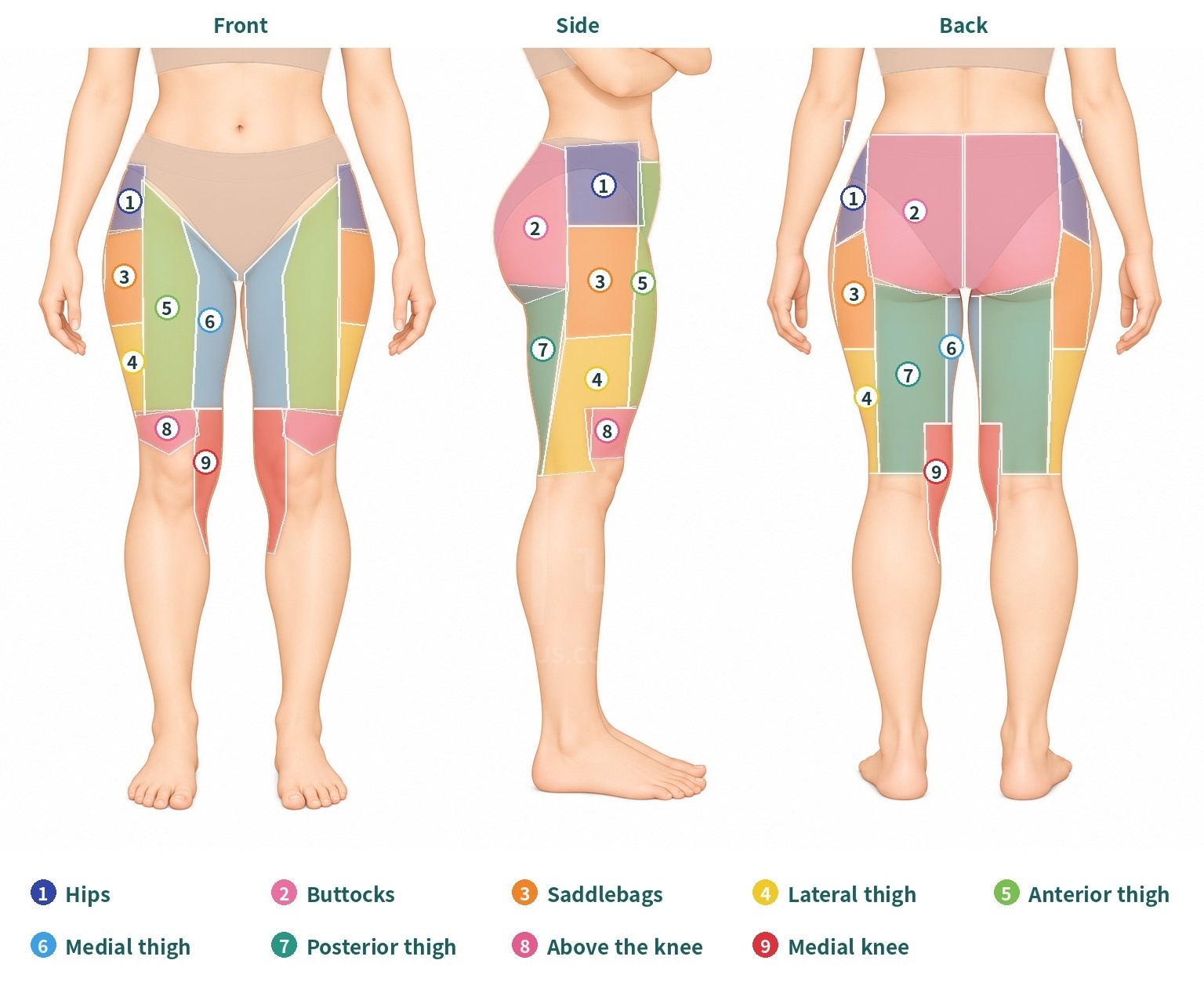
The location of each area is summarized in the table below.
| Surgical area | Location and characteristics |
|---|---|
| ① Hips | This is not the same as the buttocks. It is the part where the pelvis juts out to the side, on both sides above the buttocks. |
| ② Buttocks | The whole buttock. Below, we explain it again in four parts (quadrants). |
| ③ Saddlebags | This refers only to the upper part of the lateral thigh that is attached to the buttock. It lies next to the outer end of the crease between the buttock and thigh, at the broad part of the lower body. |
| ④ Lateral thigh | The outer side of the middle thigh, below the saddlebags. An outer bulge in the middle of the thigh is the lateral thigh, not the saddlebags. |
| ⑤ Anterior thigh | The front of the thigh, running from below the groin to above the knee. |
| ⑥ Medial thigh | The inner thigh. Because the fat here is soft and is removed easily, extra care is needed to smooth it evenly. |
| ⑦ Posterior thigh | The back of the thigh, below the gluteal crease. |
| ⑧ Above the knee | The area where fat sits in a thick layer on the front, just above the kneecap. |
| ⑨ Medial knee | The inner side of the knee. It is often treated together with the medial thigh, as a continuous area. |
Buttock Liposuction Surgical Areas: Divided into Four Parts
We divide the buttock into four parts by drawing a vertical line and a horizontal line through the center. The outer upper part is the upper-outer, the inner upper part is the upper-inner, the inner lower part is the lower-inner, and the outer lower part is the lower-outer. In the illustration, ① upper-outer and ② upper-inner together are called the upper buttock, and ③ lower-inner and ④ lower-outer together are called the lower buttock. The hips, on both sides above the buttock, and the saddlebags, just below the lower-outer, are distinguished separately from the buttock.
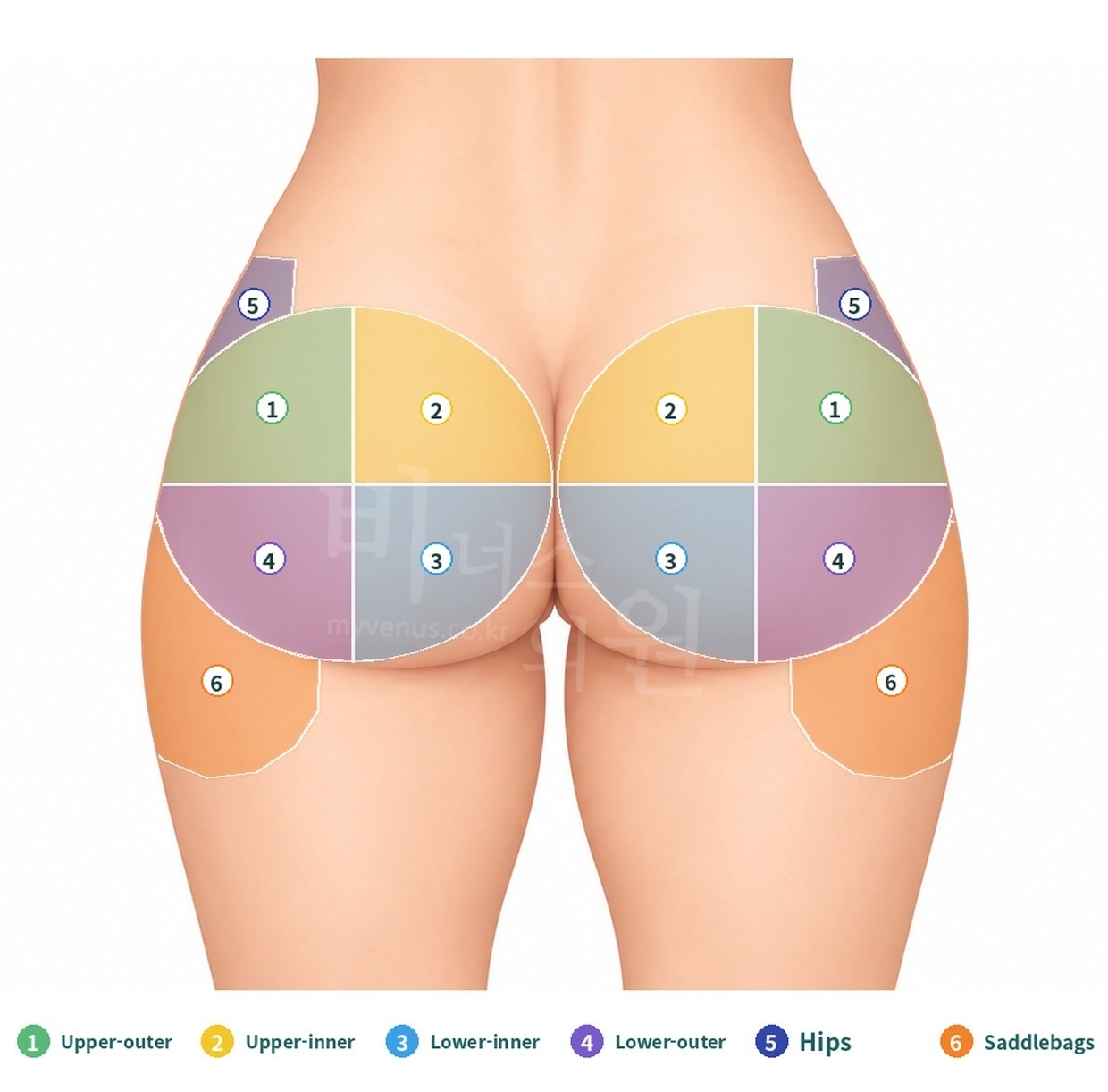
The Lower-Outer Buttock and Saddlebags Are Considered Together
When fat builds up in the lower-outer buttock, its weight pushes the saddlebags outward on the thigh. So if only the saddlebags are suctioned, the fat from the lower-outer buttock comes back down, and the reduction in size is hard to see. When we operate on the saddlebags, we also treat the lower-outer buttock, and we call this the "buttock apple-line procedure." The liposuction literature likewise explains that treating only the outer thigh can make the result look unbalanced [2].
Be Careful with the Lower-Inner Buttock and Below the Gluteal Crease
The fat just below the gluteal crease supports the buttock. It has been reported that removing too much from this area can make the buttock look saggy or create a double crease [3][4], so we handle the lower part of the buttock carefully, adjusting the amount and depth.
Treating the Hips Together Can Lift the Buttock
When the hips and areas such as below the waist are suctioned together, the skin above the buttock also tightens and pulls the buttock upward. From below, the buttock volume decreases and its lower border rises, and from above, the tightened skin pulls the buttock up. When the hip size decreases, the outer line running from the waist through the buttock to the thigh also becomes slimmer.
Why Several Areas Are Viewed as One: The Aesthetic Unit
The hips, buttocks, and lateral thigh form one aesthetic unit that together shapes the outer contour of a woman's lower body. The explanation that the outer thigh, the trochanteric area, and the hips and buttocks should be treated as one unit rather than separately follows the same thinking [3]. The same applies to the inner thigh and inner knee: it has been reported that when the two are treated as one continuous area rather than separate ones, a smooth result without a visible boundary is easier to achieve [1].
For this reason, at Venus Clinic, for a figure in which fat is concentrated in the lower body, we suggest treating the lateral, medial, anterior, and posterior thigh as a 360-degree cylinder, together with the knee, buttocks, and hips. We remove the fat that needs to be removed as thoroughly as possible, and smooth the line so that it is not bumpy.
What Can Happen When Only One Area Is Treated
If only one of the connected areas is operated on, a boundary may appear between the treated and untreated areas. If weight is gained later, fat may also build up more in the untreated areas, and the balance can change. How far to treat together is decided at the consultation after looking at your body shape in person.
Surgical Method and Technique for Thigh and Buttock Liposuction
At Venus Clinic, after infusing enough tumescent local anesthetic solution, we remove fat with a thin cannula. This is because, even in areas where the fat is soft, such as the inner thigh, doing so keeps the result consistent and helps reduce unevenness. The key points of area-by-area technique summarized in the liposuction literature are as follows.
Design Before Surgery: Fat Thickness Drawn as Contour Lines
On the day of surgery, we draw the fat thickness on the skin of the area to be suctioned, like the contour lines of a map. At the center of the concentric lines, the fat is thick, and it becomes thinner toward the outside. We review the area to be suctioned together with you using these markings [7]. During surgery, we suction crosswise, changing direction through several incisions, and taper the edges gradually so that no boundary is left with the surrounding area [8].
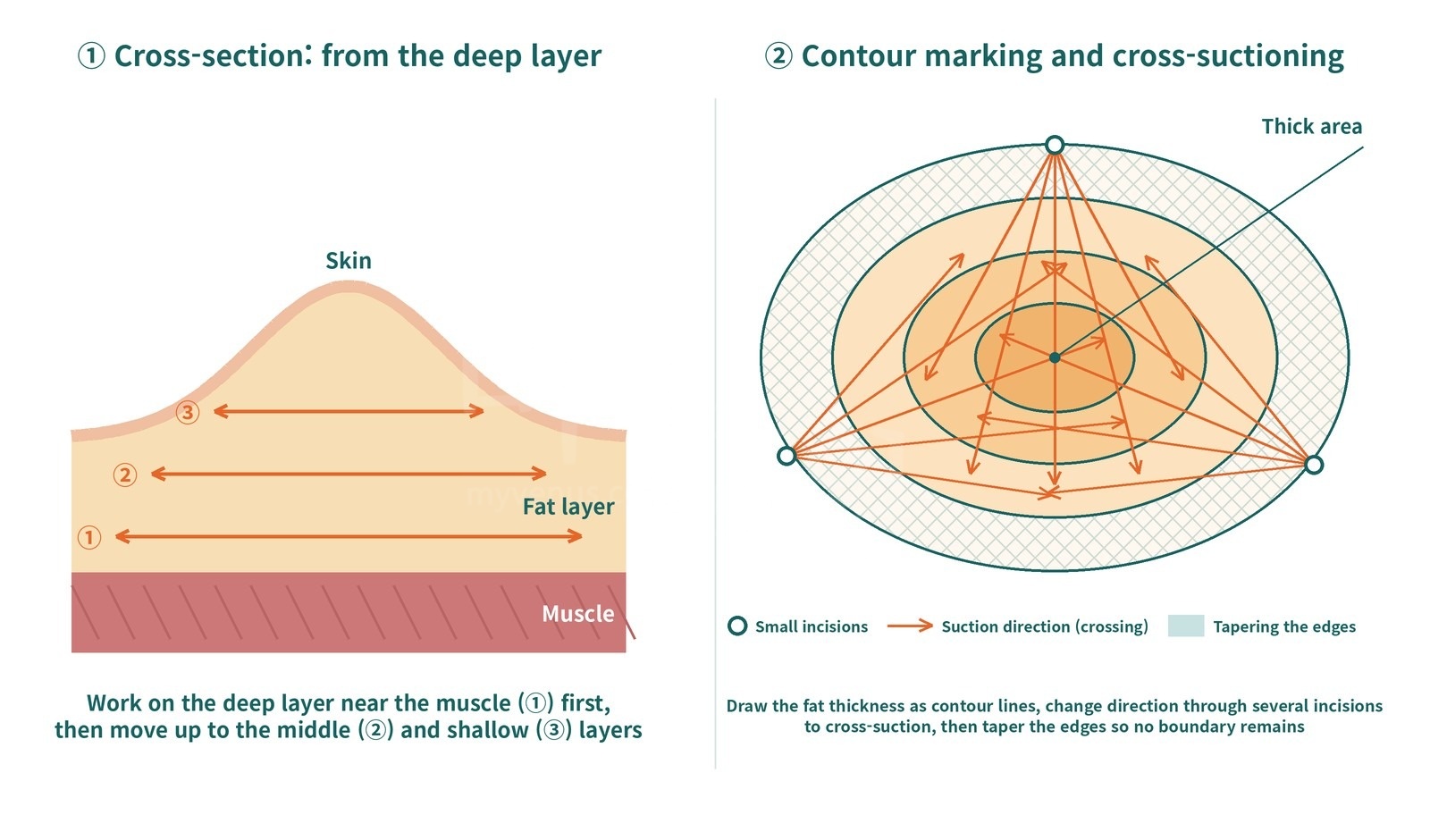
Starting from the Deep Layer, Crossing in Several Directions
If suctioning starts in a layer that is too shallow, it is easy to overlook and leave the fat in the deeper layer below [7]. So we first work on the deep layer close to the muscle, then move up to the upper layers. For the lateral thigh, the cannula is inserted near the posterior border of the outer contour and suctioned in a fan shape toward the front, crossing; the deep layer is first smoothed evenly in the horizontal direction, and then refined in the vertical direction along the long axis of the thigh [2]. Rather than suctioning in only one direction, crossing from several directions is needed to smooth the line.
Surgical Position: Frog-Leg Position and the "Pseudobulge"
The lateral thigh is strongly affected by the position used during surgery. When the patient lies on the side and the thighs are bent forward and brought together, the upper end of the thigh bone (the greater trochanter) is pushed outward and lifts the fat and skin above it, creating a "pseudobulge" that looks fuller than it really is. If this fullness is suctioned as it appears, the spot will look sunken when the patient stands up [2][7]. So the thigh is kept in a straight line with the body, and suctioning is done with the same contour as when standing.
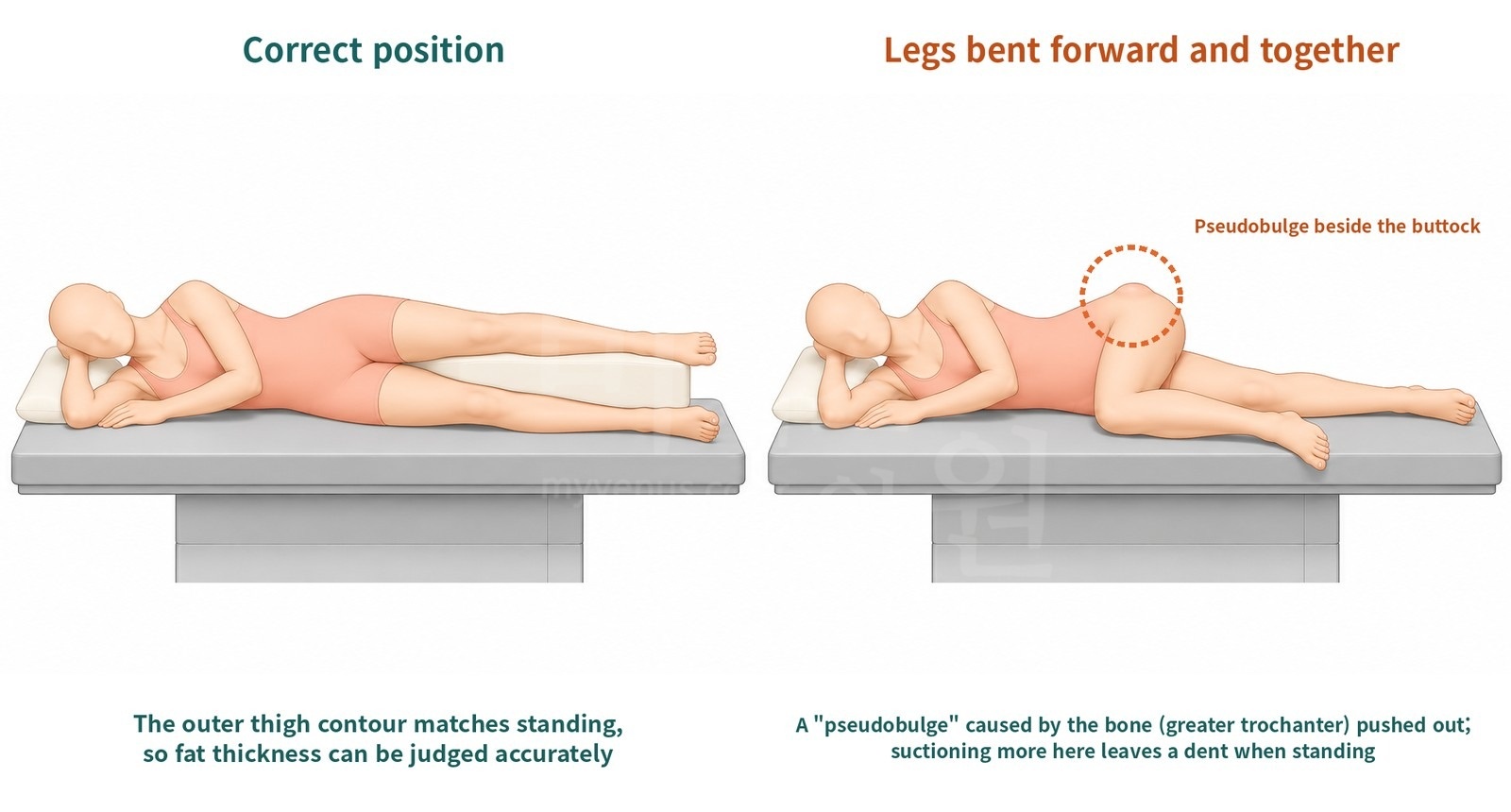
Caution is needed when operating in the "frog-leg position," in which the patient lies on the back with the knees bent and the thighs rotated outward and spread apart, for example when treating the inner thigh. In this position, the thigh rotates and the fat on the inner thigh is stretched and twisted; if it is suctioned in that shape, the fat may be removed unnaturally once the patient stands with the legs straight, and unevenness is likely. This stretching, compression, or twisting of subcutaneous fat when the body moves away from the correct posture is called lipowarp (fat warping) [1][7]. Lipowarp occurs not only in the frog-leg position but also when operating with the thigh rotated [7]. For the outer thigh as well, when the hip joint is bent forward, the fat at the back is stretched and the fat at the front is compressed, so it is easy to suction too much at the back and too little at the front [2]. Therefore, when operating in the frog-leg position, we take care with the amount and direction of suctioning, keeping in mind that the fat is in a warped shape, and we support the thigh as close as possible to its standing shape during surgery.
For the same reason, surgery should not be performed with the thigh rotated inward (internal rotation) or outward (external rotation). When the thigh rotates, the shape and proportions of the fat layer change, so even if the suctioning looks even on the operating table, once the patient stands, one side may have too much removed and the other too little [2][7].
In particular, when the thigh is drawn inward (adduction), outward (abduction), or rotated, the position of the greater trochanter, the bony prominence at the upper outer femur, moves as well. The spots that look prominent or hollow on the operating table then swap places compared with standing. If a lot is removed from an area that looks prominent in this position, that area can sink and leave a depression once the patient stands upright.
Also, if liposuction is done while the fat layer is twisted by adduction or abduction, the cannula tracks may look straight on the operating table, but once the leg returns to the normal position they are no longer straight — they become twisted like a snake. Because the fat has been removed along twisted paths, the surface becomes uneven. That is why at Venus Clinic we perform suction with the thigh kept close to its natural standing position.
Lipowarp and Lipotrop
Lipowarp (fat warping): when the thigh is bent, extended, or rotated away from the correct standing posture (anatomical position), the subcutaneous fat is stretched, compressed, or twisted, and its shape changes. It is a state in which the shape of the fat seen during surgery differs from its actual shape [7].
Lipotrop (fat depression): the skin becomes sunken or dimpled, with grooves, because fat was removed excessively and unevenly from one place. It is a commonly seen undesirable result after liposuction, and incorrect surgical positioning is one of its causes [10]. Suctioning without accounting for lipowarp or a pseudobulge can lead to lipotrop [2][7].
Zones of Adherence: Avoid Excessive Suctioning
In the thigh and buttock, there are five places where the shallow fat layer just under the skin is firmly attached to the membrane covering the muscle and there is hardly any deep fat layer. They are the lateral gluteal depression, the gluteal crease, the distal posterior thigh, the middle medial thigh, and the inferolateral iliotibial tract. These "zones of adherence" are said to be attachment bands that firmly anchor the skin to the muscle so the skin does not sag. For this reason, they are areas where excessive liposuction should be avoided. Suctioning too much here makes the area prone to sinking and unevenness, and the fat gathering between these zones instead looks more prominent [9]. At the pre-surgical design, we mark these five places first.
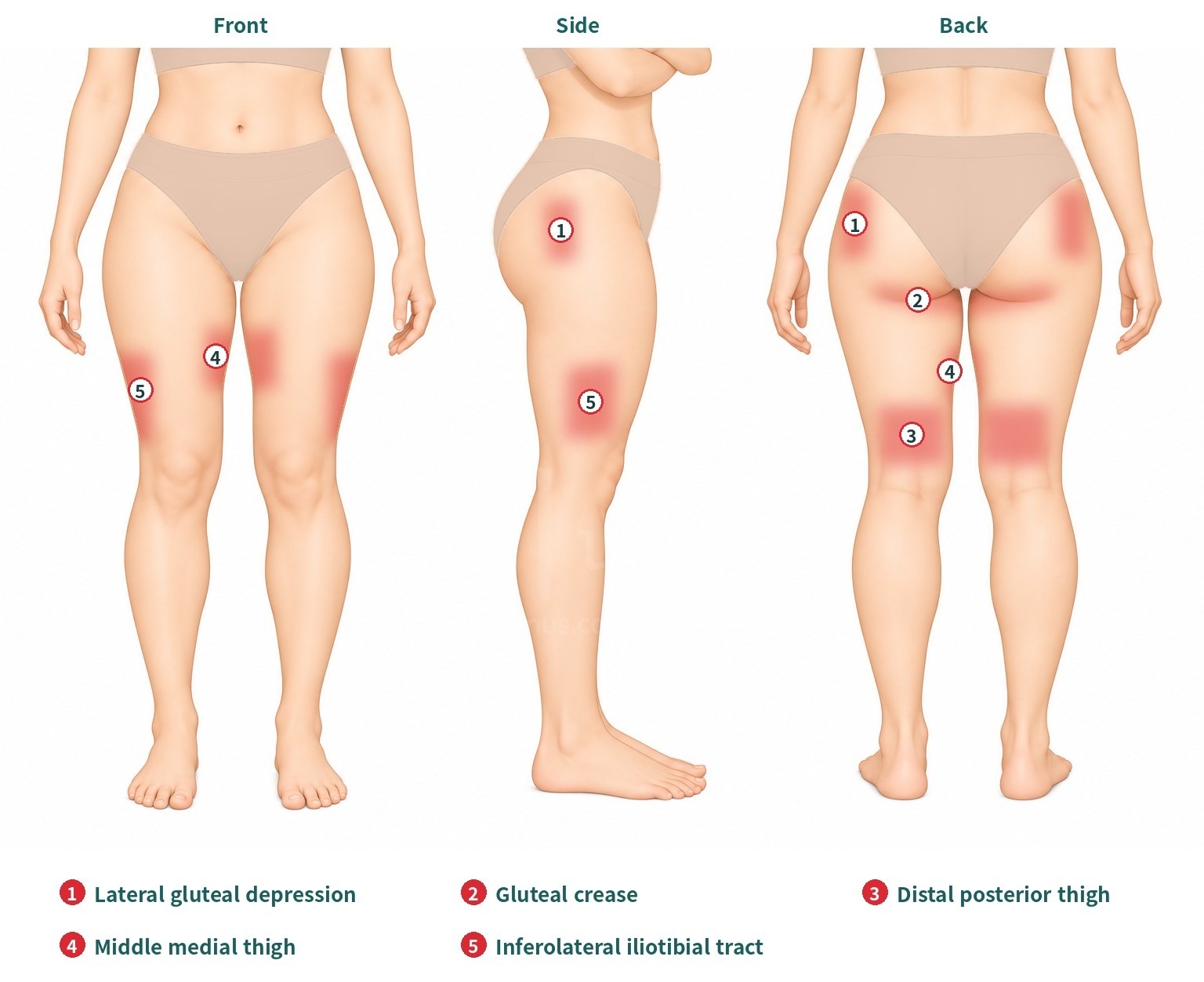
The Inner Thigh and Inner Knee
Fat on the inner thigh is removed easily, so with only a little carelessness it can be over-suctioned. We cross diagonal and vertical suctioning paths to reduce the risk of over-suctioning [1]. The inner knee is an area where liposuction can bring a large improvement, but we avoid suctioning too shallowly so that the network of blood vessels and lymphatics just under the skin is not injured [1].
The Lower Buttock and the Crease Area
In the banana-shaped fold area where the lower buttock meets the back of the thigh, removing a lot of fat carries a high risk of creating a double crease [2]. So this area is suctioned conservatively, the cannula is inserted at an angle of about 45 degrees to the gluteal crease, and suctioning is not done across the back of the thigh [4]. If too much fat just below the gluteal crease is removed, the area where the sitting bone presses when sitting may become painful, and it has been reported that a problem that arises this way is difficult to reverse [4].
The Goal of the Technique Is a "Smooth Line"
Cross-suctioning from the deep layer, and handling the easily sagging lower buttock and the thin-skinned inner knee carefully: all of this aims to avoid a bumpy surface or creases after surgery.
Liposuction Cost and Price Differ Depending on the Surgical Area
Liposuction cost, that is, liposuction price, varies with the surgical range, that is, how many surgical areas are treated together. As areas are added, the surgery time and preparation increase. Names such as "Premium" and "Maximer" at Venus Clinic group together the surgical areas that are often treated together for each body type, to make them easier to understand. Liposuction for cosmetic purposes is non-covered (non-insured) surgery, and 10 percent value-added tax is added separately.
Even with the same phrase "thigh liposuction," the areas included may differ from one consultation to another. That is why you should check the surgical areas carefully before having surgery. At the consultation, please check the items below together.
The same applies when you choose a liposuction clinic, receive consultations at several places, and compare liposuction prices. At the consultation, confirm which surgical areas are included, and compare prices only for the same areas. This is because, even when the surgery has the same name, costs cannot be compared directly if the included areas differ.
Checklist of Surgical Areas Before Surgery
1. Looking at the front, side, and back in a mirror, have you pointed out which numbered area in the illustration above is your concern?
2. If the saddlebags are your concern, is the lower-outer buttock included as well?
3. How far are the hips and the four buttock quadrants included?
4. If the medial thigh is treated, does it continue to the medial knee? Is above the knee included?
5. Is each surgical area written out by name in the estimate?
6. When comparing costs with other places, are you comparing the same surgical areas?
Precautions Before and After Thigh and Buttock Liposuction
The thighs and buttocks cover a wide range and bear body weight, so preparation before surgery and care after surgery affect the result. We have organized what we advise at Venus Clinic according to the characteristics of these areas.
What to Check Before Surgery
Please be sure to tell us at the consultation about any medication you are taking. Some medications, such as steroids, can slow wound healing. When the thigh is treated as a 360-degree cylinder, recovery takes longer than for other areas, and if the calf and ankle are also treated as a cylinder at the same time, swelling in the leg can become very severe, so we do not do them at the same time. In the lower two-thirds of the thigh, the skin may not adhere well in some people, so we also look at skin elasticity before surgery.
Compression Garment: From the Lower Abdomen to the Ankle
After thigh and buttock surgery, you wear a thigh compression garment that covers from the lower abdomen to the ankle. This is because a garment made for the torso does not press on the thighs [5]. Generally, it is worn 24 hours a day for the first 2 weeks after surgery, then only during the day once it feels comfortable, and because the skin continues to adhere during this process, we advise wearing it for at least 1 month. For the inner thigh in particular, the garment must be pulled up fully to the groin line so that no bulge remains there. On the other hand, compression that is too tight can block lymph flow and actually increase swelling [6], so it is important to wear a garment that fits your body.
Posture and Daily Life
Even while wearing the compression garment, sitting hunched for a long time can cause the surgical area to contract while folded. Sit with your back straight, and walking a little from the day of surgery helps with swelling and preventing blood clots. Please avoid showering for the first 3 days and soaking in a bath for 3 weeks, and increase active exercise such as jogging or aerobics gradually after 3 to 4 weeks following surgery.
Hardness in the Inner Thigh Is Part of Recovery
From around 1 to 2 weeks after surgery, the surgical area becomes firm; this is felt especially in the inner thigh and is more pronounced at 2 to 4 weeks. During this period the surface may look slightly uneven, but it generally begins to soften around week 5. Do not massage the firm areas hard, and do not use radiofrequency massage before 8 weeks after surgery. It takes about 6 months for swelling to subside and the line to settle, so please judge the final result then, and keep your weight stable in the meantime.
Limits: Keeping Expectations Realistic
Liposuction reduces the fat layer under the skin, so in areas where the fat is thin, the change is also small. In particular, it has been reported that the improvement from liposuction above the knee is limited [1]. Results differ from person to person depending on fat distribution, skin elasticity, and the recovery process, and some original left-right differences or skin irregularities may remain. If weight is gained after surgery, the balance of the body shape can change again. After liposuction, side effects such as bruising, swelling, pain, changes in sensation, and surface irregularities of the skin may occur.
References
- Klein JA. Tumescent Technique: Tumescent Anesthesia & Microcannular Liposuction. Mosby; 2000. Chapter 34 (Medial Thighs, Knees and Anterior Thighs).
- Klein JA. Tumescent Technique: Tumescent Anesthesia & Microcannular Liposuction. Mosby; 2000. Chapter 32 (Lateral Thighs).
- Shiffman MA, Di Giuseppe A (eds). Liposuction: Principles and Practice. Springer; 2006. Chapter 28 (Superficial Liposculpture: Rationale and Technique).
- Klein JA. Tumescent Technique: Tumescent Anesthesia & Microcannular Liposuction. Mosby; 2000. Chapter 36 (Buttocks).
- Klein JA. Tumescent Technique: Tumescent Anesthesia & Microcannular Liposuction. Mosby; 2000. Chapter 31 (Abdomen — Elastic Compression Garments).
- Klein JA. Tumescent Technique: Tumescent Anesthesia & Microcannular Liposuction. Mosby; 2000. Chapter 11 (Postliposuction Edema).
- Klein JA. Tumescent Technique: Tumescent Anesthesia & Microcannular Liposuction. Mosby; 2000. Chapter 28 (Surgical Technique: Microcannular Tumescent Liposuction).
- Shiffman MA, Di Giuseppe A (eds). Liposuction: Principles and Practice. Springer; 2006. Chapter 23 (Liposuction and Dermolipectomy).
- Rohrich RJ, Smith PD, Marcantonio DR, Kenkel JM. The zones of adherence: role in minimizing and preventing contour deformities in liposuction. Plast Reconstr Surg. 2001;107(6):1562-1569.
- Klein JA. Tumescent Technique: Tumescent Anesthesia & Microcannular Liposuction. Mosby; 2000. Chapter 8 (Miscellaneous Complications).
Before-and-After Photos
This is a "Thigh Premium Liposuction" case in which the 360-degree thigh, above the knee, medial knee, buttocks, and hips were treated together, and all of the after-surgery photos were taken about 7 weeks after surgery. Swelling may still remain at this stage, so this is not the final result.
Thigh, Knee, and Buttock Premium Liposuction Case
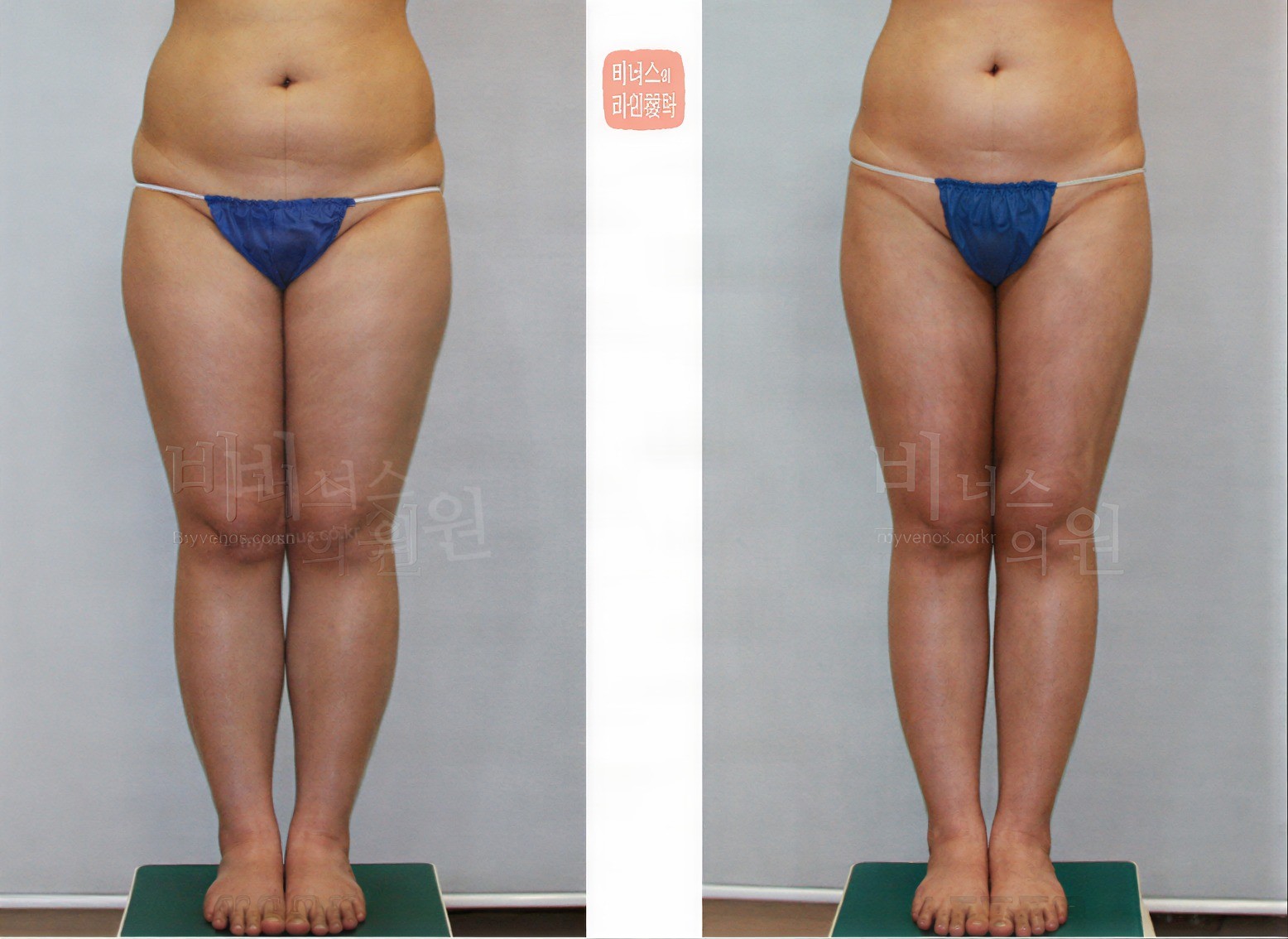
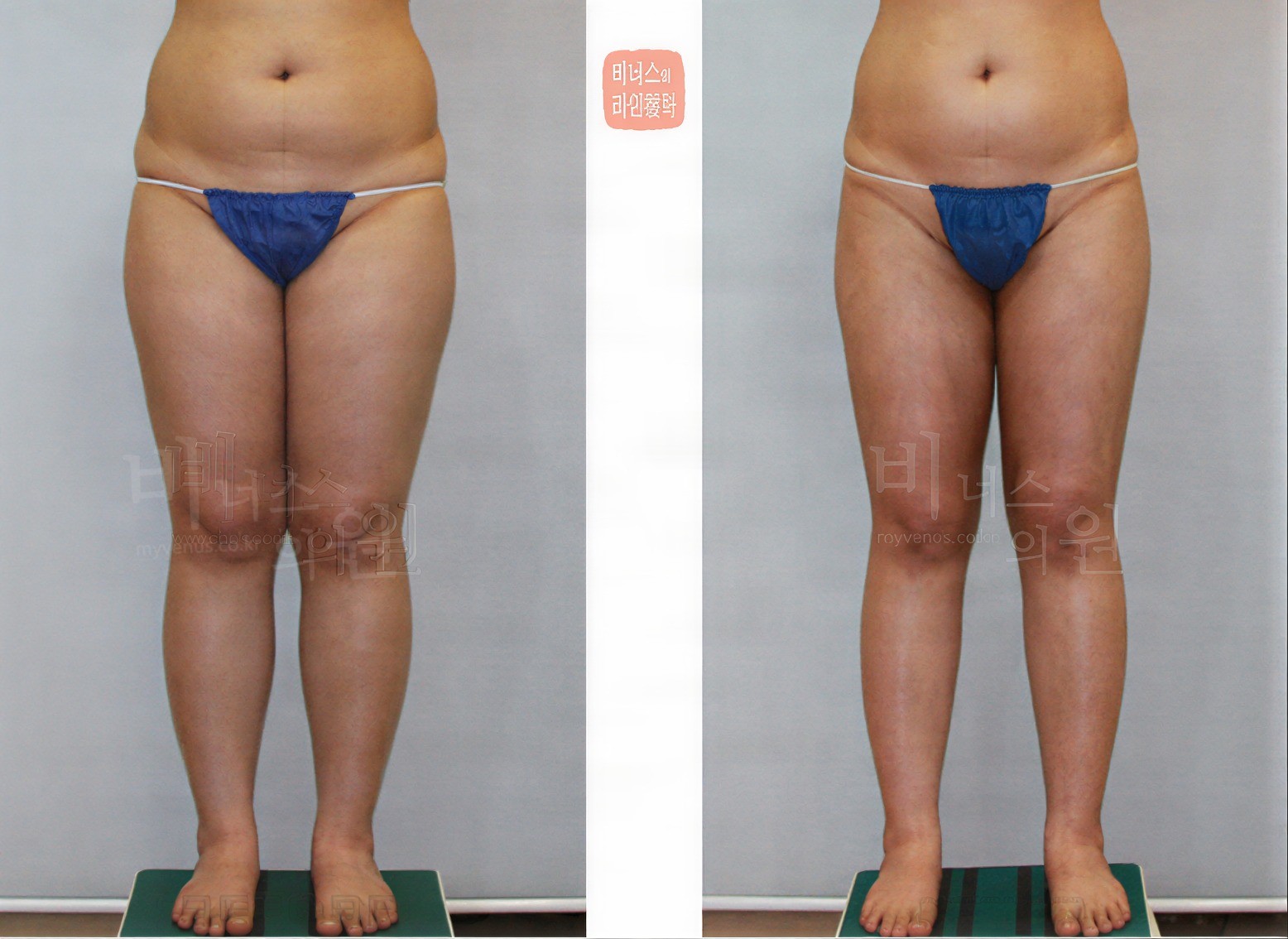
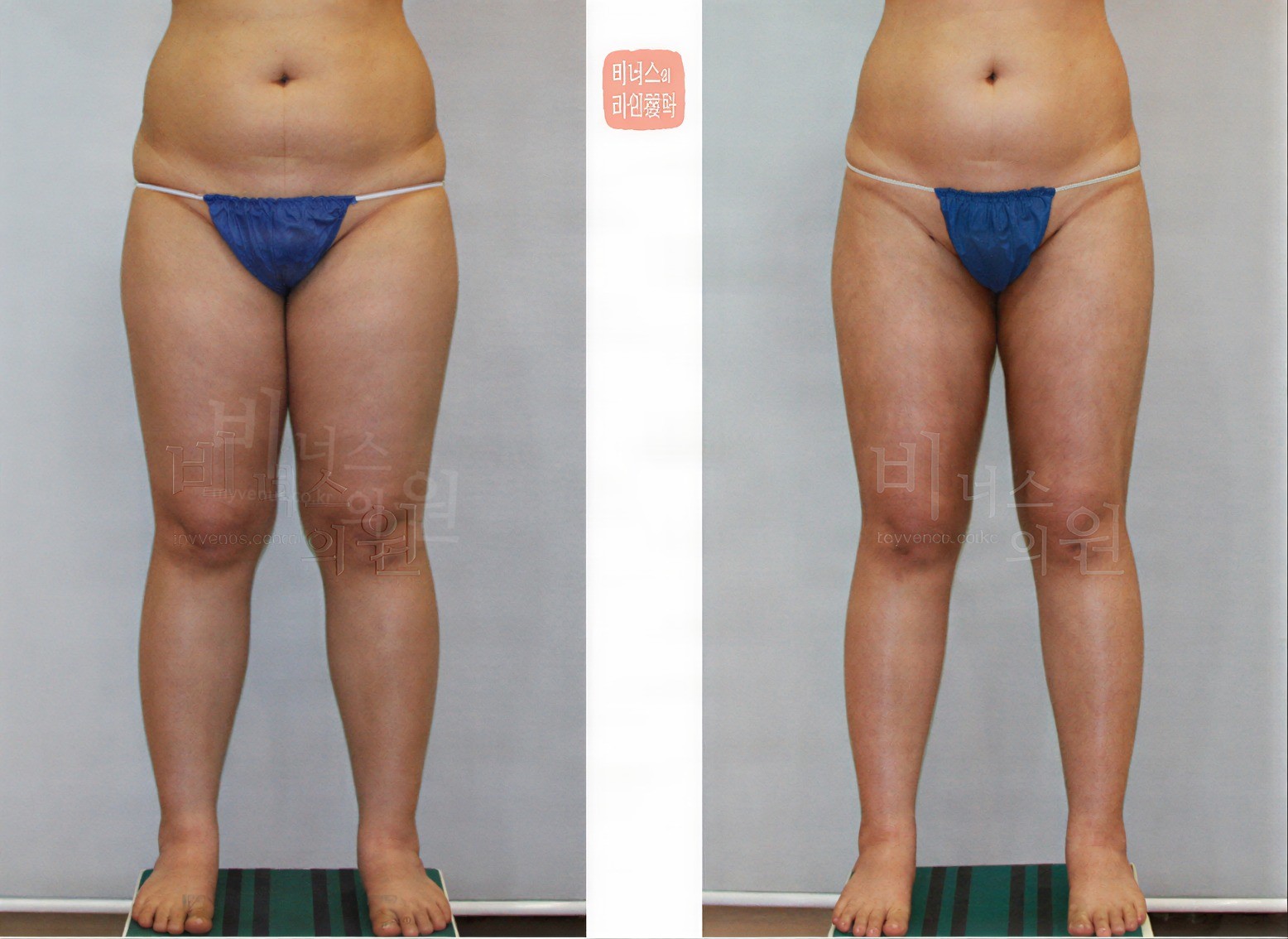
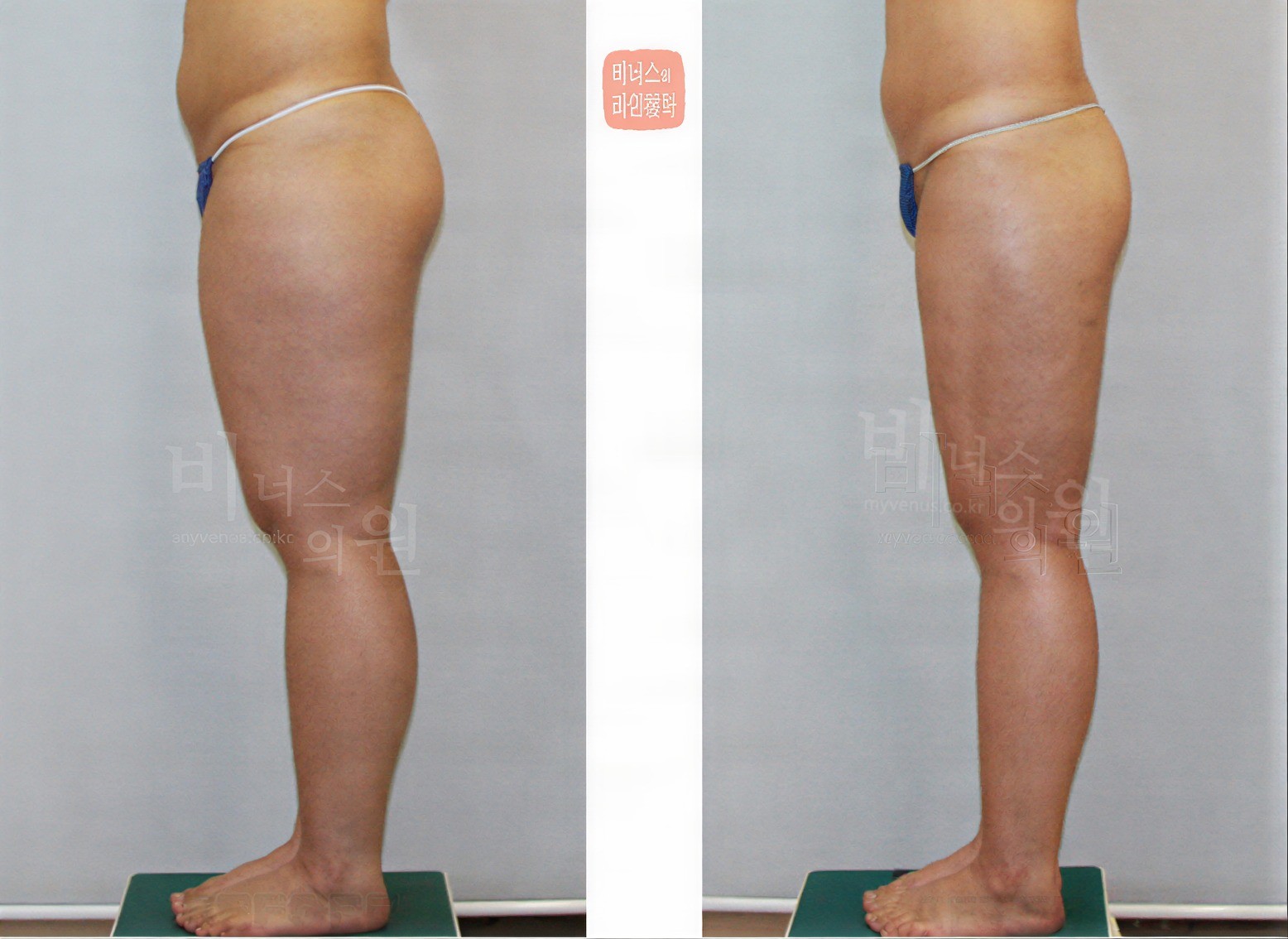
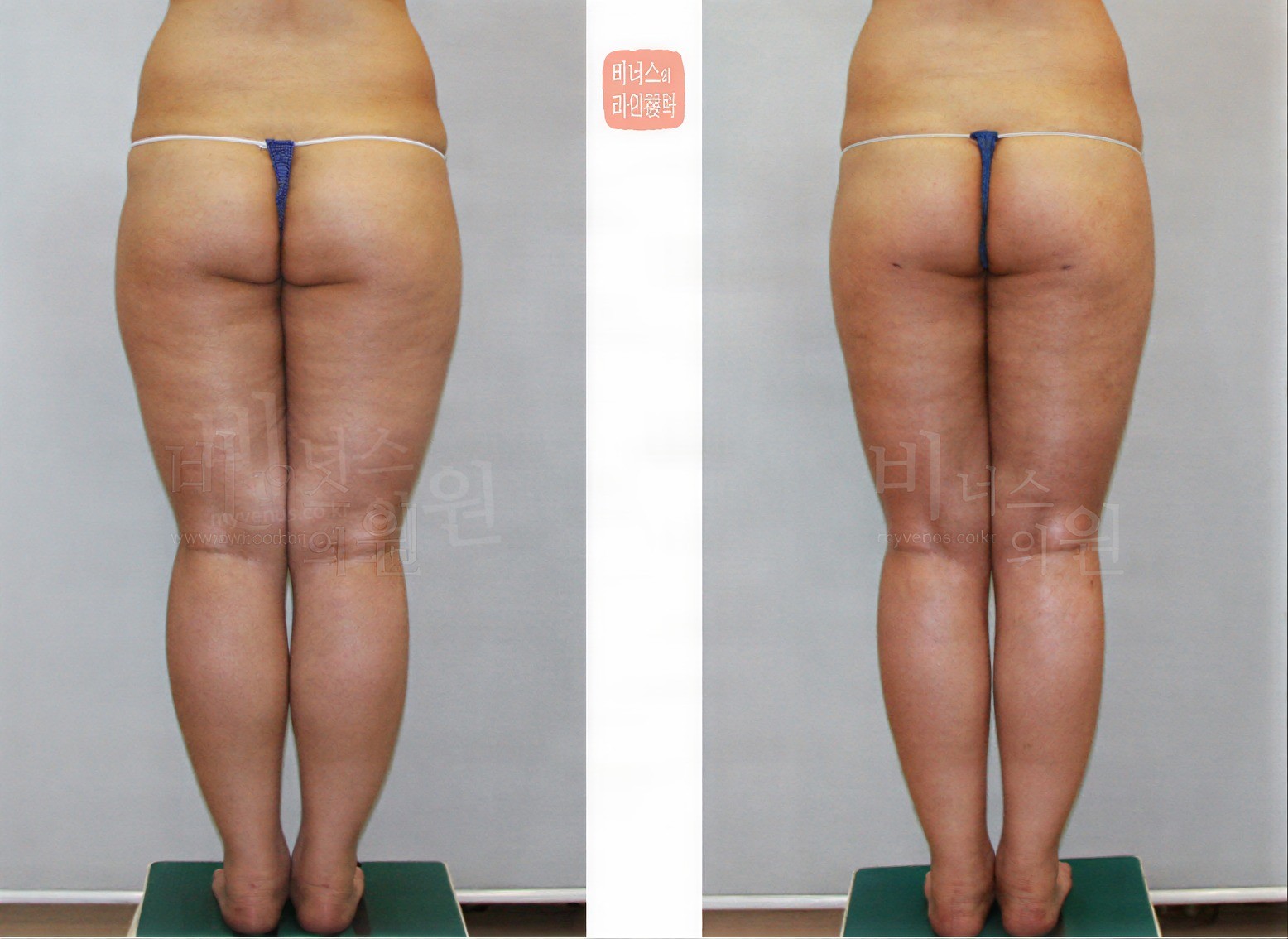
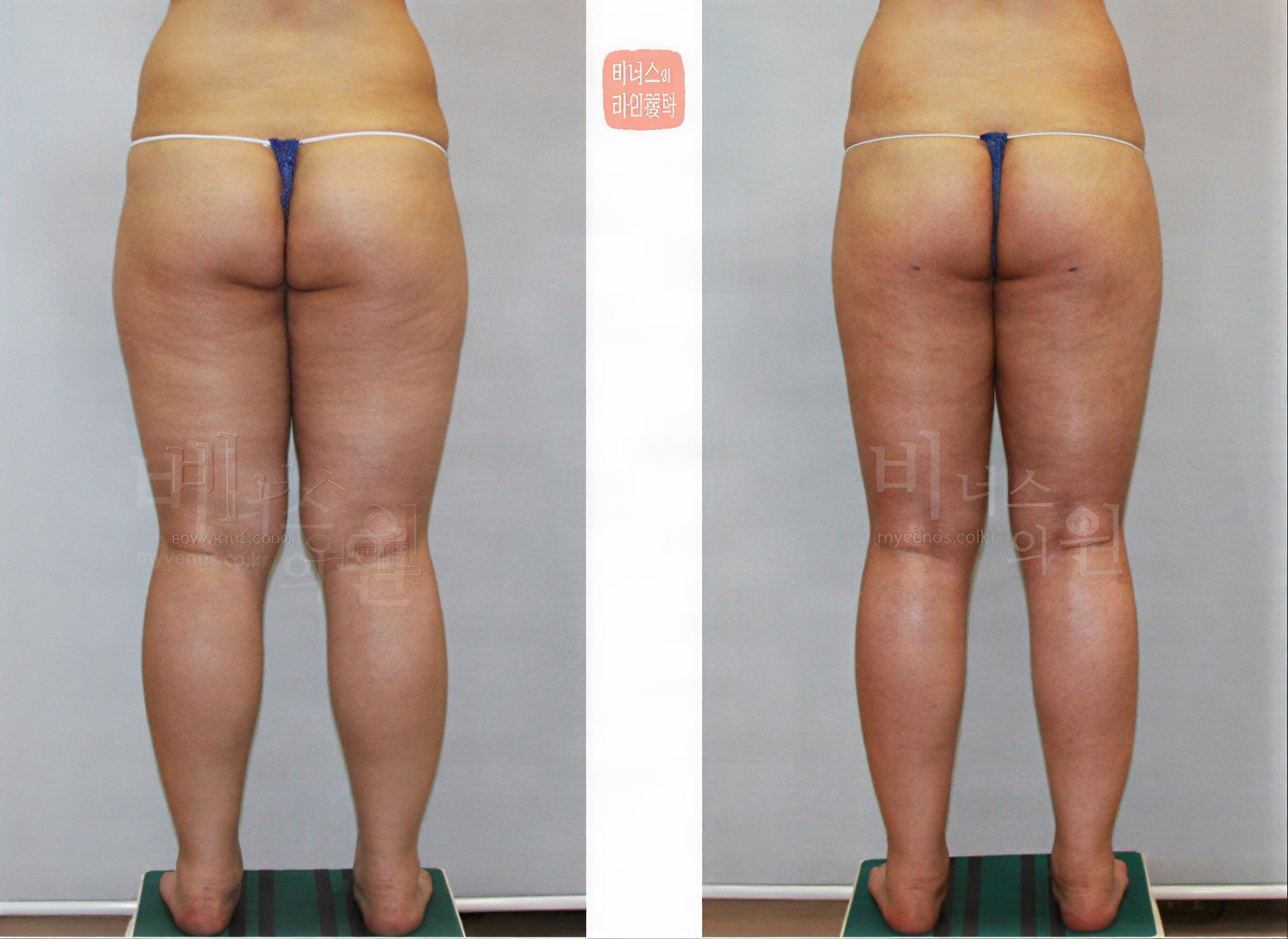
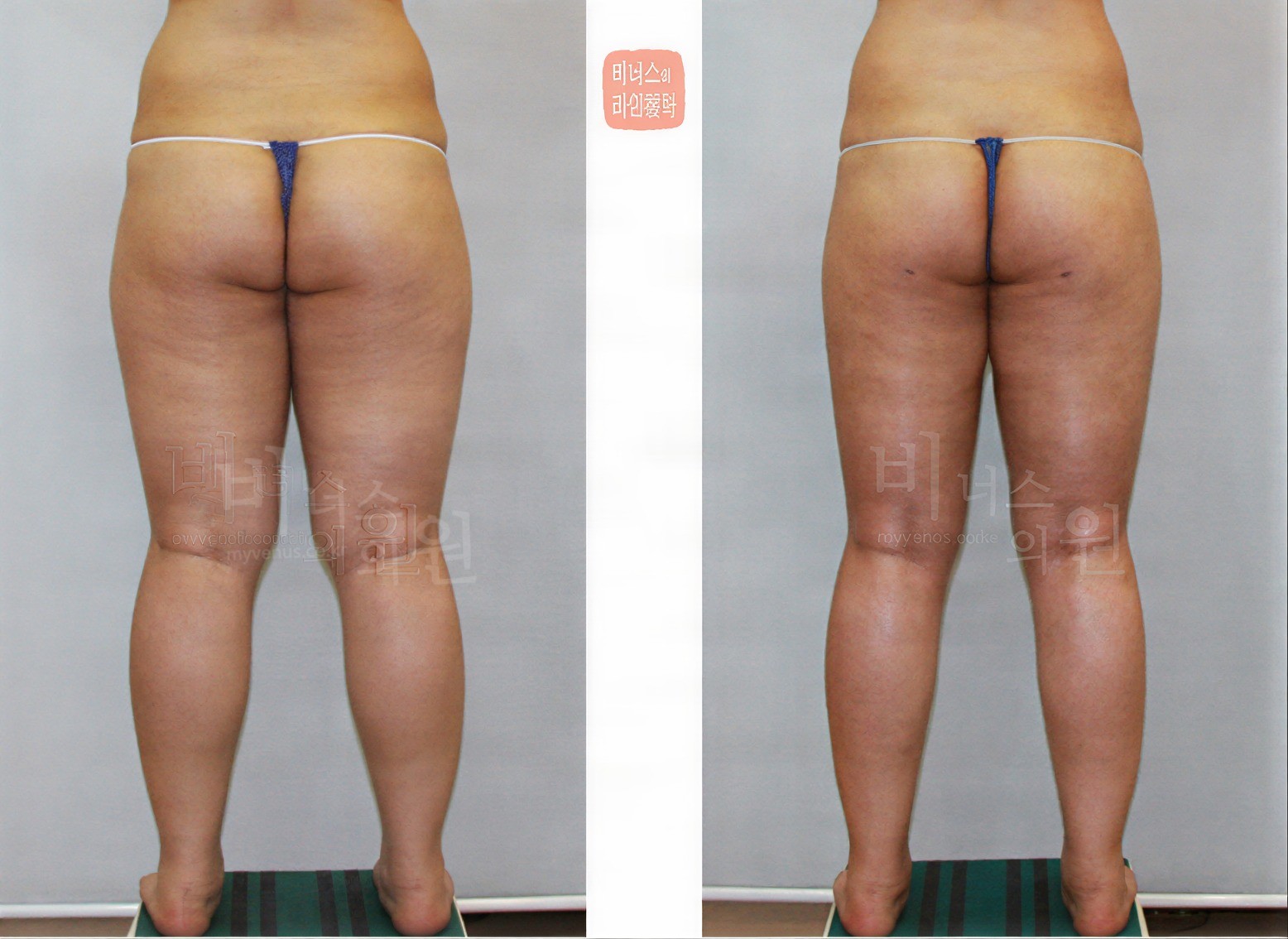
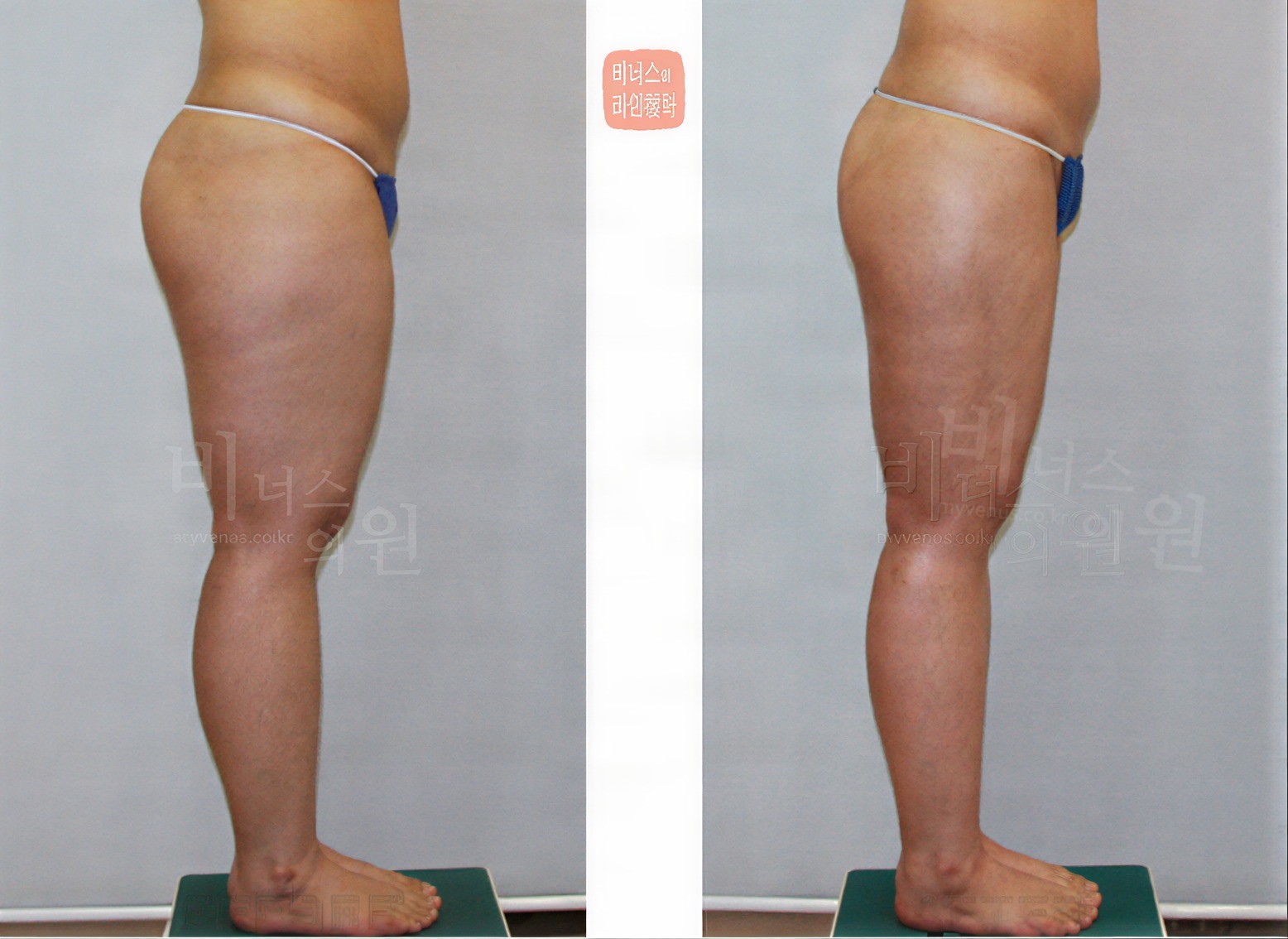
This is a case in which the 360-degree thigh, above the knee, medial knee, buttocks, and hips were treated together. All photos taken from the front, back, and side in several postures are included. Please compare the outer line running from the hips to the thigh, the inner thigh and inner knee lines, and the lower buttock line together. Although a large amount of fat was removed, with a pure fat volume of 3,300ml, you can also see in the after-surgery photos that the thighs and buttocks do not look saggy. This is because the surgery was performed to smooth the fat layer evenly while respecting the zones of adherence, and so that the skin would tighten to fit the reduced volume.
Below is a photo of the fat suctioned in this case. After excluding the red liquid layer at the bottom of the canister, the pure fat volume was 3,300ml.
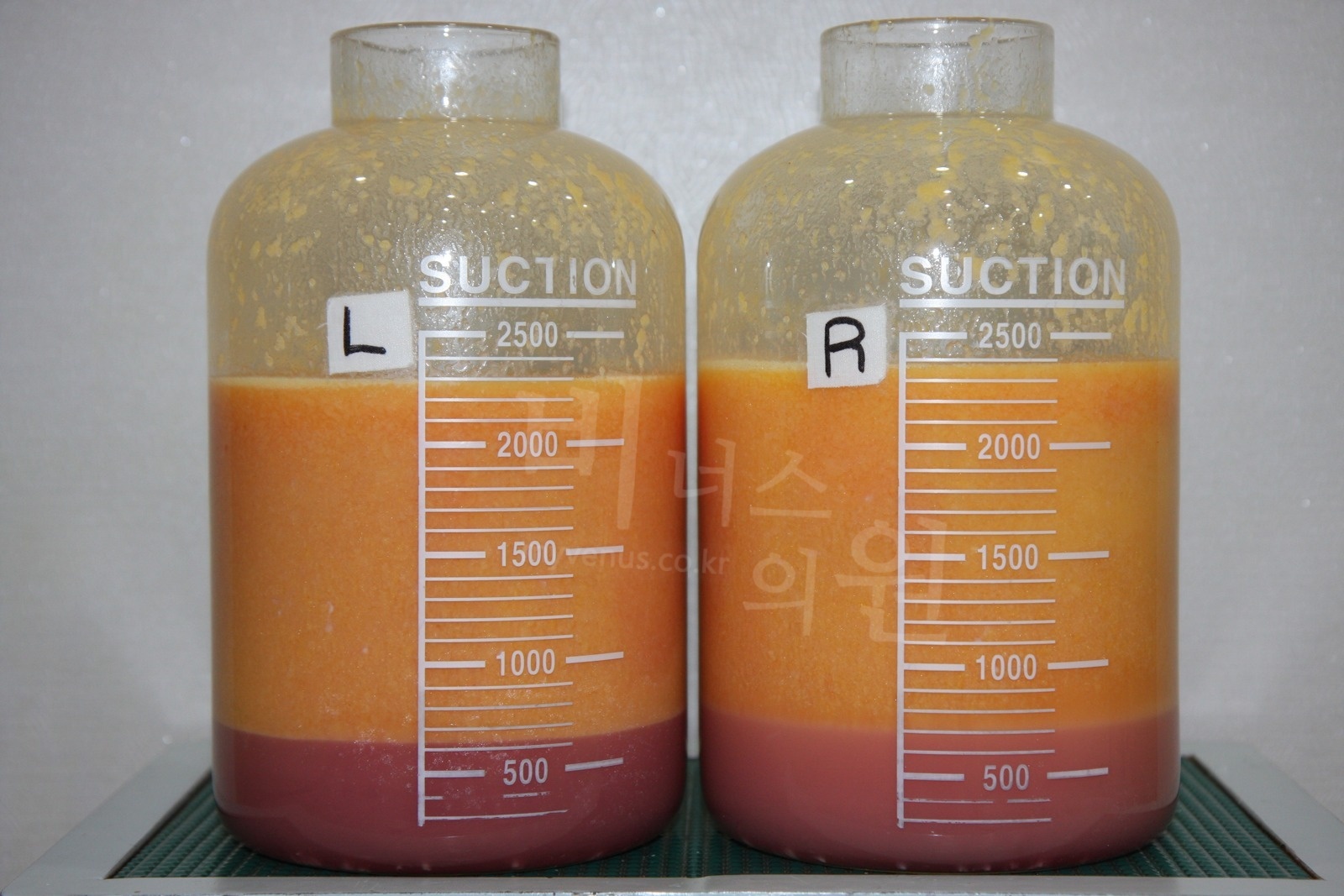
The contents collected in the canister separate into two layers. The yellow layer on top is called supernatant fat, and the red liquid layer at the bottom is called infranatant fluid. The lower layer is mostly the tumescent anesthetic solution infused during surgery, and the upper layer is the fat that was actually removed. As in the photo, an upper layer of clear yellow and a thin lower layer indicate that the yellow fat was suctioned cleanly with little bleeding. In this case, there was hardly any bruising even around 1 week after surgery. At Venus Clinic, we use handmade micro cannulas and have experience with this surgery, and we suction while working to reduce tissue damage and bleeding. However, the degree of bruising and swelling can differ from person to person.
| Information on the Posted Liposuction Before-and-After Photos | |||
|---|---|---|---|
| - Same person | Surgery performed at Venus Clinic; same person | - Date taken | Taken around 2014; comparison at about 7 weeks after surgery |
| - Same conditions | Edited to the same posture and size as closely as possible | - Side effects | https://en.myvenus.co.kr/should_know/38861 |
In Closing
Thigh liposuction and buttock liposuction have short names, but many surgical areas are included within them. Depending on which areas are treated together, both the balance of the result and the surgical cost change, so before surgery, please point out your areas of concern by the numbers in the illustrations, check carefully how far the surgery extends, and then decide. When you look for a liposuction clinic and compare liposuction cost and liposuction price, please also compare only the same surgical areas.
References: Cylindrical Thighs, Hips, Buttocks, and Knees Liposuction of the Hips, Buttocks, and Thighs The Apple Line of the Thighs and Pelvis Recovery Schedule After Liposuction Precautions by Surgical Area
Dr. Hakjun Kim, Director, Venus Clinic