Comparing Abdominal Liposuction Costs by Surgical Area
In consultations, we often hear questions such as “Is it enough to treat just the belly, or should the flanks be done too?” and “Why does the cost of abdominal liposuction differ so much from place to place?” The reason is that the single name “abdominal liposuction” actually covers several surgical areas, from the upper and lower abdomen to the flanks and back, and both the shape of the result and the cost change depending on which areas are included.
In this article, we divide the surgical areas of abdominal liposuction using illustrations, explain the surgical method, show how to compare surgery costs and prices for the same surgical areas, and describe an actual surgical case.

How Far Do the Surgical Areas of Abdominal Liposuction Extend?
Seen only from the front, the abdomen looks like one wide area, but when you look around to the sides and back, the places where fat accumulates are connected. For this reason, at Venus Clinic we divide the torso into eight areas, as shown in the illustration below, when we hold consultations.[1]
The same number marks the same area in the front, side, and back views. These numbers are meant to help you understand locations; they do not mean that each number is a separate cost unit.
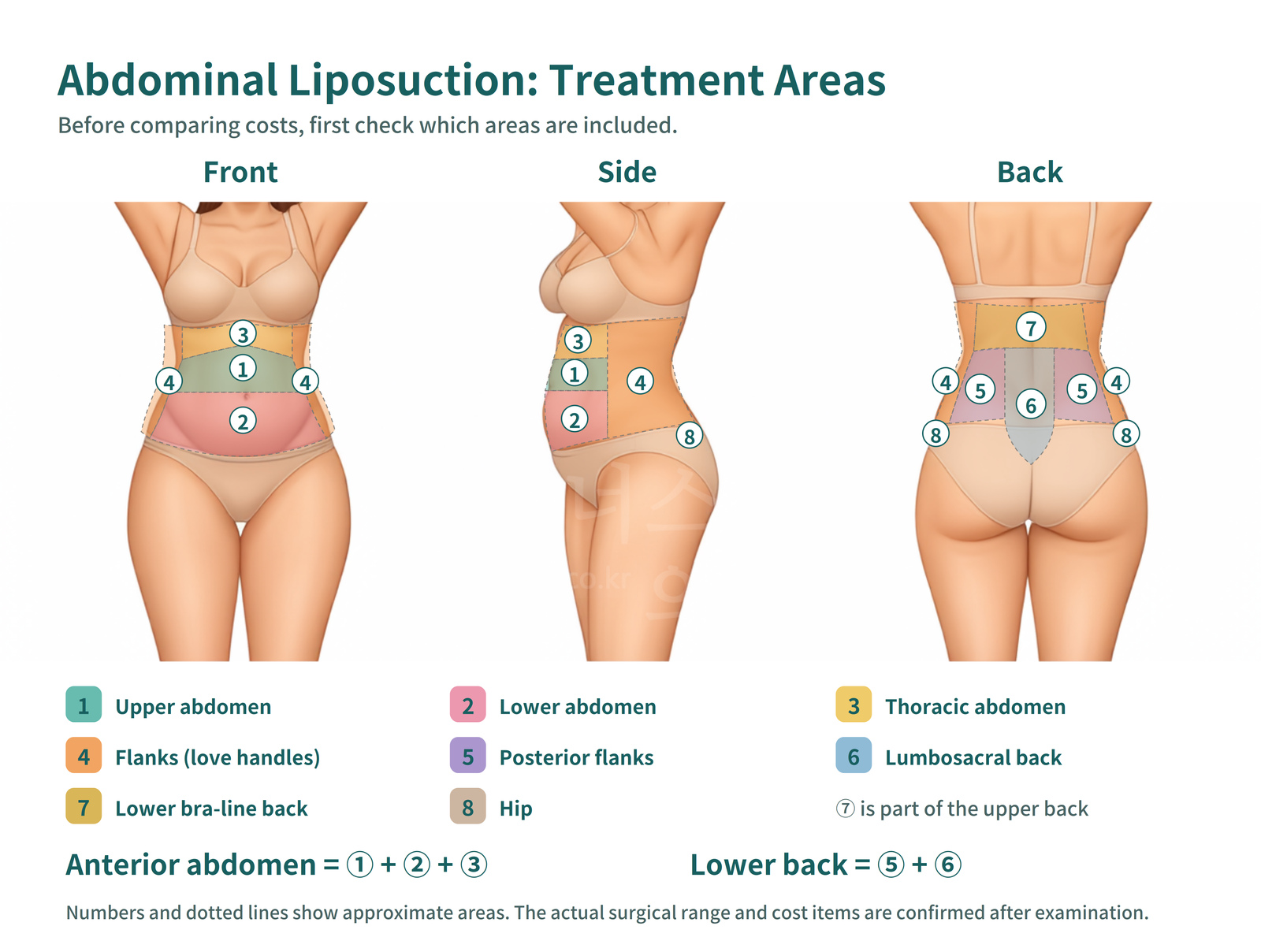
The location of each area is summarized in the table below.
| Abdominal and Torso Surgical Areas | Location and Points to Check at Consultation |
|---|---|
| ① Upper abdomen | The upper belly above the navel. We distinguish whether only the front upper abdomen is included, or whether the thoracic abdomen near the ribs is also treated. |
| ② Lower abdomen | The lower belly below the navel. Check whether the estimate covers the lower abdomen only. |
| ③ Thoracic abdomen (front of the torso, below the breast) | The fat area on the front of the torso, running from below the breast to the area near the ribs. It connects to the upper abdomen, but this area guide treats it separately. |
| ④ Flanks (love handles) | The area extending along both sides of the belly. Check whether it is included in the front abdomen or is a separate item. |
| ⑤ Posterior flanks (paralumbar area) | The area on both sides of the lower back. It is also written as posterior flanks or paralumbar area, and is distinguished from the lumbosacral back in the center. |
| ⑥ Lumbosacral back (central area of the lower back) | The central area running from below the waist toward the sacrum. Together with ⑤ posterior flanks on both sides, it is described as the lower back. |
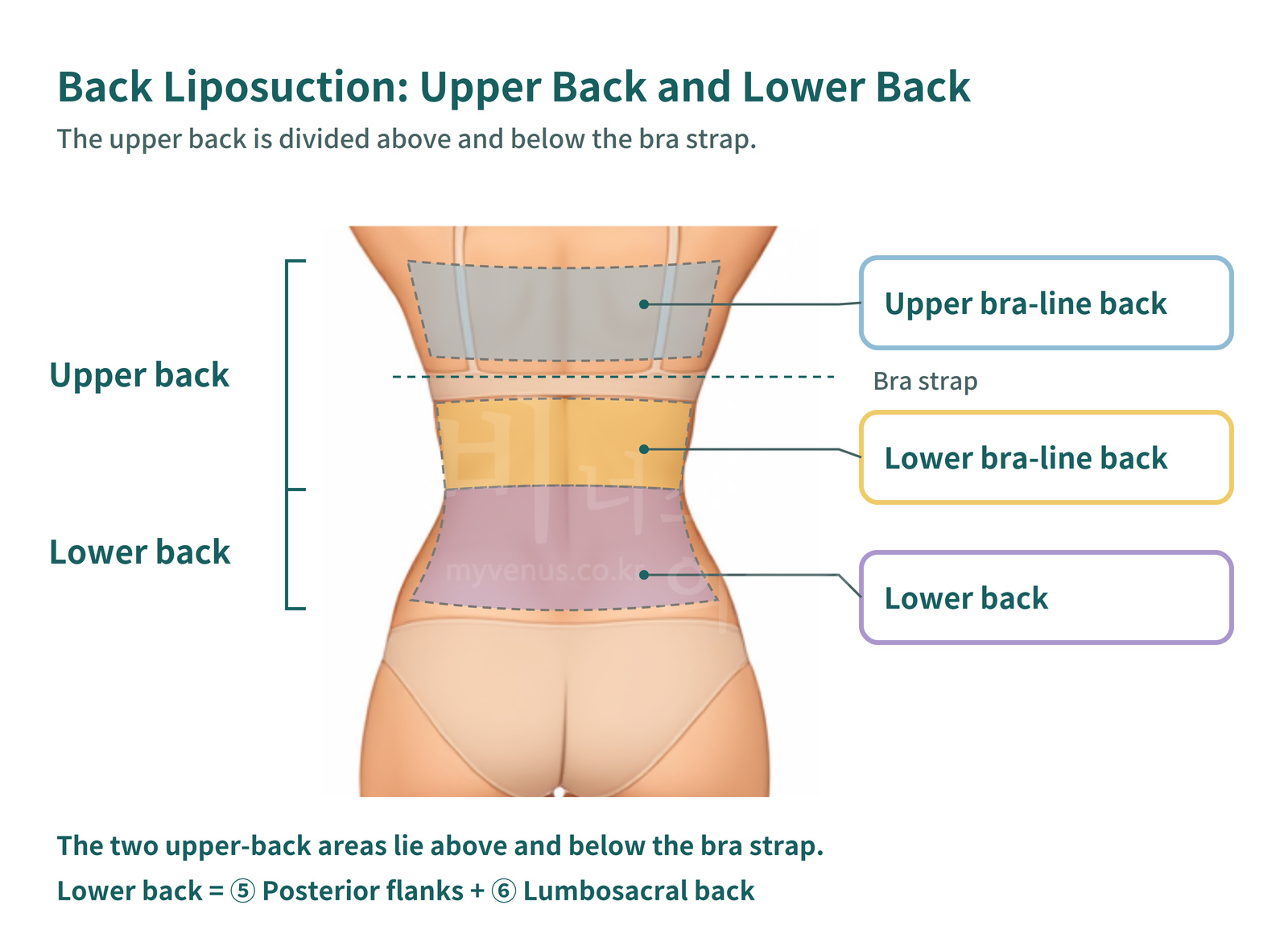
| ⑦ Lower bra-line back | The back area below the bra line, which is part of the upper back. Because of the word “lower,” take care not to confuse it with the lower back. |
| ⑧ Hip | This is not the same as the buttocks. It is the area on both sides above the buttocks where the upper pelvis projects outward. Check whether it is included in the surgical range, distinguishing it from ④ flanks. |
Grouping Into Larger Ranges
Anterior abdomen = ① Upper abdomen + ② Lower abdomen + ③ Thoracic abdomen
Lower back = ⑤ Posterior flanks (paralumbar area) + ⑥ Lumbosacral back
The detailed numbers explain the location of each area. When comparing the surgery cost for the anterior abdomen or the lower back, check which areas within the group are included. ④ Flanks and ⑦ Lower bra-line back are distinguished separately.
The Lower Bra-Line Back Is Not the Lower Back
The back is broadly divided into the upper back and the lower back. The upper back is further divided into the upper bra-line back and the lower bra-line back, and the lower back is described as the range combining ⑤ posterior flanks and ⑥ lumbosacral back. The upper-back region marked in this circumferential abdominal guide is the lower bra-line back; it does not extend up to the upper bra-line back.[1]
Considering the Proportion of Waist and Hip Together
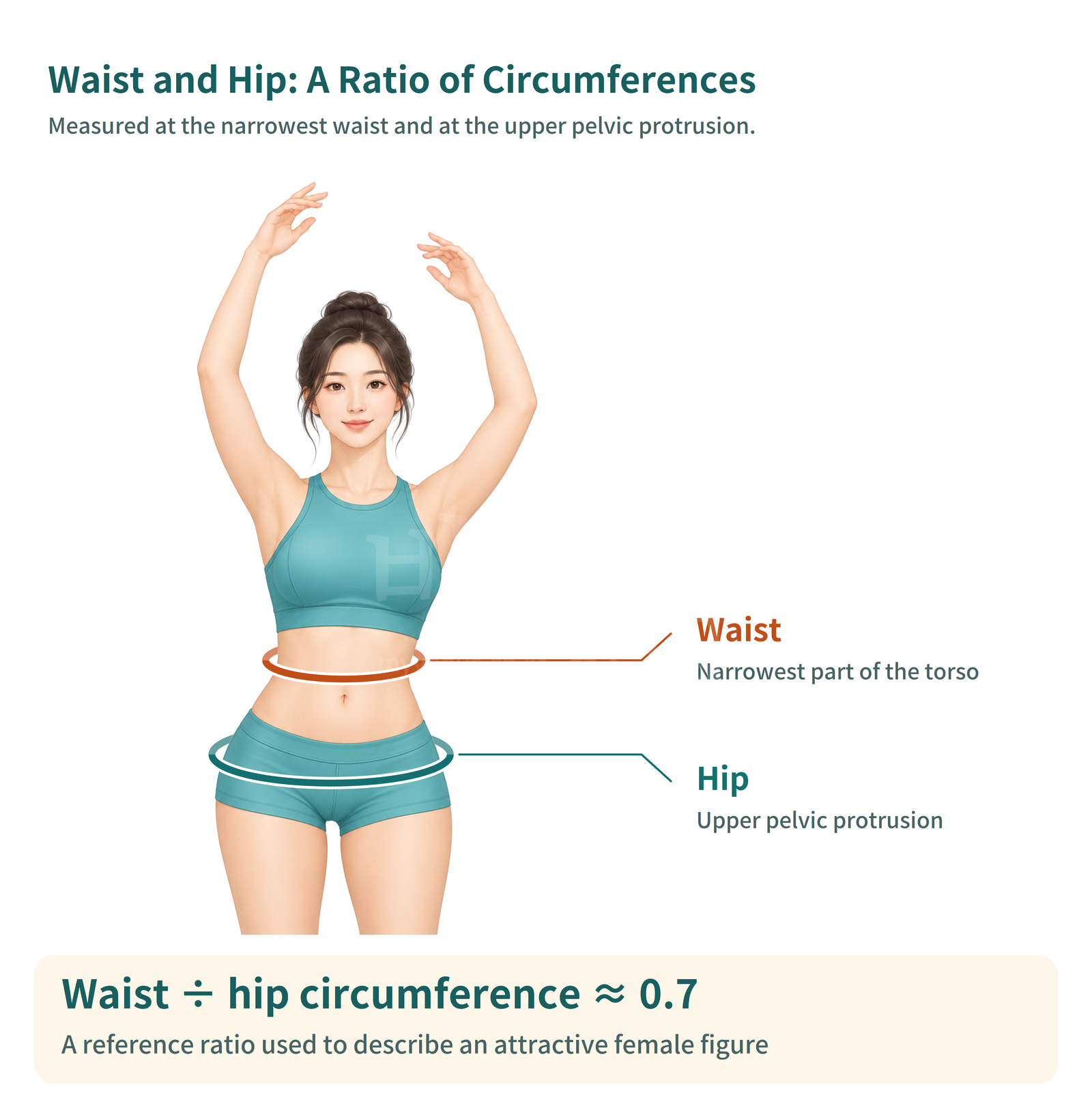
In women, the waist is the narrowest part of the torso. The height that divides the upper back from the lower back is this waist line, and the part where the upper pelvis projects outward on both sides above the buttocks is the hip. It is easy to understand if you picture a hula hoop around the body, as in the illustration below. When measuring, use the length of a horizontal loop around the body at each height.
Waist circumference ÷ hip circumference = waist-to-hip ratio (WHR). A value of about 0.7 is one of the reference values used when describing the proportions of a female figure often considered attractive.[4] Note that this is the ratio of circumferences, not the ratio of the widths seen in the picture.
By contrast, it is said that men do not have a waist. Rather than narrowing into an hourglass shape as in women, the torso tends to be straight, with the sides running straight up and down.
An Aside: Where Is the “Waist” When Someone Says “Aigo, heori-ya”?
When older Koreans groan “Aigo, heori-ya!” (roughly, “Ouch, my back!”), the word heori they point to is usually the lumbar back on the rear of the body, the area where the lumbar spine is. Although it is the same Korean word, heori, it points to a different location and meaning from the Waist, which means the narrowest line of the torso.
Mix-ups like this, where the same word points to different places, are more common than you might think. In particular, even among doctors, “love handles” is sometimes used for the flanks and sometimes for the posterior flanks. When the same area is called by different names, the range discussed at the consultation, the actual surgical range, and the surgical cost on the estimate may not match. In fact, there was a case in which a patient who had undergone flank (love handle) liposuction was told elsewhere that “the love handles were not treated,” which led to a misunderstanding. One side was calling the flanks “love handles,” while the other was using that name for the posterior flanks. From the patient’s point of view, hearing both “the love handles were treated” and “the love handles were not touched” must have sounded as contradictory as saying, “I drank, but I did not drive drunk.” That is why unifying the name of each area is very important. At Venus Clinic, as shown in the illustrations in this article, we separate ④ the flanks (love handles) from ⑤ the posterior flanks (paralumbar area), and we use the same number and name for each area consistently in consultation, surgery, and cost guidance.[1][4] When you compare surgical costs from several places, please do not rely on area names alone; check how far the range extends using the locations in the illustration.
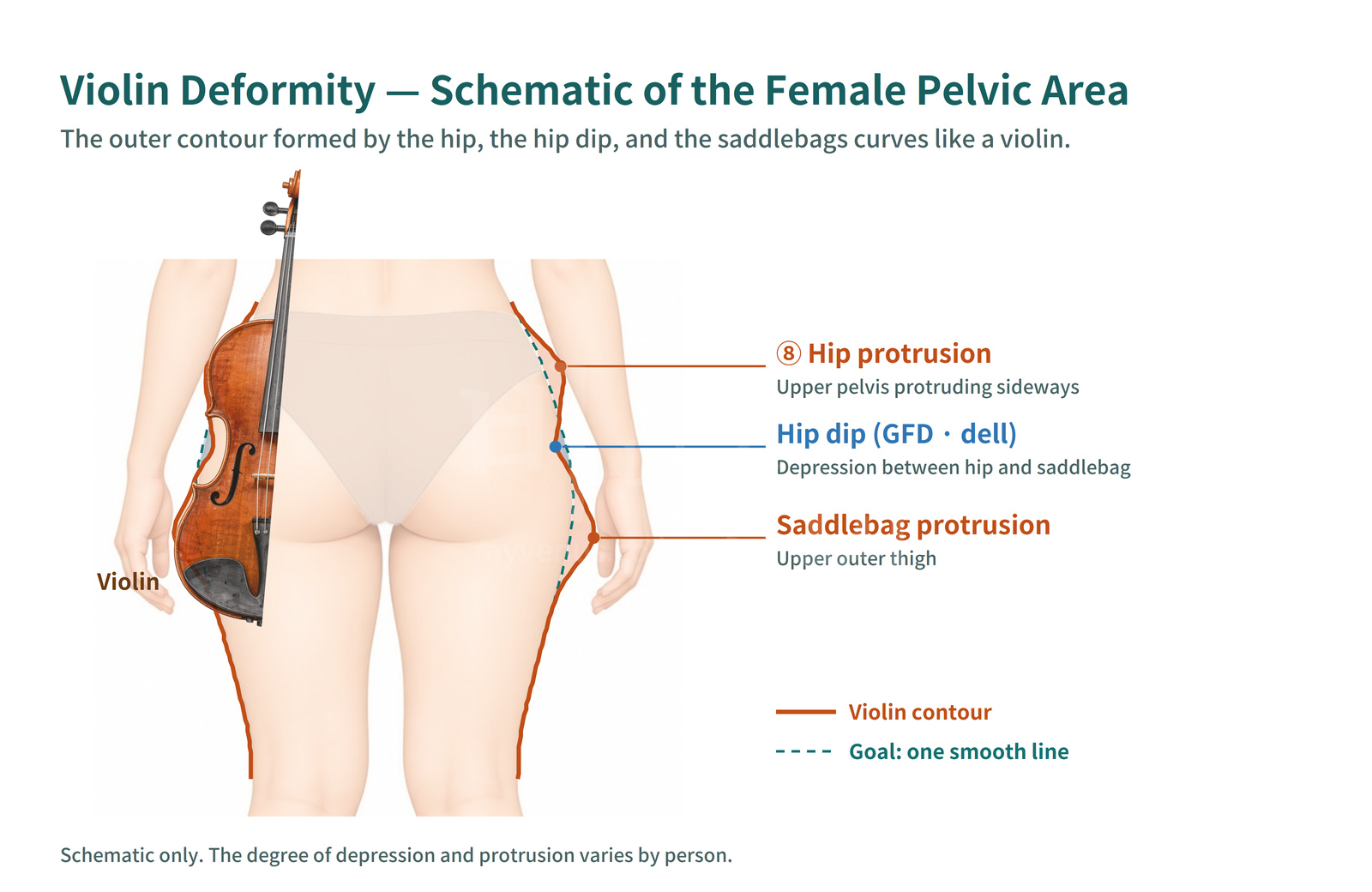
The same is true of the hip. Many people think “hip” means the same thing as the buttocks, so we often hear at consultations, “I would like a hip-up surgery.” However, the hip is not the buttocks. It is the upper protrusion of the violin deformity, that is, the area where the upper pelvis protrudes sideways, where the outer contour from the waist to the thighs curves like a violin. In men, the same area is called the flank. Since one area is called the hip in women and the flank in men, you can see how important it is to unify the names of areas. Because people take the hip to be the buttocks, surgery for sagging buttocks is commonly called “hip-up surgery.” That is why, at consultations, we first point to ⑧ the hip and the buttocks in the illustration to confirm which area you mean, rather than relying on the name.
If you draw a schematic of the female pelvic area, it takes on the shape of a violin. This is because, between the protrusion of ⑧ the hip above and the protrusion of the saddlebags (upper outer thighs) below, there is a depression running across below the pelvic bone (iliac crest) and above the greater trochanter of the thighbone. This depression is called the GFD (gluteofemoral depression) or dell; in Korea, it is most often simply called the “hip dip.” Because the outer contour formed by the hip protrusion, the GFD, and the saddlebag protrusion curves like a violin, it is called the violin deformity.[5][7] The depression forms where the buttock muscles, the outer thigh muscles, and the greater trochanter meet; it is more noticeable in slim body types, and some people have almost no depression.[5][6] For this reason, we regard the hip, buttocks, and outer thighs as one aesthetic unit and aim to refine the curved, violin-shaped contour into one smooth line.[7]
Check the Actual Range Rather Than the Words “Whole Abdomen”
Even if the estimate says “whole” or “360 degrees,” it is best to have the clinic mark on your body and explain which of the areas above are included. Take care not to compare the cost of the front abdomen alone with the cost that includes the flanks and back as if they were the same conditions just because of the name.
How Is Abdominal Liposuction Performed?
First, We Check Fat Distribution and the Surgical Range
At the consultation, we check not only the front upper and lower abdomen but also the contour continuing to the flanks and back, the thickness of the subcutaneous fat, and the skin's elasticity and laxity. Besides subcutaneous fat, visceral fat or loosening of the abdominal wall muscles may contribute to a protruding belly, so we distinguish these and explain the range that surgery can address.[1][2]
Reducing Subcutaneous Fat With Tumescent Anesthesia and Thin Cannulas
At Venus Clinic, we perform liposuction using tumescent local anesthesia and microcannulas. After tumescent solution is injected into the surgical area, a thin suction cannula is inserted through small incisions to remove subcutaneous fat.[1][3] The surgical range and anesthesia plan are decided after checking each person's condition, and the position and size of the necessary incisions are also planned to match the range.
When the abdomen, flanks, and back are treated together, we plan so that the borders between front, side, and back connect naturally. We remove the fat that needs to be removed as thoroughly as possible, and refine the contour so that the line is smooth rather than bumpy. However, because fat distribution and skin condition differ, the surgical range and expected changes must also be explained individually.[1][3]
Also Check What Liposuction Does Not Change
Abdominal liposuction treats the fat beneath the skin; it is not surgery that directly removes visceral fat or corrects the abdominal wall muscles. The degree of skin retraction also varies. When the skin is very loose and subcutaneous fat is scant, or when stretch marks themselves are the main concern, liposuction alone may not reach the change you expect.[2] It is advisable to check these limits together before deciding on the cost of surgery.
Compare Abdominal Liposuction Costs and Prices for the Same Surgical Areas
If you have received liposuction cost estimates from several places, first organize them under the same surgical areas and the same inclusion conditions. For example, an estimate for the lower abdomen only differs in range from one that covers the upper and lower abdomen, thoracic abdomen, flanks, posterior flanks, and back together. Before judging whether the total is high or low, you need to check what the amount includes.
| Comparison Item | What to Match Under the Same Conditions |
|---|---|
| Surgical areas and range | Record which of the upper abdomen, lower abdomen, thoracic abdomen, flanks, posterior flanks, lumbosacral back, and lower bra-line back are included. Also check whether both sides are included. |
| Anesthesia plan and cost | Check whether the planned anesthesia method and anesthesia-related costs are included in the quoted surgery cost. |
| Pre-operative tests | Check the types of tests required and whether the test fees are included. |
| Compression garment and prescriptions | Check whether costs for the compression garment and prescriptions are included, and which items you must prepare separately. |
| Post-operative care | Check which items are included in follow-up visits and care, and whether there are separate charges. |
| VAT and final amount | Check whether VAT is included and the final amount reflecting any additional items. |
This does not mean that all of these items are necessarily charged separately; it is a list for checking what is included in the amount you were quoted. Writing down the included areas and care conditions helps reduce the chance of comparing different operations that share the same name, “abdominal liposuction price.”
Questions to Ask at Your Consultation
“Besides the upper and lower abdomen, which of the thoracic abdomen, flanks, posterior flanks, lumbosacral back, and lower bra-line back does this surgery cost include? Is this the final amount including tests, anesthesia, compression garment, post-operative care, and VAT?”
References
- Venus Clinic. Guide to torso liposuction areas and liposuction at Venus Clinic. Guide to abdominal surgical areas; Guide to liposuction. The area divisions reflect what the representative director confirmed.
- Klein JA. Tumescent Technique: Tumescent Anesthesia & Microcannular Liposuction. Mosby; 2000. Chapter 31, Abdomen, pp.295, 300.
- Klein JA. Tumescent Technique: Tumescent Anesthesia & Microcannular Liposuction. Mosby; 2000. Chapter 28, Surgical Technique: Microcannular Tumescent Liposuction, pp.248–252.
- Cuzalina A, Retana A. Creating the Ideal Buttock (Lifting, Implanting or Fat Grafting). In: The Art of Body Contouring. IntechOpen; 2019. doi:10.5772/intechopen.84660 · Venus Clinic. On the term “love handles”.
- Klein JA. Tumescent Technique: Tumescent Anesthesia & Microcannular Liposuction. Mosby; 2000. Chapter 33, Female Hips and Back and Male Flanks, p.346.
- Duncan DI, ed. Enhanced Liposuction – New Perspectives and Techniques. IntechOpen; 2022. Chapter 19, Posterior Torso and Buttocks Contour Enhancement.
- Venus Clinic. What is hip-up surgery? · Liposuction of the hip, buttocks, and thighs.
Before-and-After Photos
These are front, side, and back photos of a patient who underwent circumferential abdominal liposuction, and all the after-surgery photos were taken about 1 week after surgery. This is a stage when swelling and bruising remain, and it is not the final result.
Circumferential Abdominal Liposuction Case
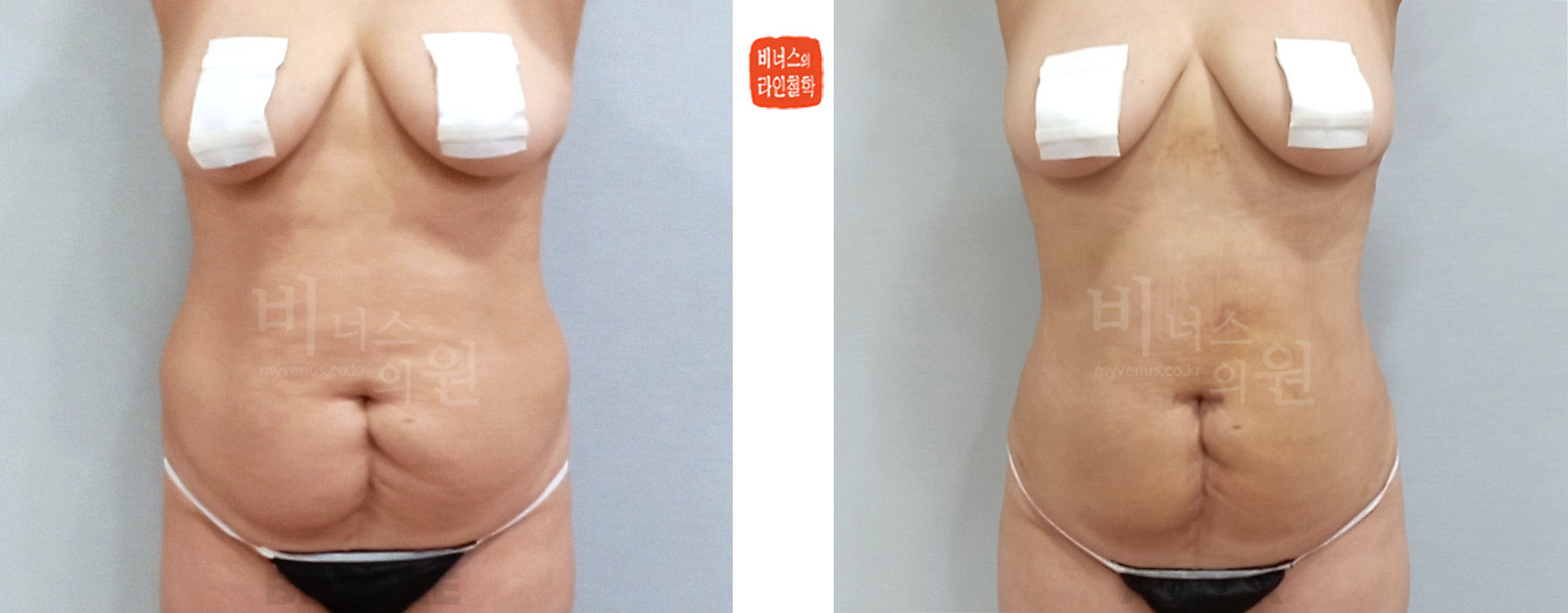
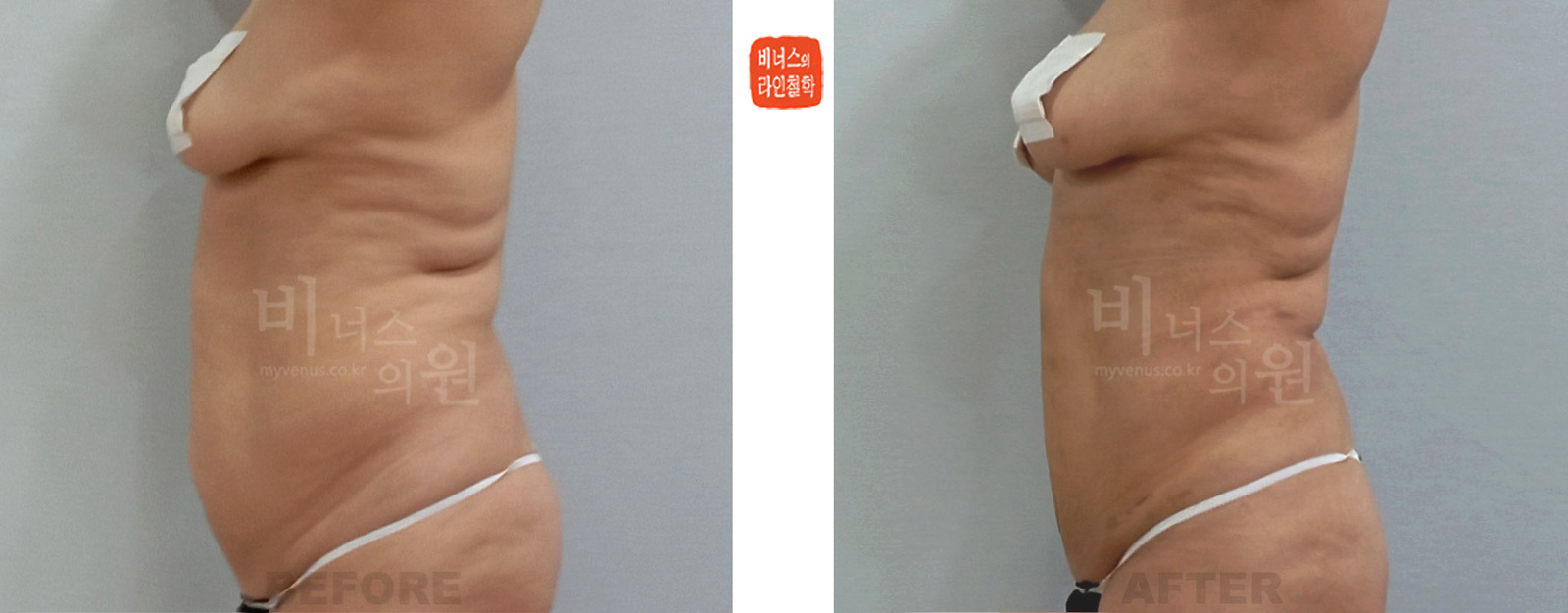
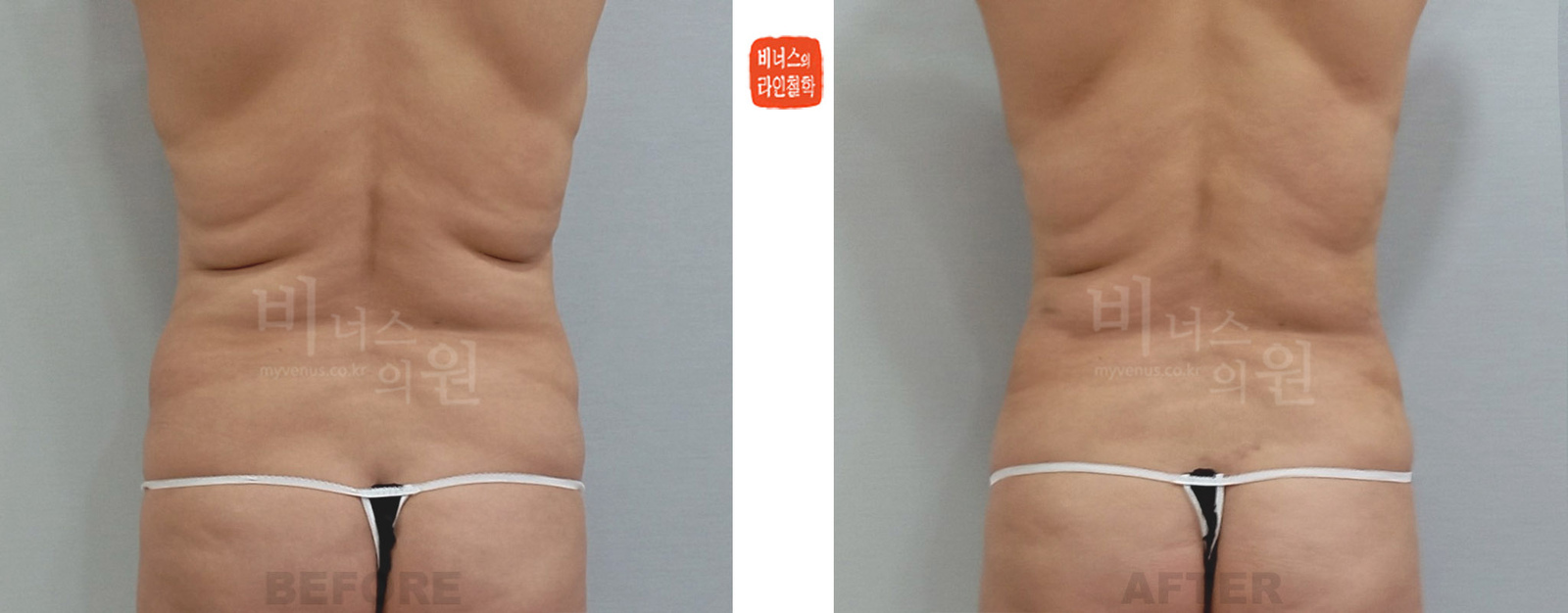
This is a case of circumferential abdominal liposuction. Surgery was performed all the way around the torso, from the front of the belly through the flanks to the back. According to the surgical record, the surgical areas, using the numbers in the illustration above, were ① Upper abdomen · ② Lower abdomen · ③ Thoracic abdomen at the front, ④ Flanks (love handles) at the side, and ⑤ Posterior flanks (paralumbar area) · ⑦ Lower bra-line back at the back.
What to compare in the front view — Before surgery, the ② lower abdomen below the navel bulged forward, and because of ④ flank fat the sides of the waist ran straight down with almost no narrowing. After surgery, the bulge of the lower abdomen has lessened, and the contour of the belly from ① upper abdomen to ② lower abdomen is flatter. As the flank fat decreased, both sides of the waist moved inward, and you can see that the outer line of the torso, running from below the breast to the pelvis, has narrowed.
What to compare in the side view — Before surgery, the lower belly protruded roundly forward. After surgery, the front line of the belly from below ③ thoracic abdomen to ② lower abdomen has been straightened, and the thickness of the belly seen from the side is thinner. On the back as well, the thickness of ⑤ posterior flanks has decreased and the line behind the waist is smoother.
What to compare in the back view — Before surgery, ⑤ posterior flanks on both sides behind the waist protruded outward so the waist line ran straight down, and in ⑦ lower bra-line back below the bra line there were creases formed by overlapping fat. After surgery, the protrusion of the posterior flanks has lessened and a curve in which the waist goes inward has appeared even from behind, and the overlap below the bra line has also lessened. Because the front, sides, and back were treated together, the circumference of the torso decreases evenly, without a boundary between treated and untreated areas when viewed from any direction; this is the characteristic of circumferential abdominal liposuction.
Because these are photos taken about 1 week after surgery, the contour will settle further as the swelling subsides. However, skin creases that existed before surgery partly remain in the photos, and the degree of skin retraction varies from person to person.
| Information on the Posted Liposuction Before-and-After Photos | |
|---|---|
| - Same person | Surgery performed at Venus Clinic; same person |
| - Date taken | Taken around 2022; comparison at about 1 week after surgery |
| - Same conditions | Edited to the same posture and size as closely as possible |
| - Side effects | https://en.myvenus.co.kr/should_know/38861 |
In Closing
When comparing the cost of abdominal liposuction, first align “how far the surgery goes” and “which items are included.” Comparing liposuction costs and prices for the same surgical areas, and checking which parts of your body surgery can change, is the starting point of a consultation. At Venus Clinic, during the consultation we point out each surgical area one by one using the numbers in the illustration, and explain the surgery cost based on that range.
References: Thigh and buttock cost comparison Upper arm cost comparison Guide to abdominal surgical areas
Dr. Hakjun Kim, Director, Venus Clinic