Breast Fat Grafting ② Absorption and Additional Grafting After Breast Fat Grafting — How Much Remains, and When Is It Refilled
In breast fat grafting consultations, I often hear questions like these. "Will all of the fat that is put in stay?" "Is it finished in one go?" "If I have additional grafting, when is it done?" Because part of the fat moved into the body is absorbed, this is something you should know before choosing the surgery.
This is the second of two articles. In the previous article (Breast Fat Grafting ① Using Your Own Fat Instead of Implants), I explained who it may suit and how much can be placed in each breast. This time, I will explain in order how much of the grafted fat remains, when additional grafting is done, how leftover fat is stored, and what checkups it is good to have before and after surgery.
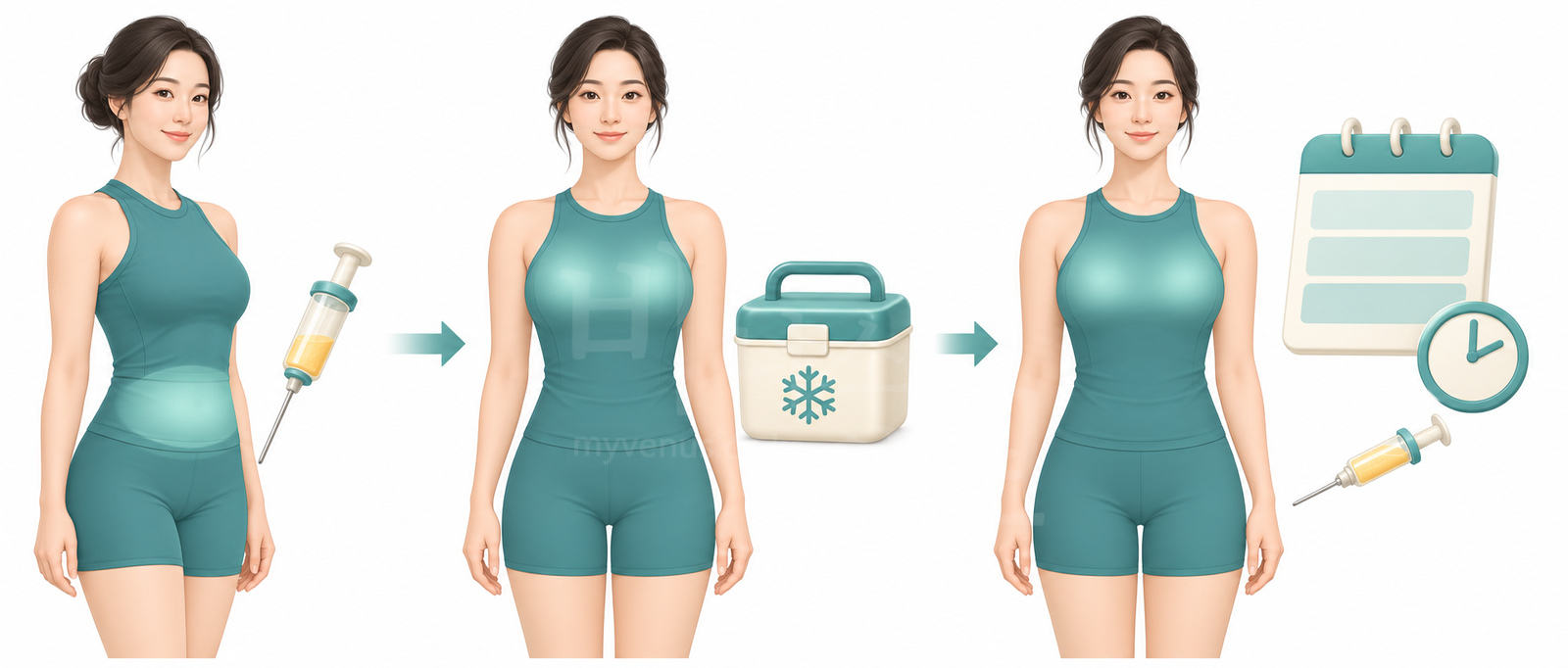
※ This is a concept illustration of the additional grafting flow at Venus Clinic. The actual schedule and method may vary depending on each person's condition.
How much of the grafted fat remains?
Part of it is absorbed
Part of the fat placed in the breast does not settle and is absorbed by the body. The literature also summarizes that some absorption always occurs after fat grafting, and that the absorption rates reported varied widely depending on differences in how the fat was collected, processed, and stored.[1]
The proportion that remains can depend on how it is measured
The volume retention of breast fat grafting was reported in a systematic review as 62.4% on average (44.7–82.6%).[2] However, this figure can differ depending on the method of measurement. There is a summary noting that even when fat is grafted in the same way, retention is reported differently if the tool used to measure volume differs, such as MRI versus three-dimensional imaging.[3] So rather than taking any single number as "the amount that will remain in my breasts," it is more accurate to understand that there is a large difference from person to person.
It takes time to settle
General fat grafting literature explains that absorption proceeds, and that after 9 months the grafted fat settles stably and further absorption is hardly expected.[4] However, this is an explanation of fat grafting in general, not a figure for the breast alone, so it cannot be assumed to apply to the breast in exactly the same way. Please just remember that the volume right after surgery is not the final appearance.
When is additional grafting done, and how many times?
The interval described in the literature
Sometimes the procedure is divided into stages to fill in what is absorbed. The literature includes reports recommending repeated procedures on the same area at intervals of 3 to 6 months.[5] However, some sources state that there is no firm evidence on the minimum interval between procedures,[6] so it is appropriate to decide the interval based on each person's condition.
Additional grafting at our Venus Clinic
At our Venus Clinic, additional grafting is done within 3 months after the first grafting. Whether additional grafting is needed, and if so how much more to place, is decided at a consultation by looking at the condition of the breast at that time.
Number of procedures
In a study comparing fat grafting with implants, nearly half (44.5%) of those who received fat grafting underwent a second procedure.[7] Rather than assuming from the start that it will be finished in one procedure, it is better to begin with the plan that it can be filled once more if needed.
What happens to the fat left over after grafting?
Of the fat collected by liposuction, the fat left over after grafting into the breasts is stored frozen for up to 3 months. If additional grafting is needed within that period, the stored fat is used, so liposuction does not have to be done again.
Fat that is not used after 3 months is disposed of through a medical waste disposal company, following the procedures set by law.
Please have a breast checkup before and after surgery
We recommend a breast checkup before surgery
If you are planning breast fat grafting, we recommend having a breast checkup (ultrasound and mammography) before surgery. Having a record of the condition of your breasts before surgery gives you a point of comparison if anything changes afterward.
Lumps may appear after surgery
If part of the grafted fat does not settle, it can appear as lumps, oil cysts, or calcifications. In a study that used ultrasound to classify 256 people who developed lumps after breast fat grafting, the order was cystic 31%, complex 25%, solid 19%, and calcification 23%.[8] Calcification is a finding that many people worry about; microcalcifications arising from fat necrosis are known to look different in size and shape from malignant ones to an experienced radiologist.[9]
So when you have breast checkups later, please be sure to tell the medical staff that you have had fat grafting in your breasts. It helps them when interpreting the images. If you feel a lump, please do not simply watch it; have it examined and checked.
How to care for yourself during recovery
The grafted breast is in the period when the fat is settling, so do not press it firmly or massage it. The area where the fat was collected, on the other hand, is managed by wearing a compression garment. The basic principle is to leave the filled area soft and to apply pressure to the area where fat was taken out. The specific wearing period and daily activities vary from person to person according to the post-operative instructions.
Limits you should know about
How much remains differs from person to person
Even with the same amount placed, how much remains differs from person to person, and even with additional grafting, we cannot promise that the size and shape you want will be created exactly. Additional grafting may also be partly absorbed.
If your weight changes, the volume may change too
If your weight changes significantly after surgery, the volume of the grafted fat may change along with it. Because every surgery carries the possibility of side effects, please decide after a thorough consultation.
References
- Current Concepts in Plastic Surgery: Fat Grafting (2012). Chapter 2, The Role of Free Fat Graft in Breast Reconstruction After Radiotherapy, section 4.4, Survival Rate of Fat Grafts (original p. 102).
- Groen JW, Negenborn VL, Twisk JW, et al. Autologous fat grafting in cosmetic breast augmentation: a systematic review on radiological safety, complications, volume retention, and patient/surgeon satisfaction. Aesthet Surg J. 2016;36(9):993-1007.
- Wang CL, Luan SS, Panayi AC, et al. Methods used for evaluation of volume retention rate in autologous fat grafting for breast augmentation: a systematic review. Chin Med J (Engl). 2019;132(18):2223-2228.
- Current Concepts in Plastic Surgery: Fat Grafting (2012). Chapter 1, Autologous Fat Grafting – Factors of Influence on the Therapeutic Results (original p. 202).
- Current Concepts in Plastic Surgery: Fat Grafting (2012). Chapter 1, Autologous Fat Grafting – Factors of Influence on the Therapeutic Results (original p. 200; cited from Bircoll 1987 and Boschert 2002).
- Current Concepts in Plastic Surgery: Fat Grafting (2012). Chapter 2, The Role of Free Fat Graft in Breast Reconstruction After Radiotherapy (original p. 101).
- Gentile P. Breast implants or lipofilling in augmentation mammoplasty? A randomized, open-label, controlled trial. Aesthetic Plast Surg. 2026;50(3):1044-1056. (cited from Venus Clinic column 578377)
- Shida M, Chiba A, Ohashi M, et al. Ultrasound diagnosis and treatment of breast lumps after breast augmentation with autologous fat grafting. Plast Reconstr Surg Glob Open. 2017;5(12):e1603.
- Serdev N. Body Contouring and Sculpting. InTech; 2016. Chapter 10 (Fat Grafting in Body Contouring), Complications of Fat Grafting (original p. 188).
Virtual Before-and-After Example
Because the breast is a sensitive area, this article does not include actual patients' before-and-after surgery photos. The image below is a virtual before-and-after example drawn to illustrate changes that may appear after breast fat grafting (after additional grafting is completed), and it may differ from actual surgical results.
Virtual Before-and-After Example — Front View
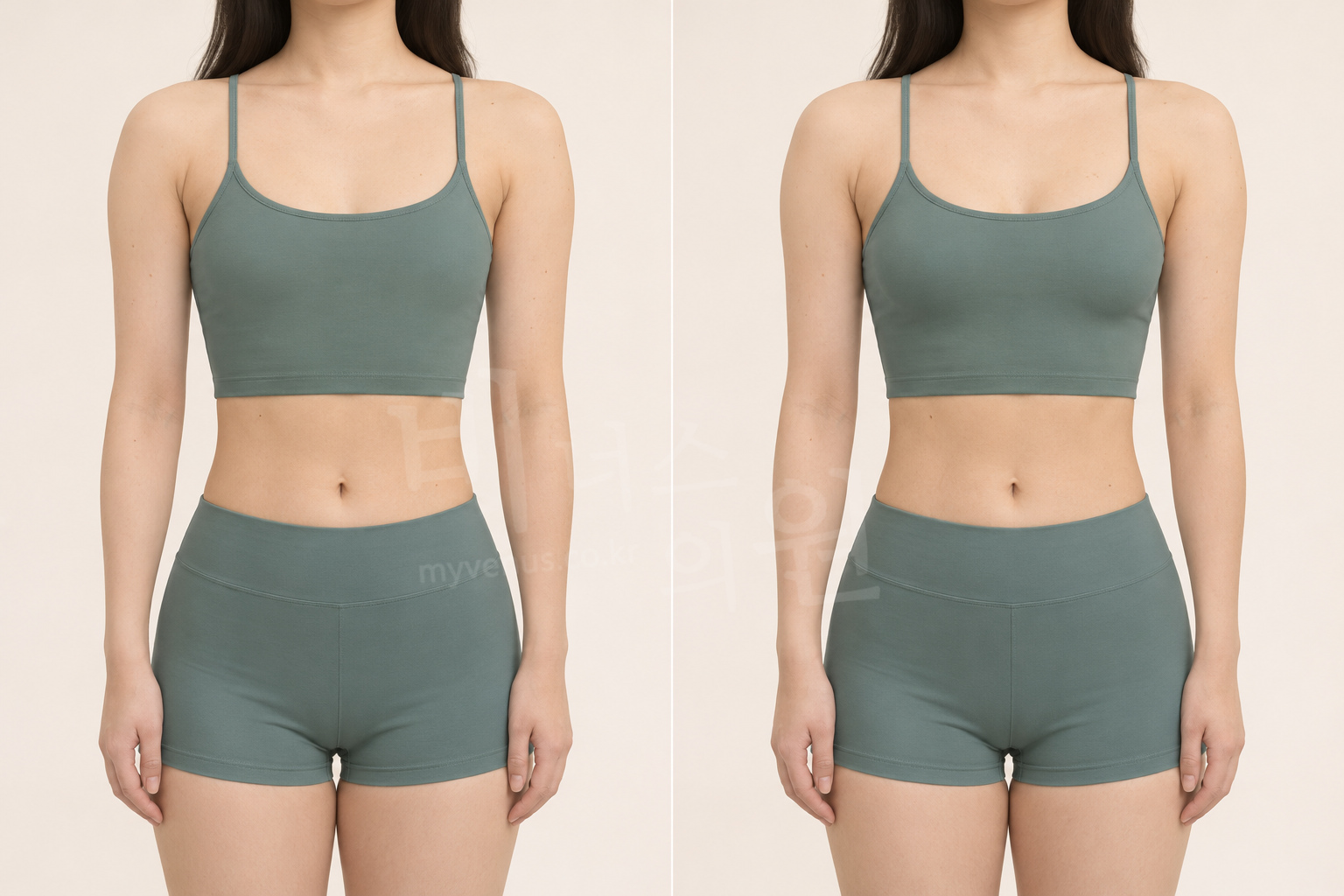
※ This is a virtual image. Actual results may vary by individual.
This is an example of volume added by fat grafting to a small breast. The left side is before grafting and the right side is an image assuming the state after additional grafting is completed, showing the volume of the breast increased slightly and naturally. In practice, it varies depending on the condition of the breast, the amount grafted, and the degree of absorption.
| Information on the Posted Virtual Before-and-After Example | |
|---|---|
| - Same person | A virtual drawing, not an actual patient photo (an example drawn of the same figure) |
| - Date taken | Not a photograph; a virtual drawing made for explanation |
| - Same conditions | Drawn with the same posture, size, and lighting |
| - Side effect information | https://en.myvenus.co.kr/should_know/38861 |
In Closing
Because part of the grafted fat is absorbed and how much remains differs from person to person, it is good to begin with the plan that additional grafting can be used to fill in as needed. At our Venus Clinic, additional grafting is done within 3 months using the fat set aside, and we recommend having a breast checkup before surgery. We will look together at the condition of your breasts and the look you want, and decide a reasonable direction at the consultation.
Dr. Hakjun Kim, Director, Venus Clinic