Liposuction for Correcting Breast Asymmetry
In consultations, we often hear patients say, "My breasts are different sizes, so choosing underwear and getting dressed is a hassle." Breast asymmetry is more common than many people think — to varying degrees, most women have breasts of slightly different sizes. When the difference is large enough to notice, however, it can cause everyday discomfort: the posture may look tilted to one side, or the larger side may feel heavier.
Today I would like to talk about liposuction for correcting breast asymmetry, which balances the two sides by suctioning fat from the larger breast. In particular, I will focus on how we decide "how much to remove to make both sides match" — not by eye, but by measuring the volume directly.

Visible Difference vs. Actual Volume Difference
The first thing to understand about correcting breast asymmetry is that the actual difference in volume is much larger than the difference you can see. This is because volume is proportional to the cube of length.
Volume Is Proportional to the Cube of Length
A cube with 1 cm sides has a volume of 1 cm3, but if each side is increased to 2 cm, the volume becomes 2 × 2 × 2 = 8 cm3. The length only doubled, yet the volume increased eightfold. The same holds for a sphere: its volume is V = 4/3 πr3, proportional to the cube of the radius.
A breast is not a perfect sphere or hemisphere, but if both breasts have roughly similar shapes, the same principle applies. In other words, even a small difference in a visible length, such as diameter or circumference, becomes a difference in volume that is cubed.

| Visible size (diameter) difference | Calculation | Actual volume difference |
|---|---|---|
| About 3% larger | 1.03 × 1.03 × 1.03 | About 9% larger |
| About 6% larger | 1.06 × 1.06 × 1.06 | About 19% larger |
| About 10% larger | 1.10 × 1.10 × 1.10 | About 33% larger |
| About 20% larger | 1.20 × 1.20 × 1.20 | About 73% larger |
As the table shows, a 10% size difference that looks only "a little bigger" in the mirror can actually mean a volume difference of about one third. Conversely, if fat is removed based on photos or eyeballing, the larger side is likely to be under-reduced, and asymmetry is more likely to remain after surgery. That is why at Venus Clinic we measure the volume of each breast directly before surgery.
Measuring Breast Volume Before Surgery
To measure volume, we use Archimedes' principle: when an object is immersed in water, water equal to its volume overflows. The method is simple.
Measurement Steps
① Place a graduated container inside a wide basin and fill it with water to the brim.
② Lean forward and immerse one breast in the water in the container.
③ Transfer the water that overflowed into the basin to a measuring cup and read the amount. This amount is the volume of that breast.
④ Measure the other side in the same way and compare the volumes of both sides.
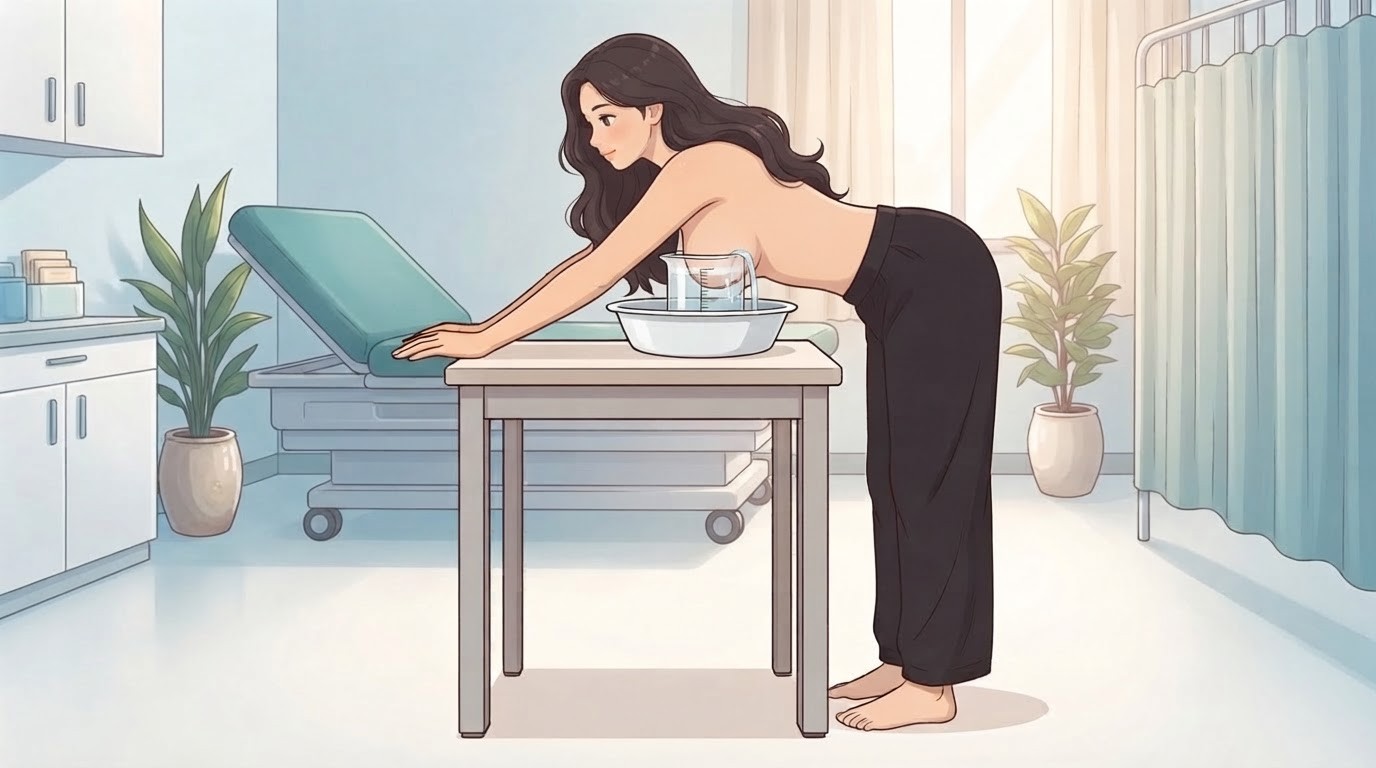
When the water that overflowed into the basin is poured into a graduated measuring cup and read, the volume of the immersed breast is given as a number in ml. Unlike eyeballing or photos, the difference between the two sides is recorded as a number, which makes comparison easy, and this number becomes the basis of the surgical plan. The measurement needs no special equipment — only water and a container — and it is painless.

The Measured Volume Determines How Much Is Suctioned
Suppose, for example, that the right breast measures 1,200 ml and the left breast 1,000 ml. Converted to diameter, the right side is only about 6% larger — a difference that looks "slightly bigger" — but in volume the difference is 200 ml.
| Side | Volume before surgery | Target suction volume | Volume remaining after surgery |
|---|---|---|---|
| Right (larger side) | 1,200 ml | 480 ml (40%) | 720 ml |
| Left (smaller side) | 1,000 ml | 280 ml | 720 ml |
If we plan to suction about 40% — 480 ml — from the larger side, we suction only 280 ml from the smaller side to match the remaining 720 ml. In this way, we plan so that the remaining volumes of both sides are equal on paper. For patients who want to correct only the size difference without greatly reducing overall size, it is also possible to suction only the difference, about 200 ml, from the larger side.
During surgery, we record the amount of fat suctioned from each side separately and work toward the predetermined target. However, because the aspirate contains not only fat but also the solution injected during surgery, we take this into account, and the actual suction volume may be adjusted depending on skin elasticity and the proportion of glandular tissue.
How Much Liposuction Can Reduce
What liposuction can reduce is the fat within the breast. At Venus Clinic, volume is reduced by about 40% on average, but the reduction may be smaller when there is a lot of glandular tissue, and reducing by more than 50% is difficult. In general, people with a higher degree of obesity also have more fat in the breasts, so the reduction tends to be larger. Results vary by individual.
The Goal Is Similar Size, Not Identical Size
Even with a plan based on measured volume, it is very difficult to make both breasts exactly the same size after surgery. Sometimes the fat in the breast cannot be suctioned as fully as planned, and sometimes the glandular tissue itself — which liposuction cannot reduce — is unevenly distributed between the two sides. In particular, if the larger breast has a higher proportion of glandular tissue than fat, it is difficult to suction the full planned amount. It is therefore more accurate to understand liposuction for breast asymmetry not as surgery that makes both sides completely identical, but as surgery that reduces a noticeable difference to make the breasts similar in size.
Size Can Change if Your Weight Changes
Even though liposuction reduces the number of fat cells, the remaining fat cells can grow larger again if you gain weight. Because the breast contains a lot of fat, breast size can increase along with weight gain after surgery, and if the amount of remaining fat differs between the two sides, the change may appear differently on each side. Pregnancy, breastfeeding, and age-related changes also affect breast size and shape. Managing your weight steadily after surgery helps maintain the corrected result for longer.
Advantages of Liposuction for Breast Asymmetry

The Glandular Tissue Is Not Cut Away
Excisional breast reduction removes skin and glandular tissue together, so the mammary glands may be damaged, which can affect future breastfeeding. Liposuction, by contrast, suctions the fat between the glands and does not cut away glandular tissue. For this reason, not only unmarried women planning marriage or childbirth but also adolescents whose breast development is complete may consider the surgery after a consultation together with a guardian. Breast asymmetry often becomes noticeable around puberty, and many people have worried about it since their school years, so it is meaningful that this is a method that can be chosen without worrying about future breastfeeding function.
Only Small Incisions Are Used
Because no tissue is cut away and the cannula is inserted through small incisions a few millimeters in size, no long incision lines are left around the breast or the areola. The incisions are placed in inconspicuous spots, such as the armpit crease or the fold under the breast, and most fade over time. Relatively quick recovery and easy post-operative care are further advantages.
The Surrounding Area Is Contoured Too, for a Natural Shape
People with breast asymmetry often have differences not only in the breasts themselves but also in the accessory breast tissue near the armpit and in the side line next to the breast. If only the breast is reduced, the volume near the armpit can stand out when viewed from the side and actually look awkward. Liposuction can contour the breast, accessory breast, the side area next to the breast, and the armpit as one continuous line, so a natural shape can be expected not only from the front but also in profile.
Before-and-After Photos
The two patients below received liposuction for breast asymmetry at Venus Clinic, and all post-operative photos were taken one week after surgery. Because swelling and bruising are still present at this stage, these are not the final results, and the shape changes a little further as the swelling subsides.
Case 1
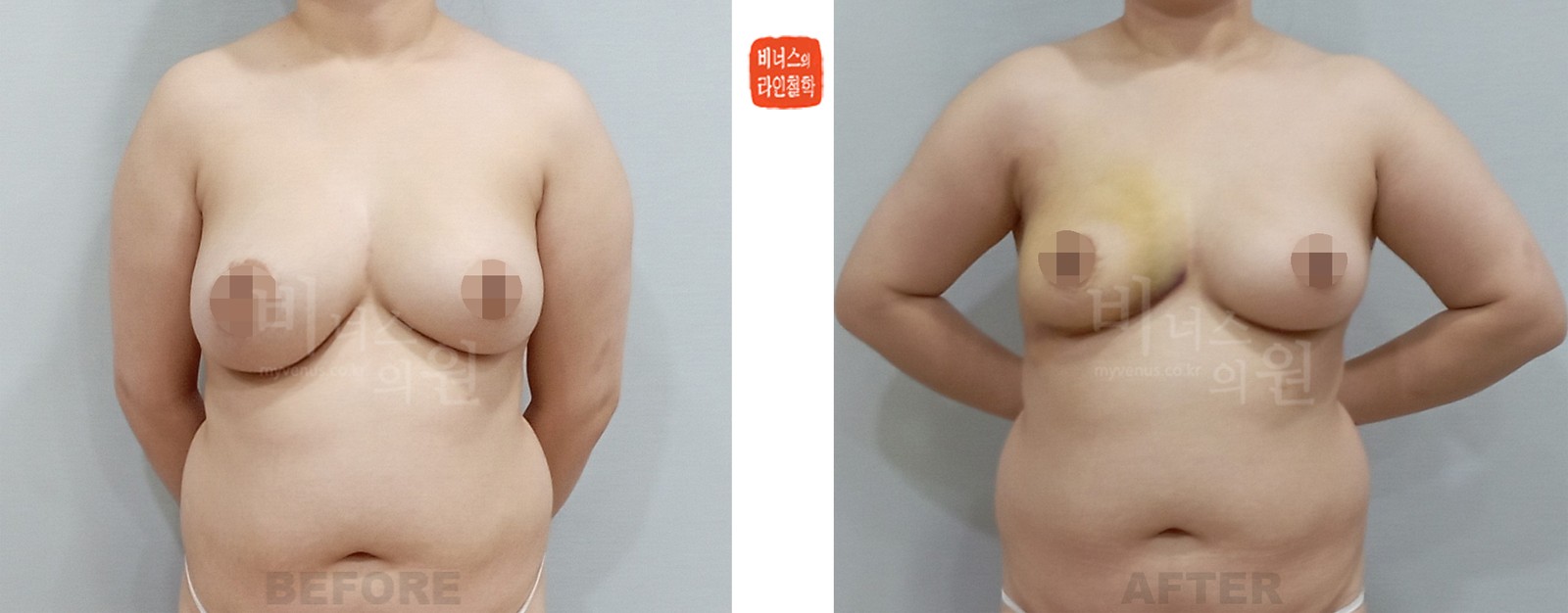
A case where the right breast is larger. Before surgery, the right breast was larger than the left and sagged lower, so the two sides differed noticeably in size and height. In the photo taken one week after surgery, in which more fat was suctioned from the right side, the two breasts have become similar in size. The yellowish bruise on the right breast is the bruising from right after surgery fading away, and it disappears with time.
| Information on the Posted Liposuction Before-and-After Photos | |||
|---|---|---|---|
| - Same person | Surgery performed at Venus Clinic; same person | - Date taken | Taken around January 2025; comparison at 1 week after surgery |
| - Same conditions | Edited to the same posture and size as closely as possible | - Side effects | https://en.myvenus.co.kr/should_know/38861 |
Case 2
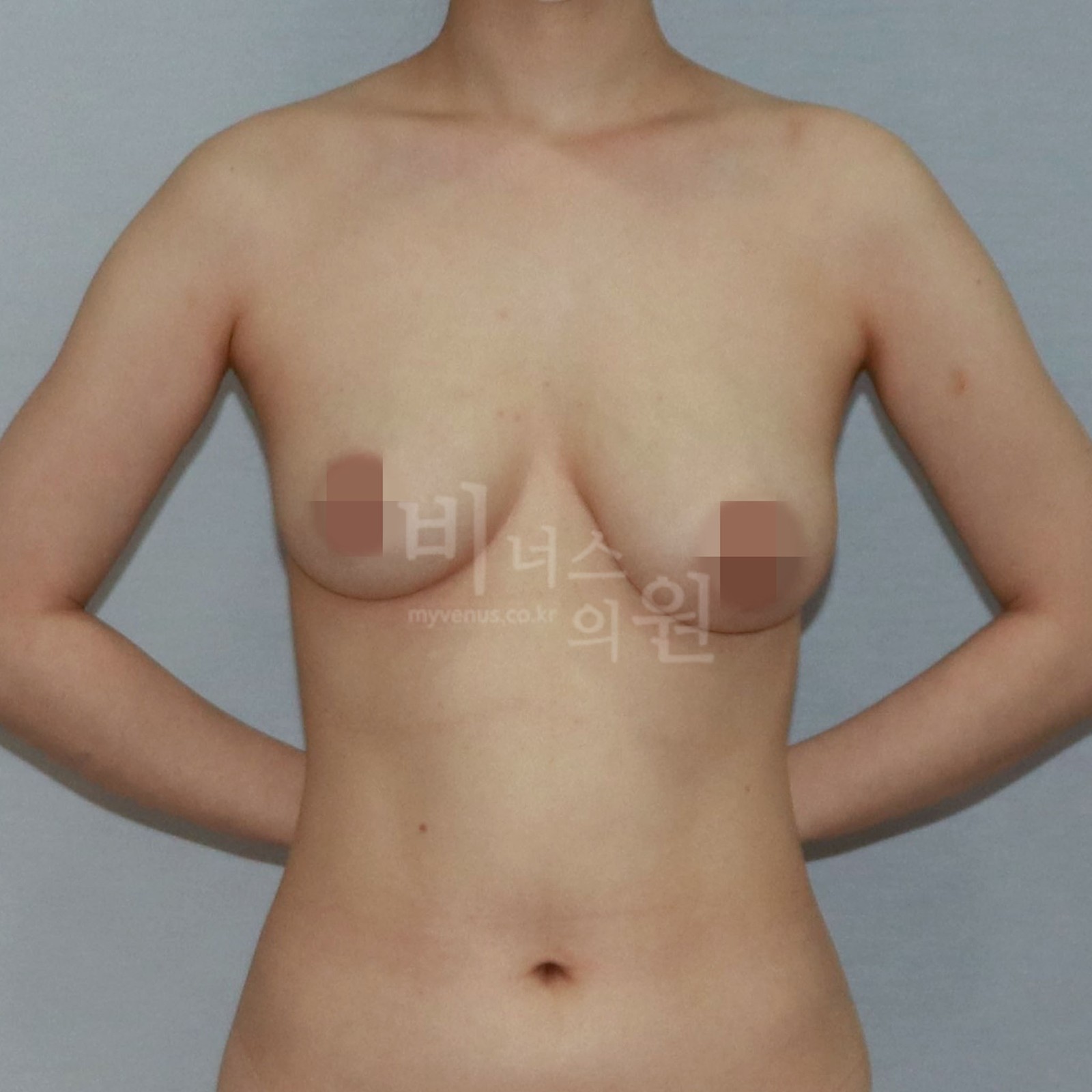
Before surgery — front
The left breast is larger and sags lower.
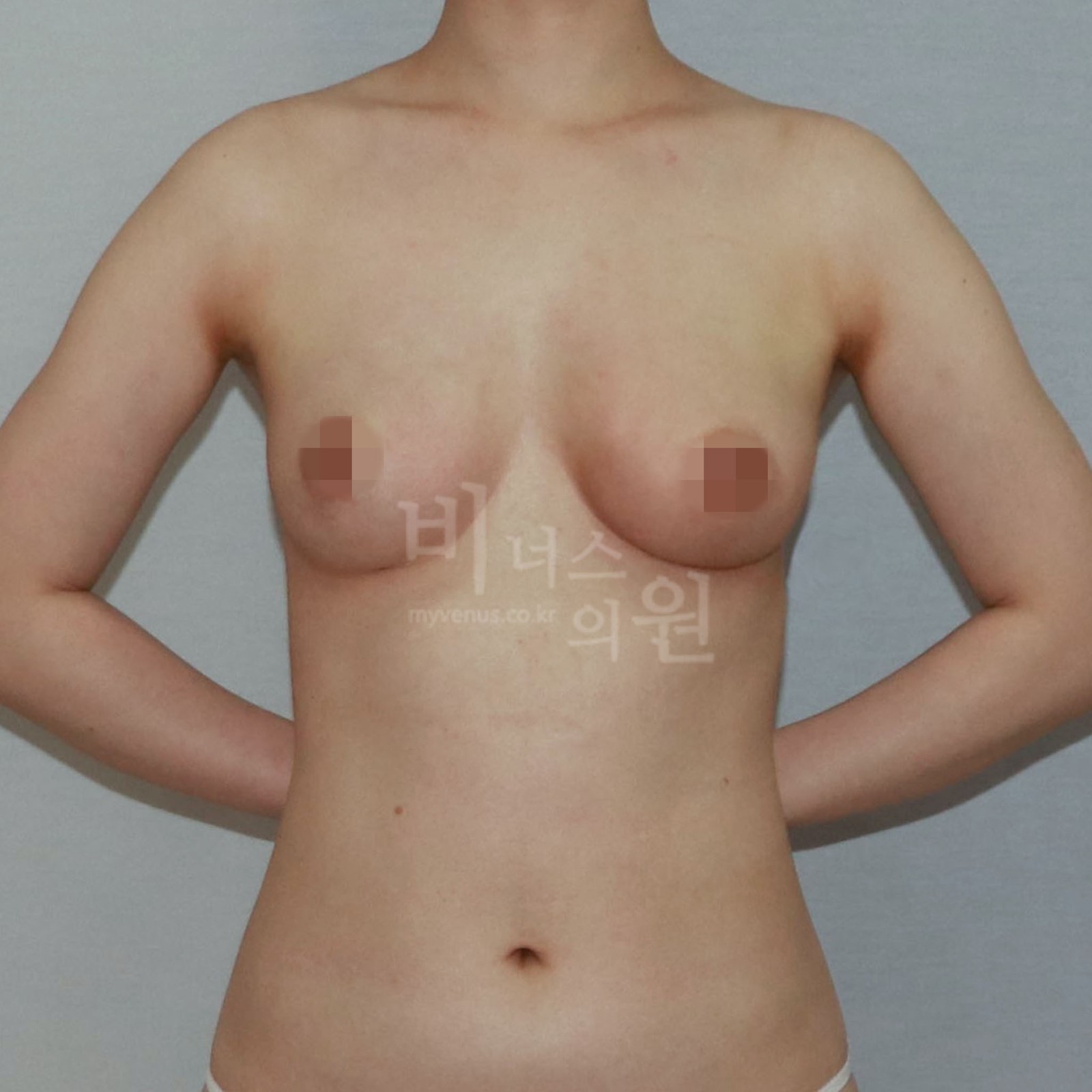
One week after surgery — front
The two breasts have become similar in size.
A case where the left breast is larger. Before surgery, the left breast was larger than the right and sagged, so the difference in volume between the two sides was clear. One week after surgery, the volume of the left breast had decreased and the two sides had become similar in size. As mentioned above, they are not exactly the same size, but the noticeable difference has been reduced, giving an overall more balanced appearance.
| Information on the Posted Liposuction Before-and-After Photos | |||
|---|---|---|---|
| - Same person | Surgery performed at Venus Clinic; same person | - Date taken | Taken around April 2018; comparison at 1 week after surgery |
| - Same conditions | Edited to the same posture and size as closely as possible | - Side effects | https://en.myvenus.co.kr/should_know/38861 |
In Closing
In correcting breast asymmetry, what matters most is not "how much to reduce" but "how much to reduce the difference between the two sides." Because a small difference in length becomes a cubed difference in volume, at Venus Clinic we measure the volume of each side directly before surgery and decide the suction volume based on that difference. I believe that planning based on measured numbers rather than eyeballing is the starting point of breast asymmetry correction.
Dr. Hakjun Kim, Director, Venus Clinic