Breast Fat Grafting ① Using Your Own Fat Instead of Implants — Who Is It Suited For, and How Far Can It Go?
During consultations, I often hear, "I'm hesitant about implants. Can't my breasts be filled with my own fat?" Many patients are troubled because their breasts are small, because the two sides differ in size, or because sagging has left the upper part looking hollow. An option for these patients is breast fat grafting, in which fat taken from another part of the body is transferred into the breasts.
This is the first of two articles. In order, I will explain how breast fat grafting differs from implants, who it may suit, where the fat is taken from, and how much can be placed in each breast and where the limits lie.

What kind of surgery is breast fat grafting?
Your own body fat is moved to the breasts
In breast fat grafting, fat is collected from an area that has fat, such as the abdomen, thighs, flanks, or upper arms, processed, and then placed into the breast in small portions through a thin cannula. Because collecting fat is part of the procedure, patients who want to fill the breasts and also reduce the area the fat is taken from can address both concerns at once. Syringe liposuction, the method used to collect the fat, is explained in detail in the article listed under References below.
How does it differ from implants?
The two methods differ in the material placed in the breast and in the preparation involved. This article does not cover implant surgery in detail; it only points out the parts that are compared with fat grafting. I am not saying that either one is better. The aim is to explain that the choice depends on the look you want and your physical condition.
| Item | Breast fat grafting | Implants |
|---|---|---|
| What is placed in the breast | Fat collected from your own body | An inserted device (implant) |
| Fat collection | Required — the contour of the collection area is also refined | Not required |
Another point to know is the number of sessions. Because part of the grafted fat is absorbed, the procedure is sometimes divided into stages until the desired size is reached. In a study comparing fat grafting with implants, nearly half (44.5%) of those who received fat grafting underwent a second procedure.[1]
Who may it suit?
When you want to fill out small breasts naturally
People who do not want implants, have small breasts, and want a moderate increase of about one cup size may be considered first. There are reports that injecting fat in several stages can increase size by more than one cup size.[2] However, how much the size can increase depends on how much the breast can hold, which is explained again below in "How much can be placed in each breast?"
Asymmetric breasts of different sizes
When the size or shape of the two breasts differs, adding more fat to the smaller side to reduce the difference can be considered. Because the fat is placed while the amount is measured precisely on the syringe markings, whether to place the same amount on both sides or a different amount on each can be decided according to the plan. Some patients are better suited to reducing the larger side to match, so the volume of both sides is assessed together at the consultation.
Sagging breasts with a hollow upper part
In some sagging breasts, the upper part has little volume and the whole breast has settled downward. In such cases, filling the upper part to give the side-view line a rounder appearance can be considered. However, fat grafting does not lift a sagging breast, so when sagging is significant, fat grafting alone has its limits. The degree of sagging and which method suits you can only be known accurately through an examination.
Where is the fat to be grafted taken from?
The amount needed and the areas you want to treat are considered together
For fat grafting, you first need to obtain as much fat as will be placed in the breasts. So when a large amount is needed, fat is taken from areas with sufficient fat such as the abdomen, thighs, and flanks; when a smaller amount is needed, fat collected by liposuction, including from the upper arms, is used. However, where and how much to collect is not fixed in advance. It is decided in a reasonable direction by looking together at what the patient wants (the area they wish to reduce) and their body type.
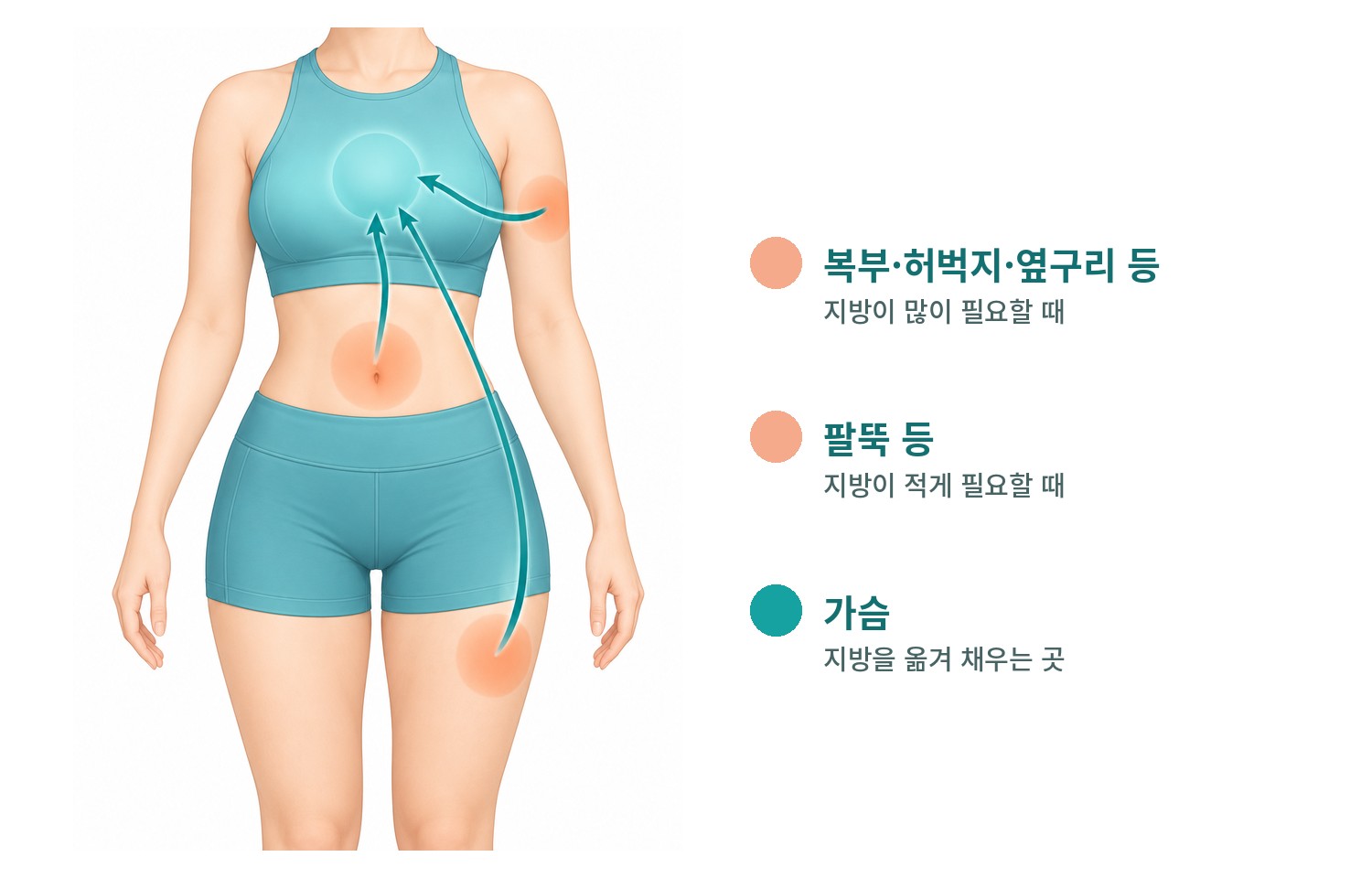
※ These are examples of collection areas. In practice, the areas are decided by looking together at the amount of fat needed, the areas you wish to treat, and your body type, and fat can also be collected from areas other than those marked in the illustration.
Areas to slim and areas to fill are addressed together
It is said that whether a particular collection area is better suited for grafting has not yet been established. However, clinical experience has also been reported in which fat from areas that respond poorly to diet and exercise is used as a guide for choosing the collection area.[2] At our Venus Clinic as well, we first ask at the consultation where you want to reduce and where you want to fill. The area where fat was collected is smoothed so that the line does not look bumpy.
How much can be placed in each breast?
The amount used at Venus Clinic and what the literature reports
At our Venus Clinic, about 200–300 mL is placed in each breast in breast fat grafting. This amount is similar to what is reported in the literature. A study summarizing 105 patients who underwent fat grafting for breast augmentation placed an average of 205 mL (120–250 mL) per side in one session, and reported that thin patients who received less than 150 mL per side because there was not enough fat to collect showed no clear improvement.[3]
Calculating the amount of fat needed
To place 250 mL in each breast, you need 250 × 2 = 500 mL of fat. With 60 mL syringes, 500 ÷ 60 ≒ 8.3, which means 9 or more syringes must be filled. This varies by individual.
The amount that can be placed depends on the condition of the breast
When the breast has little fat and is sagging so that there is room, a larger amount can be placed. Conversely, when that is not the case, there is a limit to how much can be placed. This is because placing more than the breast can accommodate does not increase the size by that much.
Academic sources also explain that the amount placed at one time is determined by the volume the recipient area can accept, and that if a large amount is clumped in one spot the center has difficulty surviving, so the fat must be divided into small units within 2–3 mm.[4] For this reason, rather than placing a large amount at once, small amounts are placed in several layers.
Limitations you should know about
It is difficult to reach the desired size in a single session
Breast fat grafting is not a surgery that reaches the desired size exactly in one session. Part of the grafted fat is absorbed, and the volume retention rate of breast fat grafting was reported in a systematic review as an average of 62.4% (44.7–82.6%).[5] However, this figure may vary depending on the measurement method. It also varies by individual, so additional grafting may be needed. This is covered in detail in the next article.
Thin patients may not have enough fat to collect
Because the fat to be grafted must be obtained from the body, it can be difficult to collect the desired amount from someone with little fat. As mentioned earlier, there is a report that improvement was not clear when less than 150 mL was placed per side, so we check at the consultation how much can be collected.
Lumps may be felt, and volume can change if your weight changes
All surgery carries the possibility of side effects. After breast fat grafting, lumps, oil cysts, and calcifications may develop, and they are checked by ultrasound.[6] If your weight changes significantly after surgery, the volume of the grafted fat may change as well.
References
- Gentile P. Breast implants or lipofilling in augmentation mammoplasty? A randomized, open-label, controlled trial. Aesthetic Plast Surg. 2026;50(3):1044-1056. (cited from Venus Clinic column 578377)
- Serdev N. Body Contouring and Sculpting. InTech; 2016. Chapter 10 (Fat Grafting in Body Contouring).
- Li FC, Chen B, Cheng L. Breast augmentation with autologous fat injection: a report of 105 cases. Ann Plast Surg. 2014;73 Suppl 1:S37-42.
- Shauly O, et al. Fat Grafting: Basic Science, Techniques, and Patient Management. 2022.
- Groen JW, Negenborn VL, Twisk JW, et al. Autologous fat grafting in cosmetic breast augmentation: a systematic review on radiological safety, complications, volume retention, and patient/surgeon satisfaction. Aesthet Surg J. 2016;36(9):993-1007.
- Shida M, Chiba A, Ohashi M, et al. Ultrasound diagnosis and treatment of breast lumps after breast augmentation with autologous fat grafting. Plast Reconstr Surg Glob Open. 2017;5(12):e1603.
Virtual Before-and-After Example
Because the breast is a sensitive area, this article does not include actual patients' before-and-after surgery photos. The image below is a virtual before-and-after example drawn to illustrate changes that may appear after breast fat grafting, and it may differ from actual surgical results.
Virtual Before-and-After Example — Front View
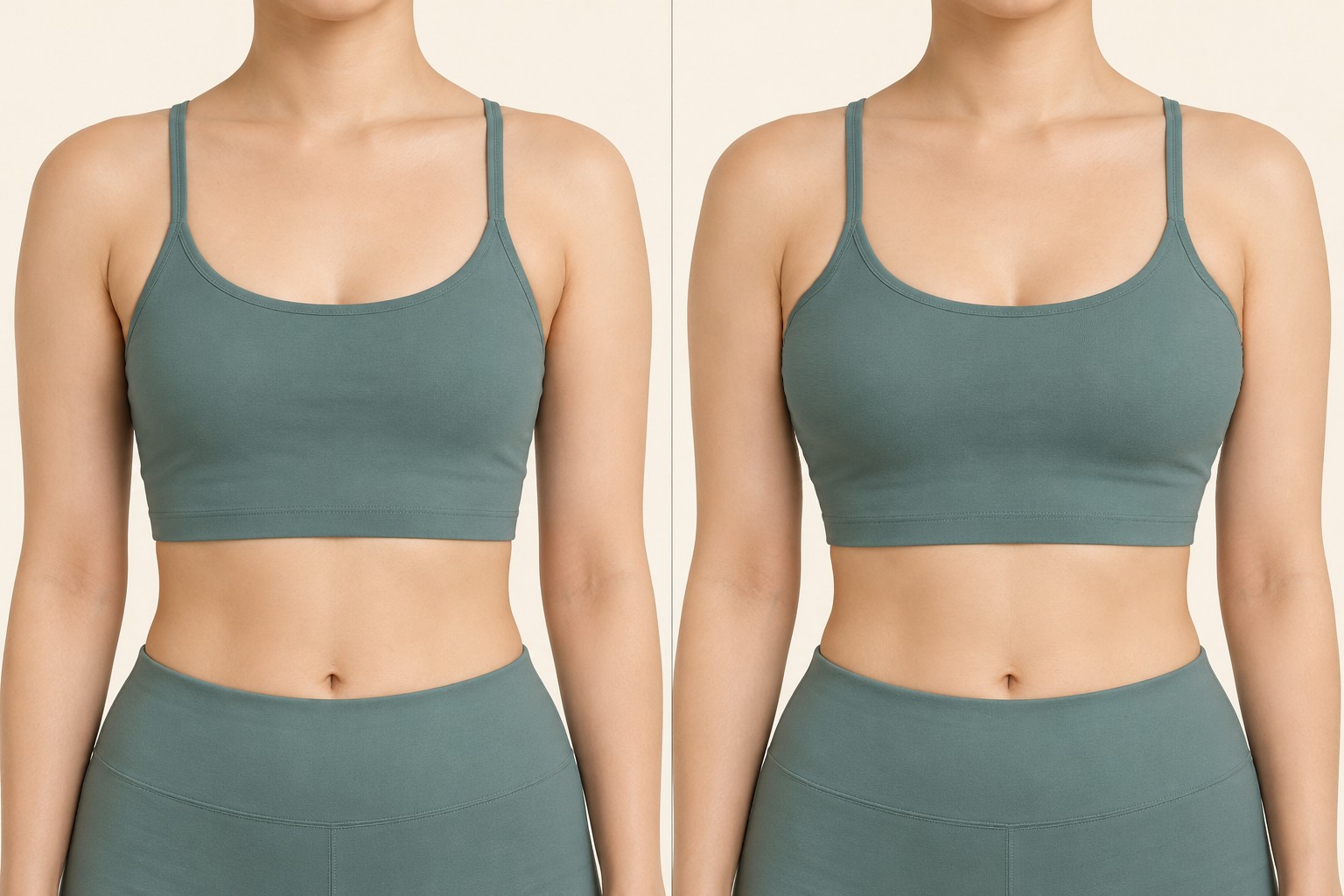
※ This is a virtual image. Actual results may vary by individual.
This is an example of volume added by fat grafting to a small breast. The left side is before grafting and the right side is an image assuming after grafting, showing a slight addition of volume to the upper part and front of the breast. In practice, it varies depending on the condition of the breast, the amount grafted, and the degree of absorption.
| Information on the Posted Virtual Before-and-After Example | |||
|---|---|---|---|
| - Same person | A virtual drawing, not an actual patient photo (an example drawn of the same figure) | - Date taken | Not a photograph; a virtual drawing made for explanation |
| - Same conditions | Drawn with the same posture, size, and lighting | - Side effects | https://en.myvenus.co.kr/should_know/38861 |
In Closing
Breast fat grafting is a method that fills the breasts with your own fat without implants and can also refine the contour of the area where the fat was collected. However, please choose it knowing that there is a limit to how much can be placed in each breast, and that because part of the grafted fat is absorbed, the procedure may be done in stages. At our Venus Clinic, we look together at the areas you want to reduce, the areas you want to fill, and the condition of your breasts, and decide a reasonable direction at the consultation.
The next article covers how the grafted fat settles in, absorption, and additional grafting. I will continue in "Absorption and Additional Grafting After Breast Fat Grafting — How Much Remains, and When Is It Refilled."
References: Breast Fat Grafting and Syringe Liposuction
Dr. Hakjun Kim, Director, Venus Clinic