Revision Liposuction: Classification by Type - case study
Liposuction has become one of the most commonly performed cosmetic procedures in Korea. However, like any surgical procedure, it carries the risk of side effects and complications, and the need for revision surgery appears to be increasing. Cases requiring revision liposuction can be classified into the following types:
- Desire for additional size reduction
- Body contour imbalance due to localized fat removal
- Surface irregularities caused by uneven fat removal
In my view, a successful liposuction procedure preserves an appropriate amount of fat tissue and, when combined with fat grafting, produces a smooth surface free of irregularities, with an overall natural, harmonious, and well-balanced body contour. Of course, minimal visible scarring, no complications, and a swift recovery further define an ideal outcome.
Patients seeking revision surgery often endure not only the physical consequences of side effects but also significant emotional distress from being unable to comfortably show their body. Most patients who visit Venus Clinic for revision consultations appear visibly distressed and harbor a deep mistrust of surgeons. Revision surgery is at least twice as challenging as the initial procedure. Yet seeing patients smile again and regaining their trust makes it a truly rewarding endeavor.
Revision surgery using liposuction and fat grafting can improve the current condition, but it cannot fully restore the original state. To approximate full restoration, twice the volume of fat would be needed for grafting, since the fat survival rate is approximately 50%. Therefore, the best way to avoid revision surgery is to thoroughly research and select a reputable clinic before the initial procedure.
1. Desire for Additional Size Reduction
Liposuction is a body contouring procedure that removes only the fat layer between the skin and muscle, and therefore has inherent limitations in terms of volume reduction. Excessive fat removal leads to complications such as skin-fascia adhesion, and since fat is removed through small perforations in the fat layer, complete elimination is neither possible nor desirable. The goal is to leave an appropriate amount of fat to create an aesthetically pleasing contour. When insufficient fat is removed, patients may be dissatisfied with the degree of size reduction.
The solution is relatively straightforward: additional fat can be removed through a revision procedure.
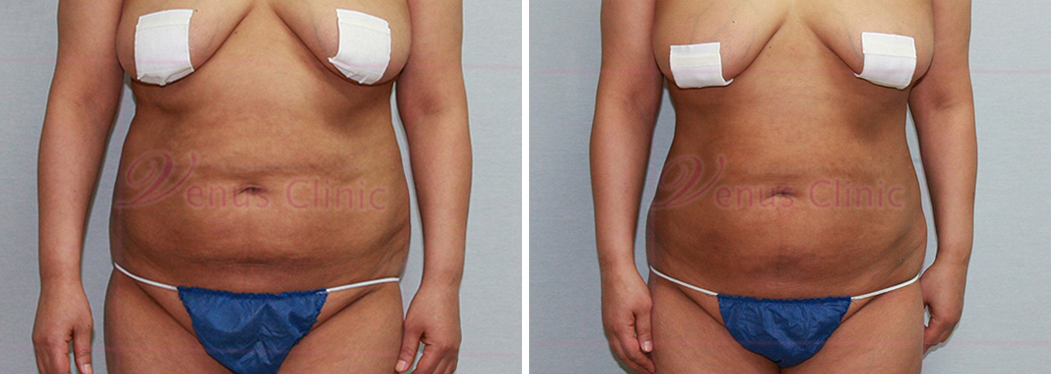
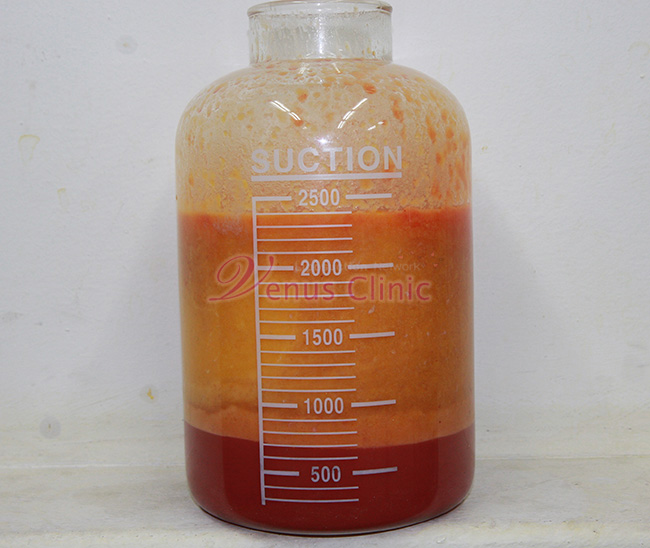
The patient shown above underwent revision abdominal liposuction at Venus Clinic. Despite being a revision procedure, 1,700 ml of pure fat was removed. The most challenging areas in abdominal liposuction are the infra-mammary region and upper abdomen. In this case, residual fat was present throughout the entire abdomen, with the upper abdomen being particularly affected.
2. Body Contour Imbalance Due to Localized Fat Removal
This is the most common reason for revision liposuction. Patients who would have benefited from comprehensive liposuction often undergo only partial treatment due to cost considerations or other reasons, resulting in a noticeable difference in fat layer thickness between treated and untreated areas that creates an unnatural body contour.
The solution is to undergo comprehensive liposuction that includes the previously treated areas. Consequently, having partial surgery initially can end up being more costly overall.
While it is possible to treat only the previously untreated areas, in many cases a comprehensive approach is preferred when considering incision site placement and optimal aesthetic outcomes.
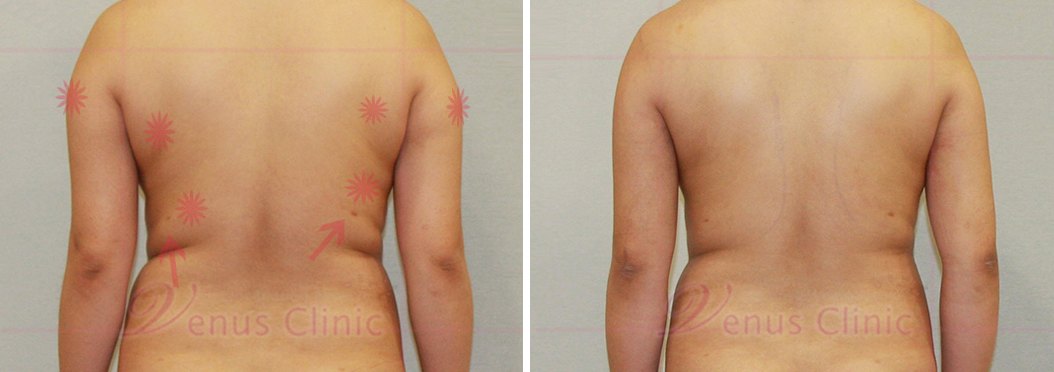
The patient above had previously undergone inner arm and back liposuction at another clinic. The arrows on the back indicate the incision sites from the initial surgery, while the markers highlight residual fat on the outer arms and back that created an unbalanced contour. Venus Clinic does not create additional incisions on the back.
After revision liposuction of the arms and back, a natural body contour was restored. Additional flank liposuction would further enhance the posterior appearance.
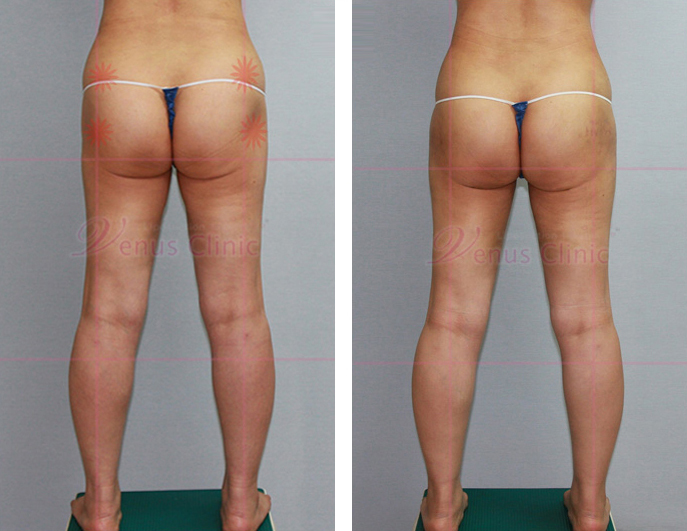
The patient above experienced depressions in the hip area and over-reduction of the outer thighs due to excessive liposuction of the upper hips and lateral thighs, resulting in an unbalanced contour. Buttock reduction liposuction combined with fat grafting to the hip region restored a more natural body shape.
3. Surface Irregularities Caused by Uneven Fat Removal
This is the most challenging type of revision liposuction. These patients typically present with an unbalanced body contour, uneven fat layer thickness across different areas, residual fat in some zones, and adhesion between the skin and muscle fascia in areas where fat was excessively removed.
Surgeons who are less experienced in liposuction often struggle to achieve uniform fat removal, leading to these results. For less experienced practitioners, it is safer and more effective to leave some fat rather than to attempt aggressive removal.
The treatment approach involves selective liposuction of areas with residual fat, followed by adhesiolysis (release of adhesions) in the over-suctioned areas to create a space, and then fat grafting into that space. This makes the revision surgery technically demanding, and achieving a completely smooth result remains difficult.
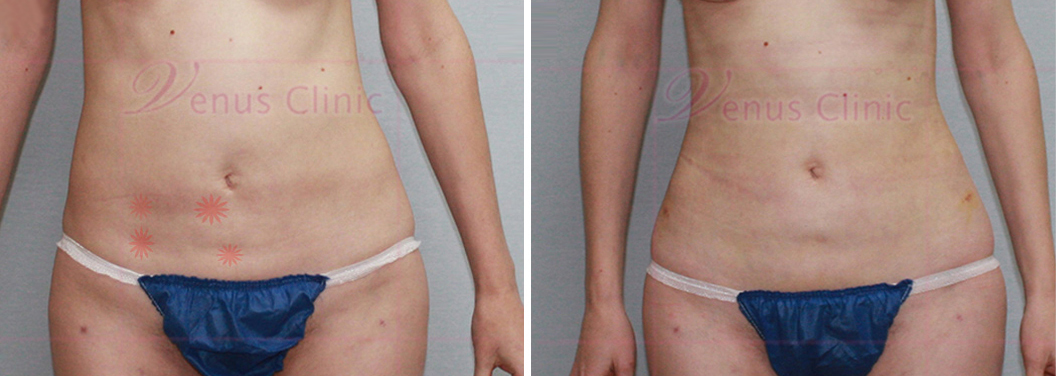
Uneven liposuction of the lower abdomen caused depressions and adhesion between the skin and abdominal muscle. After adhesiolysis and fat grafting into the released space, the contour was significantly improved.
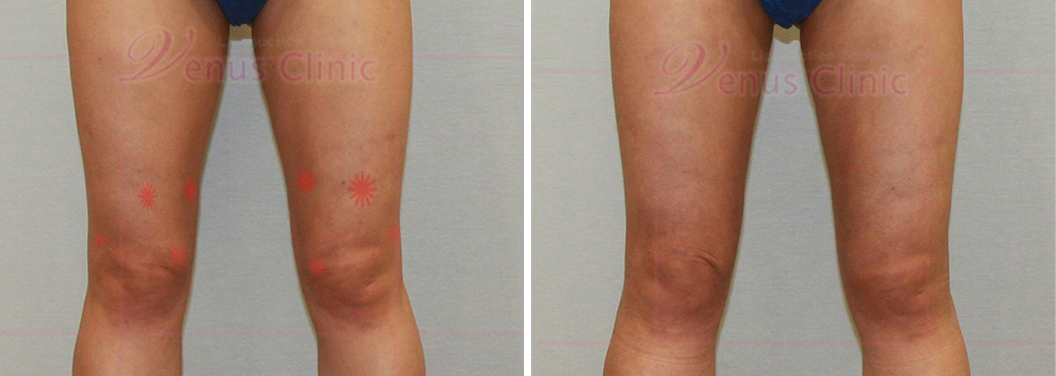
This case demonstrates uneven, excessive fat removal from the suprapatellar area and inner thighs, resulting in surface irregularities on the anterior thighs. The medial thigh contour and suprapatellar region were improved through liposuction of the protruding areas and fat grafting to the depressed areas.
| Information on the Posted Liposuction Before-and-After Photos | |||
|---|---|---|---|
| - Same person | Surgery performed at Venus Clinic; same person | - Date taken | Taken around 2011; comparison at 1 month after surgery |
| - Same conditions | Edited to the same posture and size as closely as possible | - Side effects | https://en.myvenus.co.kr/should_know/38861 |