Revision Surgery for Buttock Ptosis and Double Infragluteal Creases - case study
As mentioned previously, there are various scenarios that may require revision buttock liposuction.
Related Articles
Revision of Thighs and Buttocks Buttock Volume-Up Liposuction
Among these, the problematic cases are double infragluteal creases and buttock sagging, or ptosis (buttock ptosis).
When double infragluteal creases and buttock sagging are present, the thighs look shorter and the buttocks look longer, so the whole lower body appears shorter. This is why revision buttock volume-up liposuction can be a worthwhile procedure.
Buttock ptosis, or buttock sagging, is when the lower border of the buttock (the edge of the sagging buttock tissue) sits below the original infragluteal crease, so that the buttock hangs down below the crease. Because the sagging buttock covers and hides the original crease, many people mistake the edge of the sagging buttock for the buttock crease. After buttock liposuction, the size and weight of the buttock decrease and the skin contracts, so the ptosis improves: the lower border of the buttock rises above the crease, the buttock becomes shorter and the thigh longer, and the thighs look longer.
Degrees of Buttock Sagging — Degrees 0 to 4 Using the T-Line and the M-Line
How far the buttock has sagged is graded by looking from behind at how far the crease under the buttock extends and whether there is sagging tissue below it. Buttock sagging usually starts on the inner side and progresses outward, so the farther the crease extends outward, the more advanced the sagging. Two vertical lines serve as the reference: the T-line and the M-line.
The Two Vertical Lines
T-line — Feel under the buttock to find the ischial tuberosity (the bone that touches the seat when you sit), then draw a vertical line straight down from that point. It is the inner dotted line in the figure below, and the blue dot is the ischial tuberosity.
M-line — A vertical line parallel to the T-line that runs through the middle of the back of the thigh. It is the outer dotted line in the figure.
Both lines are set while standing upright and relaxed, without pushing the buttocks forward or backward, with the entire back of the thigh visible.
| Degree | Condition |
|---|---|
| Degree 0 | No sagging — there is no crease, or the crease reaches only to the T-line |
| Degree 1 | Mild pre-ptosis — the crease passes the T-line but does not reach the M-line. There is no sagging tissue at the T-line |
| Degree 2 | Moderate pre-ptosis — the crease reaches the M-line, and there is sagging tissue at the T-line |
| Degree 3 | Borderline — the crease extends slightly past the M-line, but there is still no sagging tissue at the M-line. Many people begin to feel that their buttocks are sagging at this stage |
| Degree 4 | True ptosis — there is sagging tissue at the M-line, and buttock tissue comes down past the crease to cover the top of the thigh. The amount of descent is measured in centimeters |
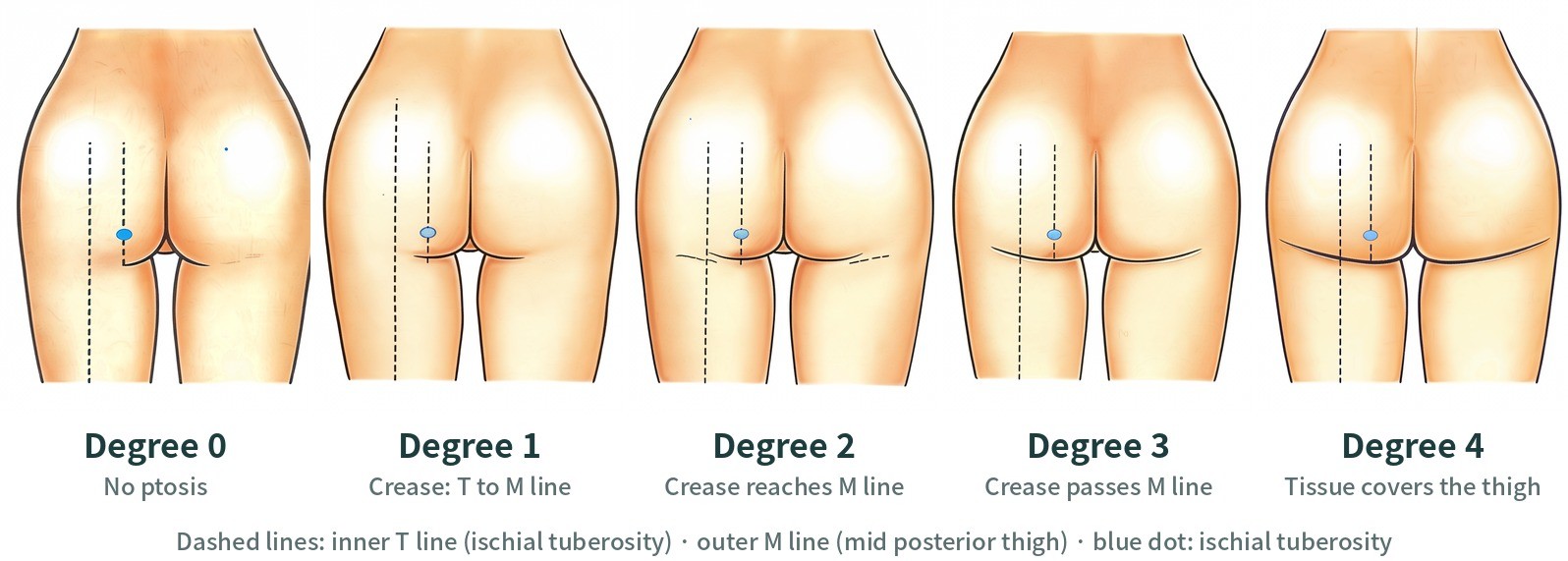
From left: Degree 0 · 1 · 2 · 3 · 4 — the crease under the buttock extends from the T-line to the M-line and beyond, and at Degree 4 sagging tissue covers the thigh
Textbooks call it “ptosis” only when buttock tissue has descended below the crease at the M-line (Degree 4), and refer to the earlier stages (Degrees 1 to 3) as “pre-ptosis.”
The Lower Border of the Buttock Is the Buttock Fold, Not the Crease
For convenience, the table above says that “the crease gets longer,” but in a sagging buttock the line that appears to separate the buttock from the thigh is not the original infragluteal crease. It is the lower edge of the buttock fold, where stretched buttock tissue (skin and fat) has folded down.
The original crease is where the skin is firmly attached to the deep tissue, so it always stays in the same place. When sagging develops, the buttock fold comes down past this crease toward the thigh and covers it, and its lower edge meets the thigh so that it looks like a long, deep crease. When the sagging progresses sideways, the edge of the buttock fold extends far out toward the outer thigh, and people feel that “the crease under the buttock is long.”
So when buttock volume-up liposuction reduces the volume and weight of the buttock fold and the skin contracts, the lower edge of the buttock fold rises above the crease: the boundary line that looked long becomes shorter or disappears, and the original crease that had been hidden is revealed.
The revision classification described below (Grade I to IV) is Venus Clinic’s own revision classification, which looks at the degree of sagging together with whether double creases are present. It is a different standard from Degrees 0 to 4 above.
The Crease, the Border of the Buttock Fold, and a Double Crease Are Different
What people confuse most often in buttock revision consultations are the lines under the buttock. People with buttock ptosis often mistake the edge of the sagging buttock for the buttock crease, and some think that the original crease revealed after volume-up surgery is a double crease. The lines seen under the buttock should be distinguished into the following four types.
① The original crease
The horizontal crease that everyone has between the buttock and the thigh. It is where the skin is firmly attached to the deep tissue, so it always stays in the same place. When there is buttock ptosis, it is covered by the sagging buttock and cannot be seen.
After surgery: It is revealed as the buttock rises.
② The border of the buttock fold
The line where the edge of the buttock that has descended below the original crease (the lower border of the buttock) meets the thigh. It looks like a crease, but it is not a crease — it is the end of the sagging buttock.
After surgery: It becomes shorter or disappears as the buttock volume decreases and the skin contracts.
③ A newly formed crease
A line that did not exist before surgery.
After surgery: When the buttock rises above the original crease, a new boundary between the buttock and the thigh forms above it. The original crease remains below it as a faint trace.
④ A double crease
A second horizontal crease that forms below the original crease. It can form when the upper back of the thigh just below the crease is over-suctioned or when the ligaments supporting the buttock are damaged, so that excess skin folds over; once it forms, it is not easy to correct. It is the subject of the revision surgery discussed on this page.
Three Ways the Crease Appears After Volume-Up Surgery
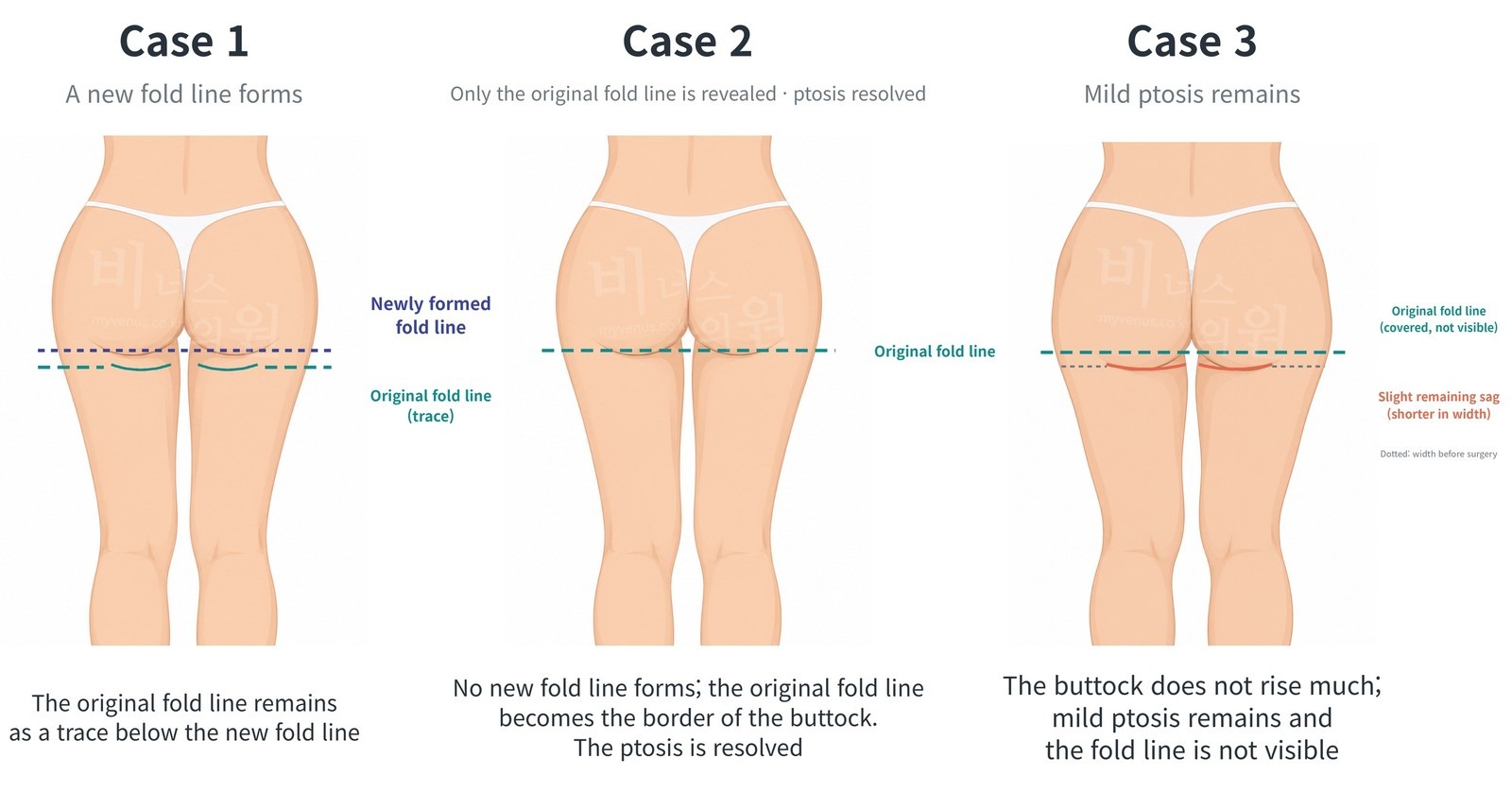
Three appearances of the crease after surgery
Case 1 is when the buttock rises above the original crease, a new crease forms, and the original crease remains below it as a trace. Case 2 is when no new crease forms and the original crease itself becomes the boundary between the buttock and the thigh. Case 3 is when the buttock does not rise very much, so a little ptosis remains and the crease cannot be seen. Which case applies depends on the degree of sagging and the elasticity of the skin, and varies from person to person.
Seeing Two Lines Does Not Always Mean a Double Crease
When two lines are seen after volume-up surgery, as in Case 1, it is because the buttock has risen and a new crease has formed above the original crease, revealing the original crease that had been hidden. It means the buttock has risen, and it is different from a double crease, in which a second crease forms below the original crease.
Read more: How the Buttocks Rise: The Mechanism [Case Review] Exposure of the Fold Line Beautiful Buttock Shape and Buttock Ptosis
▶ Also read Why Double Creases Form After Buttock Liposuction (in Korean)
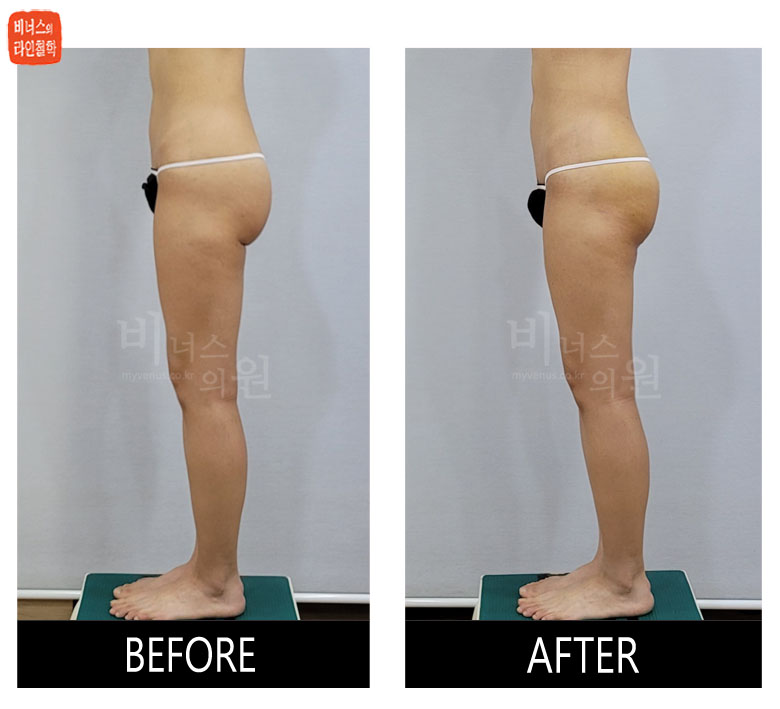
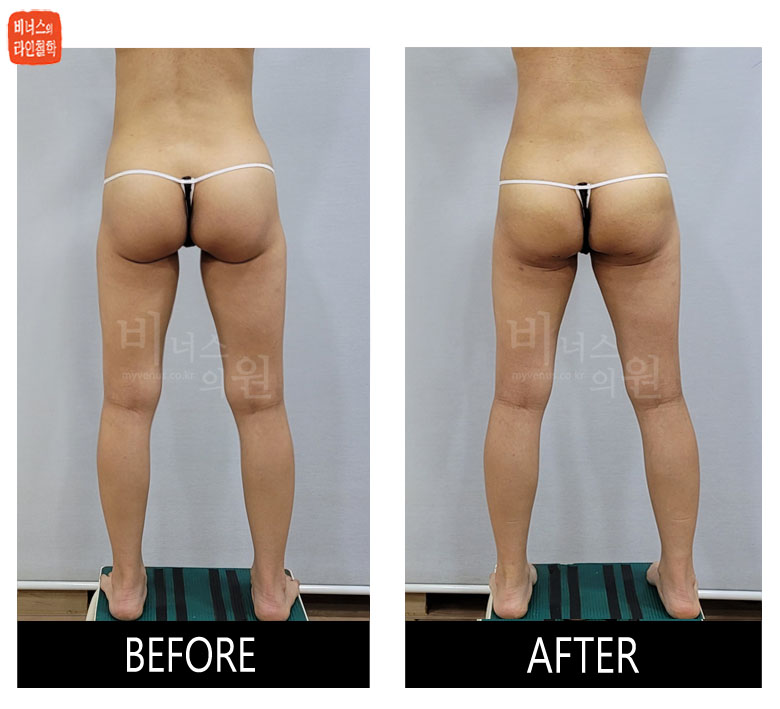
However, the original crease that had been hidden by the sagging buttock may become exposed as the sagging resolves, although it becomes shallower. The original crease under the buttock can become deeper the more the buttocks are pushed forward, and creases form with movement, so it cannot fundamentally disappear. That is why an exposed original crease can be made shallower with fat grafting but cannot be eliminated. In other words, buttock liposuction improves buttock sagging, but the crease exposed by the raised buttock cannot disappear, so after surgery you should keep an upright posture, like standing at attention, so that the buttock crease does not deepen.
Based on patients treated at Venus Clinic, those requiring buttock revision surgery can be classified into the following grades:
- Grade I: Buttock ptosis only (typically occurs when liposuction was performed only on the thighs, causing the buttocks to appear relatively larger)
- Grade II: Double infragluteal creases due to damage of the buttock-supporting ligaments, without buttock sagging (ptosis)
- Grade III: Double infragluteal creases with mild buttock sagging (ptosis) due to damage of the buttock ligaments (1 cm or less)
- Grade IV: Double infragluteal creases with moderate or greater buttock sagging (ptosis) due to damage of the buttock ligaments (1 cm or more)
At Venus Clinic, Grade I and Grade II cases can be nearly fully restored. Grade III and Grade IV cases are practically difficult to restore completely, but some degree of improvement is achieved in many cases. To repeat, buttock ptosis is improved by liposuction, but buttock creases arise with movement and posture and therefore cannot disappear. In particular, fat grafting for a double crease that formed after thigh liposuction can make it shallower, but you should understand that it can fundamentally reappear when the buttocks are pushed forward.
Grade I


Grade II


Grade III


Grade IV


| Information on the Posted Liposuction Before-and-After Photos | |||
|---|---|---|---|
| - Same person | Each before-and-after set compares the same person before and after surgery at Venus Clinic | - Date taken | Taken in 2014 and 2026 |
| - Same conditions | Edited to the same posture and size as closely as possible | - Side effects | https://en.myvenus.co.kr/should_know/38861 |
※ Side effects: Bleeding, infection, hematoma, skin irregularities, sensory changes, pigmentation, swelling, etc. may occur, and results vary between individuals.