[Case Review] Calf Liposuction
In the clinic, I often hear the question, "My calves are thick and I don't like wearing skirts. Can liposuction make them slimmer?" Unlike the thighs or abdomen, the calf is not an area where fat accumulates thickly, so even with the same liposuction, it has to be approached much more carefully. Patients also have more to manage afterward, including swelling, bruising, and compression garment care.
In this article, I will explain why calf liposuction is a demanding procedure in the order of fat layer structure, swelling and bruising, and compression garment care. I will also explain why we classify calves as muscular, fatty, or mixed type, and cases in which the area around the knee is treated together. At the end, I will show 10-day post-operative photos of a patient who had calf and inner knee liposuction together with calf Botox injections.

Why the Calf Is a Demanding Area for Liposuction
Uneven fat distribution in the calves is usually determined by genetics, and in many cases it does not change with exercise or dieting alone. That does not mean liposuction is easy in this area, however. The two reasons below are the main ones.
The fat layer is a single layer, so the surface can easily become uneven
The fat layer of the calf is a single layer. Unlike areas where the layers are separate and can be refined step by step, the difference between treated and untreated spots tends to show right away on the skin surface. In addition, the calf is curved, which makes it hard to move the cannula consistently. For this reason, at Venus Clinic we first assess the degree of calf muscle development and the thickness of the fat layer carefully, and then perform the procedure delicately with a thin cannula[1]. It has been reported that using a thin cannula (microcannula) considerably reduces the problem of surface irregularities[3]. Contour irregularities, hematoma, and nerve injury are listed as complications of calf liposuction, and precise technique, controlled suction, and avoiding aggressive suction of overly superficial layers are summarized as ways to reduce them[2].
We check the thickness of the fat layer first
For the calf, liposuction is considered meaningful only if the pinched skin fold is at least about 1 cm thick[1]. If the fat layer is thinner than that, there is not much that suction can reduce, and we tell you so at the consultation first.
As the fat layer thins, the shape of the muscle shows
Liposuction refines the line by leaving a consistent thickness of fat, so the result follows the skeletal and muscular shape the person already has. In the calf in particular, it is the muscles of the calf and ankle that determine the silhouette, so reducing a lot of fat does not necessarily make a big difference in photos. Also, if too much is removed, the shape of the muscle shows through and the leg can end up looking like a masculine, muscular calf[1].
Muscle may look more prominent after surgery
Even when an appropriate fat layer is left, the fat layer covering the muscle becomes thinner after calf liposuction, so the outline of the calf muscle that was hidden by fat may show and look more prominent. It is especially visible when the muscle tenses, such as when standing on tiptoe or walking. We recommend that you decide only after knowing in advance that, along with the legs becoming slimmer, the muscle shape may be more noticeable than before. If the calf is muscular, we also discuss combining Botox injections.
An Area Where Swelling Lasts Long and Bruises Easily
The calf is below the level of the heart and is on its feet for most of the day. After liposuction, plasma protein leaks from damaged capillaries and subcutaneous lymphatic function is partly reduced, so some swelling occurs in any area[4]; in the calf, gravity makes this swelling tend to pool in the lower part. The literature calls this kind of swelling "dependent edema"[6]. That is why the calf is an area where swelling lasts long, recovery is slow, and bruising occurs easily[1].
How long do swelling and bruising last
After liposuction, bruising usually fades within 1 to 2 weeks and swelling continues for several weeks, and the final contour is said to be visible only after the swelling has fully settled[5]. In an area like the calf, where swelling lasts long, this period is even longer. However, the numbers differ from one report to another, so please use the table below only as one reference.
| Item | Reported findings | Source |
|---|---|---|
| Bruising and swelling | Bruising usually fades within 1 to 2 weeks, and swelling lasts for several weeks. | [5] |
| Final result in the calf | Because of dependent edema, the final result may become clear only after 6 to 12 months. | [6] |
| Liposuction in general | It can take up to 6 months after surgery for the swelling to settle and the final result to be assessed. | [10] |
| Calf compression stockings | Some reports recommend 30 to 45 mmHg medical compression stockings for up to 6 to 8 weeks, and another reports wearing them during the day for 30 days for the knee, calf, and ankle. | [6] [7] |
The time frame differs from person to person
The numbers above are values reported in different studies, and actual recovery speed varies from person to person depending on the extent of surgery, the amount of fat removed, how prone you are to swelling, compression garment use, and daily care. On days when you have to stand for a long time, swelling and pain may last longer, so we recommend keeping your legs raised above heart level when resting.

The Compression Garment Covers Everything Except the Toes
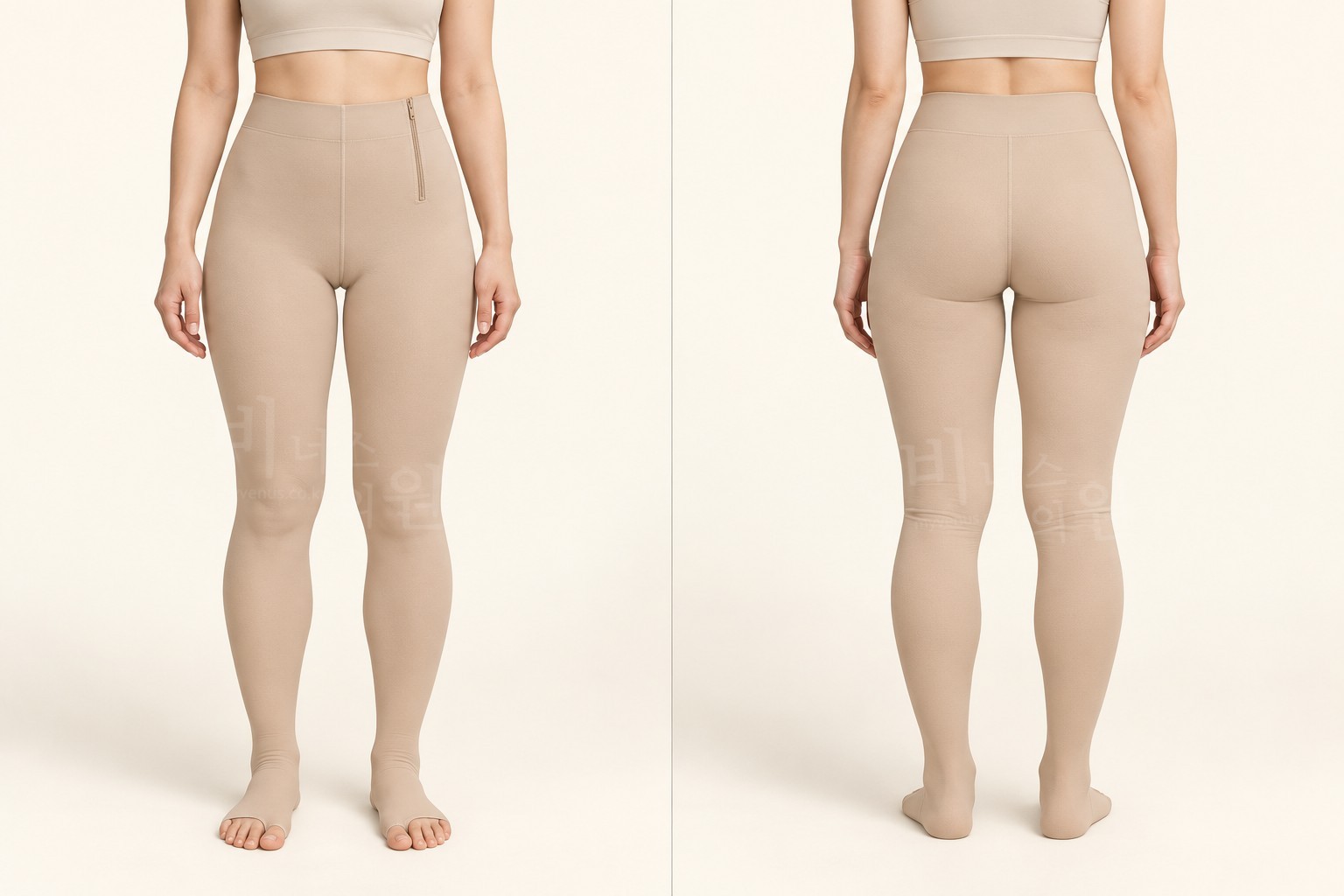
The compression garment after calf liposuction is harder to manage than for other areas. At Venus Clinic, we advise patients to wear a one-piece compression garment that runs from the instep up to the abdomen, leaving only the toes uncovered.
Many patients wonder why they have to wear it up to the abdomen when the surgery was on the calves. If the garment stops at the thigh, it encircles and squeezes the leg where it ends near the thigh, and blood circulation is poor at that spot. So we have you wear a garment that reaches the abdomen so that no constricting edge forms on the leg, and for this reason, compression garment care is demanding even for a calf procedure.
Even pressure rather than strong pressure
Leg swelling caused by venous disease is managed with graduated compression, which is tightest at the ankle and weaker toward the top. In contrast, localized swelling after liposuction is said to be largely preventable with even compression rather than graduated compression[8]. On the other hand, excessive compression on a limb can cause problems such as venous thrombosis, so the aim of compression is not to squeeze as hard as possible but to maintain appropriate pressure evenly[9]. Please check that the garment is not folded or squeezing only one spot, and contact us right away if your toes change color or the numb feeling is severe.
The hard parts of the care
You need to keep wearing a garment that reaches the abdomen for several weeks, and going to the bathroom and putting it on and taking it off are also troublesome. Your choice of shoes and pants is limited, and it is more uncomfortable in hot seasons. When considering calf liposuction, we recommend thinking not only about the surgery itself but also about whether you can manage this post-operative care period in your daily life.
For the First Month After Surgery, Avoid Standing or Walking for Long Periods
Daily-life care matters as much as the compression garment. The calf is below the level of the heart, so swelling tends to pool downward while you stand or walk, and for the first month after surgery, please avoid standing or walking for long periods. If your work involves long hours on your feet or you have a schedule with a lot of walking, please take that into account when choosing your surgery date, and we recommend keeping your legs raised above heart level when resting.
Muscular, Fatty, Mixed Type: The Approach Differs by Type
Even "thick calves" have different causes. What can be expected from liposuction differs depending on whether the thickness comes from fat, muscle, or both, so we sort out this type before surgery. This is because liposuction treats only the fat layer and does not reduce the volume of the muscle.
| Type | Characteristics | Relation to liposuction |
|---|---|---|
| Fatty type | The fat layer is thick when pinched and the muscle volume is not large | There is fat that can be reduced, so the change from liposuction may be relatively clear. |
| Muscular type | The fat layer is thin and the calf looks thick because the muscle is well developed | There is little fat to reduce, so the change from liposuction is not large. We discuss combining Botox injections, which act on the muscle. |
| Mixed type | There is a fat layer and the muscle is also well developed | We consider handling the fat with liposuction and the muscle with Botox injections. |
For the muscular type, Botox injections can be combined
In muscular or mixed-type calves, liposuction alone may produce only a small change, so at Venus Clinic we advise that calf Botox injections can be combined. Botox is an injection that acts on muscle rather than fat, so we discuss it as a way to address the part where muscle is the cause of the thickness. Which method is suitable can be explained only after we feel the calf directly and measure its thickness.
When the Area Above the Knee and the Inner Knee Are Treated Together
When discussing calf liposuction, many patients are concerned about the line of the whole leg. In some cases, we treat the area above the knee and the inner knee together. If fat built up on the inner knee protrudes, the line from the thigh to the calf can look interrupted, and refining this area may change how continuous the leg line looks. Knee liposuction is one of the areas with relatively high satisfaction[1].
The leg line that looks bowlegged, and the knee seen from the front
Reducing the fat mass on the inner knee tidies the inner knee contour into a better balance[11], and it is also performed to make the line from thigh to calf look straighter and the lower leg appear longer[12]. So a leg line that looked bowed may look straighter, and the part that appeared to bulge at the knee from the front may be reduced, which can help the look of the legs. However, this refines the outer shape created by fat; it does not change the shape of the bone or the degree of curvature of the leg itself.
Limitations: setting expectations straight
Calf liposuction is not the area where the change looks greatest when compared in photos[1]. The result follows the person's skeletal and muscular shape, so if the muscle and bone shape differ between left and right, that difference may remain after surgery. The inner knee may look slightly indented when the knee is bent to 90 degrees after surgery, which is an expected change that we need to tell you about in advance[11]. Also, if you gain weight, the remaining fat cells can enlarge and the line may change, so weight management is necessary.

References
- Venus Clinic. Special Liposuction - Cylindrical Calf Liposuction. https://myvenus.co.kr/venus_special/422208
- StatPearls. Anatomy, Bony Pelvis and Lower Limb: Calf. https://www.ncbi.nlm.nih.gov/books/n/statpearls/article-24167/
- Shiffman MA, Di Giuseppe A, eds. Liposuction: Principles and Practice. Springer; 2006. Chapter 27.
- Klein JA. Tumescent Technique: Tumescent Anesthesia & Microcannular Liposuction. Mosby; 2000. Chapter 11.
- StatPearls. Liposuction. https://www.ncbi.nlm.nih.gov/books/n/statpearls/article-112503/
- Johnson DS, Cook WR Jr. Advanced techniques in liposuction. W.B. Saunders; 1999.
- Shiffman MA, Di Giuseppe A, eds. Liposuction: Principles and Practice. Springer; 2006. Chapter 29.
- Klein JA. Tumescent Technique: Tumescent Anesthesia & Microcannular Liposuction. Mosby; 2000. Chapter 30.
- Shiffman MA, Di Giuseppe A, eds. Liposuction: Principles and Practice. Springer; 2006. Chapter 50.
- Shiffman MA, Di Giuseppe A, eds. Liposuction: Principles and Practice. Springer; 2006. Chapter 44.
- Klein JA. Tumescent Technique: Tumescent Anesthesia & Microcannular Liposuction. Mosby; 2000. Chapter 34.
- Serdev N. Body Contouring and Sculpting. 2016. Chapter 2.
Before-and-After Photos
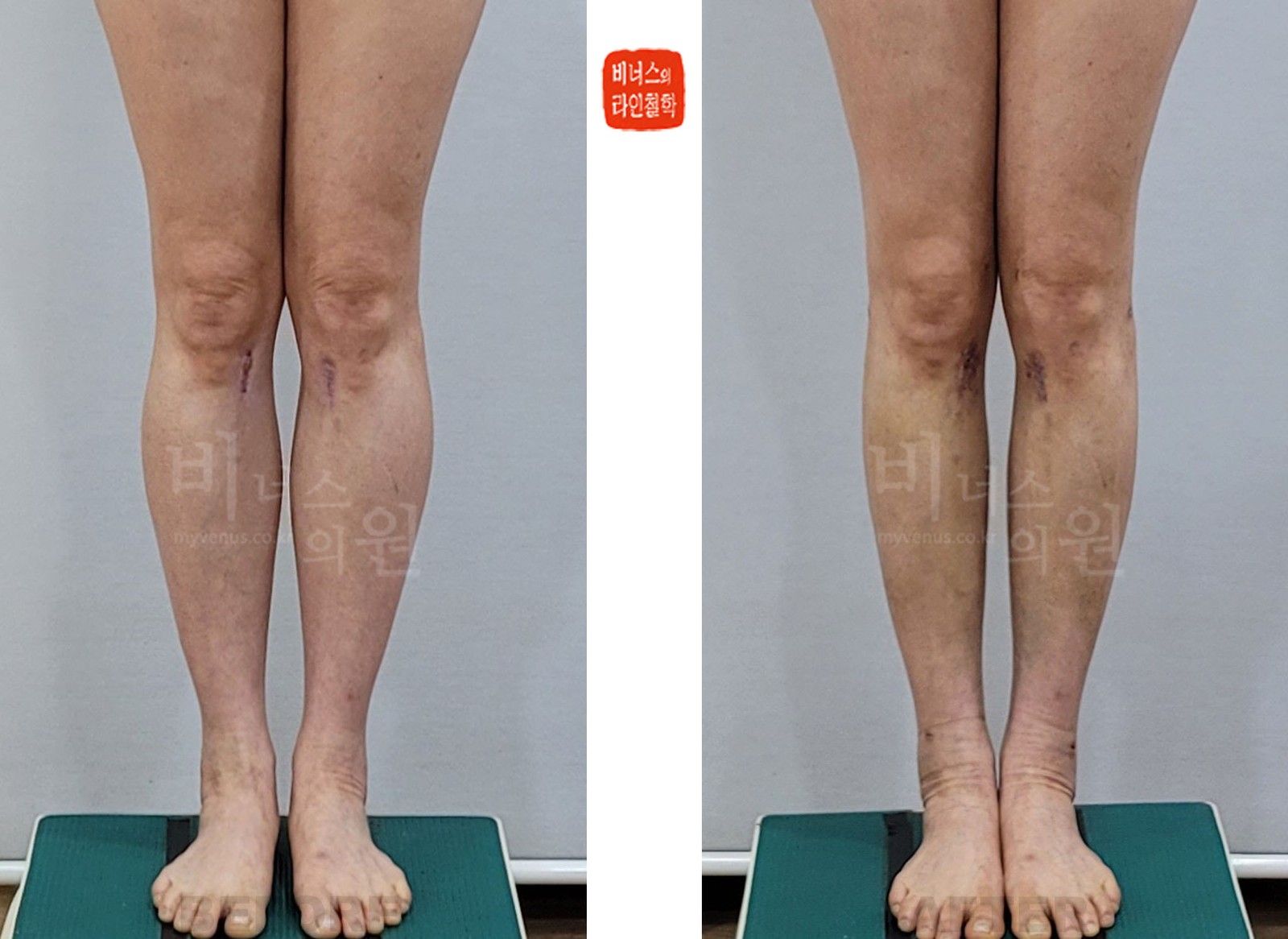
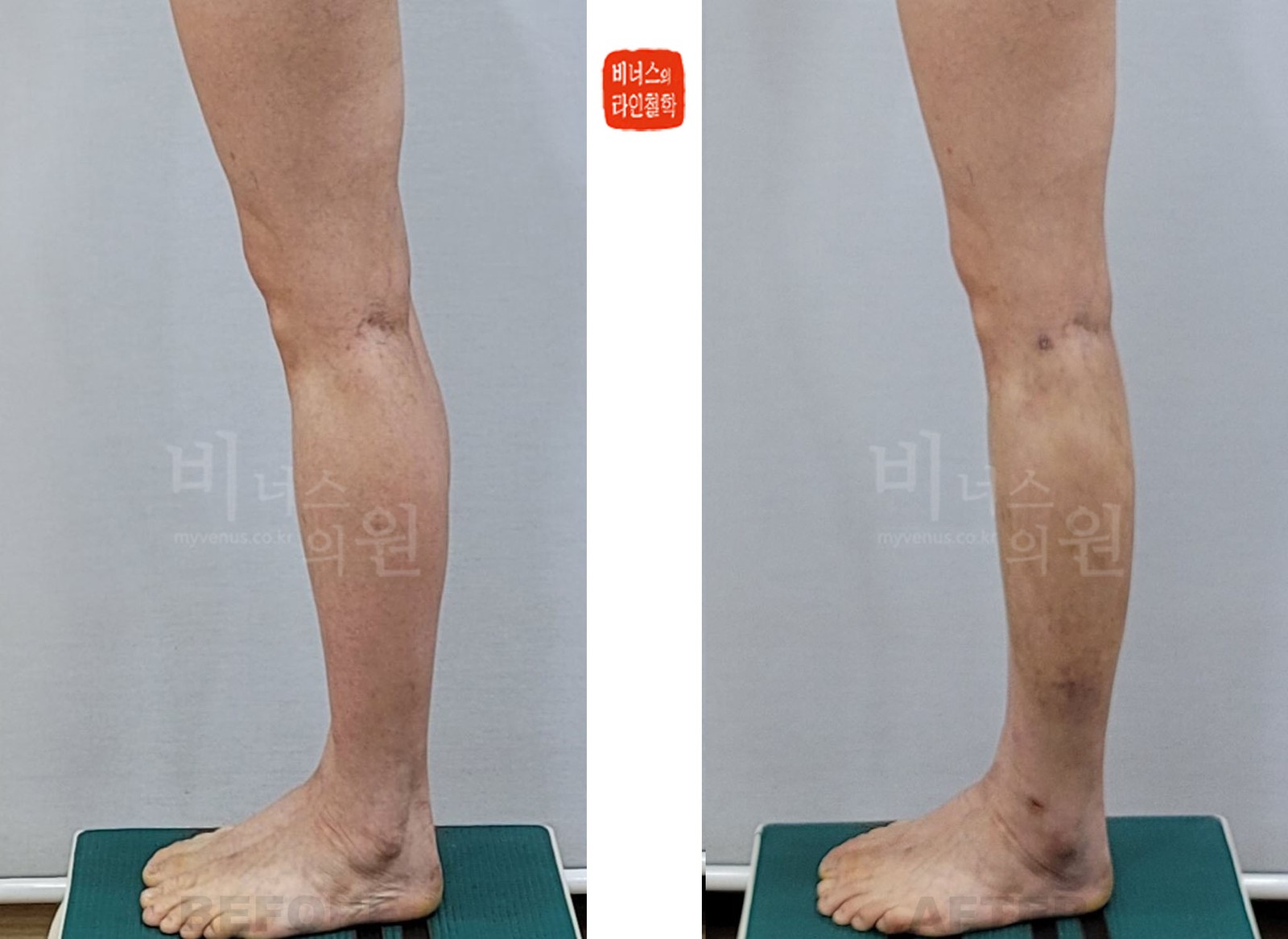
Below are photos of a patient who had cylindrical calf liposuction and inner knee liposuction together with calf Botox injections. All post-operative photos were taken 10 days after surgery. At 10 days, swelling and bruising are still at their peak, so these photos show the early course, not the final result. This is also why bruising can be seen around the ankles. In each photo, the left side is before surgery and the right side is 10 days after surgery.
Case 1
Front view - legs together
Side view
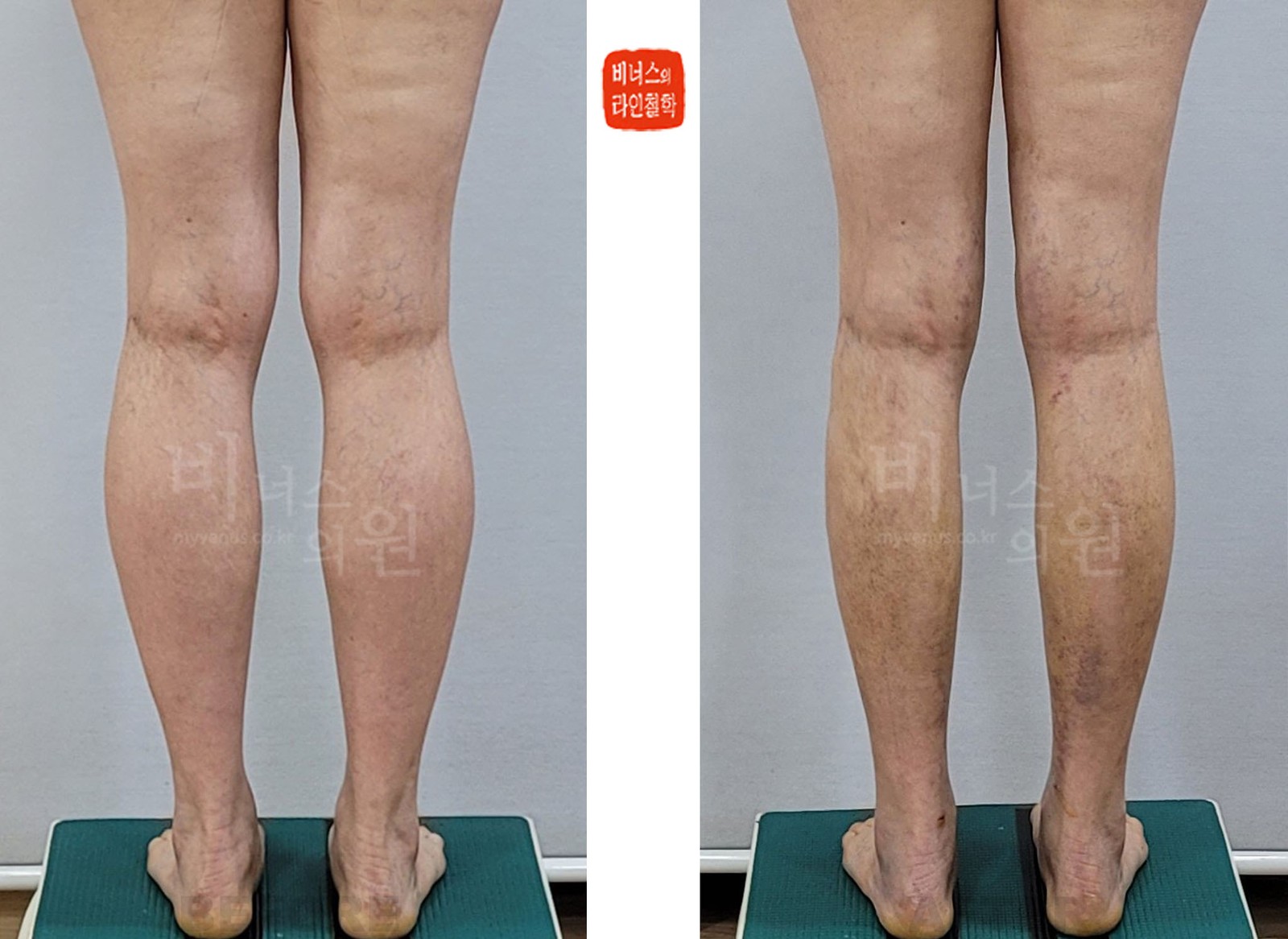
Back view - legs together
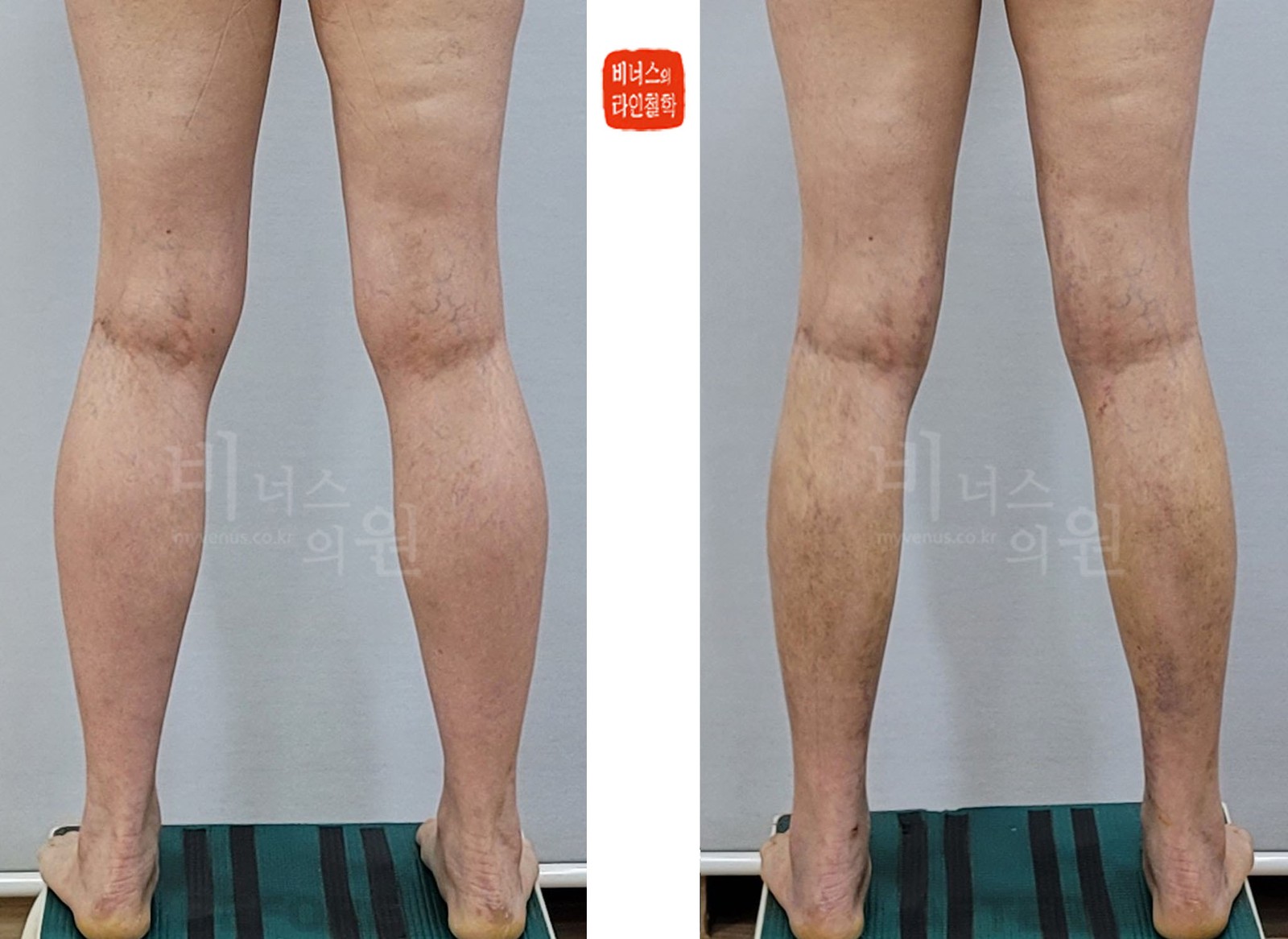
Back view - legs apart
This is a mixed-type calf. The patient had inner knee liposuction together with cylindrical calf liposuction, and also had calf Botox injections.
In the back view, after surgery the line from the thigh through the calf to the ankle looks closer to a straight line. The leg line continues without a break, so the shape of the legs looks better, and the legs also appear longer.
There is a reason inner knee liposuction was included. If fat protrudes on the inner knee, the area just below that bulge looks relatively hollow, so the inner leg line goes in and out and bowlegs look more pronounced. When the inner knee bulge is reduced, the hollow below it also becomes smaller, so even in a person with bowlegs, the leg line can look closer to a straight form. However, the degree of curvature of the bone itself does not change; it is the outline of the inner leg that looks different.
The photos were taken 10 days after surgery, when swelling remains, and the line keeps changing as the swelling subsides, so the result cannot be judged from these photos alone. As mentioned earlier, the final appearance of the calf settles over several months.
| Information on the Posted Liposuction Before-and-After Photos | |||
|---|---|---|---|
| - Same person | Surgery performed at Venus Clinic; same person | - Date taken | Taken around 2026; comparison at 10 days after surgery |
| - Same conditions | Edited to the same posture and size as closely as possible | - Side effects | https://en.myvenus.co.kr/should_know/38861 |
In Closing
What matters most in calf liposuction is understanding that the fat layer is a single layer, operating delicately with a thin cannula, and following through with swelling and compression care after surgery. We also first determine whether the calf is muscular, fatty, or mixed type and discuss combining Botox for the muscle side, and when needed we look at the area above the knee and the inner knee as well, deciding the extent of surgery with the line of the whole leg in mind.
References: Calf Liposuction
Dr. Hakjun Kim, Director, Venus Clinic