Medial Knee Liposuction — A Straighter Line from Thigh to Calf
After thigh liposuction, we often hear in the clinic: "My thighs are slimmer, but my knees are unchanged, so my legs look like sticks." When you stand with your legs together and only the inner knee bulges out, with the calf curving outward below it, the line of the whole leg does not flow smoothly even if the thigh size has gone down.
Today, taking up this issue on its own, I will explain what area medial knee (inner knee) liposuction addresses, how the line running from the thigh to the calf is made straighter, and where its limits lie.

Why the Inner Knee Shapes the Whole Leg Line
When you stand with your legs together, the first places where the two legs touch are the inner thigh and the inner knee. If fat remains here, then from the front the line running from thigh to calf appears to bend outward once at the knee.
The inner knee has fat that stands out when you are upright
On the inner side of the knee there is a pad of fat covering the bony prominence, and it becomes especially noticeable when you stand straight. When this fat is reduced, the contour of the inner knee is tidied to better proportion. However, when the knee is bent to 90 degrees, the inner side may look slightly indented. This is an expected change after surgery, so it is good to know about it in advance.[1]

If only the thigh is treated, the knee remains
When thigh liposuction is performed, the area above or inside the knee is often not included in the treatment range. The result is that only the thigh becomes slimmer while the volume of the knee stays the same, leaving the leg looking disconnected from top to bottom. If the thigh and the inner knee are regarded as separate areas and treated separately, a distinct step tends to form at the boundary of suction, and treating them together as one continuous surface is known to give a smoother result.[1] At Venus Clinic, in order to create a line that flows gently from the thigh to the calf, the knee area is often included in the surgery.
Where Does Medial Knee Liposuction Fall?
The inner knee is not usually given a separate surgical name; it is sometimes included in calf liposuction and sometimes in thigh liposuction. Which one it goes under is decided by how far your fat extends and what kind of line you would like.
| Surgical scope | Position of the inner knee | When it is considered |
|---|---|---|
| Included in thigh surgery | Treated as one continuous surface, from the inner thigh downward to the inner knee. | When the thighs are thick and that fat continues toward the knee |
| Included in calf surgery | Treated continuously, from the inner knee to the upper inner calf. | When you want to refine the calf contour and also tidy the line below the knee |
| Inner knee only | Only the protruding part of the inner knee is treated. | When the thighs and calves are fine but only the inner knee stands out |
The calf has a single fat layer, so delicate surgery is needed
In the calf, the fat layer is thin and spread as a single layer, gathering especially on the inner and back sides. For this reason the area must be approached delicately with a fine cannula rather than roughly with a thick one, and the incision is placed in an inconspicuous spot such as beneath the crease behind the knee.[2] Please also be aware that the silhouette is determined not only by fat but also by the muscles of the calf and ankle, so this is not an area where the change appears dramatic in photographs.
A Straight Line from Thigh to Calf
When the protruding fat on the inner knee is reduced, the line from the thigh to the calf comes closer to a straight line, giving the impression of legs that look straighter and longer.

A calf line that looks bowlegged can also be refined to look straighter
When the inner knee stands out and there is volume on the outer calf, the legs look curved outward, which many people feel as bowlegs. In this case, tidying the fat of the inner knee and calf can improve the line so that it looks straighter when the legs are together. However, I want to be clear that this is not a surgery that changes the degree of curvature of the bone itself. Liposuction treats only subcutaneous fat, so a curve caused by the skeleton stays as it is; what decreases is only "the part that looked more curved because of fat."
Careful contouring is what makes the line smooth
In this area the fat is spread broadly rather than sitting in one or two lumps, so suctioning only part of it easily leaves unevenness or steps. That is why it is important not to look at the inner knee alone, but to blend and contour the boundary smoothly from the upper thigh to the lower calf.
Calf Swelling Lasts Long — Why the Compression Garment Matters
The question people ask most during recovery after calf liposuction is "When will the swelling go down?" Swelling in the calf is greater and lasts longer than in other areas, and recovery tends to be slower. If you know this before surgery, you can get through the recovery period much more comfortably.
Swelling gathers because the calf is at the very bottom of the lower body
The calf is the lowest part of the lower body. While you are standing or sitting, fluid in the body moves downward with gravity, so swelling after surgery also tends to gather in the calf and ankle. Because of this swelling that pools in the lower part (dependent edema), it has been reported that the calf can take 6 to 12 months to show its final result, which is quite different from areas such as the inner thigh or the arm that recover quickly with about one week of light compression.[3]
Swelling of the legs can occur even when the calf itself is not operated on. Whichever part of the lower body is treated with liposuction, pitting swelling can appear in the legs and ankles, and the more the leg or thigh is suctioned all the way around (360 degrees), the more likely this downward-moving swelling becomes.[4] In Venus Clinic's area-specific guidance as well, the calf is described as an area with marked swelling that can continue from several days to several weeks.
It takes time for lymph flow to recover
It is the lymphatic vessels that drain swelling. Suctioning broadly around the leg can temporarily block a considerable part of the lymph flow rising from the leg, and the swelling at the surgical site presses on the fine lymphatic vessels again, slowing the speed at which swelling fluid drains even further. Because of this vicious cycle, swelling in the legs can continue for several weeks.[5] This is why recovery after circumferential calf liposuction is slower than in other areas.
That is why the compression garment matters
To reduce swelling that gathers downward, the legs need to be pressed evenly from the outside so that fluid does not pool. After calf liposuction, some reports recommend wearing medical compression stockings (30 to 45 mmHg) for up to 6 to 8 weeks after surgery.[3] At Venus Clinic, after calf surgery you wear a calf compression garment, which wraps from the lower abdomen through the buttocks, thighs, and calves all the way to the feet (leaving only the toes exposed). If the compression breaks off at the ankle, the swelling moves down and pools in the top of the foot, so when the calf has been operated on, even compression down to the foot is needed.
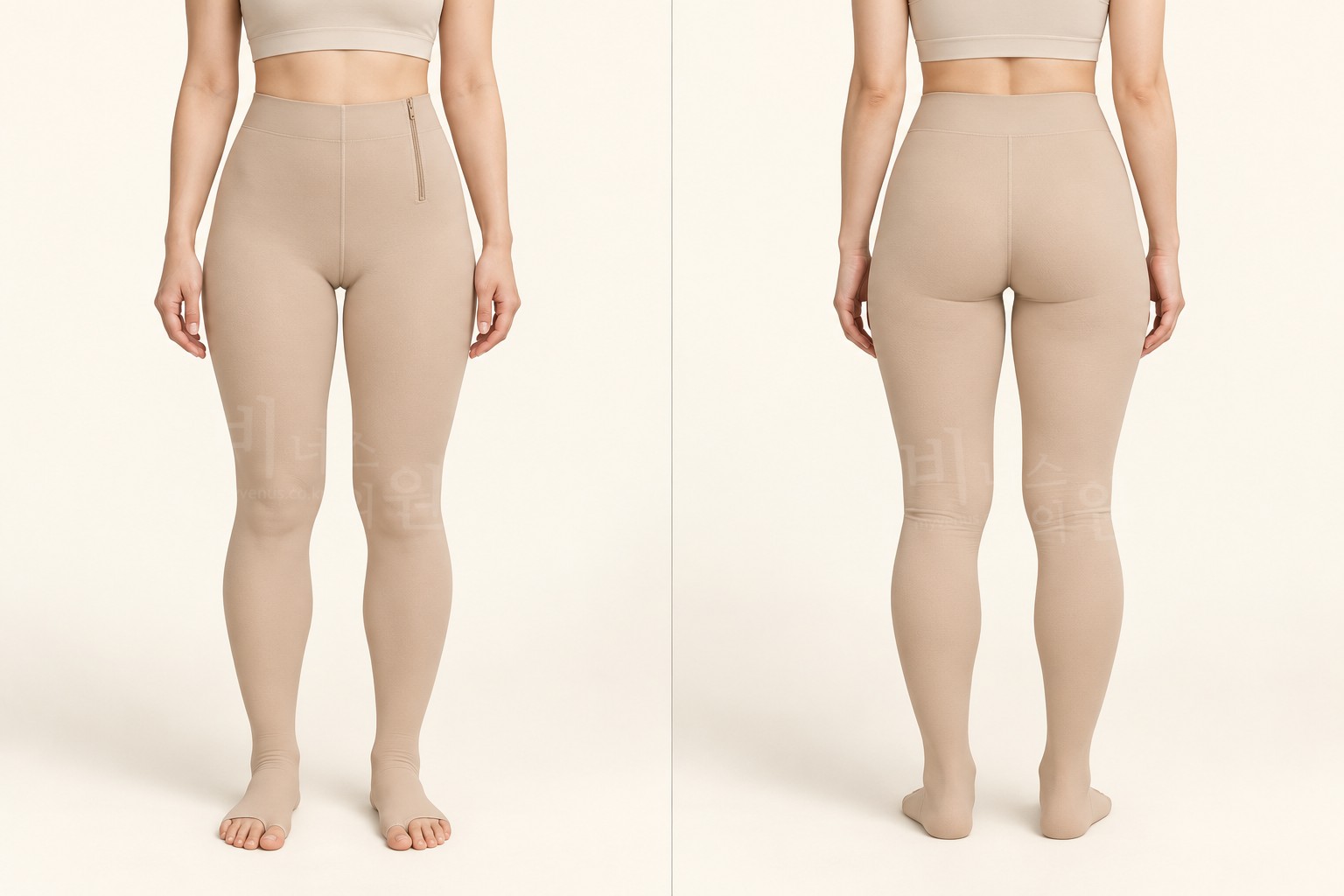
Calf compression garment — wraps from the lower abdomen to the feet, leaving only the toes exposed (front and back)
However, stronger compression is not necessarily better. Continuing excessively strong compression can press on the fine lymphatic vessels and actually block the path by which swelling fluid drains.[6] It is important to wear a garment that fits your body for the prescribed period, and walking lightly during the first few days after surgery also helps drainage and reduces swelling.[7]
Please keep in mind during calf recovery
· The calf swells a lot and for a long time, so how it looks during the first few weeks after surgery is not the final result.
· Wear the compression garment evenly down to the feet, consistently for the period you were instructed.
· Standing or sitting for a long time lets swelling settle lower. Walk from time to time, and keep your legs comfortable when resting.
· The speed at which swelling goes down varies by individual.
Limits and Things to Know

Bone and muscle do not change
The calf is an area where muscle and bone determine the silhouette, so there are limits to the change that liposuction alone can create. It is more accurate to understand this not as making completely straight legs, but as a surgery that reduces the lines that stood out because of fat so that the legs look straighter. Results vary by individual.
Right after surgery there is swelling and bruising
As in the photos below, around 10 days after surgery swelling and bruising remain, so this is not the final appearance. As the swelling goes down and the skin settles, the contour changes little by little.
Weight changes and leg posture
Liposuction reduces the number of fat cells, so the remaining fat cells can grow again if you gain weight. Managing your weight steadily after surgery helps maintain the line. Also, as mentioned earlier, in a posture with the knee bent, the inner knee may look slightly indented.[1]
References
- Klein JA. Tumescent Technique: Tumescent Anesthesia & Microcannular Liposuction. Mosby; 2000. Chapter 34 (Medial Thighs, Knees, and Anterior Thighs).
- Shiffman MA, Di Giuseppe A (eds). Liposuction: Principles and Practice. Springer; 2006. Chapter 28 (Superficial Liposculpture: Rationale and Technique).
- Johnson DS, Cook WR Jr. Advanced Techniques in Liposuction. W.B. Saunders; 1999.
- Klein JA. Tumescent Technique: Tumescent Anesthesia & Microcannular Liposuction. Mosby; 2000. Chapter 8 (Miscellaneous Complications — Edema and Ecchymosis).
- Klein JA. Tumescent Technique: Tumescent Anesthesia & Microcannular Liposuction. Mosby; 2000. Chapter 11 (Postliposuction Edema).
- Klein JA. Tumescent Technique: Tumescent Anesthesia & Microcannular Liposuction. Mosby; 2000. Chapter 11 (Postliposuction Edema — Normal Function).
- Klein JA. Tumescent Technique: Tumescent Anesthesia & Microcannular Liposuction. Mosby; 2000. Chapter 40 (Female Legs and Ankles — Postoperative Care).
Before-and-After Photos
The photos below are of one patient who underwent circumferential calf liposuction and medial knee liposuction at Venus Clinic; calf Botox was also received at the time of surgery. All after-surgery photos were taken 10 days after surgery. Swelling and bruising still remain at this stage, so these are not final results, and the shape will change a little more over time.
First — Front view, legs together
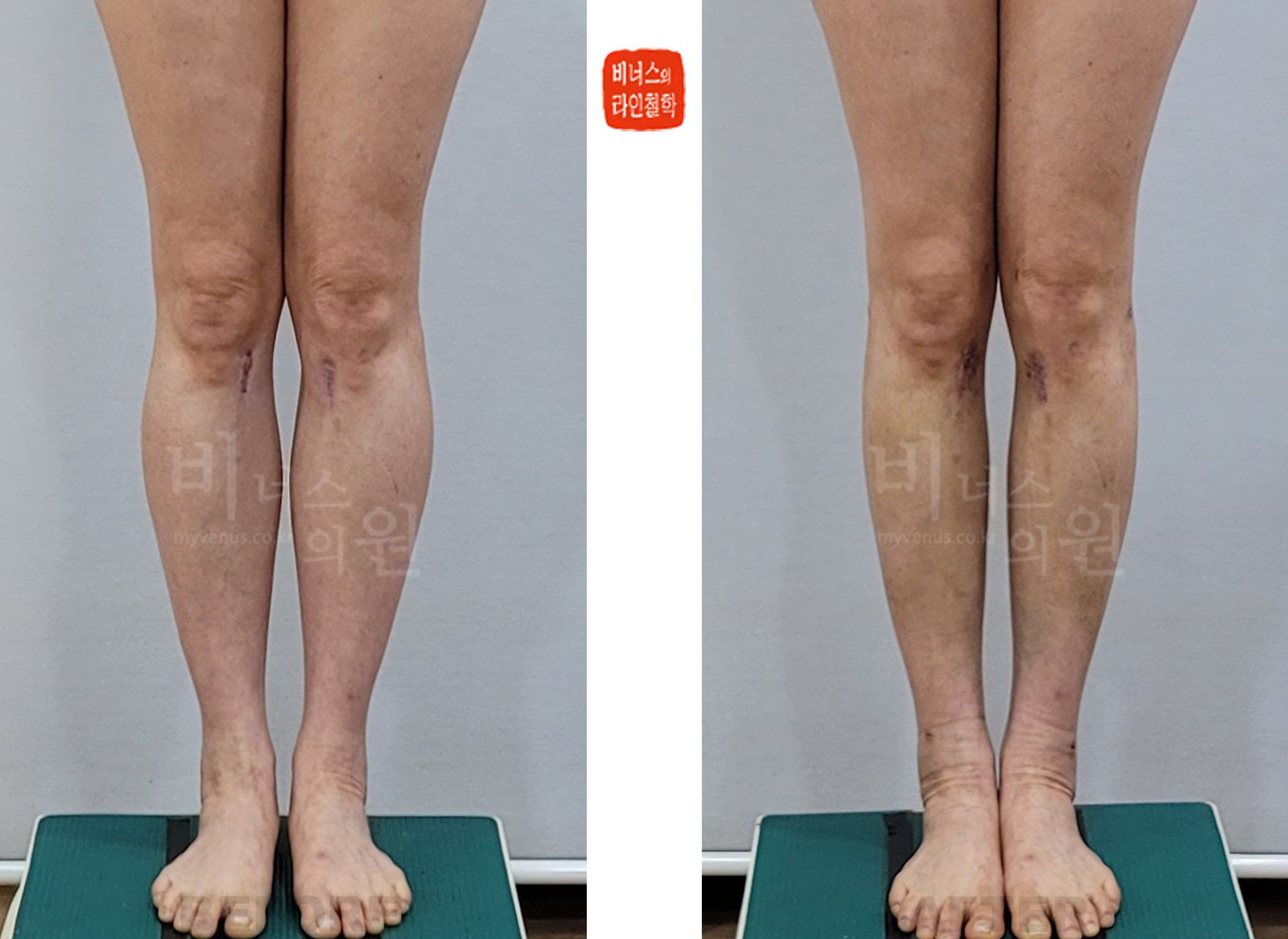
This is the front view standing with legs together. Before surgery, the line from the inner knee to the calf looked rounded and curved outward; after surgery, the calf width is smaller and the line below the knee appears to run a little straighter. Color changes from bruising can be seen in the after-surgery photo on the right, so please view it with the 10-day point in mind.
| Information on the Posted Liposuction Before-and-After Photos | |||
|---|---|---|---|
| - Same person | Surgery performed at Venus Clinic; same person | - Date taken | Taken around 2026; comparison at 10 days after surgery |
| - Same conditions | Edited to the same posture and size as closely as possible | - Side effects | https://en.myvenus.co.kr/should_know/38861 |
Second — Back view, legs together
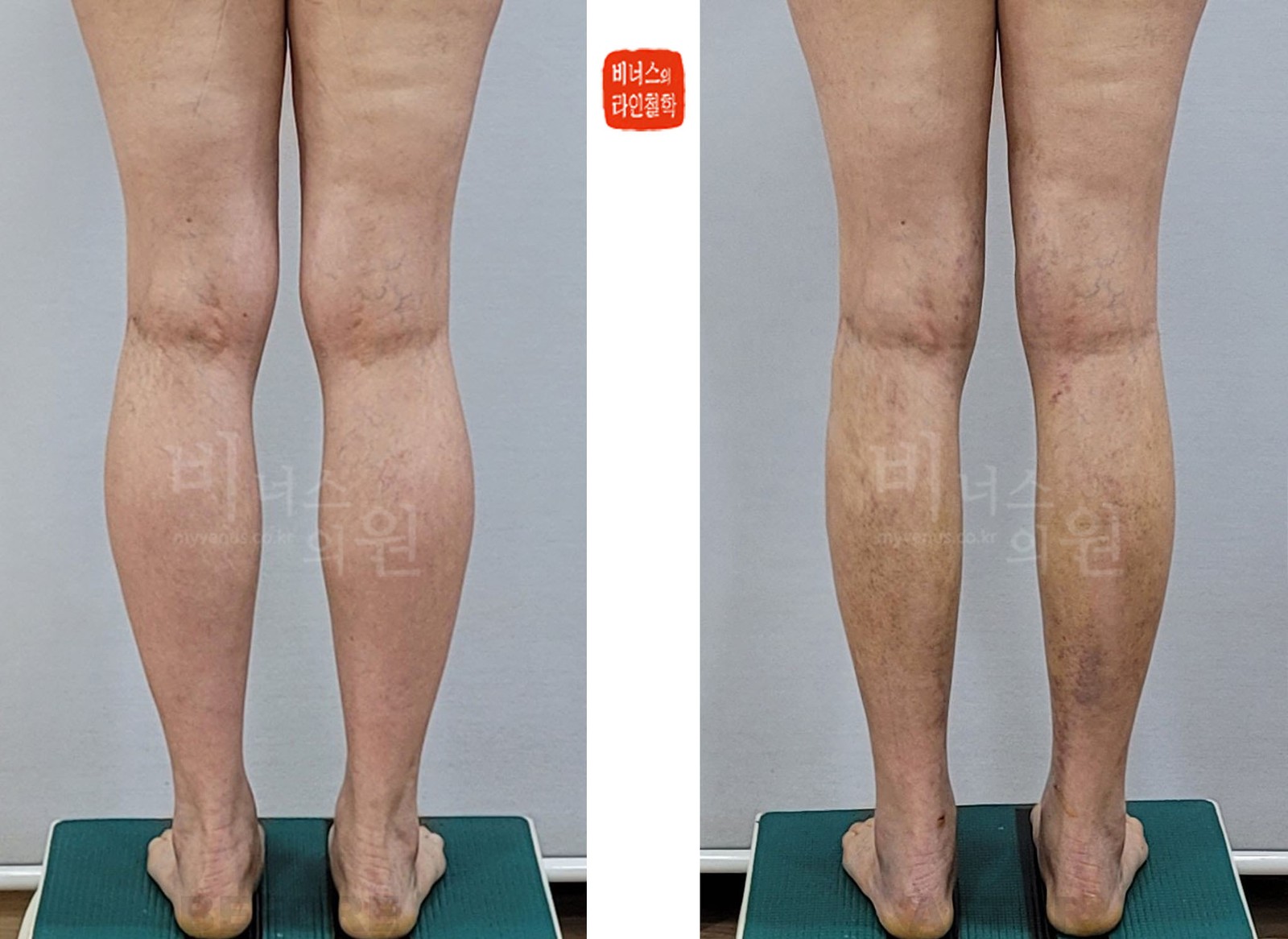
This is the same patient seen from behind, standing with legs together. After surgery, the volume that stood out on both sides of the calf has decreased, the calf width is narrower, and the contour from behind the knee to the ankle looks tidied. In particular, the line from the thigh to the calf has changed to a shape closer to a straight line, so the calf looks straighter and longer. In the after-surgery photo, some uneven skin color can be seen, which is bruising and skin change appearing at day 10.
| Information on the Posted Liposuction Before-and-After Photos | |||
|---|---|---|---|
| - Same person | Surgery performed at Venus Clinic; same person | - Date taken | Taken around 2026; comparison at 10 days after surgery |
| - Same conditions | Edited to the same posture and size as closely as possible | - Side effects | https://en.myvenus.co.kr/should_know/38861 |
Third — Back view, legs apart
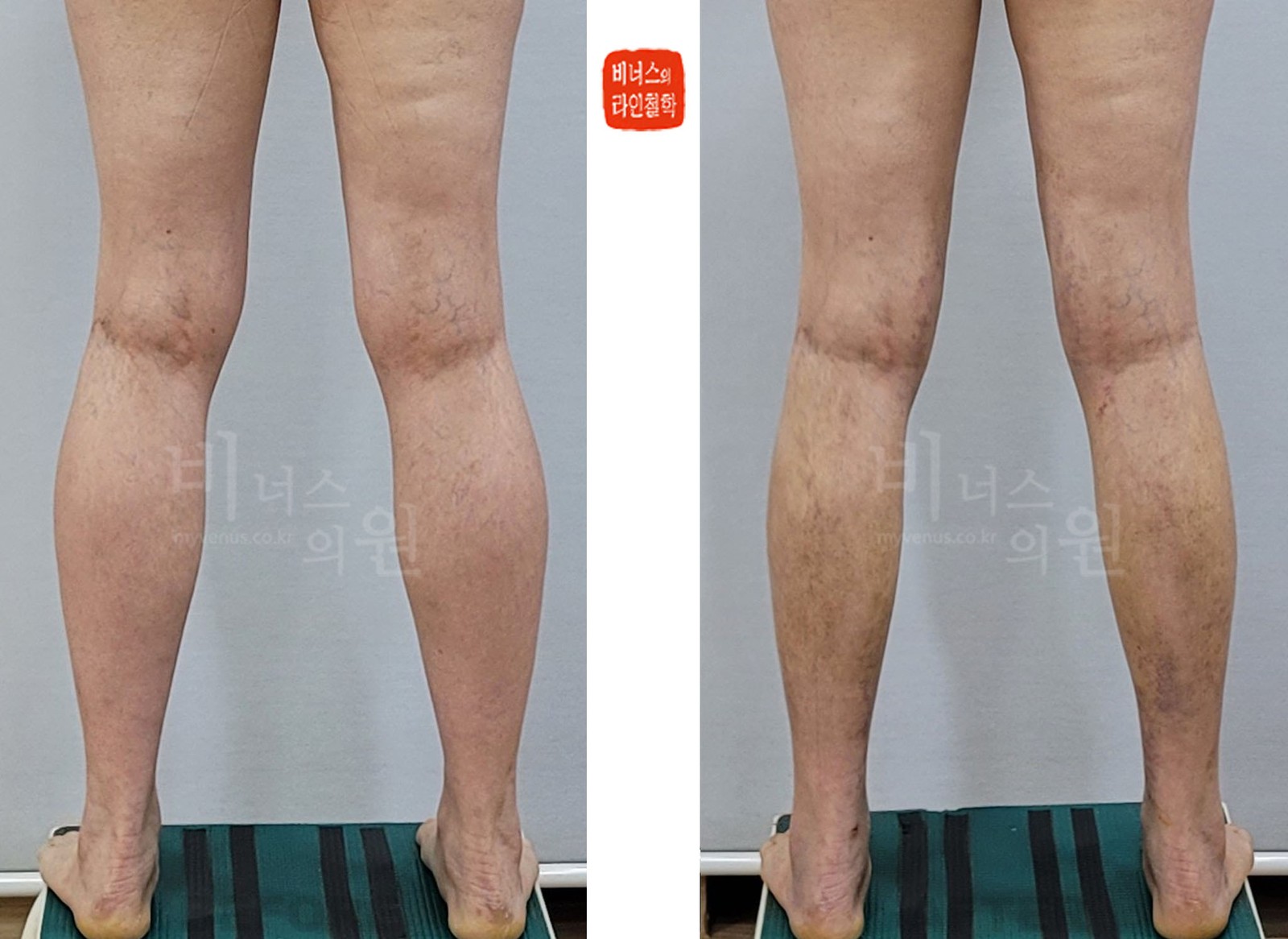
This is the back view standing with legs apart. With the legs apart, the outer curve and the inner line of the calf each become visible. After surgery, the volume on the outer calf is reduced, and the leg line appears to come down in a straighter shape. Even in the legs-apart posture, the line from the thigh to the calf has changed to a shape closer to a straight line, so the calf looks straighter and longer. This photo too was taken 10 days after surgery, so swelling and bruising remain.
| Information on the Posted Liposuction Before-and-After Photos | |||
|---|---|---|---|
| - Same person | Surgery performed at Venus Clinic; same person | - Date taken | Taken around 2026; comparison at 10 days after surgery |
| - Same conditions | Edited to the same posture and size as closely as possible | - Side effects | https://en.myvenus.co.kr/should_know/38861 |
In Closing
With thigh surgery alone, the fat remaining on the inner knee can make the leg line look interrupted. The key to this surgery is to see the line from the thigh through the knee to the calf as one line, and to refine the inner knee together with it. At Venus Clinic, we do not look at areas separately; we operate by connecting them as a line.
Dr. Hakjun Kim, Director, Venus Clinic