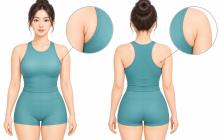
Why Do Women Gain Weight in the Lower Body?
In consultations, I very often hear patients say, "My top is a size S, but I have to wear an L in pants," or "I exercise and eat less, but only my thighs stay the same." Many say that what upsets them first is finding that their top and bottom sizes in a clothing store do not match. This is also long recorded in the liposuction literature, which notes that many patients complain they must buy one size to fit the chest and a larger size to fit the hips and thighs [1].
Today I would like to explain, based on the medical literature, why women tend to gain fat on the thighs and buttocks rather than the abdomen, and why that fat is so hard to reduce even with exercise and diet control. I will then go over a condition that must be told apart from ordinary lower-body fat, and why Venus Clinic evaluates the hips, buttocks, and thighs together. In the middle I will also share some of my personal conjecture; I will keep what is supported by evidence clearly separate from my own conjecture.

"Two-Body Syndrome": When Top and Bottom Sizes Differ
There is a condition often called "two-body syndrome". It refers to cases in which the thighs are large relative to the upper body, so the clothing sizes that fit the upper and lower body differ. The liposuction literature describes that women tend to accumulate fat preferentially on the thighs, and that some people who are frustrated by the lack of noticeable change in shape or size despite vigorous exercise and body care choose liposuction for reasons such as these [2]. So why do women gain fat so readily on the thighs in particular? Let us look at the reasons one by one.
Women Gain Fat on the Thighs, Men on the Belly
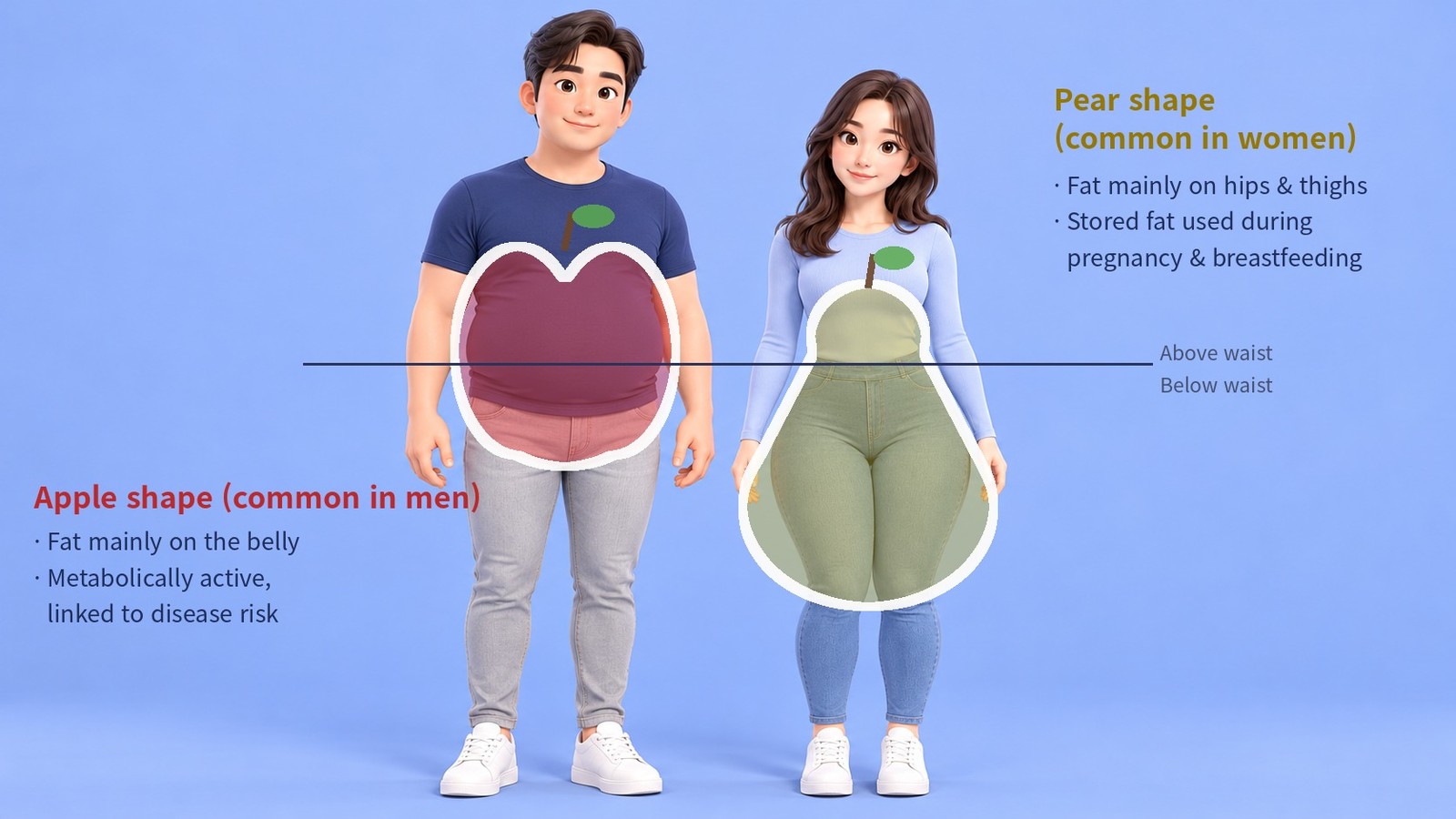
Where fat accumulates in the body differs by sex. Harrison's Principles of Internal Medicine classifies the female fat distribution as "gynoid" (fat stored on the hips and thighs) and the male distribution as "android" (fat stored centrally on the trunk), and explains that women also have more subcutaneous fat than men [3]. The liposuction literature says the same. In a typical adult male, fat accumulates prominently under the skin of the abdomen, waist, shoulders, and nape, which is related to androgen receptors on fat cells. In women, by contrast, fat accumulates below the waist, in peripheral storage sites such as the thighs and buttocks, which is related to estrogen receptors on fat cells [4].
Female Hormones and Constitution Determine Where Fat Goes
Put simply, under the influence of estrogen, women are set up to store fat on the thighs and buttocks. The male-type and female-type patterns of fat accumulation are described as being determined by genetics and hormones [5]. Harrison's also states that in women, higher androgen levels are associated with more abdominal fat [3]. However, the same source adds that why these differences arise is not yet fully understood, and that evidence is emerging that genetic variation is involved [3]. So I say that it is "because of female hormones and constitution," while also making clear that the detailed mechanisms are not all known.
Interpreted as a Reserve for Pregnancy and Breastfeeding
Fat on the thighs and buttocks is also related to pregnancy and breastfeeding. The peripheral fat characteristic of women is described as stable and not easily changed, and as becoming active during pregnancy and lactation [4]. Because breastfeeding requires about 450 to 500 extra kcal per day [6], this fat can be understood as a storage space prepared for the postpartum period. In other words, lower-body fat in women is not simply "fat from eating too much"; you can think of it as fat connected to the body's design for childbirth. Please note that this is my own way of explaining what the literature shows.

Thighs Are Hard to Reduce Even with Exercise and Diet Control
Many people think, "My thighs won't slim down because my willpower is weak." But lower-body fat differs in nature from trunk fat. According to the liposuction literature, trunk fat is metabolically active and changes with eating habits, whereas peripheral fat on the thighs and buttocks is not greatly affected by dietary restriction. During fasting, fat breakdown is said to occur in the central trunk in the first week but not in peripheral storage sites [4].
| Category | Trunk (abdominal) fat | Thigh and buttock fat |
|---|---|---|
| Associated receptor | Androgen receptor | Estrogen receptor |
| Response to dietary restriction | Changes with eating habits | Not greatly affected |
| First week of fasting | Fat breakdown activity appears | No fat breakdown activity appears |
| During pregnancy and breastfeeding | No such description | Becomes active |
Some Receptors Also Make Fat Hard to Release
Another explanation is that fat cells carry alpha-2 adrenergic receptors, which act in the direction of blocking fat breakdown. Areas with many of these receptors release fat poorly and become so-called "genetic fat" areas; these are said to be the abdomen in men and, in women, the trochanteric area (around the bony prominence at the upper outer thigh) [7]. The same source notes from clinical experience that this genetic fat corresponds to the amount of fat that does not easily decrease with diet and exercise [7].
In Summary
The difficulty in reducing the thighs is not only a matter of willpower; it is a characteristic created together by hormones, receptors, and constitution. However, these mechanisms have not all been proven, and there are individual differences. Exercise and diet management are essential for your health and should be continued.
My Conjecture: Thinking in Evolutionary Terms
From here on, what I describe is not stated directly in the literature but is my own personal conjecture. In my practice I feel that I often see people whose thighs become thinner after middle age. This is an impression from my clinical work, not a fact I have verified with separate statistics. There is, however, some research that may serve as a reference. During the menopausal transition, as estrogen declines, central fat increases and fat accumulates mainly in the abdomen [8], and when estrogen declines, fat is said to accumulate in the central abdomen even in lean women [9]. If estrogen is the force that kept fat on the thighs, it is a natural course for fat to shift toward the belly when that force weakens.
Based on this, I conjecture that this fat distribution may have an evolutionary meaning. During the years when a woman may become pregnant, fat accumulating on the belly could burden pregnancy and childbirth, so she may be set to store it on the thighs; for men, heavy thighs would probably have been a disadvantage in tasks that require fast movement, such as hunting, so fat may have come to settle on the abdomen instead. Let me say it once more: this is only my conjecture and has not yet been proven. In the materials I reviewed, I also could not find a sentence that directly supports this hypothesis. For that reason, I do not use it as a basis for deciding treatment, and offer it only as one perspective for understanding the body's structure.
A Condition to Distinguish from Ordinary Lower-Body Fat: Lipedema
Not every case of fat accumulating in the lower body should be considered ordinary lower-body fat as described above. A condition that needs to be examined separately is lipedema. Lipedema occurs only in women and often begins around puberty, pregnancy, or menopause; it is characterized by fat accumulating from below the waist down the legs while sparing the feet. A notable feature is that with dieting the upper body slims down while the legs stay the same [10]. Because it overlaps in many ways with ordinary lower-body fat, if symptoms are severe or accompanied by pain or swelling, it is best to get an accurate diagnosis first.

Venus Clinic Views the Hips, Buttocks, and Thighs as One
Many people troubled by lower-body fat come asking for a specific area, saying "just the thighs, please" or "just the saddlebags, please." However, the liposuction literature explains that these areas should be viewed not as separate parts but as one complete unit, and that the area a patient feels is the problem may differ from the area that actually needs to be contoured [1]. It is also described that a person with both a large abdomen and large buttocks who has only the abdomen treated may later realize the large buttocks remain and be dissatisfied [11].
Saddlebags Are Considered Together with the Lower Outer Buttocks
The area commonly called saddlebags is not the middle of the thigh but the area beside the outer end of the crease between the buttocks and thighs, the upper part of the lateral thigh that is attached to the buttocks. This area is continuous with the fat of the lower outer buttocks, so if only the saddlebags are reduced, the fat of the lower outer buttocks may descend again and the change in size may not look large. For this reason, at Venus Clinic we regard the hips, buttocks, and saddlebags as one aesthetic unit and plan them together, so that the outer line running from the waist through the pelvis to the thighs connects naturally.

Our Principle on the Amount Removed
Many people ask how much is removed. We remove the fat that needs to go as thoroughly as possible, and smooth the contour so that it is not bumpy. As mentioned earlier, fat on the thighs and buttocks does not readily decrease with diet, so approaching it by reducing the fat itself is what differs from ordinary dieting.
The Limits, Too
Liposuction is a procedure that reduces shape and circumference; it is not a way to eliminate every concern. Fat in areas other than the treated area can grow again if you gain weight, and the degree of skin elasticity and contraction also differs by constitution. If lipedema is suspected, as discussed earlier, it may be difficult to expect the same result from liposuction, so diagnosis comes first. Bodily changes tied to periods such as pregnancy, breastfeeding, or menopause can also affect the shape after surgery. It is important to keep managing your weight and lifestyle after surgery as well.
References
- Shiffman MA, Di Giuseppe A, eds. Liposuction: Principles and Practice. Berlin: Springer; 2006. Chapter 28 (28.9.2 Lateral Thigh, Trochanteric Area, Hip and Buttocks).
- Klein JA. Tumescent Technique: Tumescent Anesthesia & Microcannular Liposuction. Mosby; 2000. Chapter 32 (Lateral Thighs).
- Loscalzo J, Fauci AS, Kasper DL, Hauser SL, Longo DL, Jameson JL, eds. Harrison's Principles of Internal Medicine, 21st ed. McGraw-Hill; 2022. Chapter 398 (Women's Health).
- Shiffman MA, Di Giuseppe A, eds. Liposuction: Principles and Practice. Berlin: Springer; 2006. Chapter 63 (63.4.1 Regional Fat Distribution by Gender and Race).
- StatPearls [Internet]. Treasure Island (FL): StatPearls Publishing. Panniculectomy.
- StatPearls [Internet]. Treasure Island (FL): StatPearls Publishing. Physiology, Postpartum Changes.
- Serdev N. Body Contouring and Sculpting. InTech; 2016. Chapter 10 (Fat Grafting in Body Contouring, 2.3 Donor site preference).
- StatPearls [Internet]. Treasure Island (FL): StatPearls Publishing. Secondary Causes of Obesity.
- StatPearls [Internet]. Treasure Island (FL): StatPearls Publishing. Hormone Replacement Therapy.
- StatPearls [Internet]. Treasure Island (FL): StatPearls Publishing. Lipedema.
- Klein JA. Tumescent Technique: Tumescent Anesthesia & Microcannular Liposuction. Mosby; 2000. Chapter 33 (Female Hips and Back and Male Flanks).
Before-and-After Photos
The two patients below had thigh liposuction at Venus Clinic. The two cases were photographed at different times: the after photo of the first case was taken 1 week after surgery, and the after photo of the second case 3 months after surgery. In particular, the first case is only 1 week after surgery, so swelling and bruising remain and it is not the final result; the shape may change over time.
First Case
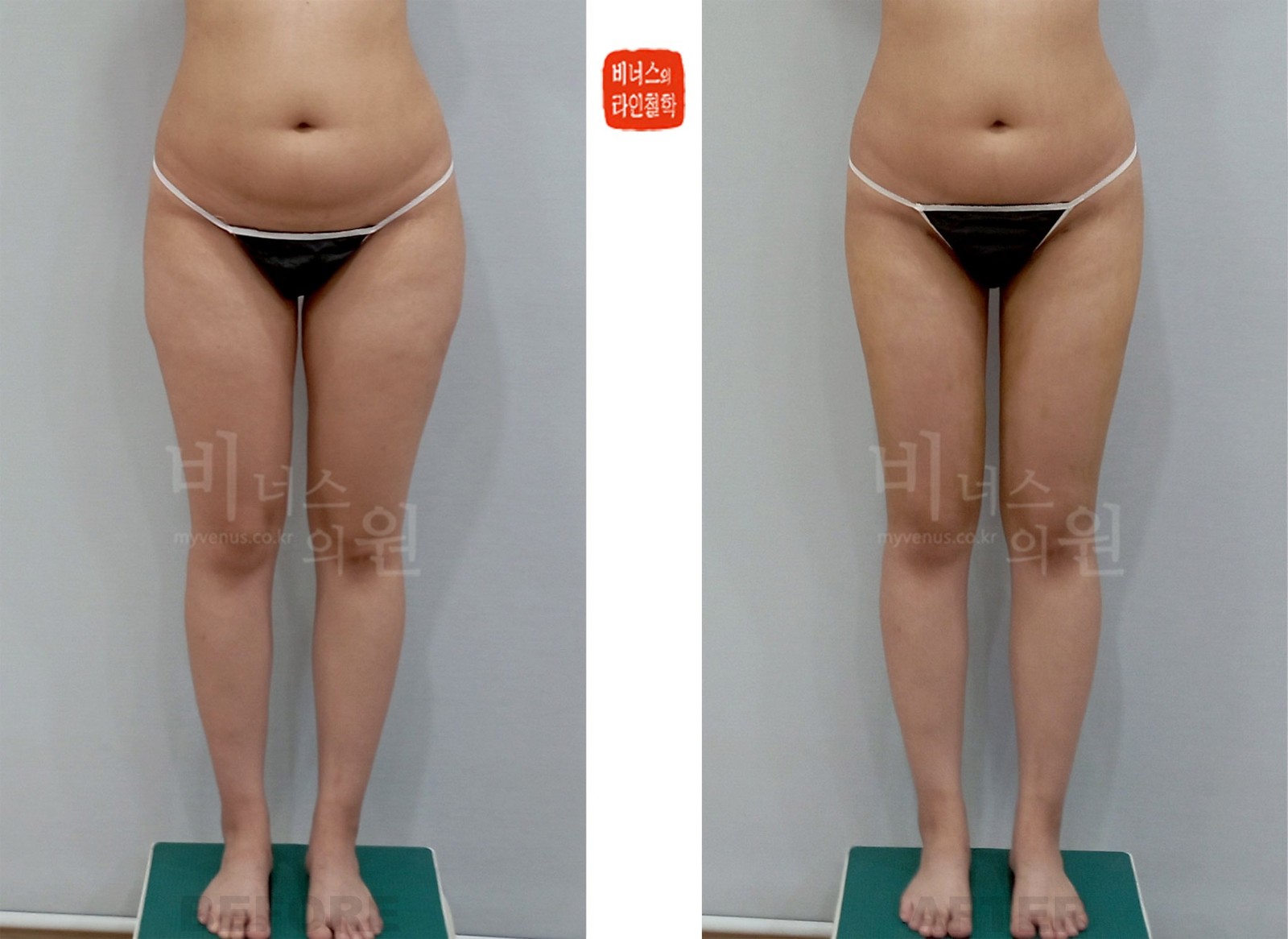
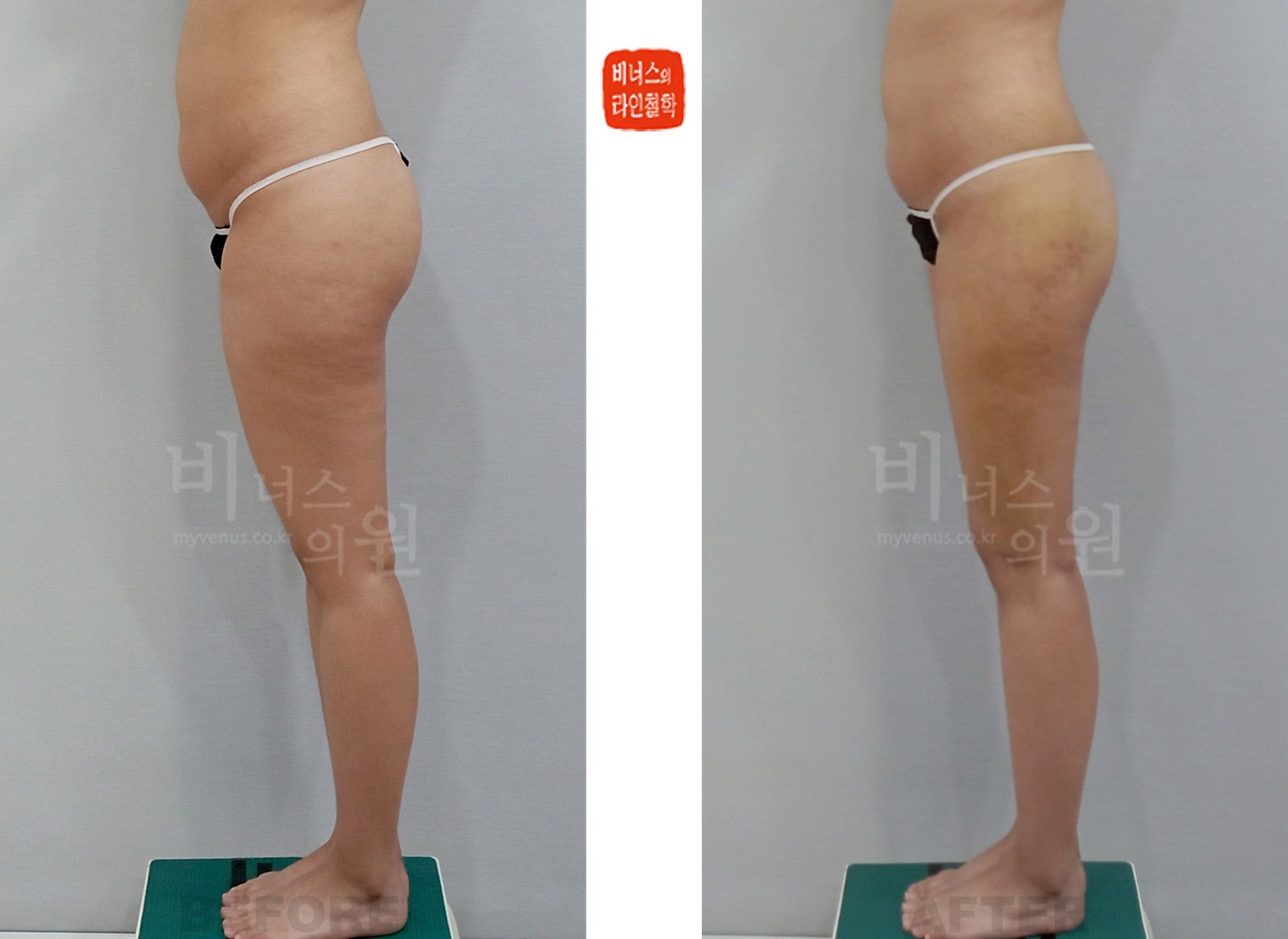
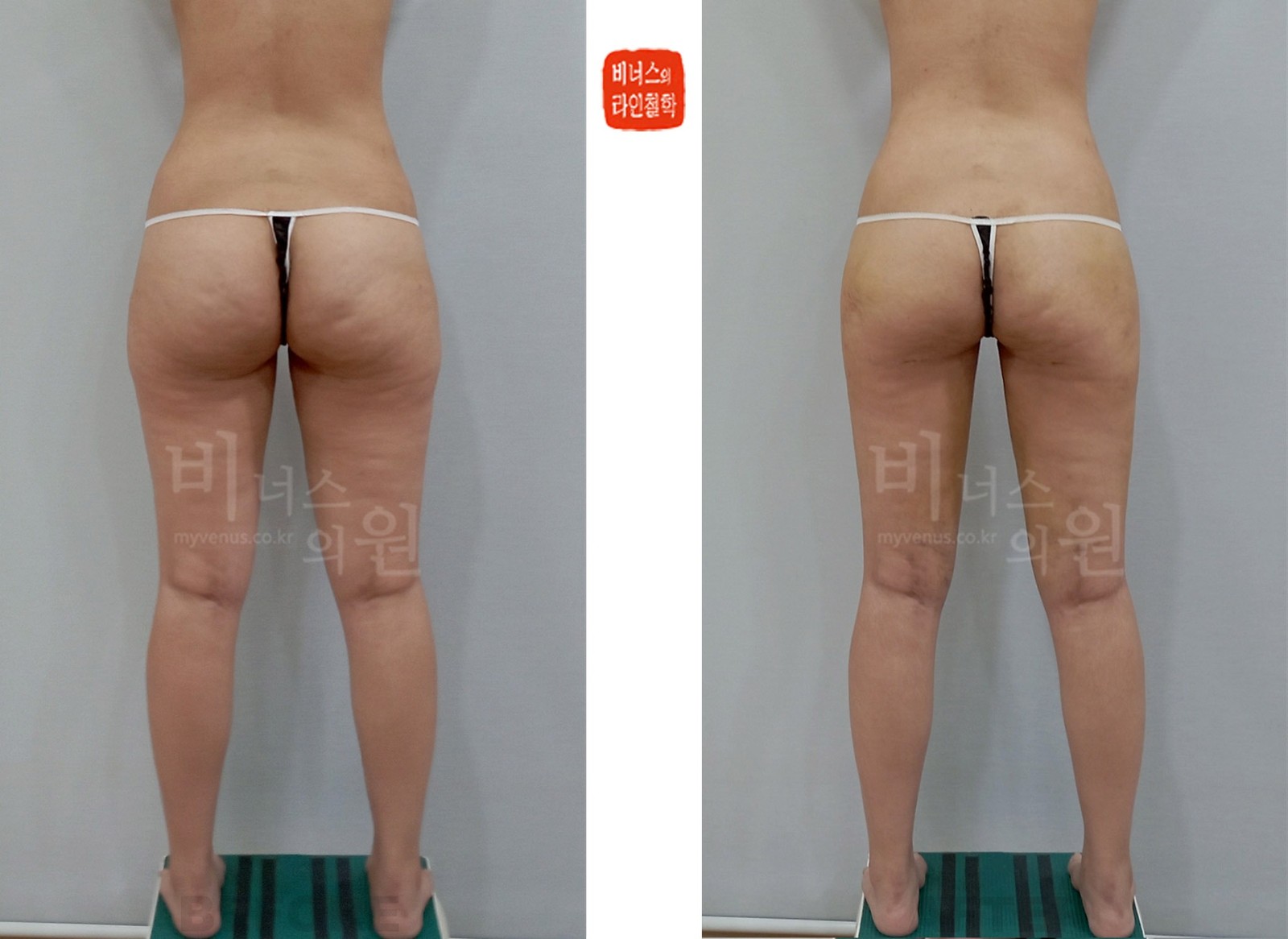
This is a case in which cylindrical thighs and buttocks were treated together with liposuction. In the order of front, left side, and back, the before-surgery photo (left) and the 1-week after-surgery photo (right) are placed side by side. Because this is a photo 1 week after surgery, swelling remains and the shape is not yet final. Since the thighs and buttocks were operated on together as one unit, you can see the change in the outer line of the lower body from the front and back.
| Information on the Posted Liposuction Before-and-After Photos | |||
|---|---|---|---|
| - Same person | Surgery performed at Venus Clinic; same person | - Date taken | Taken around 2023; comparison at 1 week after surgery |
| - Same conditions | Edited to the same posture and size as closely as possible | - Side effects | https://en.myvenus.co.kr/should_know/38861 |
Second Case
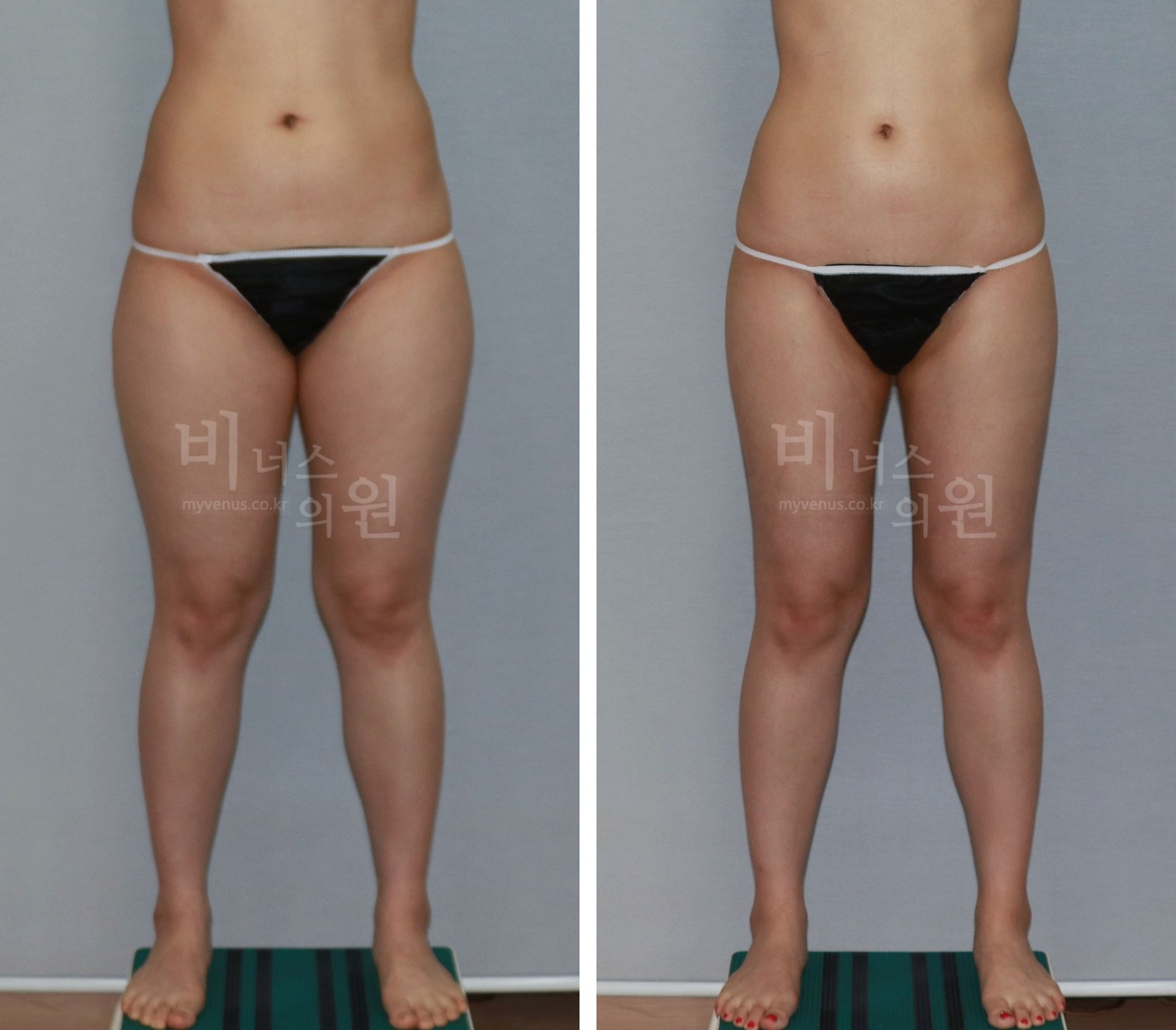
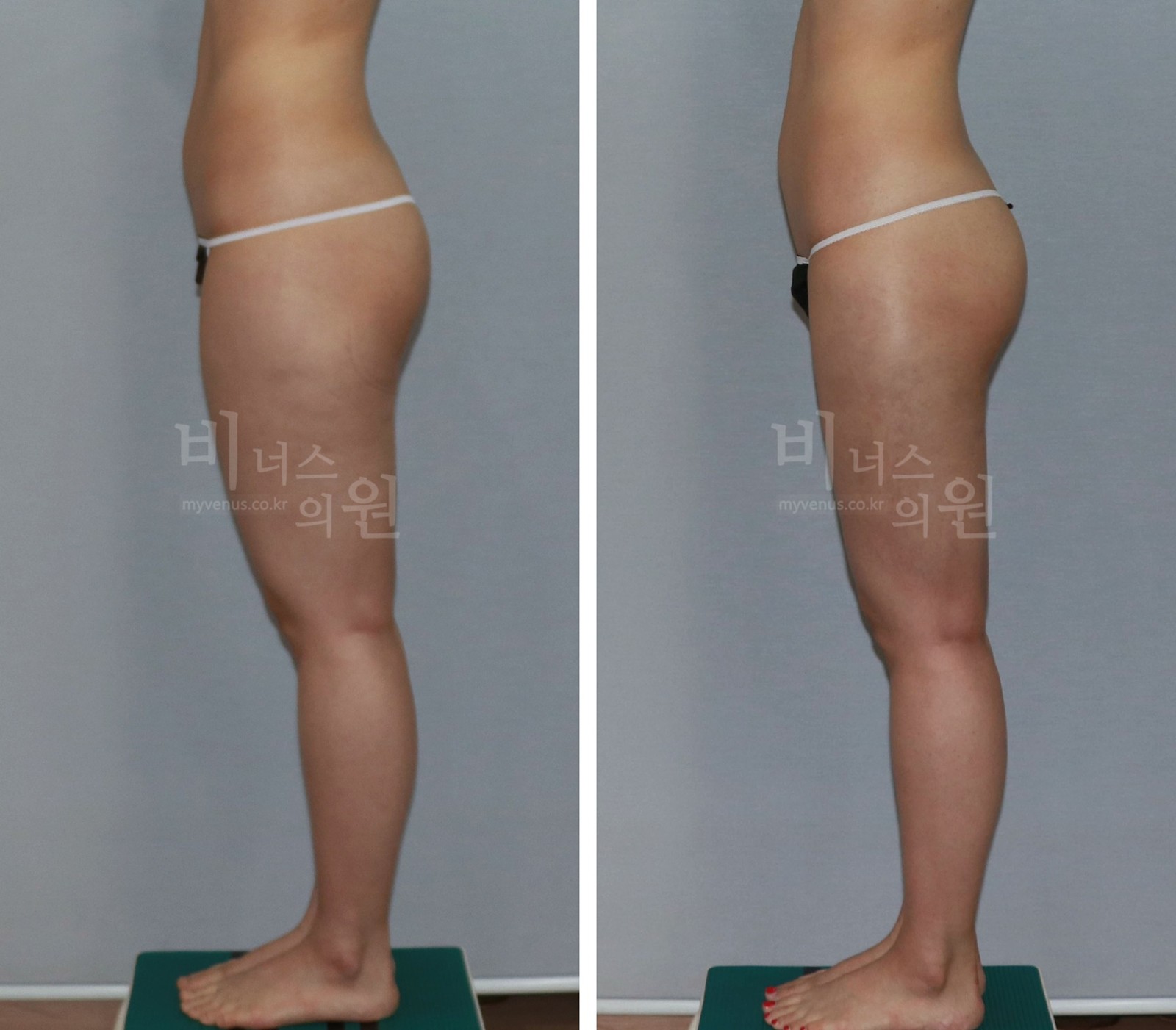
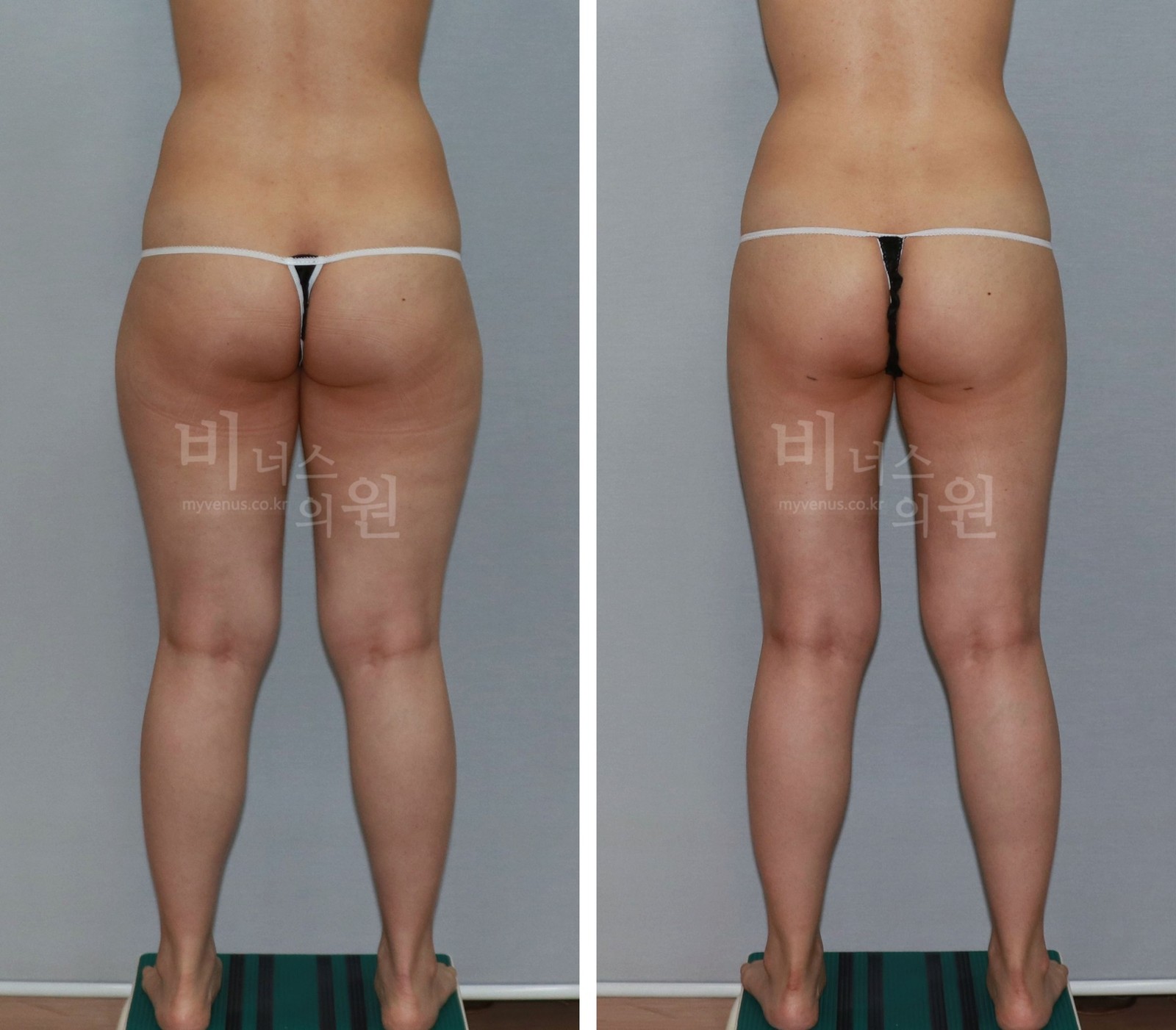
This is a case of cylindrical thigh liposuction. In the order of front, left side, and back, the before-surgery photo (left) and the 3-month after-surgery photo (right) are placed side by side. This shows the period 3 months after surgery, when much of the swelling has subsided, but results vary by individual.
| Information on the Posted Liposuction Before-and-After Photos | |||
|---|---|---|---|
| - Same person | Surgery performed at Venus Clinic; same person | - Date taken | Taken around 2018; comparison at 3 months after surgery |
| - Same conditions | Edited to the same posture and size as closely as possible | - Side effects | https://en.myvenus.co.kr/should_know/38861 |
In Closing
Fat accumulating on a woman's thighs and buttocks is related to female hormones, constitution, and a bodily structure tied to childbirth, and it is not only a matter of weak willpower. I also hope you will remember that the cause has not yet been fully clarified. Venus Clinic is a clinic that focuses on liposuction, and we offer consultations that regard the hips, buttocks, and thighs as one aesthetic unit.
References: Cylindrical Thighs, Hips, Buttocks, and Knees
Dr. Hakjun Kim, Director, Venus Clinic