[Case Review] Revision Liposuction of the Upper Abdomen
"My lower belly went down, but my upper belly is still there." "The skin folds above my navel and looks like it is sagging." We often hear this from people who come back for a consultation after abdominal surgery. Among those who come in for revision abdominal liposuction, the area that needs to be treated again is often the upper abdomen.
In this article, we explain why so much fat remains in the upper abdomen, the inverted smile shape that the remaining upper abdominal fat creates as it droops above the navel, and two cases in which fat remained in the upper abdomen even after abdominoplasty or abdominal liposuction, and revision upper abdominal liposuction was performed — together with photos taken 1 week after surgery.

Why So Much Fat Remains in the Upper Abdomen
Even within the same abdomen, the lower belly and the upper belly differ in the structure of the fat layer. The lower belly is suctioned relatively evenly and its skin tends to tighten well after surgery, whereas the upper belly is an area where less fat is removed in the first surgery and more tends to be left behind. There are two main reasons.
It is a hollow area between the ribs
The upper abdomen is a hollowed-out area that sits between the arches formed by the lower ends of the left and right rib cages (the costal margins). Because the ribs protrude forward, it is hard to move the cannula evenly, and in the waist area fibrous tissue is firmly attached to the skin, so simply reaching the upper abdomen is not easy [4]. Upper abdominal liposuction is also an area where you must keep checking that the cannula is moving «above» the costal margin [3]. For this reason, upper abdominal fat is often difficult to remove completely [4].
In addition, the fat above the ribs lies toward the chest when you are lying down, but when you stand, gravity pulls it down into the abdomen. If this area is neglected, the fat flows down toward the abdomen and the result of abdominal liposuction is also poor [4].
The fat contains a lot of fibrous tissue, which makes it hard to remove
Upper abdominal fat sits within a much denser and more fibrous tissue base [3]. The fibrous septa of the upper abdomen are more numerous, thicker and harder to penetrate than those of the lower belly, so even with the same cannula the fat does not come out as smoothly as it does from the lower belly [1]. Because of these fibrous septa, the waist and the upper abdomen are regarded as the most difficult areas from which to remove fat [2], and bleeding during surgery can also occur more easily than in the lower belly [4].

| Category | Upper abdomen | Lower abdomen |
|---|---|---|
| Location | A hollowed area between the arches of the left and right rib cages | Below the navel, above the pelvis |
| Fat layer | One large layer, with many thick fibrous septa | Two layers separated by Scarpa's fascia, relatively soft |
| Skin tightening after surgery | Less than the lower abdomen | Tightens well and adheres well |
| Revision surgery | Revision is common because fat remains | Relatively less common |
What Is the Inverted Smile Shape?
If you draw a line across the abdomen through the navel, its two ends normally curve upward or stay level, like the corners of a smiling mouth. However, when the upper abdomen has not been suctioned enough and the fat left above droops downward [5], this line takes on a shape with the navel at the top and both ends dropping downward — the same shape as the dome (arch) of a bridge. Because it looks like a smiling mouth turned upside down, it is called an inverted smile. If the lower belly has become flat but only the upper belly fat remains, its weight hangs down on both sides of the navel and this shape becomes more pronounced.
Waistline fibrosis — where the crease forms
At or just above the level of the navel there is a horizontal groove that separates the fat of the upper and lower belly, the waistline sulcus. This groove forms because fibrous tissue gathers like a band in the subcutaneous fat at that spot. This fibrous band is called waistline fibrosis, and almost everyone has it. The band is firmly attached to the skin above, and, deeper down, to the midline of the abdomen (the linea alba), the rectus sheath and the external oblique muscle [1].
If the lower belly has been suctioned thoroughly but the upper belly has not, the weight of the remaining upper abdominal fat sags down over this fibrous band. As a result, the crease passing through the navel takes on a shape with the navel at the top and both ends dropping downward — that is, an inverted smile shape [1][5].
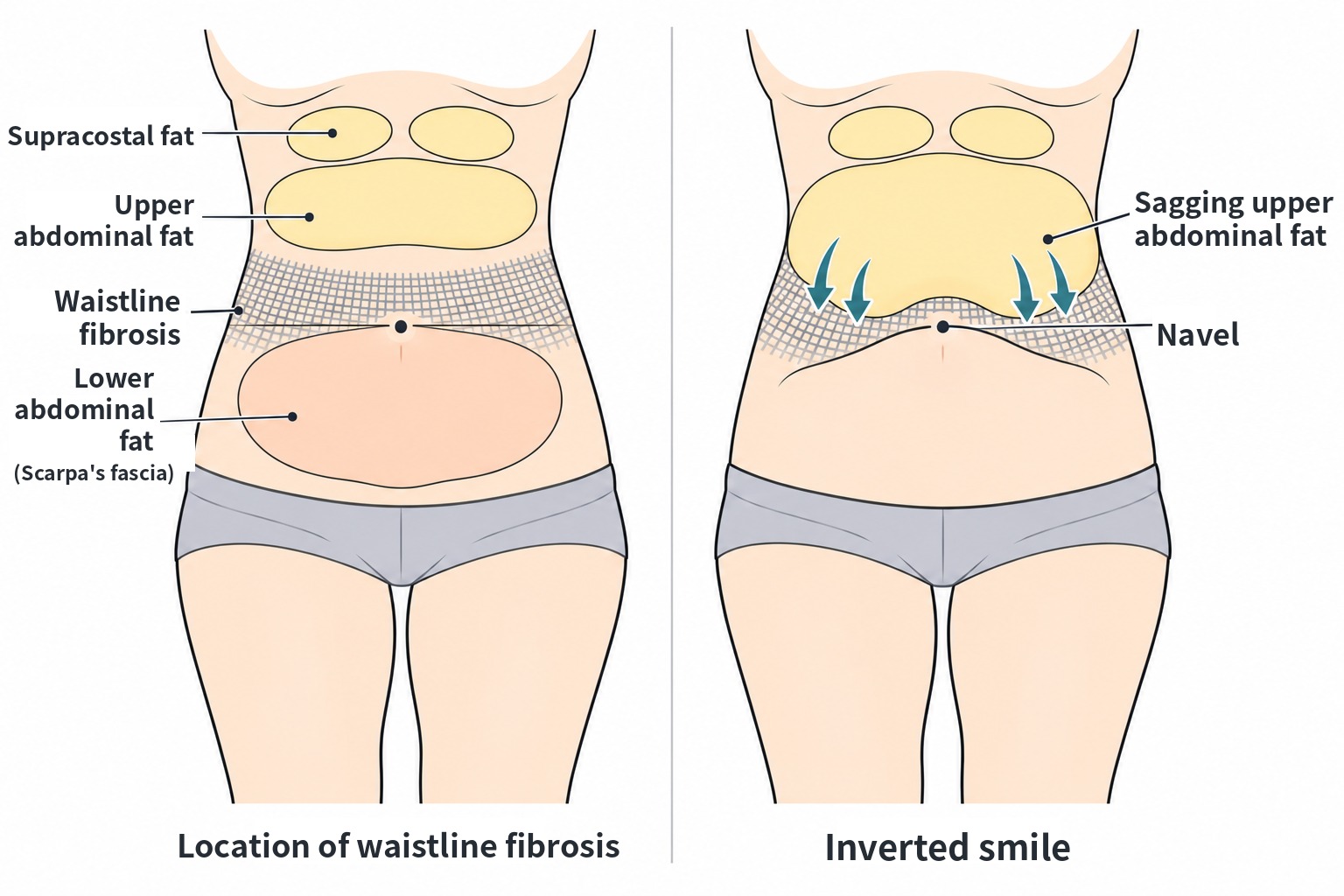
Diagram — redrawn based on Figures 31-3 and 31-21 in Chapter 31 of Klein JA (2000)
The left side of the diagram shows the location of the waistline fibrosis that runs across between the upper and lower belly. The right side shows a case in which the lower belly has been suctioned but the remaining upper abdominal fat sags over the fibrous band, so that the crease passing through the navel takes an inverted smile shape with both ends dropping downward.
This shape can be shown with a simulated before-and-after image as follows. On the left is the inverted smile shape, in which the crease passing through the navel drops at both ends because of upper abdominal fat sagging on both sides of the navel. On the right is the appearance after the upper abdominal fat has been reduced and its weight lightened.
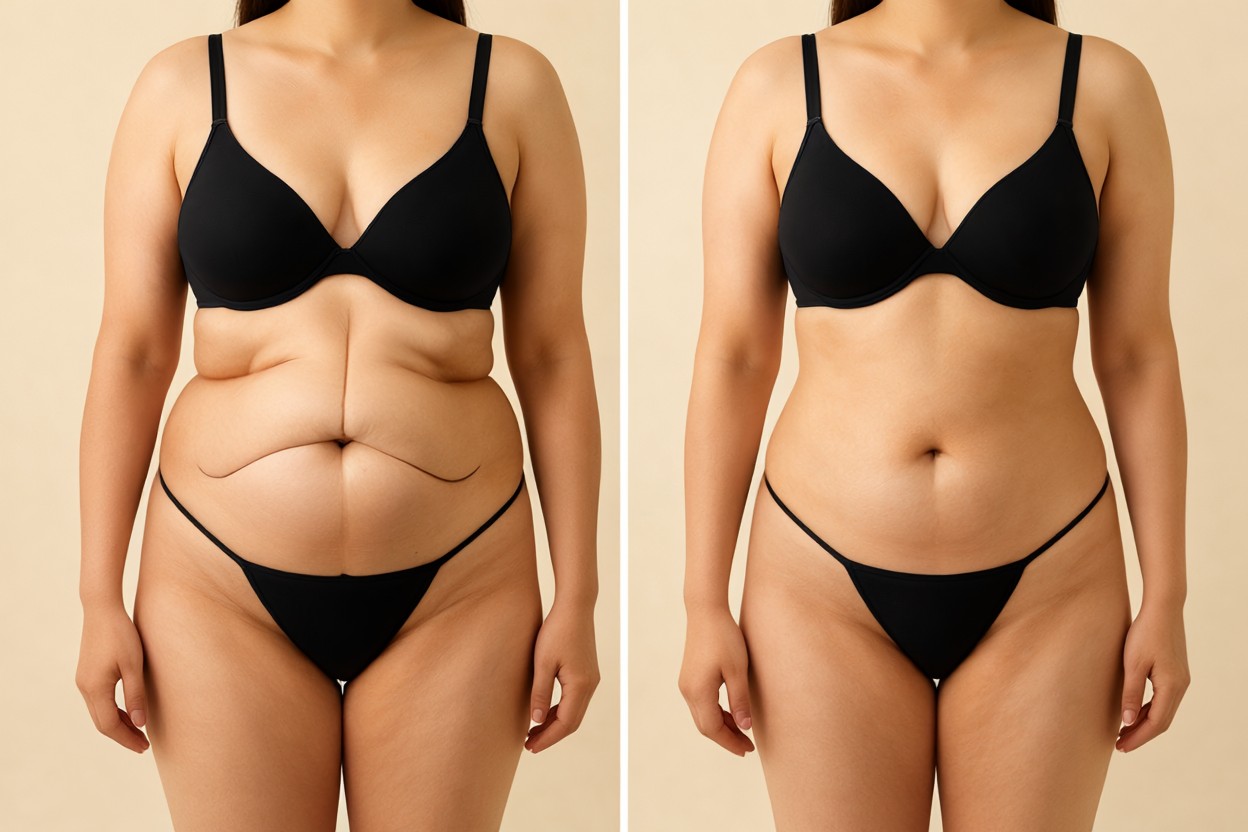
※ This is a simulated image, not an actual photo. Actual results may vary from person to person.
The shape created by sagging upper abdominal fat
If the upper abdominal fat is not removed, a heavy layer of upper abdominal fat remains and becomes an unsightly, bulging, sagging upper belly [3]. Also, unlike the lower belly, the upper belly folds when you bend your body, so horizontal creases form and it tends to protrude, and this can be mistaken for a fat layer [4]. For this reason, at the consultation we examine you standing, lying down, and sitting while bending forward, to check whether what you see is remaining fat or a skin crease.
The principle of correction — reducing the weight that pulls downward
The inverted smile shape is corrected by carefully reducing, with a thin cannula, the weight of the fat that pulls the upper abdominal skin downward [1]. Rather than cutting out the sagging crease itself, the upper abdominal fat that causes the crease is suctioned to take off its weight. At Venus Clinic as well, we correct the inverted smile shape with sagging around the navel, caused by insufficient suctioning of the upper abdomen, with repeat liposuction [5].
How Revision Upper Abdominal Liposuction Is Done
The upper abdomen requires suctioning of both the superficial and deep layers, and it is an area where special care is needed when working along the costal margin [3]. Because there is a lot of fibrous tissue and a large cannula cannot easily push through it, the fat between the fibrous tissue is suctioned evenly with a thin cannula [1]. The fat that flows down from above the ribs must be addressed together, so that the upper belly line does not become heavy again [4].
Revision surgery involves tissue that has already been operated on once, so it is firmer than in the first surgery, and over-suctioning can cause the skin and fascia to adhere, leaving an uneven surface. For this reason, we check the thickness of the remaining fat by hand as we work, and we remove the fat that needs to go as thoroughly as possible, and smooth the line so that it is not bumpy.
Liposuction is also possible after abdominoplasty
Abdominoplasty mainly removes the loose skin of the lower belly, so the upper abdominal fat between the ribs may remain. This remaining upper abdominal fat can be reduced with liposuction. However, the scar from the previous surgery remains, and liposuction does not remove scars. The amount of remaining fat is checked directly at the consultation.
Limitations of revision upper abdominal surgery
The upper abdomen shows less skin tightening after surgery than the lower belly, so even when the fat is reduced, the skin may sag and still look bulging [4]. In particular, when skin elasticity has declined, the upper belly skin may look finely wrinkled once the swelling goes down [1]. The sagging crease does not «completely» disappear; it «becomes less pronounced,» and results vary by individual depending on skin elasticity and the amount of remaining fat. If you gain weight after surgery, the remaining fat cells can enlarge and the line may change again, so weight management is also important.
References
- Klein JA. Tumescent Technique: Tumescent Anesthesia & Microcannular Liposuction. Mosby; 2000. Chapter 31.
- Shiffman MA, Di Giuseppe A, eds. Liposuction: Principles and Practice. Springer; 2006. Chapter 22.
- Shiffman MA, Di Giuseppe A, eds. Liposuction: Principles and Practice. Springer; 2006. Chapter 28.
- Venus Clinic. Liposuction at Venus Clinic — Characteristics of the Subregions of the Abdomen.
- Venus Clinic. Complications and Side Effects of Liposuction. https://en.myvenus.co.kr/should_know/38861
Before-and-After Photos
Both are cases in which fat remained in the upper abdomen after a previous abdominal surgery, and revision upper abdominal liposuction was performed. The first patient had undergone abdominoplasty; the second had undergone abdominal liposuction a long time ago. All after-surgery photos were taken 1 week after surgery. Swelling and bruising are still present at this stage, so these are not the final results, and the line becomes more refined as the swelling subsides.
Case 1 — Upper abdominal liposuction after abdominoplasty
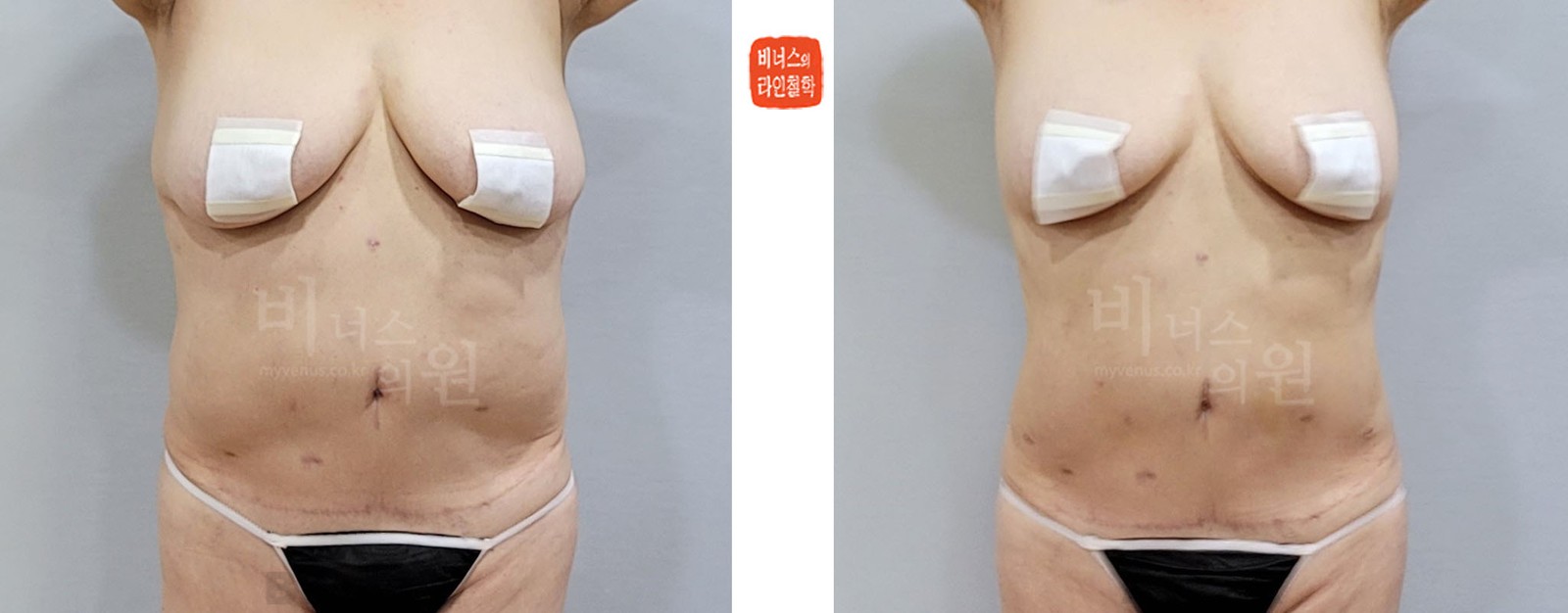
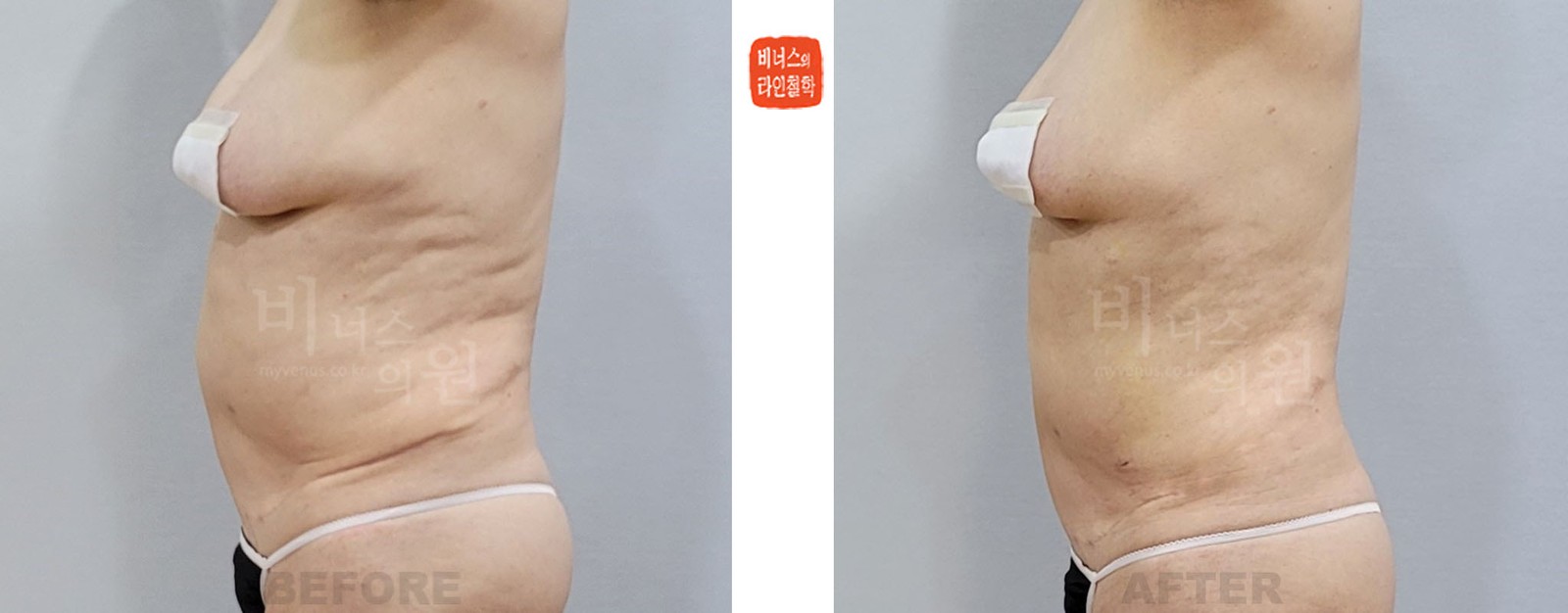
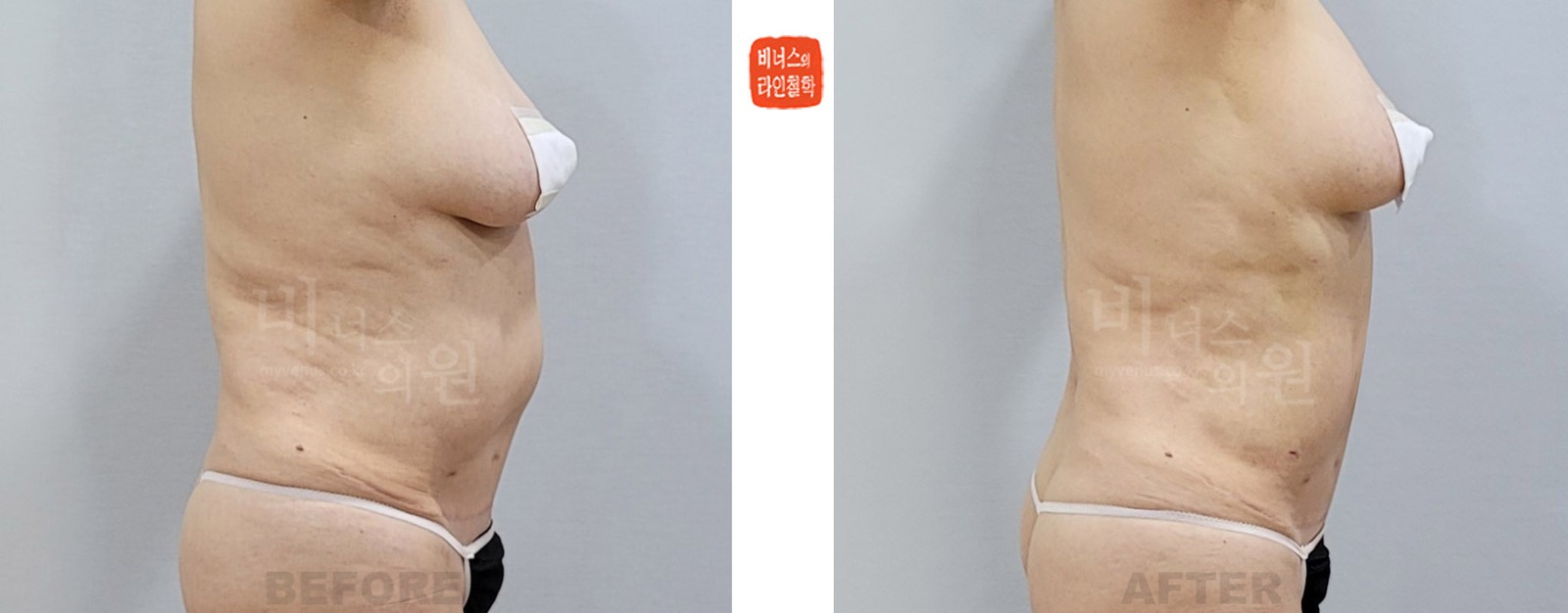
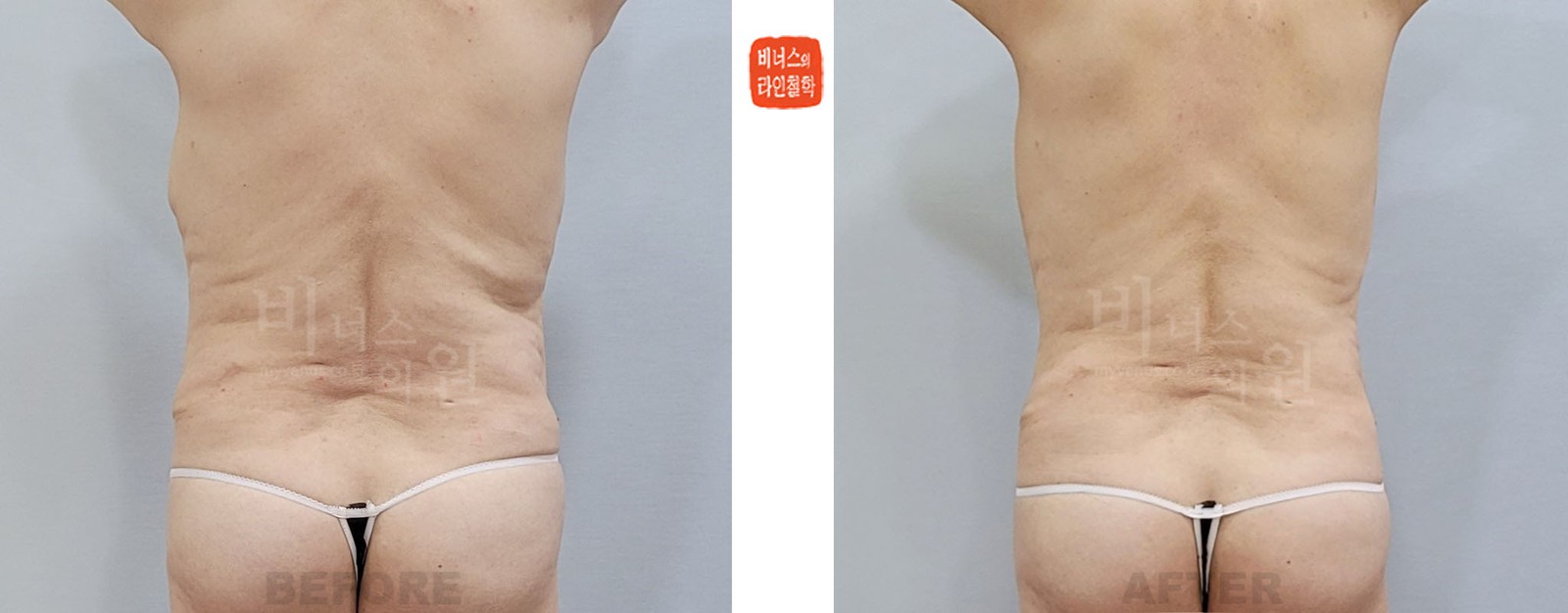
This patient had undergone abdominoplasty, but the upper abdominal fat had not been completely removed, so upper abdominal liposuction was performed. In the front view, the horizontal scar from the previous abdominoplasty is visible on the lower belly, and the lower belly is relatively flat, but the upper belly below the ribs remained bulging, and its fat sagged on both sides of the navel, showing an inverted smile shape in which, centered on the navel, both ends dropped downward like the dome of a bridge. In the photo 1 week after upper abdominal liposuction, the bulge of the upper belly has decreased and the sagging on both sides of the navel has eased. In the left and right side views, the forward protrusion of the upper belly has decreased, and in the back view, the upper abdomen and rib area have become smaller and the circumference of the upper trunk looks more refined. The scar from the previous surgery remains.
| Information on the Posted Liposuction Before-and-After Photos | |||
|---|---|---|---|
| - Same person | Surgery performed at Venus Clinic; same person | - Date taken | Taken around 4/2026; comparison at 1 week after surgery |
| - Same conditions | Edited to the same posture and size as closely as possible | - Side effects | https://en.myvenus.co.kr/should_know/38861 |
Case 2 — Upper abdominal liposuction after abdominal liposuction
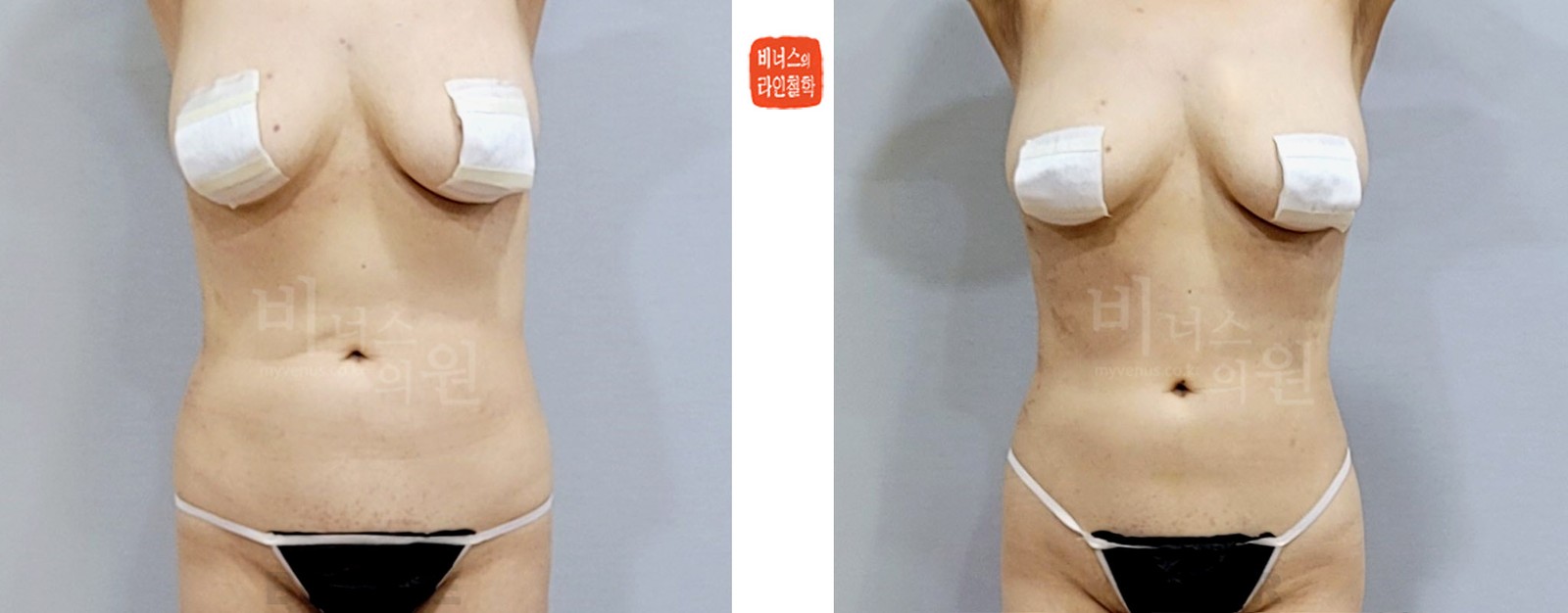
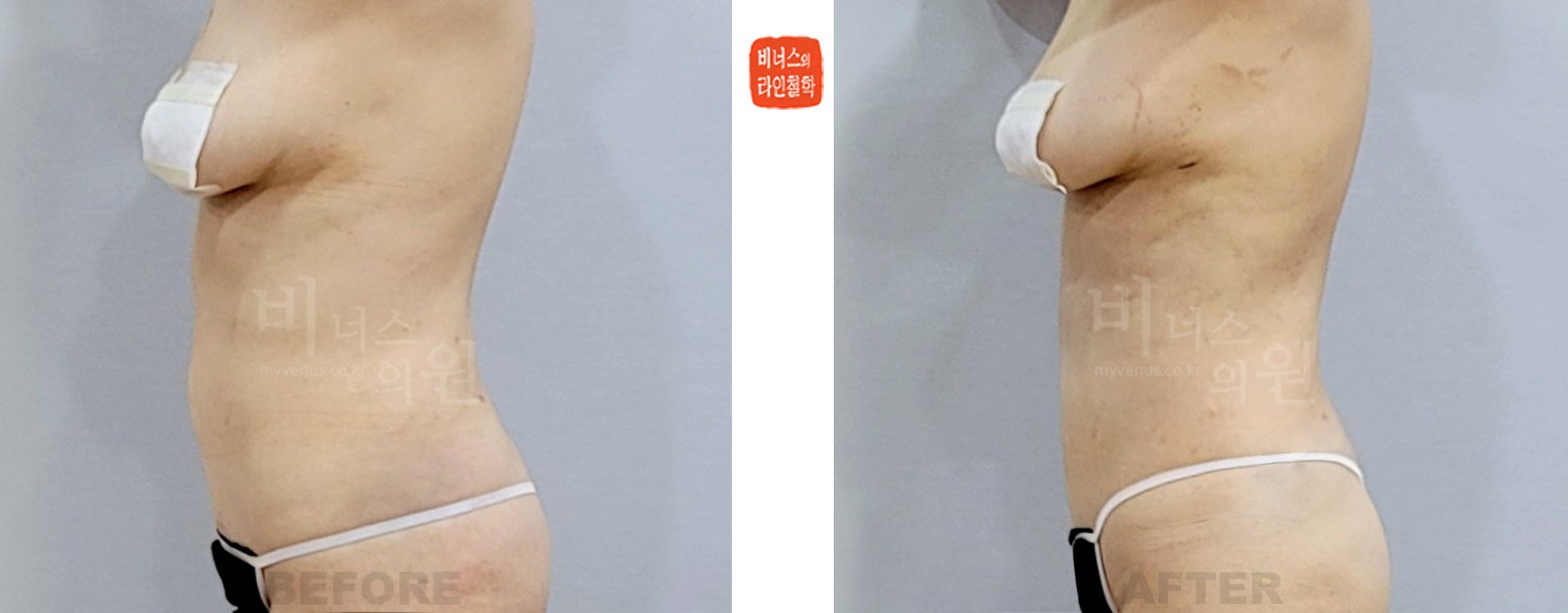
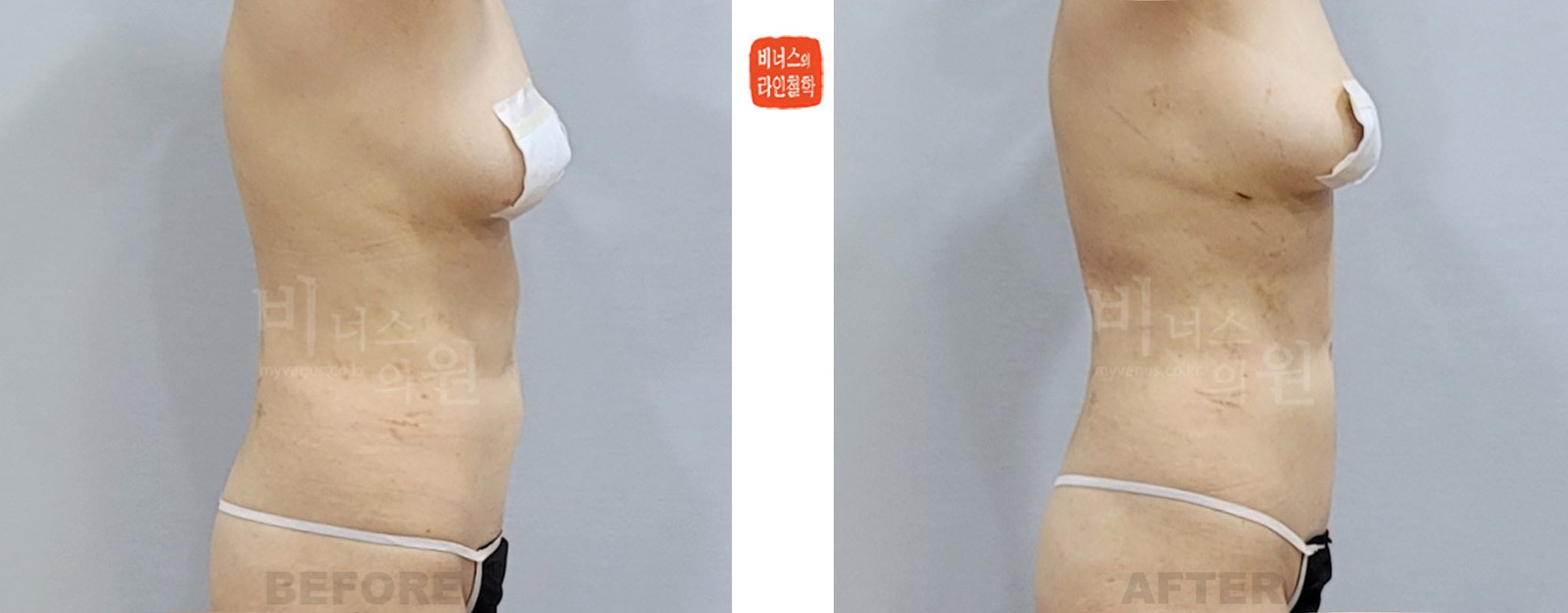
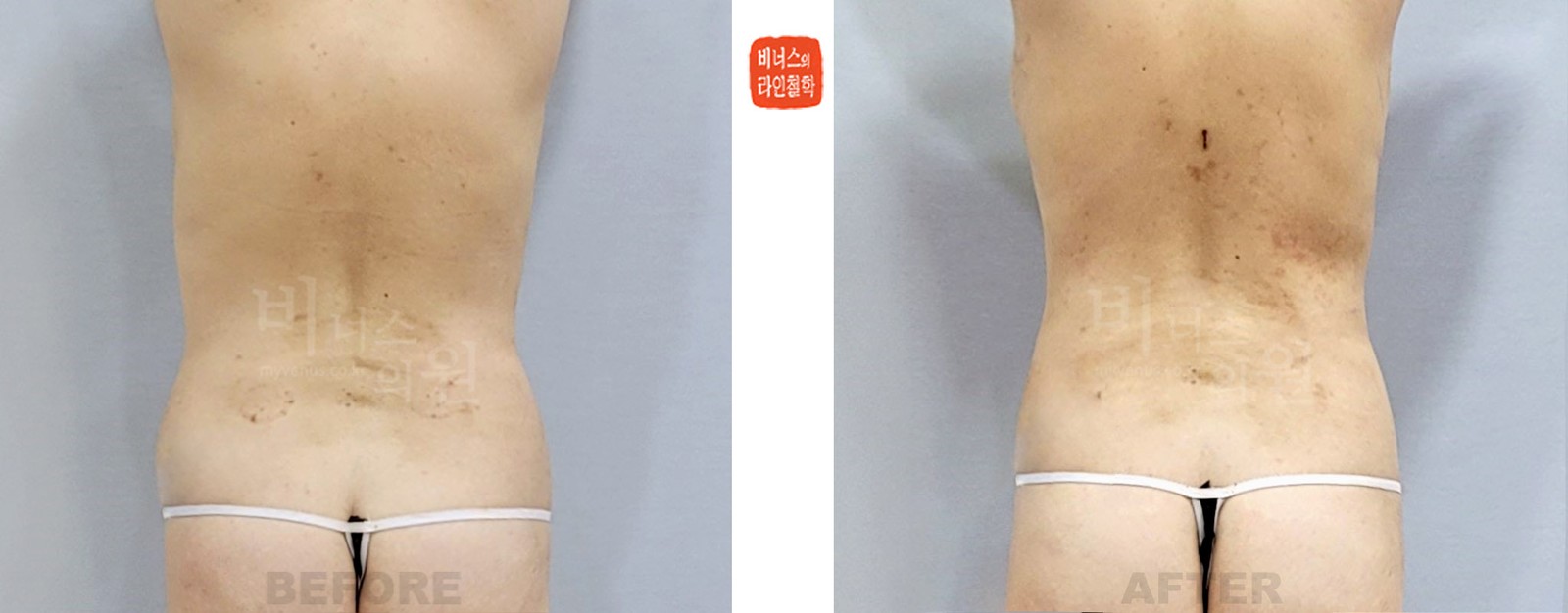
This patient had abdominal liposuction a long time ago and came in asking for the fat that remained only in the upper abdomen to be removed. The lower belly was relatively flat from the earlier surgery, but fat remained in the upper belly, and the remaining upper abdominal fat sagged on both sides of the navel, showing an inverted smile shape in which, centered on the navel, both ends dropped downward. Along with revision upper abdominal liposuction, liposuction of the back above and below the bra line was also performed. In the photo 1 week after surgery, the bulge of the upper belly has decreased and the sagging around the navel has eased, and in the left and right side views the forward protrusion of the upper belly has decreased. In the back view, the back line above and below the bra line looks more refined. Bruising and swelling are still present at this stage.
| Information on the Posted Liposuction Before-and-After Photos | |||
|---|---|---|---|
| - Same person | Surgery performed at Venus Clinic; same person | - Date taken | Taken around 10/2026; comparison at 1 week after surgery |
| - Same conditions | Edited to the same posture and size as closely as possible | - Side effects | https://en.myvenus.co.kr/should_know/38861 |
In Closing
The upper abdomen is hollowed in between the ribs and its fat contains a lot of fibrous tissue, so it is the area where fat is most likely to remain even after abdominal surgery. The remaining upper abdominal fat sags on both sides of the navel and can create an inverted smile shape, in which both ends drop downward from the navel. At Venus Clinic, when performing revision upper abdominal surgery, we also examine the area above the ribs, and we suction the fat between the fibrous tissue evenly with a thin cannula to take off the weight that has been pulling the upper belly downward. If you are concerned about an upper belly that remains after abdominoplasty or abdominal liposuction, we suggest first checking the amount of remaining fat together at a consultation.
References: Revision Abdominal Liposuction
Dr. Hakjun Kim, Director, Venus Clinic