For Smooth Liposuction Without Lumps and Bumps
During consultations, I often hear the question, "I heard liposuction can leave the skin lumpy. Will I be okay?" Some patients also come to us after surgery elsewhere because the surface was left uneven, so many people worry not only about how much fat is removed but also about whether the line will be smooth after surgery.
Today I would like to explain what we keep to in the operating room so that the line after liposuction is smooth rather than lumpy. I will go through, in order, superficial liposuction, which draws out skin contraction, and its limits; hand-held suction-assisted liposuction (SAL), in which the surgeon holds the cannula directly by hand; the fan-like pattern and criss-cross pattern, which spread the paths of the cannula evenly; and microcannula liposuction, which we use for sagging breasts, the buttocks, and the calves.
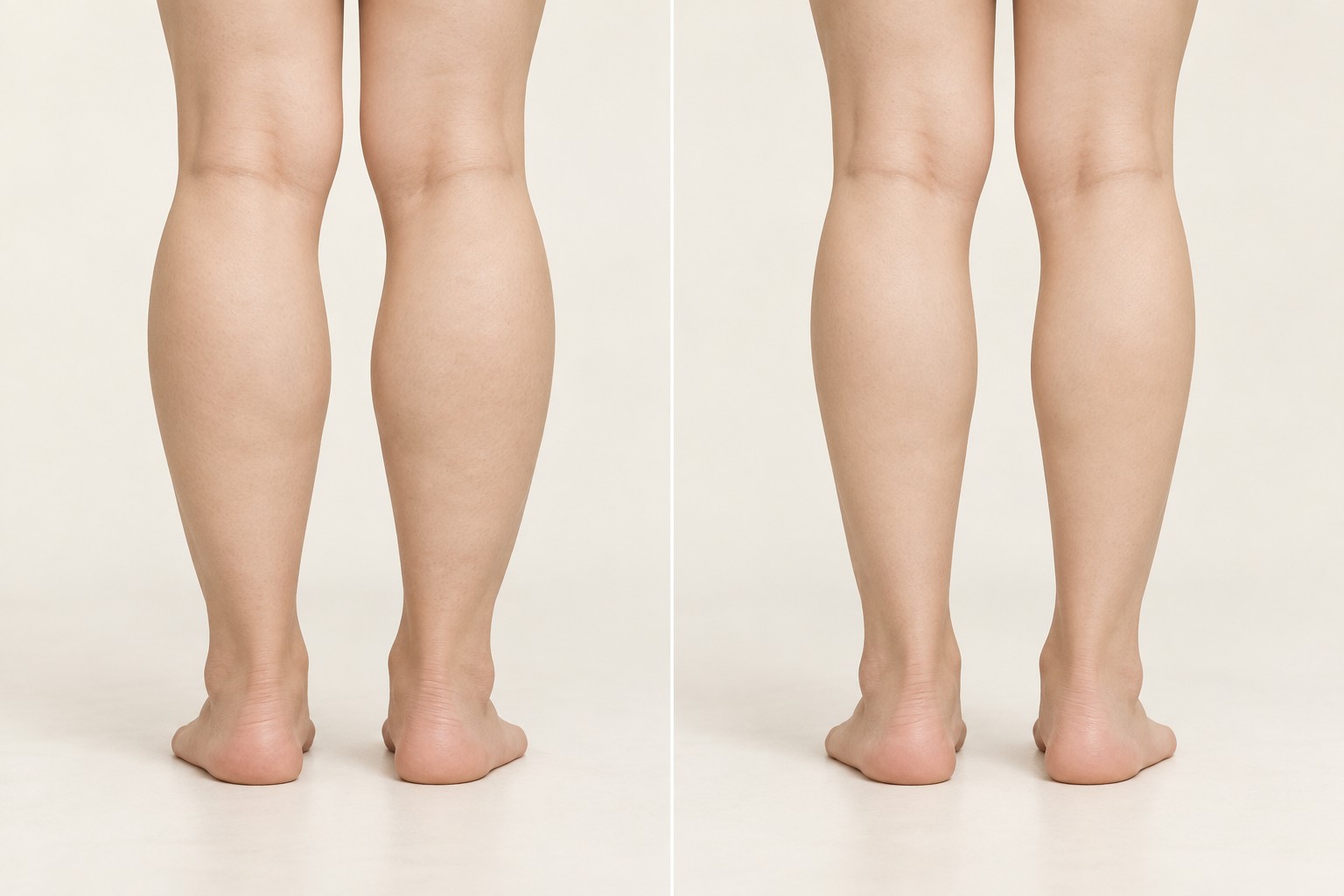
※ This is a virtual image. Actual results may vary from person to person.
The Superficial Fat Layer, Skin Contraction, and Lumpiness
The fat under the skin is divided into a shallow layer close to the skin (the superficial layer) and a deeper layer beneath it. How these layers are handled is the key to a smooth result.
Subcutaneous Fat Is Viewed as Three Layers
Liposuction textbooks explain that, for surgery, it is practical to divide subcutaneous fat into three layers: a thin layer just under the skin, an intermediate layer beneath it, and a deep layer at the bottom. [15] In the figure below, "Superficial" is the superficial layer just under the skin, "Intermediate" is the intermediate layer, and "Deep" is the deep layer. In the superficial layer, small fat lobules are wrapped in dense fibrous septa and firmly attached to the skin; the deeper you go, the larger and looser the fat lobules become.
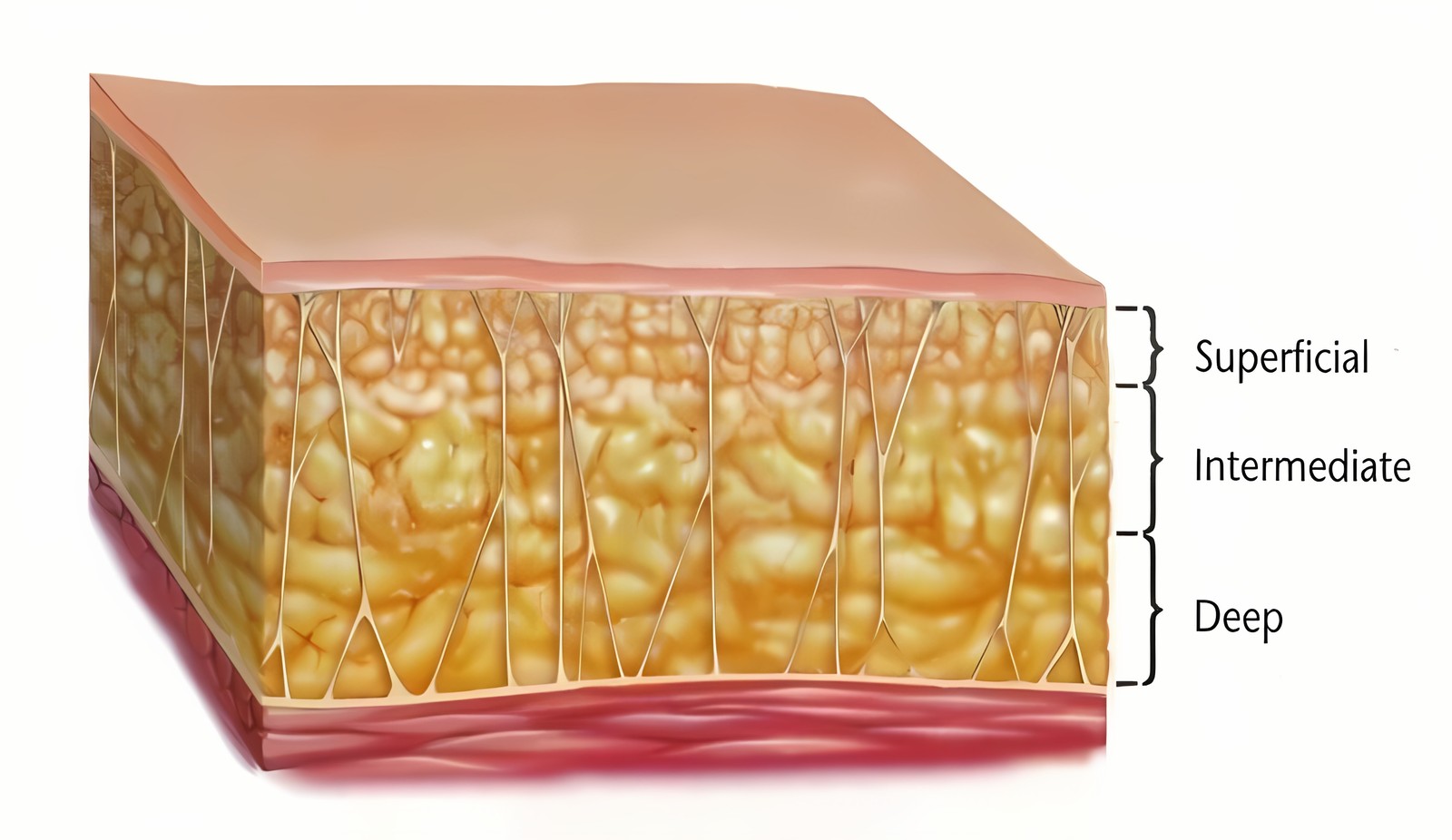
Structure of the subcutaneous fat layers — superficial, intermediate, and deep (Illustration: Venus Clinic fat tissue diagram)
The Superficial Layer: One We Would Like to Avoid, but Cannot
If you think only about lumpiness, leaving the superficial layer alone causes the fewest problems. Because this layer is attached directly to the skin, even slightly uneven suction shows up on the skin surface as it is. Textbooks also warn that deliberately and aggressively scraping the fat just under the skin does not tighten the skin but instead causes harm. [15]
However, if only the deep and intermediate layers are suctioned, the volume decreases, but a thick superficial layer remains under the skin, and the loose skin cannot re-drape over the reduced volume. In areas where skin contraction is essential, such as sagging breasts and buttocks or a loose abdomen, suctioning the superficial layer as well is unavoidable. So we at Venus Clinic choose not to "avoid" the superficial layer but to handle it "evenly" — rather than scraping just under the skin, we use the patterns and thin cannulas described below to thin the entire superficial layer to the same thickness.
Superficial Liposuction Draws Out Skin Contraction
If only the fat in the deep layer is suctioned, the volume decreases, but a thick, heavy fat layer remains under the skin, and because of gravity and swelling it tends to stay saggy. Superficial liposuction suctions evenly up to the shallow layer close to the skin, making the skin thinner and lighter. In the textbook chapter "Three-Dimensional Superficial Liposculpture for Aged and Relaxed Skin," it is explained that the thinner the skin becomes, the better it contracts, and that the looser the skin, the thinner it must be sculpted to bring out its ability to contract. [1] At Venus Clinic, we also use this principle to induce skin contraction in surgery for sagging breasts and loose areas. [2]
Removing Too Much of the Superficial Layer Makes It Lumpier
That does not mean the superficial fat should be scraped out all the way to the underside of the skin. Surgery that thoroughly suctions even the superficial fat tends to become lumpy and also raises the risk of skin necrosis and seroma (clear fluid collecting at the surgical site). [3] Liposuction textbooks also warn that trying to remove all the fat over a large area so that the skin and fascia touch tends to create small depressions, as patches of thinly remaining fat mix with empty spaces. [4]
For this reason, textbook principles of liposuction have long included the item "Respect the superficial fat layer." They also say not to point the suction openings of the cannula toward the skin, so as not to injure the blood vessels just under the skin, and explain that trying to obtain skin contraction by suctioning right up to the underside of the skin is dangerous. [5]
Skin Contraction and Surface Smoothness Must Be Balanced Together
If too little of the superficial layer is treated, skin contraction is insufficient; if it is scraped too deeply, the surface can become lumpy and the skin can be damaged. A smooth result comes from evenly sculpting the fat layer under the skin between these two.
We Leave and Refine an Even Fat Layer Under the Skin
Even for arm liposuction, textbooks explain that the superficial fat should be suctioned so that the skin contracts well, while leaving a fat layer of about 1 cm under the skin and pinching the area by hand to check that it is even. [6] At Venus Clinic, we also refine the area so that the fat layer remaining under the skin has an even thickness throughout. The skin above can contract smoothly only when an even cushion lies beneath it.
Hand-Held Suction-Assisted Liposuction (SAL) — We Hold the Cannula Directly by Hand
Evenly refining the shallow layer requires adjustments of a few millimeters at a time. That is why we at Venus Clinic perform hand-held suction-assisted liposuction (SAL), in which the surgeon moves the cannula by hand.
We Connect the Cannula Directly to the Suction Tubing, Without a Handle
Some SAL cannulas also come with a handle to grip, but we do not use a handle and instead connect the cannula directly to the suction tubing, operating while holding the metal cannula directly with our fingers. [7] There are three reasons.
| Reason | Explanation |
|---|---|
| Curved areas | Even in curved areas such as the crease under the buttock or under the chin, the cannula can be laid low along the skin surface |
| Fine control | Holding it directly with the fingertips makes it easy to change depth and direction a few millimeters at a time |
| Where a handle gets in the way | We can reach areas the cannula could not enter because the handle would first hit the operating table, the legs, or the curves of the body |
Because we move the cannula while feeling the thickness of the remaining fat layer through the resistance at our fingertips, this is advantageous for refining the surface evenly. For a detailed comparison of hand-held SAL and machine-driven PAL, please see the article "SAL vs. PAL" in the references below.
The Fan-Like Pattern and the Criss-Cross Pattern
Even with the same cannula, how smooth the result is depends on the paths (tunnels) the cannula takes through the fat layer. Two methods that textbooks commonly emphasize are the fan-like pattern and the criss-cross pattern.
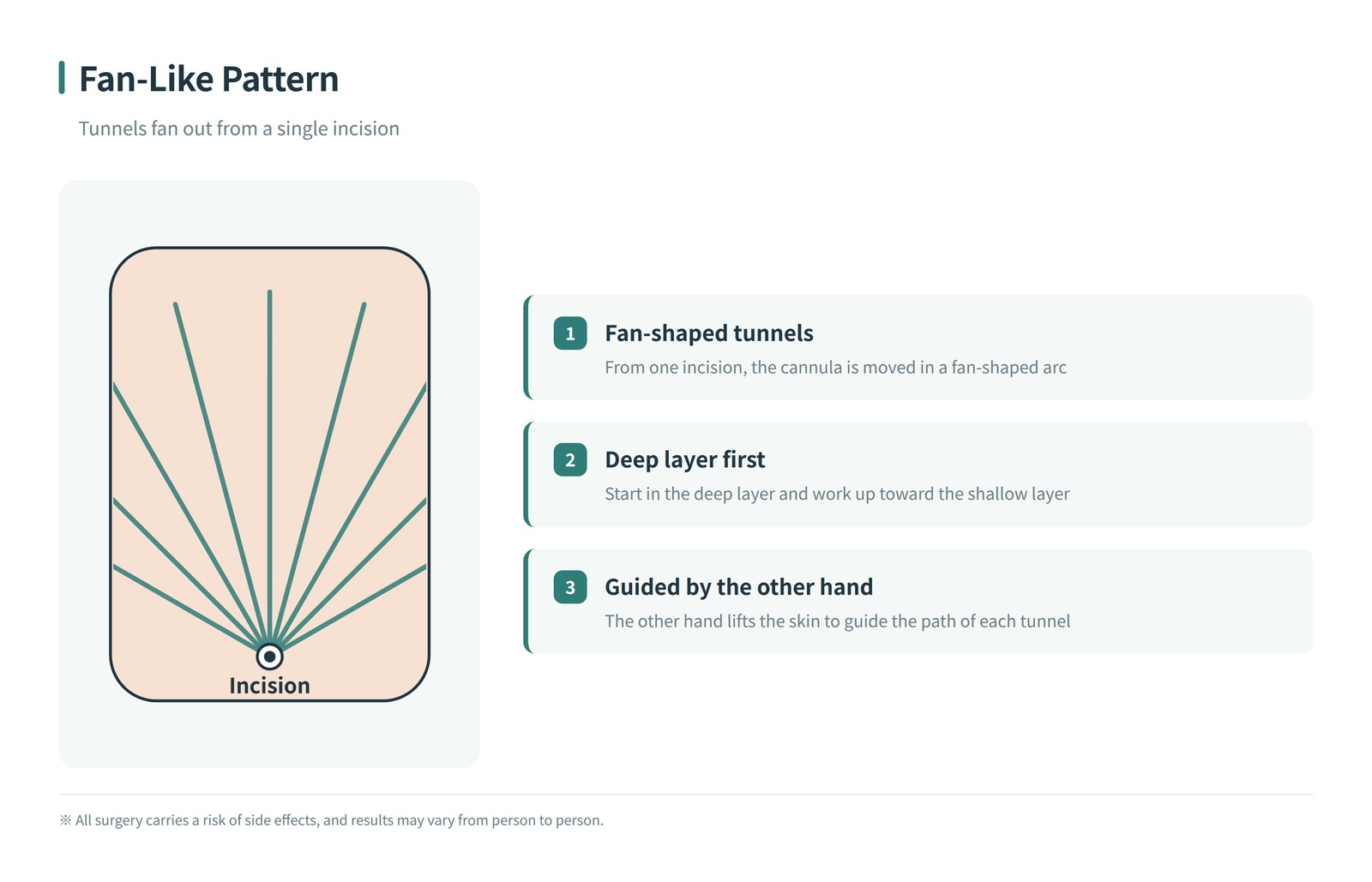
The Fan-Like Pattern — Tunnels That Spread Out Like a Fan
This method creates tunnels by moving the cannula from a single incision as if opening a fan. The tumescent liposuction textbook explains that at each incision the cannula should be moved several times along tunnels that spread out like a fan before moving on to another incision. [8] Another textbook explains that the other hand lifts the skin to create the tunnel for the cannula, that one layer of fat is suctioned as a whole in a fan pattern, and that this is repeated starting from the deep layer and moving up to the shallow layer. [9]
The Criss-Cross Pattern — Tunnels That Cross One Another
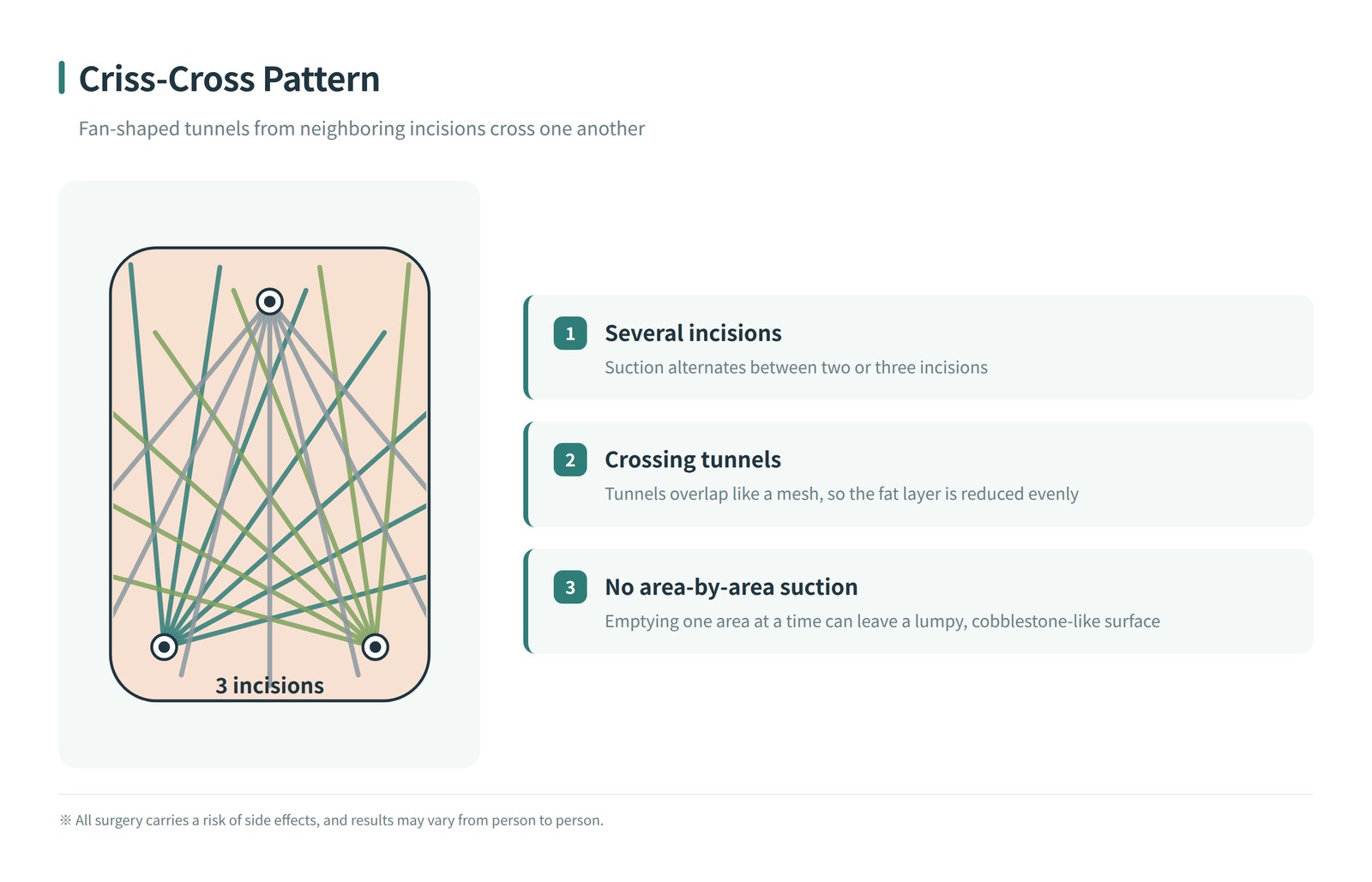
In this method, the fan-shaped tunnels made from two or three neighboring incisions are arranged to cross one another. Textbooks explain that tunnels made from one incision should cross the tunnels made from a neighboring incision, and that operating by removing all the fat in one area before moving on to the next creates a risk of a lumpy surface like a cobblestone road. [8] Another textbook also says that creating crossing tunnels removes fat more evenly. [5]
Principles Textbooks Emphasize Alongside These Patterns
The "Principles of Liposuction" chapter of a liposuction textbook summarizes, in addition to the patterns, principles directly related to a smooth surface. [5]
| Principle | Details |
|---|---|
| Crossing tunnels | Tunnels are made to cross one another so that fat is removed evenly |
| Openings facing down | The suction openings are not pointed toward the skin, so as not to injure the blood vessels just under the skin |
| Tapering the edges | At the edges of the treated area, suction is made gradually shallower so that it blends naturally with the untreated area (feathering) |
| No pinching fat into the cannula | Pinching fat and pushing it into the cannula during suction can create irregularities. Pinching is done only to check the remaining fat and the evenness between the left and right sides |
| Avoiding overcorrection | If one spot is over-thinned and becomes depressed, it must be refilled with fat grafting, so it is said to be better to touch up areas that need more later |
| Guidance by the other hand | The other hand guides the cannula so that suction is done only within the area marked in advance |
Microcannula Liposuction — Smoothing Sagging Breasts and Buttocks
The final key to reducing lumpiness is the thickness of the cannula. In particular, breasts and buttocks with sagging (ptosis) must be operated on so that the sagging skin contracts, not just so that their size is reduced, which calls for a highly delicate technique.
Sagging Breasts and Buttocks Need Superficial Liposuction
Skin contraction after liposuction comes from the elasticity of the dermis trying to return to its original state and from the shrinking force of the fibers in the fat tissue under the skin. [8] When sagging breasts are suctioned evenly up to the superficial layer, their size decreases and skin contraction is induced, so the sagging also improves. [2] The same is true of the buttocks: when the volume of the lower buttock decreases, the skin contracts, the buttock lifts, and the crease under the buttock that had been hidden becomes visible. [10] To draw out enough skin contraction in this way, the superficial layer must be suctioned evenly, not just the deep layer. Yet, as I mentioned earlier, the superficial layer is the layer where even a slight misstep shows up on the surface as lumpiness right away. [3]
That Is Why We Use Microcannulas
A microcannula is a thin cannula with an inner diameter of 2.2 mm or less. It allows precise and even suction, but because it is thin it is fragile, and because its bore is small it often clogs with fat. [11] Textbooks also recommend cannulas under 6 mm (preferably under 4 mm) for the deep layer and under 3 mm for the superficial layer, and explain that microcannulas are helpful but require many more incisions and lengthen the operating time. [5] So for large-volume liposuction over wide areas we use cannulas with a 3–4 mm bore [11], and for places that must be refined delicately, such as the superficial layer of sagging breasts and buttocks, we use microcannulas.
Microcannulas Must Be Used Together with Technique
The tumescent liposuction textbook explains that at each stage the surgeon should move through all the incisions, inserting the microcannula in a fan pattern and crossing the tunnels from neighboring incisions, so that the whole fat layer is reduced little by little. [8] It also says that when surgery aims for a smooth result with this microcannula technique, no noticeable lumpiness should occur. [8] This means that a thin cannula alone is not enough; the fan-like and criss-cross patterns and the hand-held handling described above must go together with it.
Breasts — Evenly Up to the Superficial Layer, Following the Round Shape
The breast is an area where the cannula must keep changing direction to follow its round shape. [7] To reduce size while also improving sagging, the breast must be refined evenly up to the superficial layer, and if even one spot is over-suctioned, irregularities appear on the surface. So we refine it evenly, little by little, crossing fan-shaped tunnels with a hand-held microcannula.
Buttocks — Improving Sagging by Reducing the Lower Volume
When the buttocks sag, the loose tissue of the lower buttock covers the crease between the buttock and the thigh. The lower buttock is where the body bends sharply along this crease, so the hand-held cannula must be laid low to follow the curve. [7] Only when the superficial layer here is refined evenly with a microcannula can the lower buttock line rise through skin contraction while the surface stays smooth. [10]
Calves — Carefully, with the Thinnest Cannula Possible
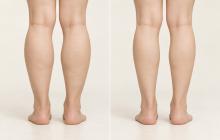
The calves and ankles have considerable pain and swelling after surgery and were once even considered unsuitable areas for liposuction. [14] After calf liposuction, long-lasting swelling around the ankles, an irregular skin surface, and fibrosis are cited as common problems. [13] For this reason, a paper analyzing leg contouring in Asian women states that, to avoid lumpiness, the thinnest cannula possible is used, especially in the calves. [12] As in the illustration at the beginning of this article, the calf is an area where an uneven surface makes the whole line look rough, so evenly refining the shallow layer with a thin cannula is what determines the result.
Limitations — What You Should Know
Suctioning evenly up to the superficial layer can induce contraction of sagging skin, but it does not completely correct the sagging. If skin elasticity is already greatly reduced before surgery or there is a large amount of excess skin, contraction may not be sufficient and some sagging or fine wrinkles may remain; the degree varies from person to person depending on skin elasticity. [11] As the fat layer becomes thinner, the shape of the muscles and bones beneath it shows through, so the result follows the original bone and muscle structure; if the calves are thick because of muscle rather than fat, liposuction alone has limits in reducing them. [13] For several weeks right after surgery, the surface may temporarily look uneven because of swelling and firmness, and if body weight increases after surgery, the remaining fat layer can become thicker again.
References
- Shiffman MA, Di Giuseppe A, eds. Liposuction: Principles and Practice. Springer; 2006. Chapter 29. Gasparotti M. Three-Dimensional Superficial Liposculpture for Aged and Relaxed Skin.
- Venus Clinic. [Case Review] Liposuction Breast Reduction for Breasts That Sag After Childbirth. en.myvenus.co.kr/column/38988.
- Venus Clinic. Liposuction and Uneven, Lumpy Results. en.myvenus.co.kr/column/38888.
- Klein JA. Tumescent Technique: Tumescent Anesthesia & Microcannular Liposuction. Mosby; 2000. Chapter 8.
- Shiffman MA, Di Giuseppe A, eds. Liposuction: Principles and Practice. Springer; 2006. Chapter 57. Shiffman MA. Principles of Liposuction.
- Shiffman MA, Di Giuseppe A, eds. Liposuction: Principles and Practice. Springer; 2006. Chapter 19. Shiffman MA, Mirrafati S. Liposuction of the Upper Extremities.
- Venus Clinic. Manual Liposuction (SAL) vs. Power-Assisted Liposuction (PAL): What Is the Difference? en.myvenus.co.kr/column/39001.
- Klein JA. Tumescent Technique: Tumescent Anesthesia & Microcannular Liposuction. Mosby; 2000. Chapter 28.
- Shiffman MA, Di Giuseppe A, eds. Liposuction: Principles and Practice. Springer; 2006. Chapter 10. Raskin B. Liposuction with Local Tumescent Anesthesia and Microcannula Technique.
- Venus Clinic. [Case Review] Asymmetric Creases Below the Buttocks. en.myvenus.co.kr/column/38983.
- Venus Clinic. [Case Review] Circumferential (360-Degree) Liposuction for a Sagging Abdomen. en.myvenus.co.kr/column/38989.
- Tsai FC, Chen CH, Lin CY, Ho LY. Analysis of the Body Mass Index and Leg Profiles of Asian Women after Total Leg Sculpture. Plast Reconstr Surg. 2009.
- Hwang K, Kim YJ, Chung IH, Won HS, Tanaka S, Lee SI. Innervation of Calf Muscles in Relation to Calf Reduction. Ann Plast Surg. 2003;50(5).
- Shiffman MA, Di Giuseppe A, eds. Liposuction: Principles and Practice. Springer; 2006. Chapter 21. Cherif-Zahar K, Bensenane-Hasbelaoui S. Liposculpture of the Lower Extremities Using a Tourniquet.
- Klein JA. Tumescent Technique: Tumescent Anesthesia & Microcannular Liposuction. Mosby; 2000. Chapter 25. Subcutaneous Fat Anatomy and Histology.
Before-and-After Photos
Here are photos of a patient who underwent breast reduction liposuction, shown from the front, the left 45-degree angle, and the right side. All of the after photos were taken 1 week after surgery. Bruising and swelling still remain, so the skin color is uneven and this is a picture of recovery in progress, not the final result; the shape will change a little more as the swelling subsides and the skin contracts.
Breast Reduction Liposuction Case
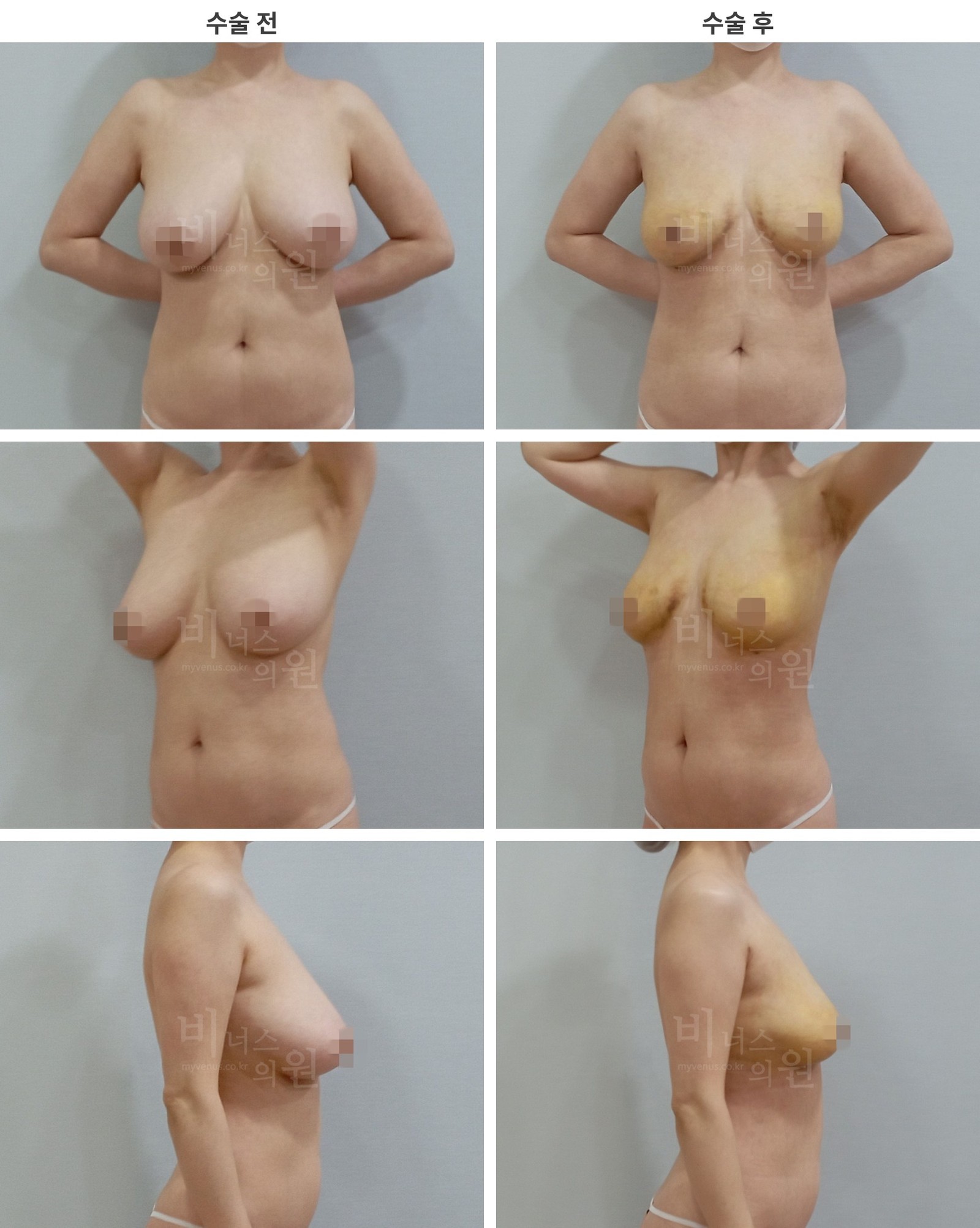
This is a breast reduction liposuction case. The treated areas were the back, armpits, and breasts; from top to bottom, the photos show the front, left 45-degree, and right side views before surgery (left) and after surgery (right). Before surgery, both breasts were large and sagging downward. In the photos taken 1 week after surgery, the breasts are smaller, and the lower part of the breasts sits higher than before, showing less sagging. In the right side view as well, both how far the breasts project forward and how far they sag downward have decreased.
The areas this patient had treated are shown in the illustration below.
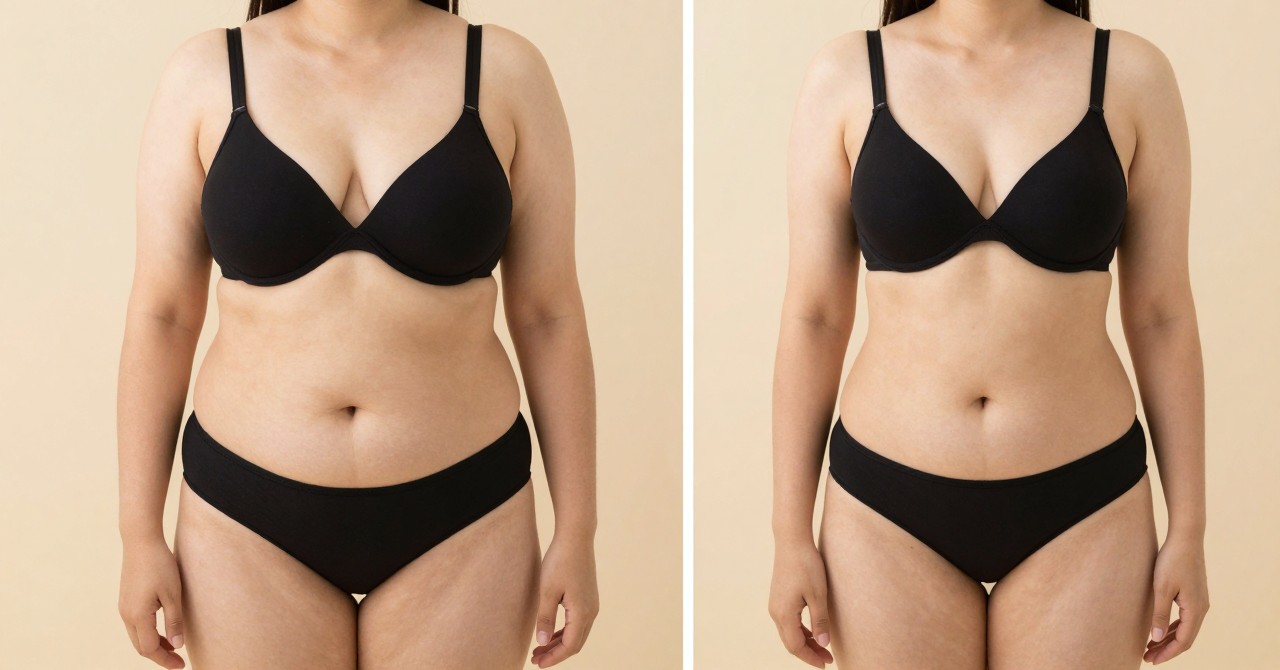
※ This is a virtual image. Actual results may vary from person to person.
| Information on the Posted Liposuction Before-and-After Photos | |||
|---|---|---|---|
| - Same person | Surgery performed at Venus Clinic; same person | - Date taken | Taken around 2022; comparison at 1 week after surgery |
| - Same conditions | Edited to the same posture and size as closely as possible | - Side effects | https://en.myvenus.co.kr/should_know/38861 |
In Closing
Smooth liposuction begins with drawing out skin contraction through superficial liposuction, without scraping the superficial layer right up to the underside of the skin, and refining the area while leaving an even fat layer under the skin. At Venus Clinic, we perform hand-held liposuction in which we hold the cannula directly by hand, keeping to the fan-like pattern and the criss-cross pattern, and in places where the superficial layer must be refined, such as sagging breasts and buttocks, we use microcannulas to remove the fat that needs to be removed as thoroughly as possible and to refine the line so that it is smooth rather than lumpy. In areas where the surface easily shows, such as the calves, we also operate carefully with the thinnest cannula possible.
References: Liposuction and Uneven, Lumpy Results SAL vs. PAL Sagging Breast Reduction After Childbirth
Dr. Hakjun Kim, Director, Venus Clinic