Manual Liposuction (SAL) vs. Power-Assisted Liposuction (PAL): What Is the Difference?
During consultations, I often hear questions like "What machine do you use for surgery?" or "Isn't power liposuction, where the cannula moves on its own, better?" Because people see the names of many devices in advertisements, many assume that the better the machine, the better the result.
Today I would like to compare the two most basic methods of liposuction: SAL (manual, hand-held liposuction), in which the surgeon moves the cannula by hand, and PAL (power-assisted liposuction), in which a motorized handpiece makes the cannula vibrate. In particular, I will explain why the difference between the two methods becomes larger in small, delicate areas such as the buttocks, breasts, chin, and calves, and show you, with actual surgery scenes and before-and-after photos, how we at Venus Clinic operate on hard-to-reach areas such as the lower buttock.

How Do SAL and PAL Differ?
Whatever device is used, modern liposuction follows a common process: tumescent fluid is first injected to swell and firm up the fat layer, and then the fat is drawn out by the negative pressure of an aspirator. The difference between the two methods lies in what moves the cannula. [1]
SAL — Manual Liposuction in Which the Surgeon's Hand Moves the Cannula
SAL (suction-assisted liposuction) uses the negative pressure of an aspirator, while the back-and-forth movement of the cannula is done directly by the surgeon's hand. It is the most basic surgical method, so much so that it is also called conventional liposuction, and most modern liposuction is performed this way. It is also the method we mainly use at Venus Clinic. [2] Syringe liposuction, which uses only the negative pressure of a syringe instead of an aspirator, is broadly the same kind of "by hand" liposuction. [2]
As shown in the photo below, some manual cannulas also have a grip (handle) attached behind the metal tube. There is no motor, but the surgeon holds the thick handle to move the cannula. The tip of the cannula is rounded and closed, and fat is drawn in through the holes on its side.
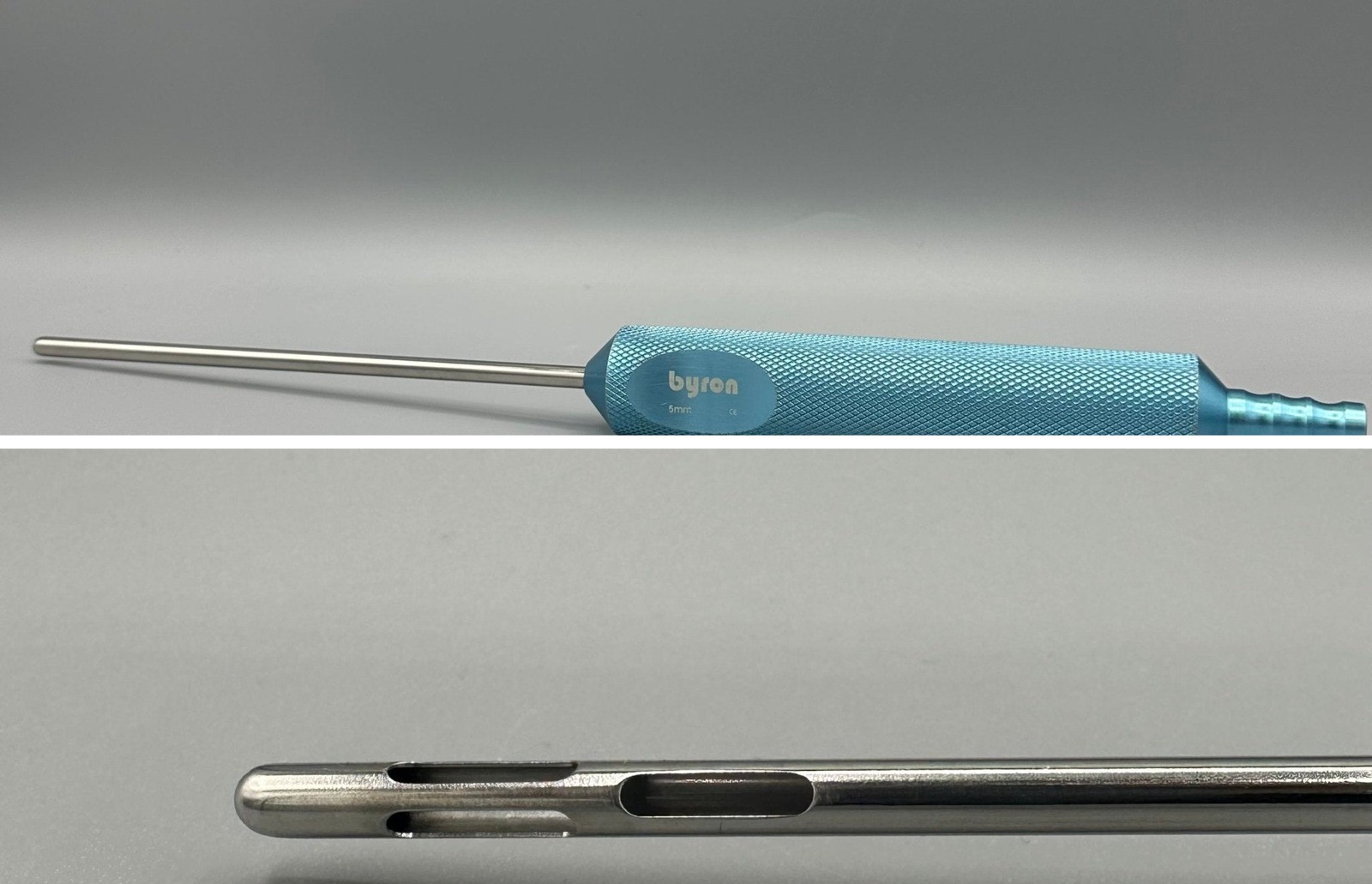
Example of an SAL cannula with a handle (top) and the suction holes at the cannula tip (bottom) — a Byron (now Mentor) product (Photo source: Angelus Medical product page, angelusmedical.com)
However, we at Venus Clinic do not use this kind of handle. Instead, we connect the cannula directly to the suction tubing and operate by holding the metal cannula itself with our fingers. There are three reasons. First, in curved areas such as the crease under the buttock or under the chin, the cannula must be laid low along the skin surface, and a handle prevents us from reaching that angle. Second, holding the cannula directly with the fingers makes fine control easier, allowing us to change depth and direction millimeter by millimeter. Third, the handle tends to hit the operating table, the legs, or the curves of the body first, creating areas the cannula cannot reach because of the handle.
PAL — Power-Assisted Liposuction in Which a Motorized Handpiece Vibrates the Cannula
PAL (power-assisted liposuction) connects the cannula to a handpiece containing a motor driven by electricity or compressed air, so that the cannula vibrates back and forth hundreds of times per second. [1] Textbooks explain that the cannula moves back and forth over a range of about 2–7 mm, helping it pass through the fat layer. [3] Below is what an actual PAL device looks like. There is a thick motorized handpiece connected to the main unit by a cable, and the cannula is inserted into the front of that handpiece.
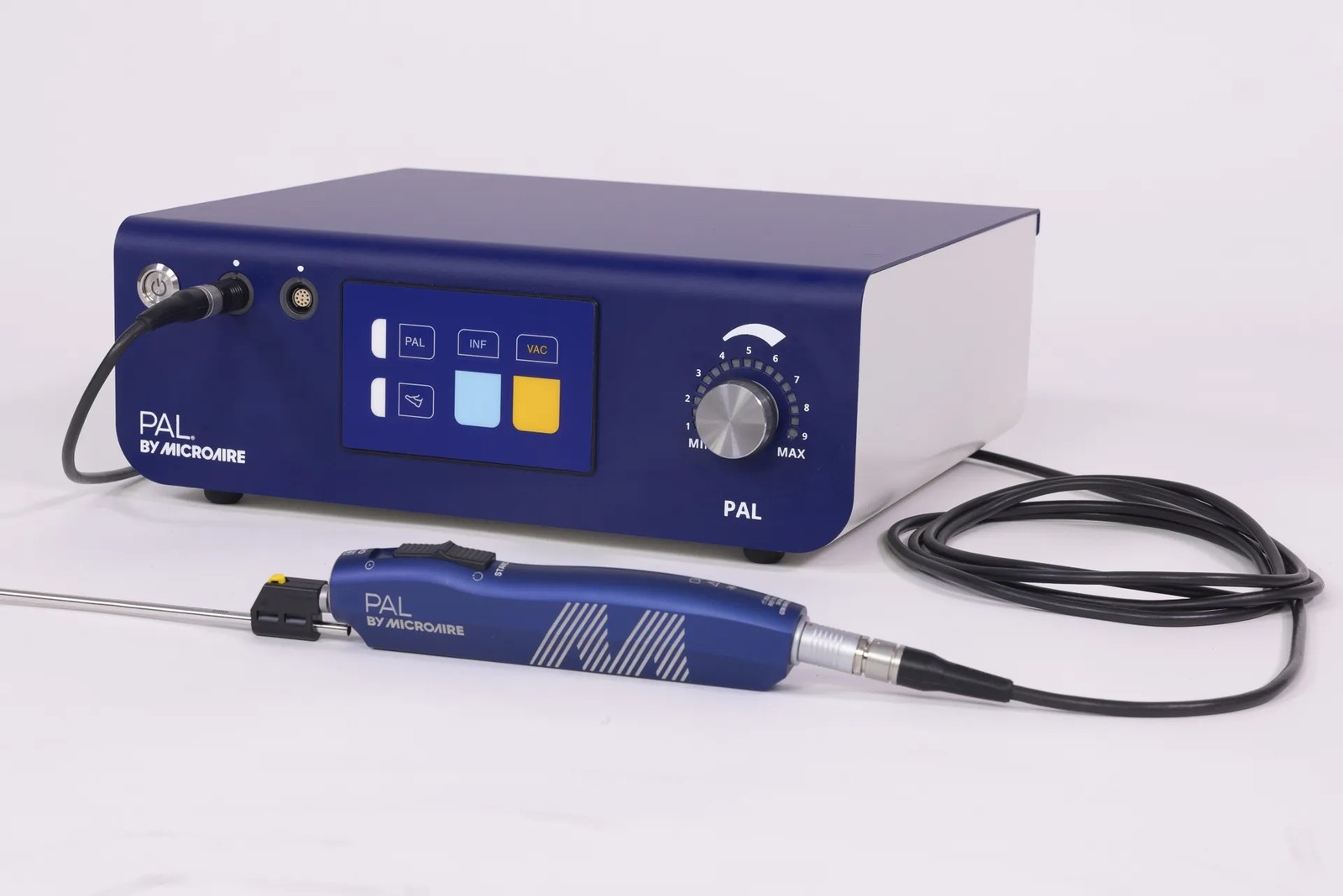
PAL main unit and motorized handpiece (Photo source: MicroAire website, microaire.com)
During surgery, the surgeon holds this motorized handpiece, and the suction tubing connected to the back of the handpiece leads to the suction canister. The biggest difference from SAL, where the cannula is held directly in the hand, is that a handpiece longer than the palm and a power cable trail behind the cannula.
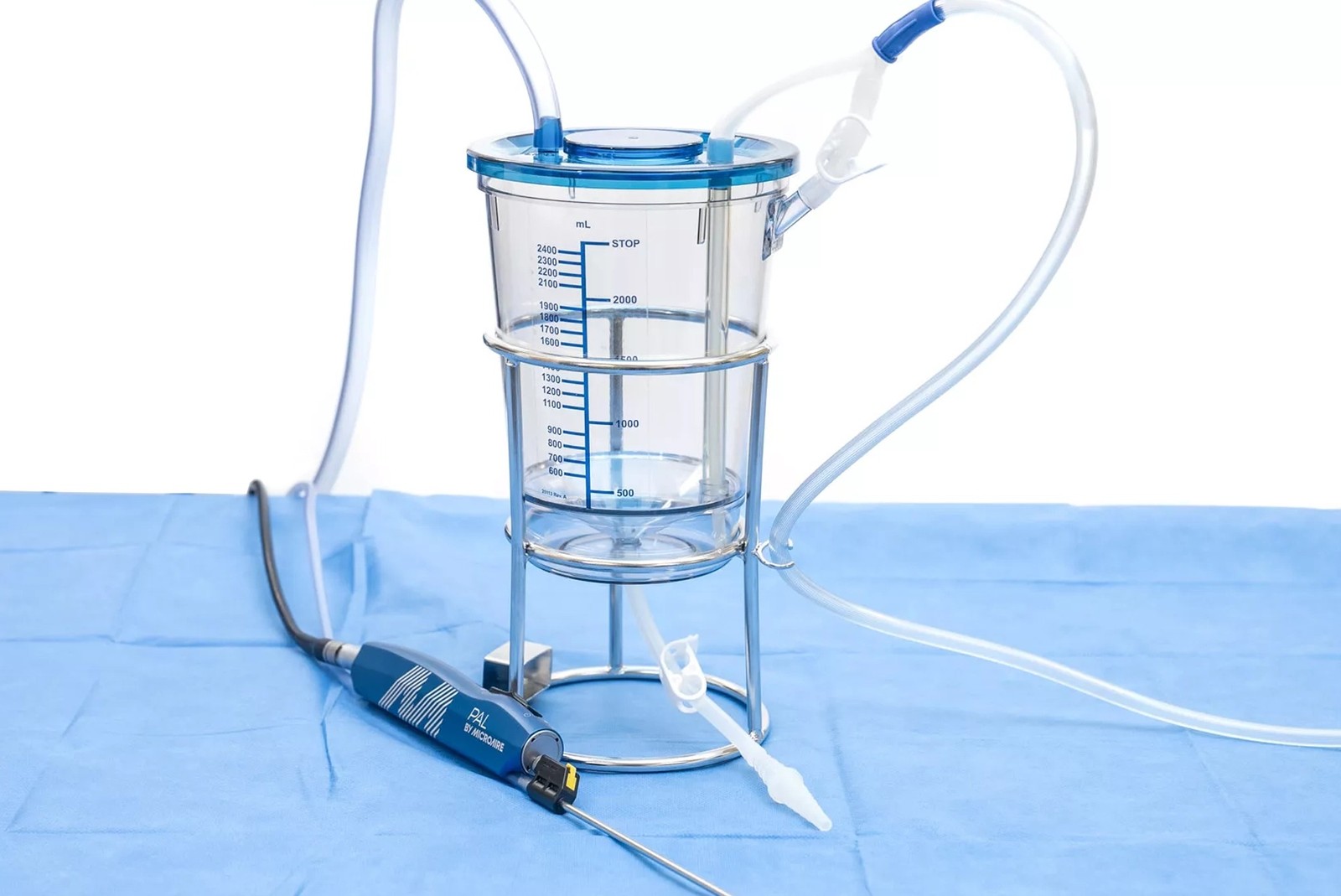
PAL motorized handpiece and suction canister on surgical drapes (Photo source: MicroAire website, microaire.com)
If the device above is an electric PAL, then Lipomatic, which is also widely used in Korea, is a PAL driven by compressed air. [1] The company that makes Lipomatic describes its current product as one in which a handpiece with a pneumatic motor swings the tip of the cannula in small circles (nutation) to remove fat. [9] An air hose and suction tubing are connected to the back of the handpiece, and the main unit is a mobile device fitted with a suction canister. Although the principle of movement is slightly different, the structure is the same: there is a thick handpiece held in the hand, and the cannula is connected in front of it.
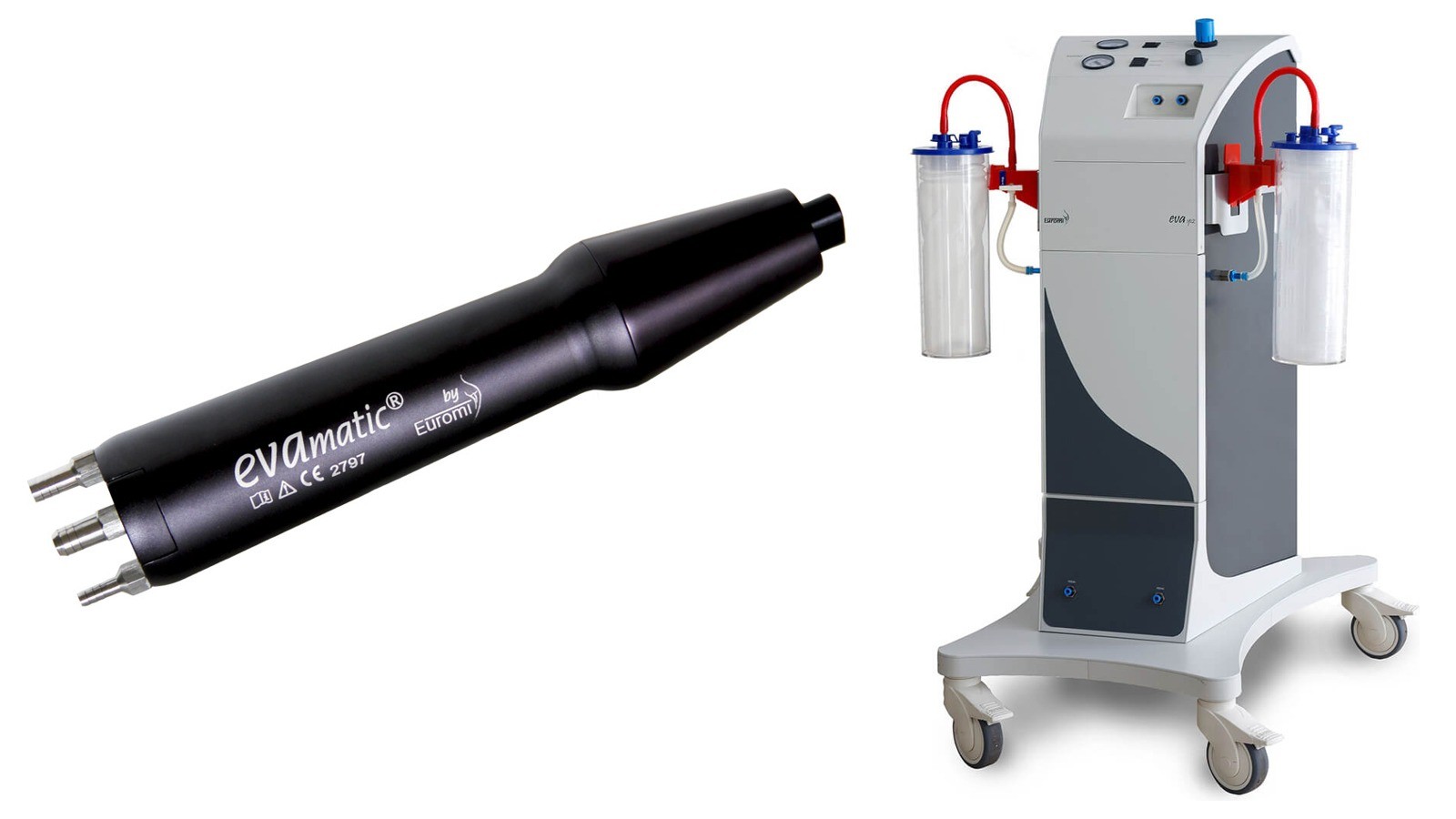
Pneumatic PAL device — handpiece on the left, main unit on the right (current product of Euromi, the maker of Lipomatic · Photo source: Euromi website, euromi.com)

The features of the two methods are summarized in the table below.
| Item | SAL (manual) | PAL (power-assisted) |
|---|---|---|
| How the cannula is held | Some cannulas have a handle, but at Venus Clinic we hold the cannula directly in the hand without a handle | The surgeon holds a handpiece containing a motor, and the cannula is connected to the front of the handpiece |
| Movement of the cannula | The surgeon's hand adjusts depth, direction, and speed moment by moment | The motor vibrates continuously over a fixed range [3] |
| Weight and noise | Light and quiet | The handpiece is heavy, and there is noise and vibration [1][4] |
| Fibrous areas | Requires more effort from the surgeon | Passes more easily through firm areas such as the male breast and flanks [1][3] |
| Surgeon fatigue | Requires a lot of physical stamina from the surgeon | There are reports that it takes less effort and that suction is faster [5] |
| Bruising, swelling, and recovery | Comparative studies found no clear difference between the two methods [5] | |
| Access to small, delicate areas | Even curved areas can be reached by adjusting the angle with the fingertips | Depending on the patient's position, some areas are hard to reach because of the handpiece |
Why the Difference Grows in Small, Delicate Areas
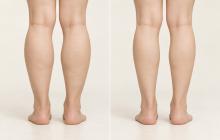
In wide, flat areas such as the abdomen or the front of the thighs, the cannula can be moved in long strokes with either method. But in areas that are small and sharply curved, such as the buttocks, breasts, chin, and calves, the story is different.
PAL with a Handpiece — Some Areas Cannot Be Reached Depending on Body Position
PAL has a handpiece containing a motor, to which the cannula is connected. The cannula must be inserted at a low angle along the skin surface, but in places where the body curves, the more you try to lay the cannula down, the more the thick, heavy handpiece behind it hits the operating table, the other leg, or the curves of the body first. As a result, depending on the patient's position, there are areas where it is difficult for the cannula to enter at the desired angle. Also, because the motor keeps vibrating over a fixed range, there are limits to fine control in small, delicate areas where depth must be refined millimeter by millimeter.
Venus Clinic's Handle-Free SAL — Holding the Cannula Directly and Following the Curves
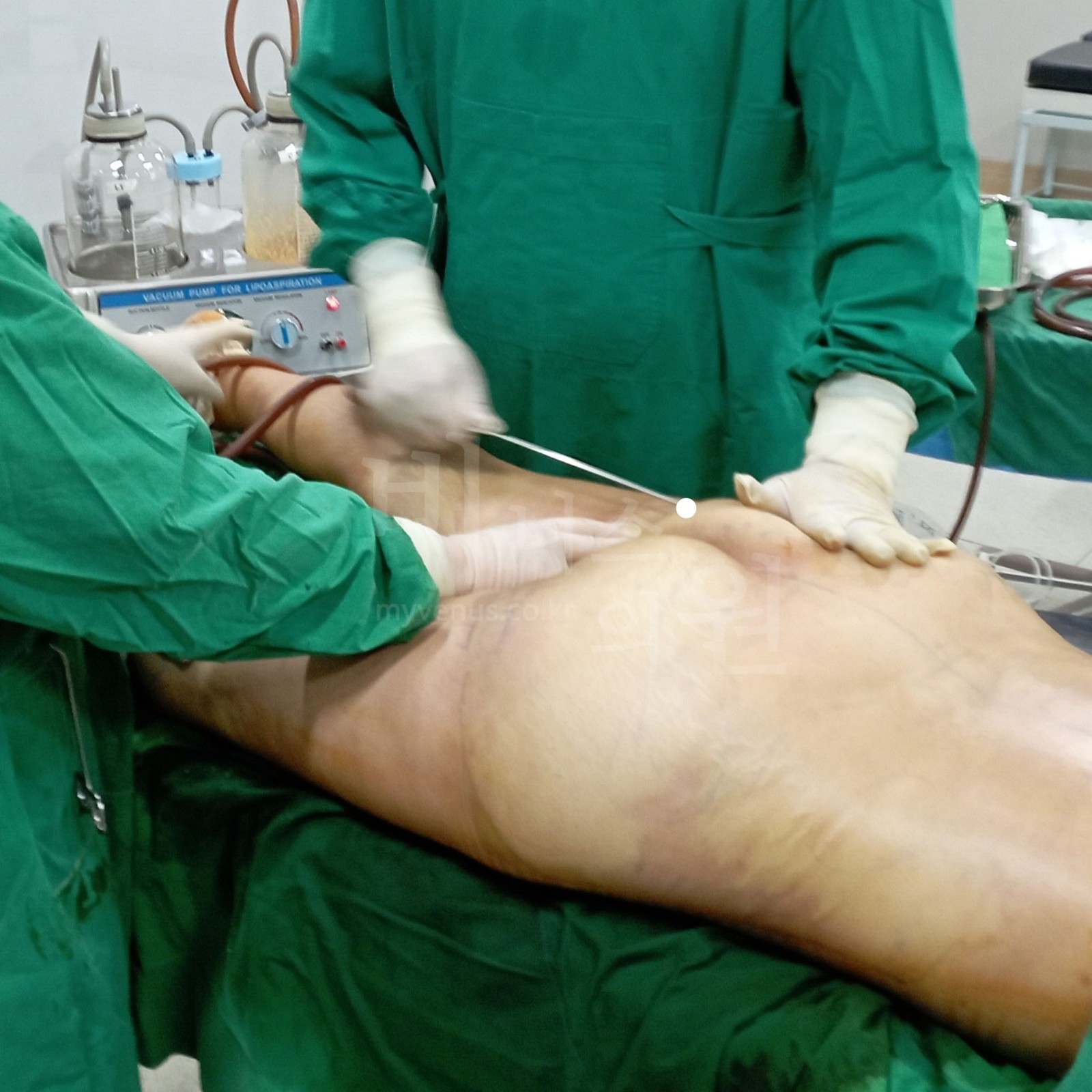
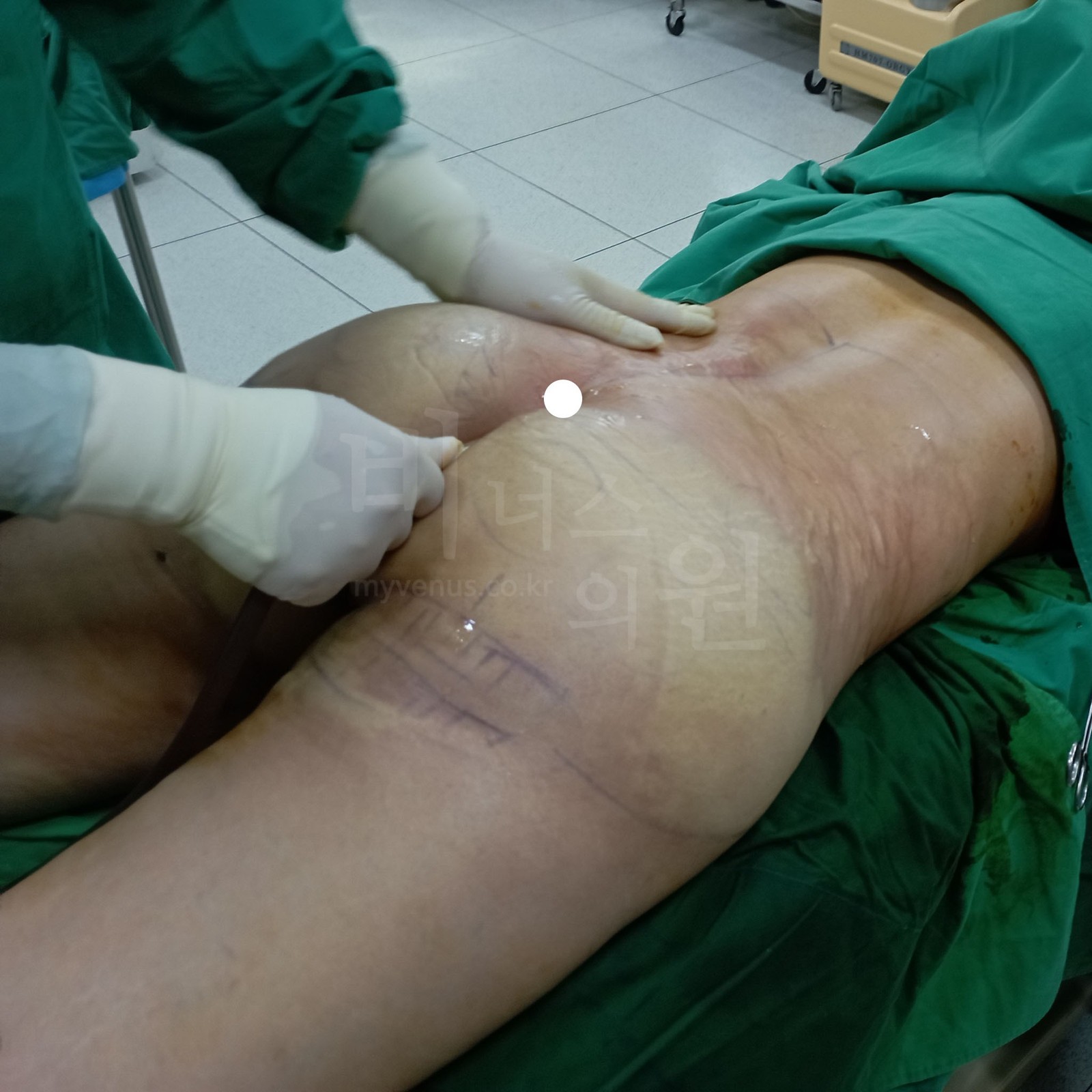
In SAL at Venus Clinic, the surgeon operates holding the cannula directly in the hand without a handle. Because the hand itself acts as the handle, the cannula can be laid low or angled to follow the curves of the body, making it possible to operate on hard-to-reach areas such as curved regions. Textbooks also describe lifting the skin slightly with one hand to guide the cannula's path while controlling the cannula's movement and direction with the other hand. [6] Because the surgeon moves the cannula while feeling the thickness of the fat layer through the resistance transmitted to the fingertips, this approach is advantageous for smoothing the lines so they are not lumpy.

Why We Call the Buttocks, Breasts, Chin, and Calves "Small, Delicate Areas"
The fat in the chin, neck, calves, and ankles consists of only a single layer, so in these areas the shallow layer close to the skin must be suctioned. [7] In the shallow layer, removing even slightly more or less shows up immediately on the surface, so delicate control is needed. In submental (under-the-chin) liposuction, cannulas are used in order starting from thin ones, and textbooks explain that the thinner the cannula and the smaller its holes, the smoother the result and the lower the chance of injuring nerves or blood vessels. [8]
The lower buttock is where the body bends deeply along the crease between the buttock and the thigh, and the breast is where the cannula must keep changing direction to follow its round shape. In such areas, the biggest advantage of SAL is that a hand-held cannula can follow the curves. Below is an actual surgery scene at Venus Clinic, where the lower buttock is being suctioned while the cannula is held in the hand without a handle.
PAL Has Its Advantages Too
To be fair, PAL clearly has its advantages. According to textbooks and studies, PAL suctions faster and requires less effort from the surgeon, and it is especially useful in fibrous areas where the cannula does not pass easily, such as the male breast and male flanks. [3][5] There are also reports that many patients find the sensation of a vibrating cannula more comfortable. [3]
SAL and PAL in Research
In studies comparing PAL with conventional liposuction (SAL), PAL came out ahead in ease and speed of fat removal, shorter operating time, and less surgeon fatigue. However, neither method showed a clear advantage in postoperative bruising, swelling, results, recovery time, or complications. [5] On the other hand, the disadvantages of PAL include cost and excessive vibration and noise of the cannula [4], as well as a heavy handpiece and the possibility that friction from vibration may enlarge the incision site or cause pigmentation. [1]
In the end, PAL may be convenient for quickly removing fat from large areas, but in our view, manual SAL is better suited to small, delicate areas and curved areas where the lines must be refined millimeter by millimeter. And whichever device is used, what determines the result of liposuction is not the machine but the surgeon's knowledge and experience, and the care taken to refine the details to the very end. [1]
You Should Also Know the Limitations of SAL
Because in SAL the surgeon moves the cannula by hand from start to finish, the operation takes longer and requires a lot of physical stamina from the surgeon. At Venus Clinic, for large-volume surgeries, two doctors operate together to share this burden. Also, as the fat layer becomes thinner, the shape of the underlying muscles and bones shows through, so no matter which method is used, the result is affected by the person's original bone structure, muscle shape, and skin elasticity. Please also keep in mind that if you gain weight after surgery, the remaining fat layer can become thicker again.
Buttock Volume-Up — The Hard-to-Reach Lower Buttock and Upper Thigh
The surgery that best shows the advantages of SAL is buttock volume-up liposuction. Buttock volume-up liposuction reduces fat in the lower buttock and encourages skin contraction, so that the buttock becomes smaller while the lower line of the buttock appears lifted. The key technique for drawing out as much skin contraction as possible is superficial liposuction. It is known that evenly reducing the fat in the shallow layer makes the area just beneath the skin thinner and lighter, which helps the skin contract well. [7]
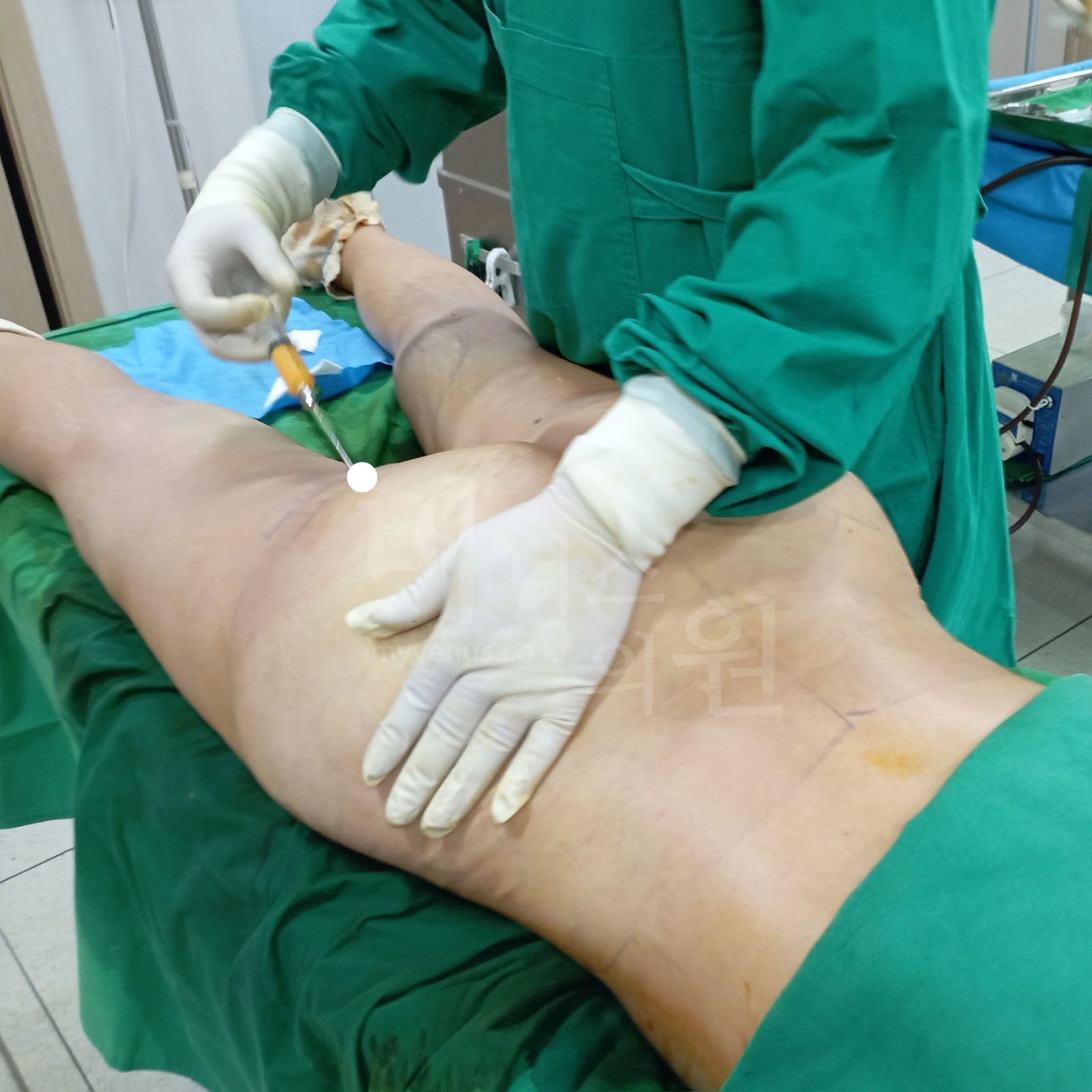
The challenge is that the areas to be treated are the lower buttock (the area often called the "Bermuda triangle" in Korea) and the upper thigh. The body bends deeply along the crease between the buttock and the thigh, and with the patient lying face down, the cannula must be laid low and inserted in the direction of the crease. It is hard to match the angle with an instrument that has a handle, but with SAL, where the cannula is held directly in the hand, the surgeon can follow the curve and refine the lower buttock and upper thigh together. In the photo below, the surgeon holds the tissue with one hand and inserts the cannula with the other to suction the lower buttock.
References
- Venus Clinic. Liposuction Equipment and Methods. en.myvenus.co.kr/should_know/38871.
- Venus Clinic. Liposuction Techniques and Advances (Literature Review). en.myvenus.co.kr/should_know/38859.
- Shiffman MA, Di Giuseppe A, eds. Liposuction: Principles and Practice. Springer; 2006. Chapter 1.
- Shiffman MA, Di Giuseppe A, eds. Liposuction: Principles and Practice. Springer; 2006. Chapter 69.
- Serdev N, ed. Advanced Techniques in Liposuction and Fat Transfer. InTech; 2011. Chapter 5. Power-Assisted Liposuction vs Traditional Liposuction - Tissue Shrinkage and Tightening.
- Shiffman MA, Di Giuseppe A, eds. Liposuction: Principles and Practice. Springer; 2006. Chapter 26.
- Gasparotti M. Superficial Liposuction Yields Superior Results for Most Patients.
- Klein JA. Tumescent Technique: Tumescent Anesthesia & Microcannular Liposuction. Mosby; 2000. Chapter 35.
- Euromi. Evamatic® 5 product description. euromi.com/fr/p/liposuccion-evamatic-5.
Before-and-After Photos
Here are photos, taken from the back and from the left and right sides, of a patient who had buttock volume-up liposuction together with the thighs and other areas. All after photos were taken about 2 weeks after surgery. They show the patient during recovery, with some bruising and swelling still present, so they are not the final result; as the swelling subsides and the skin contracts, the lines become somewhat more refined.
Back View
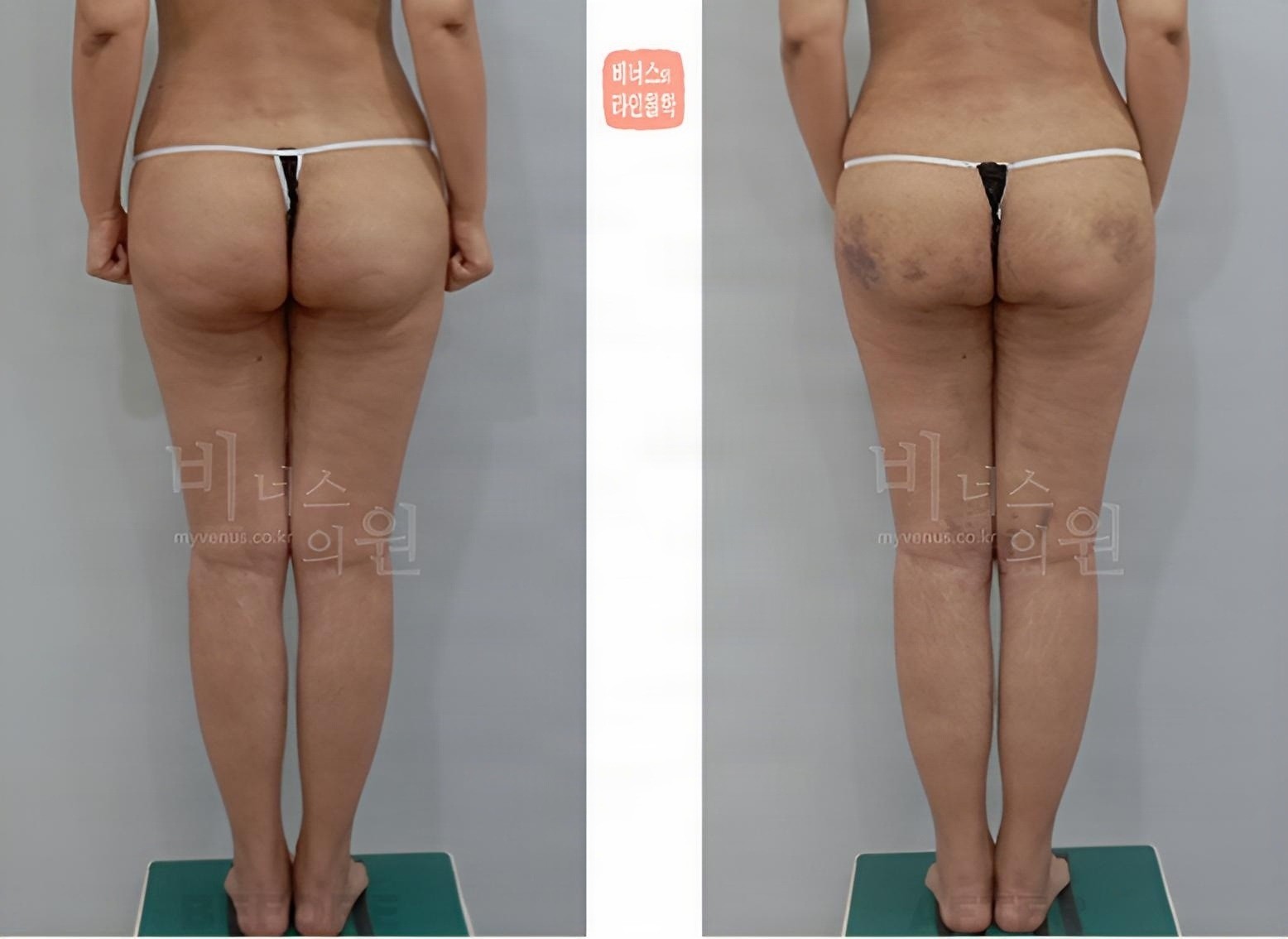
This is a case in which the lower buttock and upper thigh were treated together. Before surgery, tissue from the lower buttock had descended toward the thigh, so the border between the buttock and thigh looked thick and continuous. After surgery, the volume of the lower buttock and upper thigh decreased, so the crease under the buttock is more visible than before, and the line of the upper thigh has also been refined. The purplish color on the upper buttock is bruising at 2 weeks after surgery and fades over time.
| Information on the Posted Liposuction Before-and-After Photos | |||
|---|---|---|---|
| - Same person | Surgery performed at Venus Clinic; same person | - Date taken | Taken around 2023; comparison at about 2 weeks after surgery |
| - Same conditions | Edited to the same posture and size as closely as possible | - Side effects | https://en.myvenus.co.kr/should_know/38861 |
Left Side View
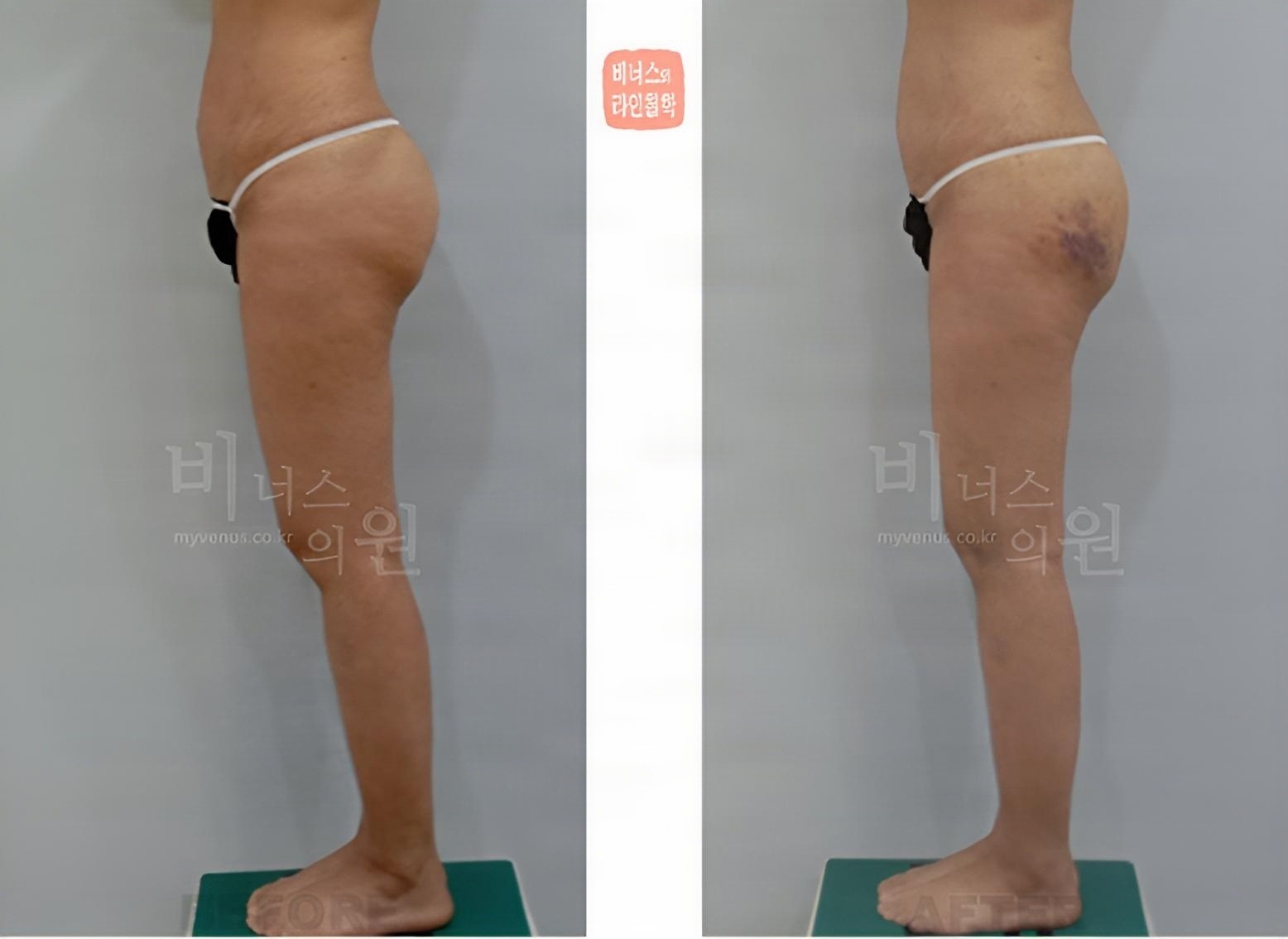
This is a side view of buttock volume-up liposuction. Before surgery, the lower buttock flowed down continuously into the back of the thigh. After surgery, the volume of the lower buttock decreased, and the line where the buttock meets the back of the thigh has been refined.
| Information on the Posted Liposuction Before-and-After Photos | |||
|---|---|---|---|
| - Same person | Surgery performed at Venus Clinic; same person | - Date taken | Taken around 2023; comparison at about 2 weeks after surgery |
| - Same conditions | Edited to the same posture and size as closely as possible | - Side effects | https://en.myvenus.co.kr/should_know/38861 |
Right Side View
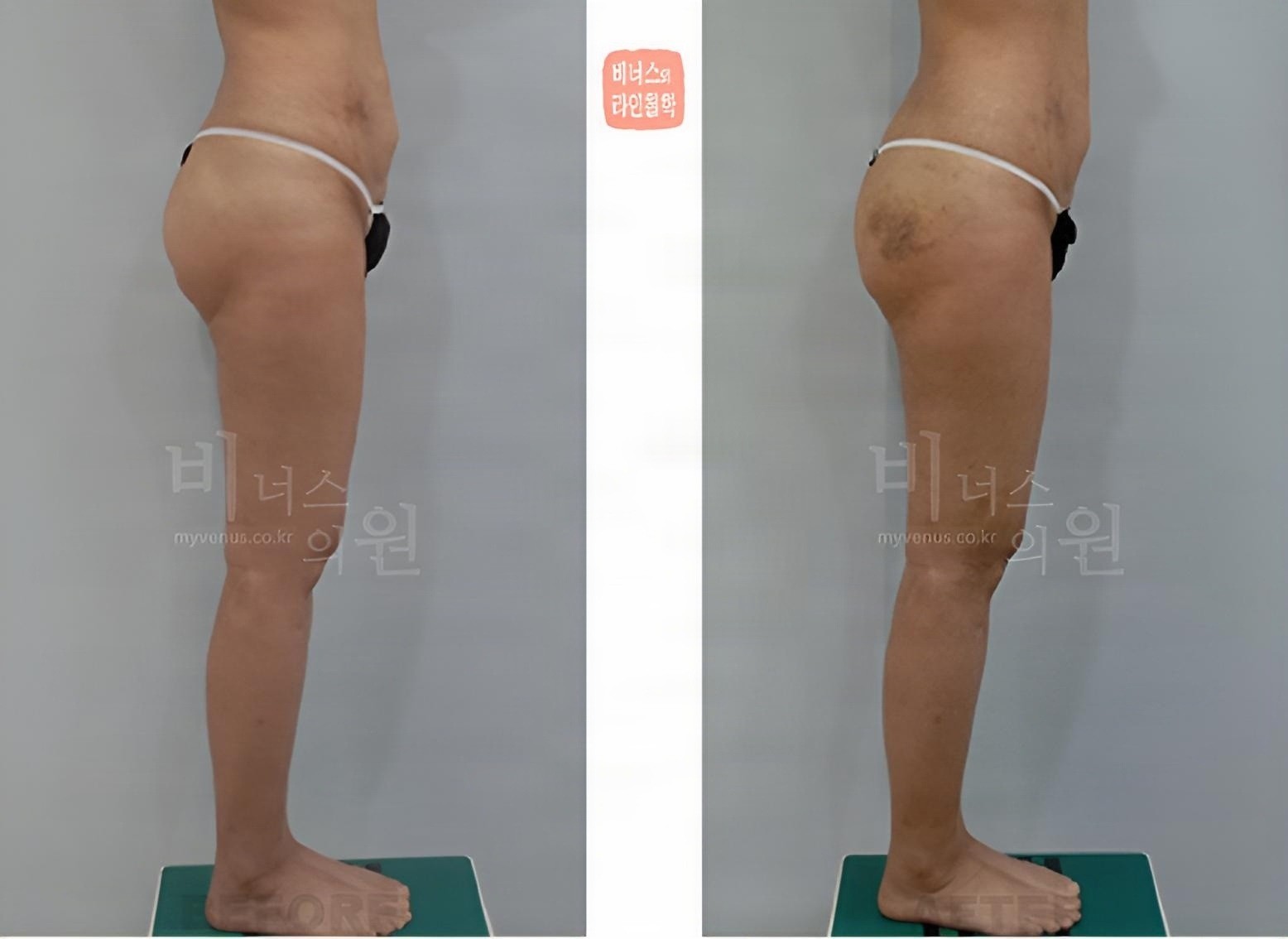
This is the side view from the opposite side. After surgery, the volume of the lower buttock and upper thigh decreased, and the lower line of the buttock is more defined than before. Both sides were smoothed according to the same principle.
| Information on the Posted Liposuction Before-and-After Photos | |||
|---|---|---|---|
| - Same person | Surgery performed at Venus Clinic; same person | - Date taken | Taken around 2023; comparison at about 2 weeks after surgery |
| - Same conditions | Edited to the same posture and size as closely as possible | - Side effects | https://en.myvenus.co.kr/should_know/38861 |
In Closing
Every liposuction device has its own advantages and disadvantages, and in the end, what determines the result is not the device but the surgeon's hands. In small, curved, delicate areas such as the buttocks, breasts, chin, and calves, SAL, in which the cannula is held directly in the hand and follows the curves of the body, is advantageous for precise refinement. At Venus Clinic, using manual SAL liposuction, we remove the fat that needs to be removed as thoroughly as possible, even in hard-to-reach areas such as the lower buttock and upper thigh, and smooth the lines so they are not lumpy.
References: Liposuction Equipment and Methods
Dr. Hakjun Kim, Director, Venus Clinic