Why Secondary Liposuction Is Sometimes Needed
Patients who have had a first liposuction often tell us, "I'd like to reduce the fat a little more." Their body has clearly changed after the first surgery, yet they want to go a bit further. Many of them also worry: "If I have another surgery, is that a revision?" or "Do I need another one because the first surgery went wrong?"
In this article we will explain how revision surgery differs from secondary liposuction, and why liposuction cannot remove the entire fat layer in a single session. We will also show the results of measuring fat-layer thickness with ultrasound at Venus Clinic, along with actual photos of a patient's first and second-stage surgeries.

Revision Surgery and Secondary Liposuction Have Different Purposes
Both operations have one thing in common: the same area is operated on once more. But the reason for operating again is completely different.
Revision surgery — correcting a problem from the first surgery
Revision surgery is performed when a problem has arisen from the first surgery, in order to correct that problem. Examples include a spot that was over-suctioned and became sunken, or an uneven, lumpy surface caused by irregular suction. In such cases, fat is grafted into the sunken area, or areas that were under-suctioned are refined to restore balance [4].
Secondary liposuction — one step further after a successful first surgery
Secondary (second-stage) liposuction is an additional operation performed after a first surgery that went well, in order to reduce the size further or refine the body contour. It is not done because something was wrong with the first surgery; it is done to reduce the remaining fat layer once more in the same area. For reference, operating on a different area rather than the same one is called additional surgery on a different area — for example, having the thighs done after the abdomen.
| Type | Why is it done? | Which area? |
|---|---|---|
| Revision surgery | To correct a problem from the first surgery (sunken areas, unevenness, etc.) | Same area as the first surgery |
| Secondary liposuction | The first surgery went well, but to reduce the remaining fat layer further | Same area as the first surgery |
| Additional surgery (different area) | To refine the contour of another body area as well | A different area from the first surgery |
Why Can't Liposuction Remove the Whole Fat Layer at Once?
Liposuction is not an operation that cuts out fat tissue in one block. A thin suction tube (cannula) is inserted into the fat layer and moved back and forth, making countless holes, and fat is suctioned out along those holes. As shown on the left of the illustration below, tunnels form inside the fat layer; as those tunnels collapse, the fat layer becomes thinner, as shown on the right.
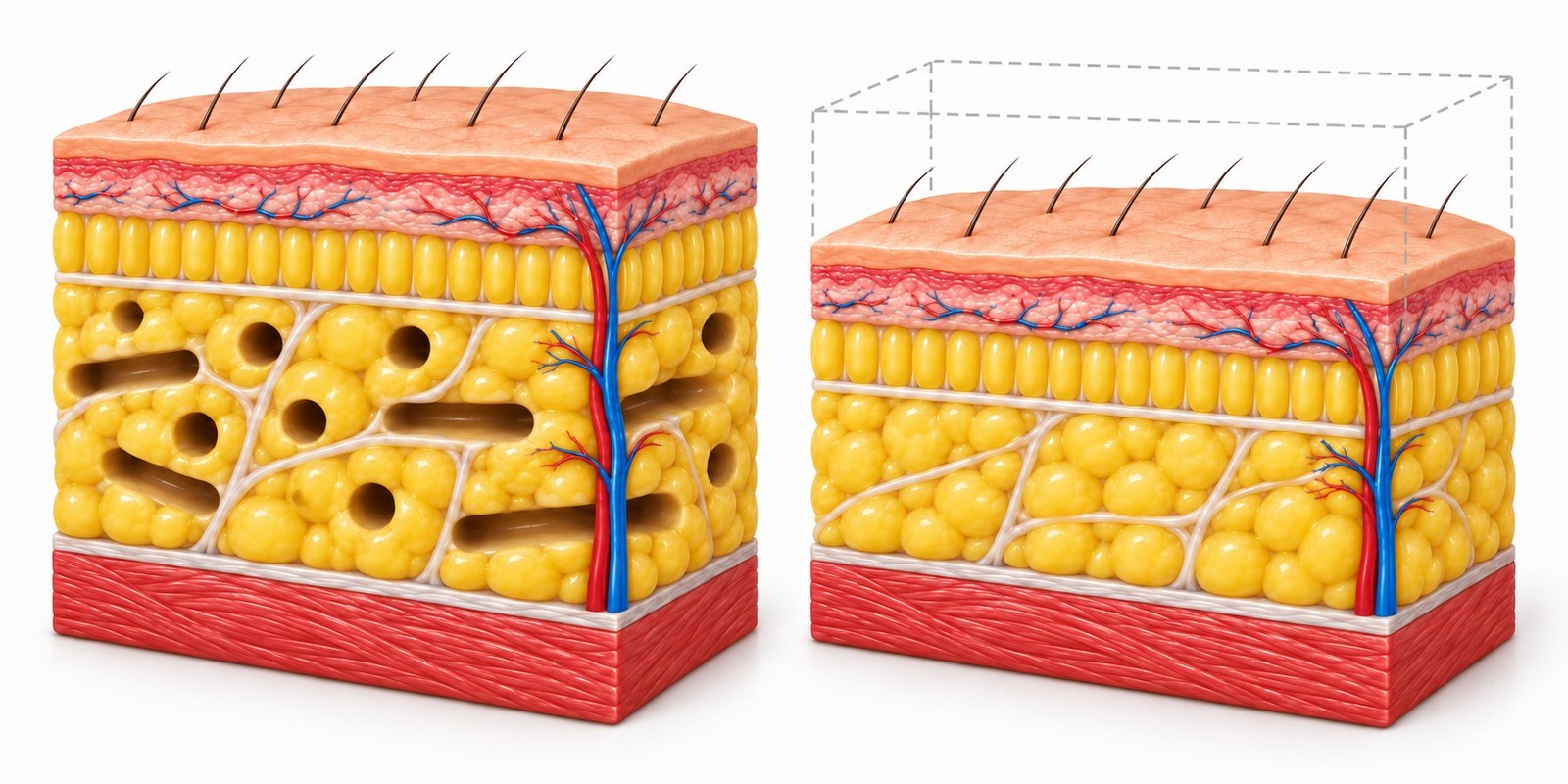
Between the holes, some fat tissue, blood vessels, and the fibrous tissue that connects the skin to the muscle must remain. This keeps blood flowing to the skin and allows the skin to contract evenly after surgery, creating a smooth line. The thin layer of fat just beneath the skin (the mantle layer) protects the skin and must also be preserved. Removing this layer, or suctioning too much from one spot, can cause complications such as an uneven, lumpy surface or sunken areas [4].
That is why part of the fat layer always remains, even after the first surgery. This is not because the fat is removed carelessly, but because the method of removing fat by making holes in the fat layer cannot remove the entire layer at once. At Venus Clinic, we aim to remove the fat that needs to be removed as thoroughly as can be done safely, and to refine the line so that it is smooth rather than uneven. The textbook also advises against removing the entire fat layer at once, recommending instead to reduce it little by little and evenly while checking the condition each time [3].
Fat-Layer Reduction Measured by Ultrasound
At Venus Clinic, we used ultrasound to measure the fat-layer thickness just before surgery in 66 patients who underwent liposuction that included the flanks, and measured it again after surgery in 40 of them for comparison [1]. The fat-layer thickness measured 4 to 11 weeks after surgery was on average about 31% less than before surgery, that is, about one-third less. Below are the ultrasound images of one of those patients (who had secondary abdominal liposuction). The top row is before surgery and the bottom row is 8 weeks after surgery; the number on each screen is the thickness of the fat layer beneath the skin. The Korean labels under the images read, in the top row, "Before surgery · right 0.81 cm" (left image) and "Before surgery · left 0.71 cm" (right image), and in the bottom row, "8 weeks after surgery · right 0.52 cm" (left image) and "8 weeks after surgery · left 0.54 cm" (right image).
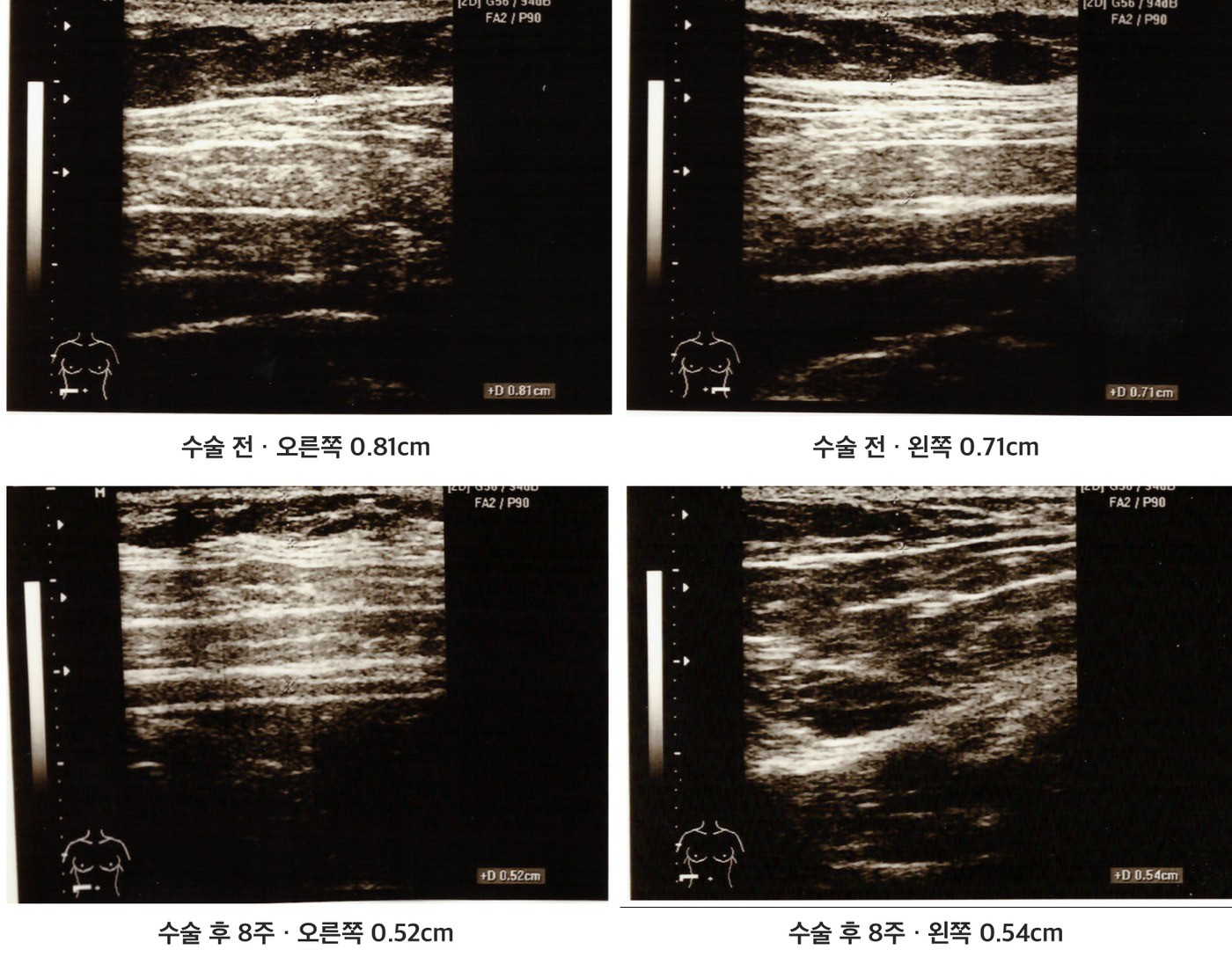
In this patient, the fat layer decreased from 0.81 cm to 0.52 cm on the right (about a 36% reduction) and from 0.71 cm to 0.54 cm on the left (about a 24% reduction). The average of both sides went from 0.76 cm to 0.53 cm, a reduction of about 30%, similar to the overall average.
Why the thickness is only about one-third less at 4–11 weeks, even when a lot of fat has been removed
The fat-layer thickness measured by ultrasound 4 to 11 weeks after surgery showed a reduction of about 31% (about one-third). This is a result we actually measured. Yet, as you can see in the before-and-after photos below, the appearance and waistline changed noticeably after surgery. The fact that the appearance changed so much while the ultrasound-measured thickness decreased less than expected does not mean that liposuction had little effect. After liposuction, the skin has excess room where fat was removed and shrinks; the skin and the remaining fat layer go through an induration (hardening) process, in which they clump together and become firm [5]. Skin contraction occurs through the elasticity of the dermis and the contraction of the fibrous tissue within the subcutaneous fat [3]. We believe that during this recovery process the skin and fat layer contract together, making the fat layer thicker again, and that this is why the ultrasound-measured thickness shows only about a one-third reduction. In addition, 4 to 11 weeks after surgery is a time when swelling may still remain, so we estimate that the fat layer will decrease further after 6 months, when the recovery period ends.
Why Secondary Liposuction Is Needed
This is exactly why secondary liposuction is needed. If, as described above, the skin and fat layer contract after the first surgery and the fat layer becomes thicker again, then that fat layer is once again in a state where fat can be removed by making holes in it. So, for those who want to reduce their size further, secondary liposuction is possible, and it is also a surgery they may need.
In our ultrasound study as well, the patients who had the same area operated on again (4 patients) saw their remaining fat layer reduced by a further 26% or so with the secondary liposuction, which was not much different from the reduction rate of the first surgery (about 31%) [1]. This means the remaining fat layer can also be reduced at a rate similar to that of the first surgery.
| Stage | Fat-layer thickness (original = 100) | Calculation |
|---|---|---|
| Before surgery | 100 | — |
| After first surgery (4–11 weeks) | About 69 (measured) | 100 × (1 − 0.31) ≈ 69 |
| After secondary liposuction | About 51 (estimated) | 69 × (1 − 0.26) ≈ 51 |
Textbooks also recommend reducing fat in several stages like this. Removing fat in several sessions (serial liposuction) rather than removing a large amount at once is a recommendation of the American Academy of Cosmetic Surgery [2], and the textbook explains that patients who initially had a lot of fat sometimes undergo liposuction once more to further refine their body contour [2]. We believe that, rather than removing too much at once and causing complications, it is better to operate once more within a safe range.

You should also know the limits of secondary liposuction
The figures in the table above are averages measured 4 to 11 weeks after surgery, and we estimate that the fat layer will become thinner than this after 6 months, when recovery is complete. However, not everyone will see the same reduction. The degree of reduction varies depending on the original thickness of the fat layer, skin elasticity, and fat distribution. Because the fat layer that protects the skin must be preserved in secondary liposuction as well, patients whose fat layer was thin to begin with may have little room for further reduction. Secondary liposuction is decided after the swelling from the first surgery has sufficiently subsided and the result has settled, based on the condition at that time. If you gain weight after surgery, the remaining fat cells can enlarge and your size may increase again.
References
- Venus Clinic. Ultrasound measurement of subcutaneous fat-layer thickness before and after flank liposuction (66 patients; before-and-after comparison in 40). Unpublished manuscript; 2026.
- Shiffman MA, Di Giuseppe A, eds. Liposuction: Principles and Practice. Springer; 2006. Chapter 60 and Part X.
- Klein JA. Tumescent Technique: Tumescent Anesthesia & Microcannular Liposuction. Mosby; 2000. Chapter 28.
- Venus Clinic. Complications and side effects of liposuction. https://en.myvenus.co.kr/should_know/38861
- Venus Clinic. Activities after liposuction (in Korean). https://myvenus.co.kr/column/398239
Before-and-After Photos
These are photos of a patient who had secondary liposuction on the same area after a first liposuction. All post-surgery photos were taken 1 week after surgery. The photos in the middle column were taken just before the secondary liposuction, about 8 months after the first surgery. One week after surgery is a time when swelling and bruising still remain, so these are not the final results.
Case 1
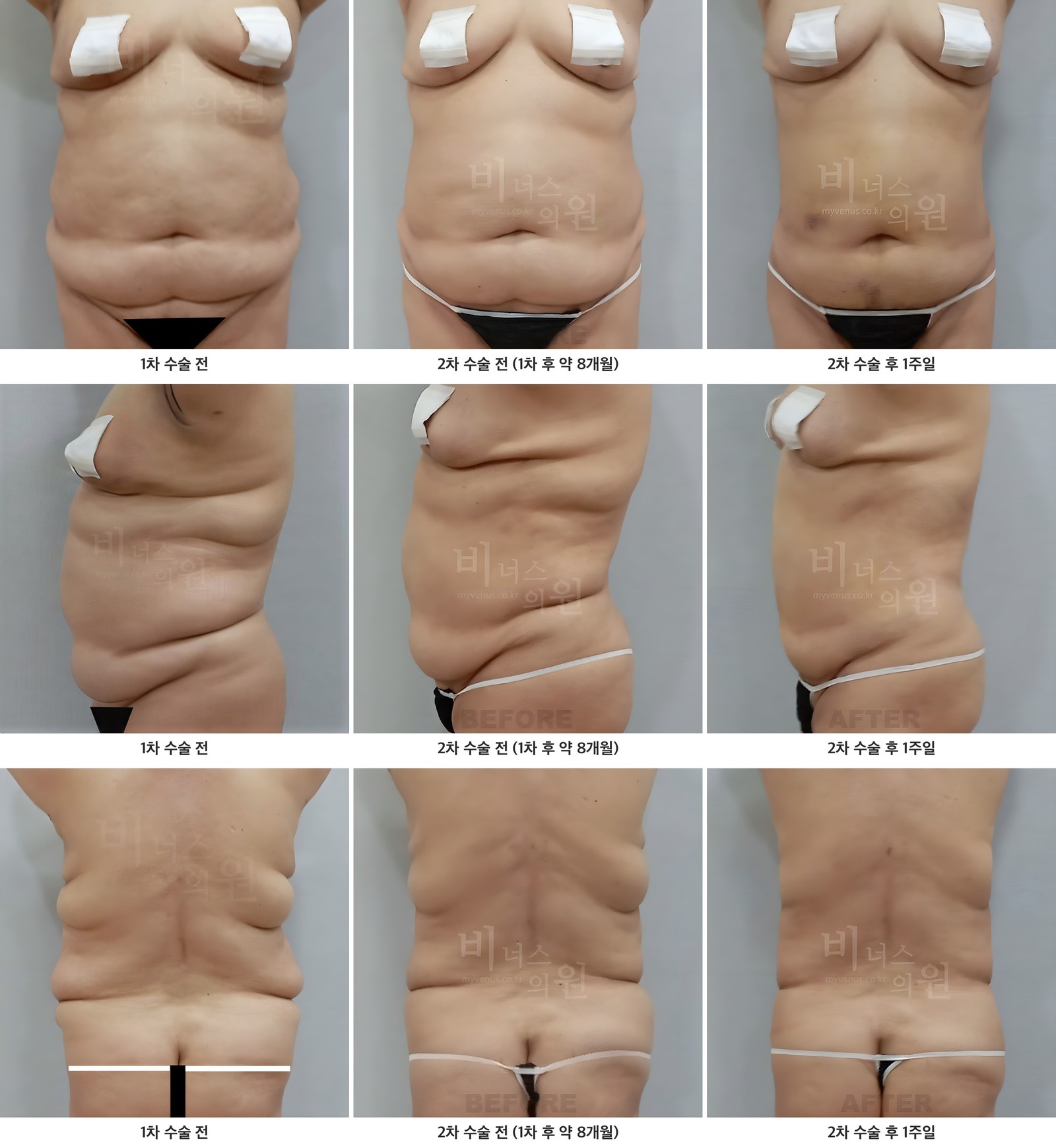
In this case, fat remaining after the first liposuction was reduced further with secondary liposuction on the same area. From top to bottom, the rows show the front, side, and back views; from left to right, the columns show before the first surgery, before the secondary liposuction (about 8 months after the first surgery), and 1 week after the secondary liposuction. The Korean labels under each photo read, from left to right, "Before first surgery," "Before second surgery (about 8 months after the first)," and "1 week after second surgery." You can see that the fat layer that still remained after being reduced by the first surgery was reduced once more after the secondary liposuction.
| Information on the Posted Liposuction Before-and-After Photos | |||
|---|---|---|---|
| - Same person | Surgery performed at Venus Clinic; same person | - Date taken | Taken around 8/2024 (first surgery) and around 4/2025 (secondary liposuction); comparison at 1 week after surgery |
| - Same conditions | Edited to the same posture and size as closely as possible | - Side effects | https://en.myvenus.co.kr/should_know/38861 |
In Closing

Secondary liposuction is not surgery you have because the first one went wrong. Because liposuction removes fat by making holes in the fat layer, a fat layer that can be removed again still remains after the first surgery, and secondary liposuction can reduce that fat layer once more at a similar rate. At Venus Clinic, once the result of the first surgery has settled, we check the remaining fat layer together with you and tell you honestly whether secondary liposuction is likely to help.
References: Size Reduction after Liposuction Complications and Side Effects of Liposuction Circumferential (360-Degree) Abdominal Liposuction Abdominal Liposuction and the Features of Each Sub-Area
Dr. Hakjun Kim, Director, Venus Clinic