[Case Review] When Some Buttock Ptosis Remains After Liposuction
Among patients who have had liposuction for buttock ptosis (sagging), some tell me after surgery, "My buttocks have definitely become smaller, but I can't see the fold under my buttocks the way other people can," or "The sagging part has become shorter, but it still seems to hang down a little." This is because, even with the same surgery, how much the buttocks rise differs from person to person.
In my previous article, I described three patterns in which the fold line is revealed after the buttock rises. Today I will explain one of them, Case 3 — when mild ptosis remains and the fold line is not visible, through the case of one patient, and, together with what the textbooks say, I will summarize the two factors that determine how much ptosis remains: the amount of fat aspirated and the contractility of the skin.

The Fold Line Hidden by a Sagging Buttock
Everyone has a horizontal fold line running between the buttock and the thigh. Textbooks describe this spot as a place where the skin is firmly attached to the deep tissue (the subgluteal fold), and explain that buttock ptosis develops as the tissue above it descends under the influence of the buttock's weight, the amount of fat, and gravity. Aging and large weight loss are also named as important causes of buttock ptosis.
Source: Schavelzon D, et al. Application of the Liposuction Techniques and Principles in Specific Body Areas and Pathologies. In: Serdev N (ed). Advanced Techniques in Liposuction and Fat Transfer. InTech, 2011. Chapter 1.
When buttock ptosis is present, the drooping tissue of the lower buttock (skin and fat) comes down and covers this original fold line. As a result, the fold line cannot be seen, and many people think of the bottom edge of the sagging buttock as their fold. When buttock liposuction reduces the volume, the skin that had been stretched contracts and the buttock rises, and how the fold line is revealed depends on how much the buttock rises.
| Case | Appearance of the fold line after surgery |
|---|---|
| Case 1 — A new fold line forms | The buttock rises above the original fold line and a new fold line forms, while the original fold line remains as a trace below it. |
| Case 2 — Only the original fold line is revealed | No new fold line forms; only the original fold line that had been hidden is revealed, and the buttock ptosis is gone. |
| Case 3 — Mild ptosis remains | The buttock cannot rise much, so mild ptosis remains and the fold line is not visible. The width of the sagging fatty tissue decreases. |
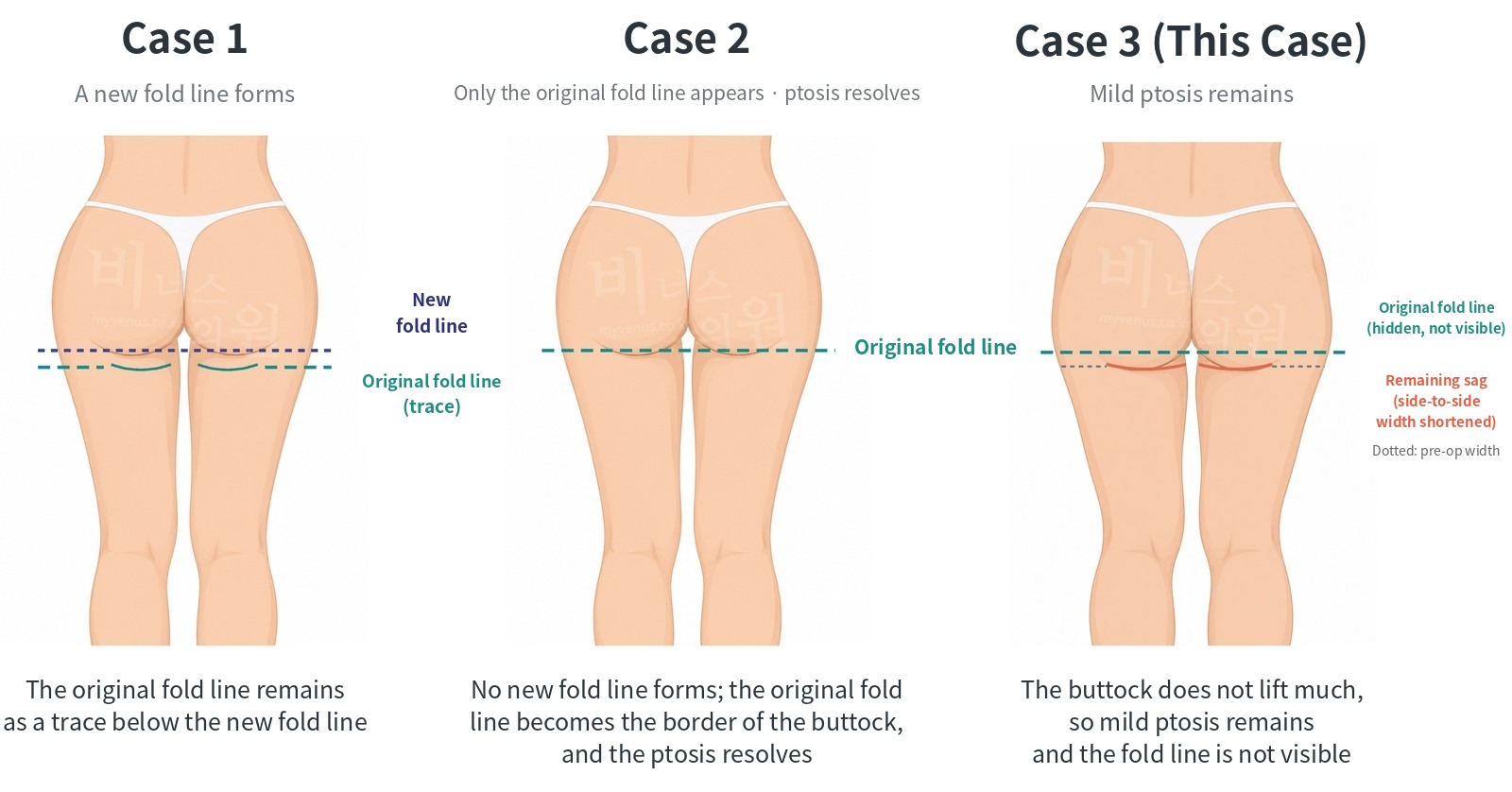
Case 3 — Mild Ptosis Remains
The patient I am introducing today is this Case 3. Liposuction of the buttocks, hips, and sacral back reduced the size of the buttocks and lessened the sagging, but the buttock could not rise above the original fold line, so no new buttock–thigh line has formed, and the original fold line is not visible either. The illustration below shows this state as seen from behind.
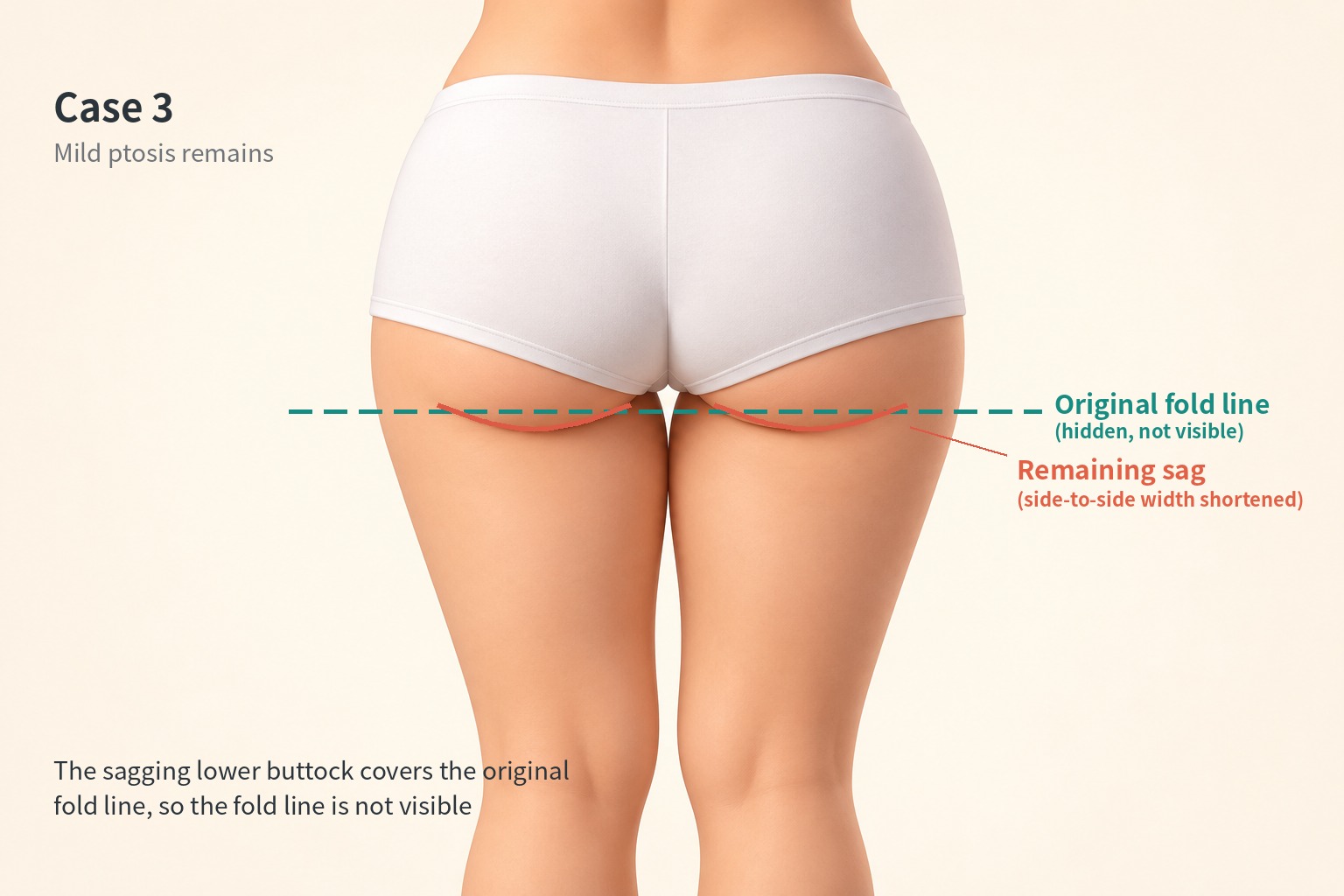
Why the Fold Line Cannot Be Seen
The dotted line marks the height of the original fold line, and the red line is the bottom edge of the lower buttock, which still sags slightly after surgery. When ptosis remains, the sagging tissue hides the fold line, so the fold line cannot be seen. It is easy to mistake the red line for the fold line, but it is not a fold; it is the bottom edge of the lower buttock, which is still sagging a little.
What Shortens Is the Width of the Sagging Tissue
There is a change in Case 3 as well. What shortens after surgery is not the fold line but the side-to-side width of the sagging fatty tissue. A shorter sagging area means the buttock has risen to some extent, and the degree of sagging has eased by that much. In the end, the only difference between Case 2 and Case 3 is whether ptosis remains. In Case 2 the ptosis is gone and the original fold line is revealed; in Case 3 mild ptosis remains and the fold line stays hidden.
The Degree of Ptosis Depends on the Amount of Fat Aspirated and the Contractility of the Skin
Even with the same liposuction for buttock ptosis, some patients end up as Case 2 and others as Case 3. How much the buttock rises after surgery and how much ptosis remains are determined mainly by two things: the amount of fat aspirated and the contractility of the skin.
Amount of Fat Aspirated — Reduced Volume Gives the Skin Room to Contract
The buttock rises because the skin that had been stretched contracts by the amount of volume that was reduced. Only when the fat accumulated in the lower buttock is reduced and the weight and volume become lighter can the skin contract and pull upward. Therefore, the more fat is removed, the greater the reduction in volume, the more the skin contracts, and the more the buttock rises. Conversely, when less fat is removed, there is less room for the skin to contract, the buttock rises less, and ptosis tends to remain. In our experience at Venus Clinic, too, the more of the fat layer is left, the smoother the result but the less the skin contracts, and skin contraction occurs better when liposuction is done while the patient carries some weight and the skin still has elasticity. Conversely, if fat has already been greatly reduced by dieting and the skin has become lax, there is little fat that can be aspirated, so skin contraction after surgery is also small.
What the Papers Say
① The Italian researchers who first presented superficial liposuction just beneath the skin reported in an aesthetic plastic surgery journal in 1995 that aspirating the shallow fat layer improves skin retraction, and that the method can be used even in cases where the skin has difficulty adapting.
Source: Gasperoni C, Salgarello M. Rationale of Subdermal Superficial Liposuction Related to the Anatomy of Subcutaneous Fat and the Superficial Fascial System. Aesthetic Plastic Surgery. 1995;19:13-20.
② The same researchers stated that to obtain good skin retraction, fat in both the shallow and deep layers must be aspirated sufficiently together, and named this method MALL (Massive All Layer Liposuction). This follows the same principle: the greater the volume of fat reduced, the more room the skin has to contract.
Source: Gasperoni C, Salgarello M. MALL Liposuction: The Natural Evolution of Subdermal Superficial Liposuction. Aesthetic Plastic Surgery. 1994;18:253-257.
That does not mean the goal is to remove a lot of fat. Liposuction is not an operation that removes a large amount of fat; it is a body contouring operation that creates balance in the body shape by leaving fat well. At Venus Clinic, rather than removing as much as possible, we remove an appropriate amount with harmony with the surrounding areas and the overall balance of the body shape in mind. We leave the remaining fat layer at a consistently equal thickness regardless of the area or side, and we do not suction the left and right sides differently.

Contractility of the Skin — Elasticity of the Dermis and Contraction of Fibrous Tissue in the Fat Layer
The liposuction textbook by Klein explains skin retraction after liposuction as the normal elastic recoil of the dermis and the fibrous contraction of the subcutaneous fat layer. In other words, how much the skin shrinks depends on the elasticity of that person's skin and subcutaneous tissue.
Source: Klein JA. Tumescent Technique: Tumescent Anesthesia & Microcannular Liposuction. Mosby, 2000. Chapter 28.
A textbook covering facial and body liposuction also explains that the younger the patient, the greater the skin elasticity and the better the skin contracts to the newly created subcutaneous contour, and that skin contraction decreases as elasticity declines with age. The result of liposuction relies on the skin's ability to contract and adhere to the new contour, and factors such as age reduce this ability. Regarding the area around the buttocks, it explains that liposuction above and below the waist (the back) gives good skin contraction thanks to the thickness and fibrous tissue of that area, which helps improve the contour of the back view, including the buttocks. However, it also explains that even when skin elasticity declines with age, the skin's ability to shrink itself remains, so age alone is no reason to avoid liposuction.
Source: In: Shiffman MA, Di Giuseppe A (eds). Liposuction: Principles and Practice. Springer, 2006. Chapter 18 · Chapter 69 / Schavelzon D, et al. Application of the Liposuction Techniques and Principles in Specific Body Areas and Pathologies. In: Serdev N (ed). Advanced Techniques in Liposuction and Fat Transfer. InTech, 2011. Chapter 1.
In This Patient's Case
The patient I am introducing today is a middle-aged woman whose skin elasticity had already declined before surgery. The size of her buttocks decreased, but because her skin's contractility was weak, the buttock could not rise above the original fold line, and as a result she became Case 3, with mild ptosis remaining. Most of the Case 3 patients we see at Venus Clinic are likewise middle-aged women whose elasticity has declined and whose skin has become lax.
Ways to Help Skin Contraction — Superficial Liposuction and Volume-Up Liposuction
Surgery cannot restore the skin's elasticity itself, but it can be planned to draw out the contractility the skin already has. Buttock volume-up liposuction at Venus Clinic is an approach that reduces the fat of the lower buttock and induces skin contraction so that the buttock becomes smaller while its lower line appears to rise.
Superficial Liposuction
The key technique for inducing skin contraction is superficial liposuction. Whereas general liposuction removes the bulk of fat in the deep layer, superficial liposuction refines even the shallow fat layer just beneath the skin. The textbook (superficial liposculpture) explains that moving the aspiration to the shallow fat layer allows the body to be contoured more finely and improves skin contraction, which helps the result, and that this made it possible to apply the method even to older patients with considerably lax skin.
What the Textbook Says
The chapter "Three-Dimensional Superficial Liposculpture for Aged and Relaxed Skin" in a liposuction textbook explains that the thinner the skin flap, the better it contracts, and the more lax the skin, the thinner it must be refined to draw out its ability to contract as fully as possible. In this way, it says, the skin becomes not a passive element of the operation but an active element that wraps the form. At the same time, it emphasizes that the vascular network just beneath the skin must be preserved and that about 3–4 mm of fat beneath the skin must be left to keep the surface from becoming uneven.
Source: Gasparotti M. Three-Dimensional Superficial Liposculpture for Aged and Relaxed Skin. In: Shiffman MA, Di Giuseppe A (eds). Liposuction: Principles and Practice. Springer, 2006. Chapter 29.
What We Keep in Mind in Superficial Liposuction
Superficial liposuction is advantageous for skin contraction, but if the fat is not left evenly, the surface can become uneven. That is why, at Venus Clinic, we regard leaving the remaining fat layer evenly as most important. As the fat layer becomes thinner, the shape of the muscles and bones beneath it shows through, so the result ultimately follows the shape of that person's own bone structure and muscles.
We Plan the Hips and Sacral Back Together with the Buttocks
The outline running from below the waist to the hips (both sides of the upper buttock, where the pelvis projects outward), from the hips to the buttocks, and from the buttocks to the thighs is one continuous line. Textbooks also explain that liposuction of the areas adjacent to the buttocks together with the buttocks makes the final shape of the buttocks much better (Schavelzon et al., liposuction and fat transfer textbook, Chapter 1). That is why, when operating on the buttocks at Venus Clinic, we plan the hips and sacral back together and look at the balance of the entire back and side views, not only the size and sagging of the buttocks.
What to Know in Advance
Liposuction for buttock ptosis is an operation that raises the buttock by reducing the sagging; it is not an operation that creates or removes the buttock fold. It is difficult to know exactly before surgery which case it will be, because the position and shape of the fold line hidden by the sagging buttock cannot be seen before surgery, and how much the skin will contract also differs from person to person. One study included in a textbook reports that there was no statistically significant difference in measured skin elasticity between areas that had liposuction and surrounding areas that did not (Sasaki et al., liposuction and fat transfer textbook, Chapter 5). This means liposuction does not change the skin's elasticity itself, so if your skin elasticity has declined, it is best to understand in advance that some ptosis may remain before you decide. In addition, if you gain weight again after surgery, the remaining fat cells can enlarge, and the size and sagging of the buttocks may change as well.
Before-and-After Photos
Below are photos of a middle-aged woman who had liposuction of the buttocks, hips, and sacral back at Venus Clinic. All of the post-surgery photos were taken one week after surgery. Swelling and bruising still remain at this stage, so this is not the final result, and the shape may change a little more while the swelling subsides and the skin contracts. The degree of change varies from person to person.
Rear View
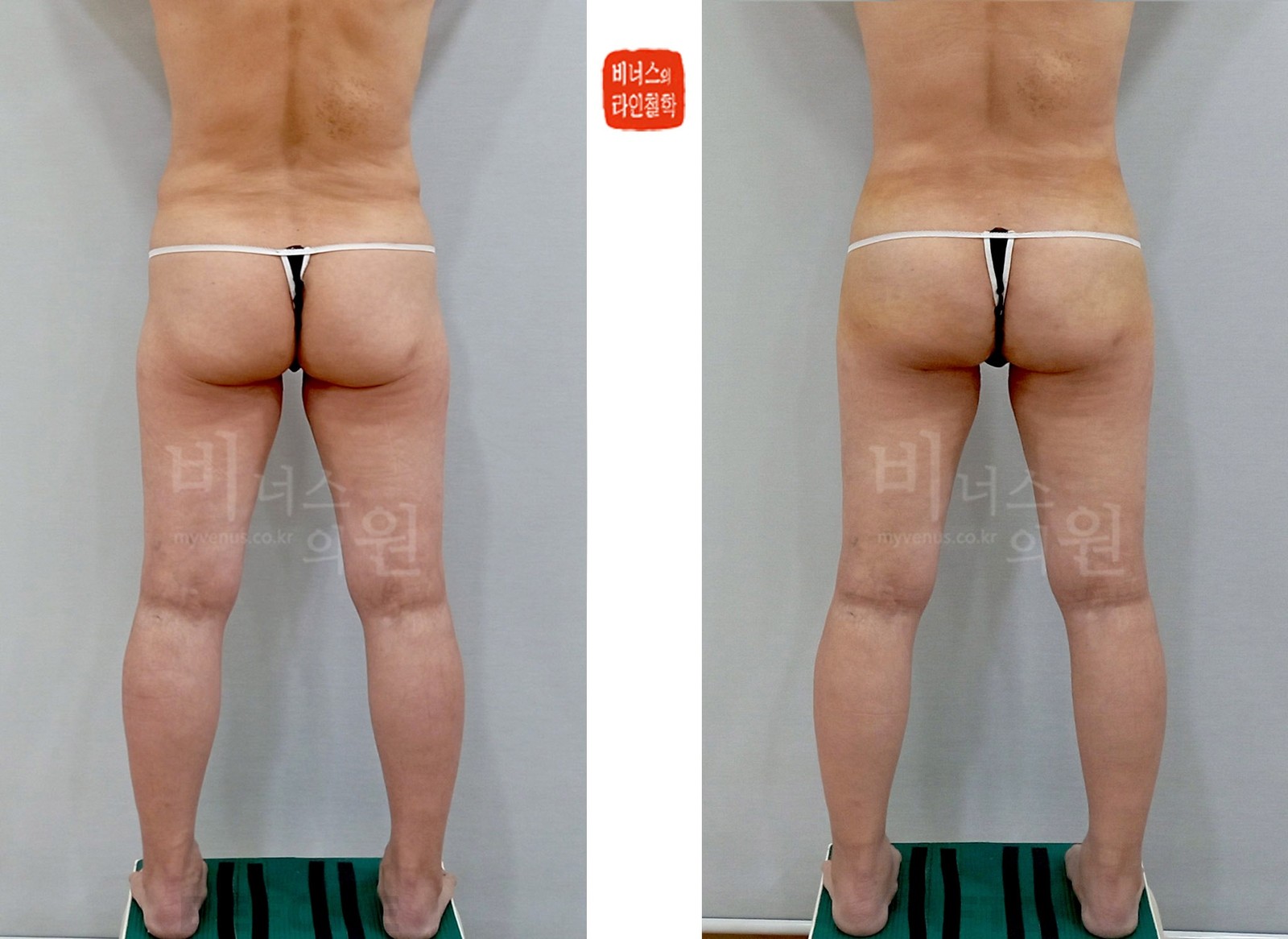
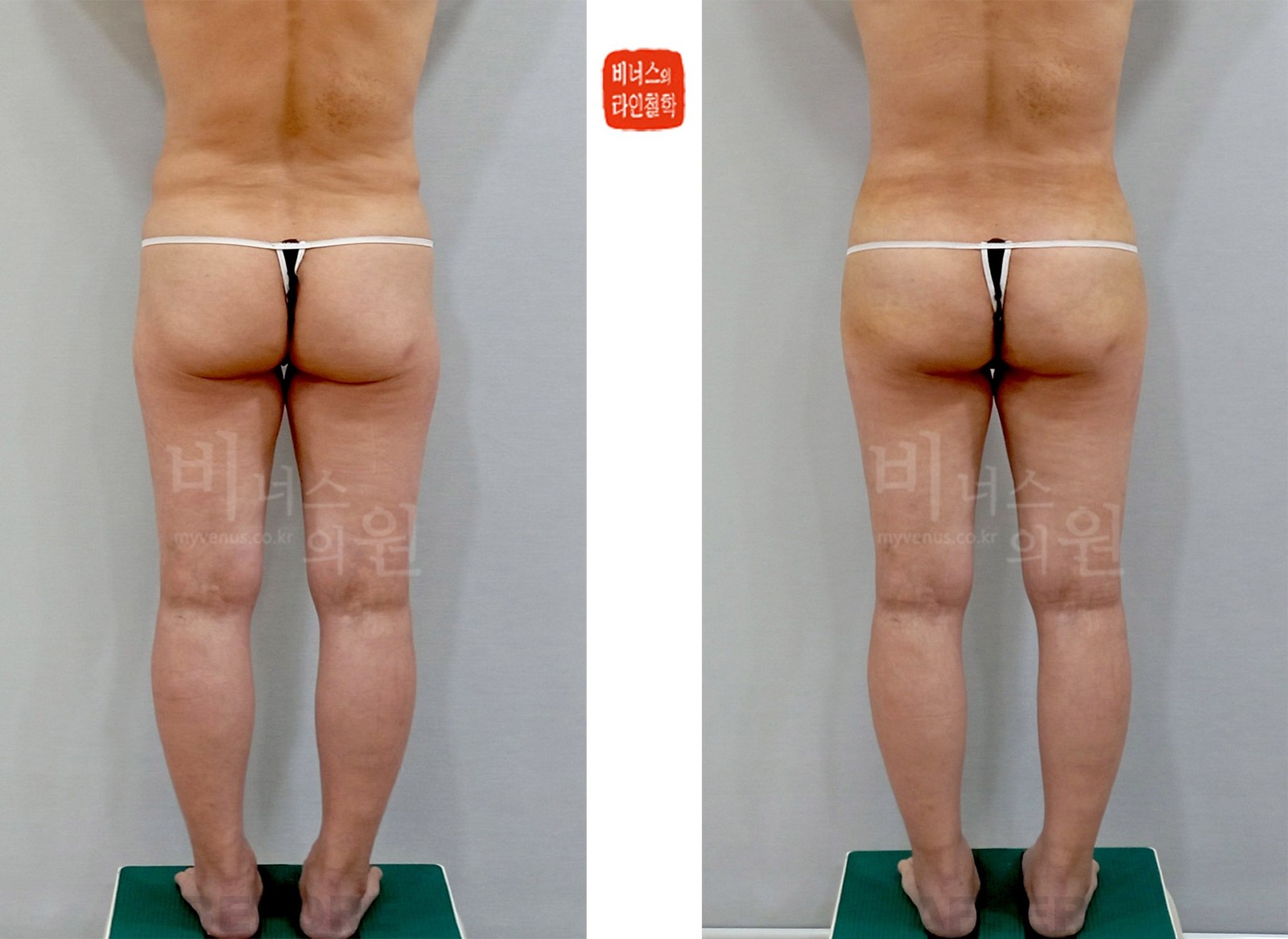
This is a case in which the buttock sagging improved, but mild ptosis remains, so the fold between the buttock and the thigh is not visible. The upper photo shows the legs-apart posture and the lower photo the legs-together posture. Before surgery, the tissue of the lower buttock hung down toward the thigh and covered the original fold line. At one week after surgery, the buttocks have become smaller and the side-to-side width of the sagging lower part has shortened, so the sagging is reduced; however, the buttock could not rise above the original fold line, so mild ptosis remains and the fold between the buttock and the thigh is still not visible. This is Case 3, described above.
| Information on the Posted Liposuction Before-and-After Photos | |||
|---|---|---|---|
| - Same person | Surgery performed at Venus Clinic; same person | - Date taken | Taken around 2023; comparison at one week after surgery |
| - Same conditions | Edited to the same posture and size as closely as possible | - Side effects | https://en.myvenus.co.kr/should_know/38861 |
Side View
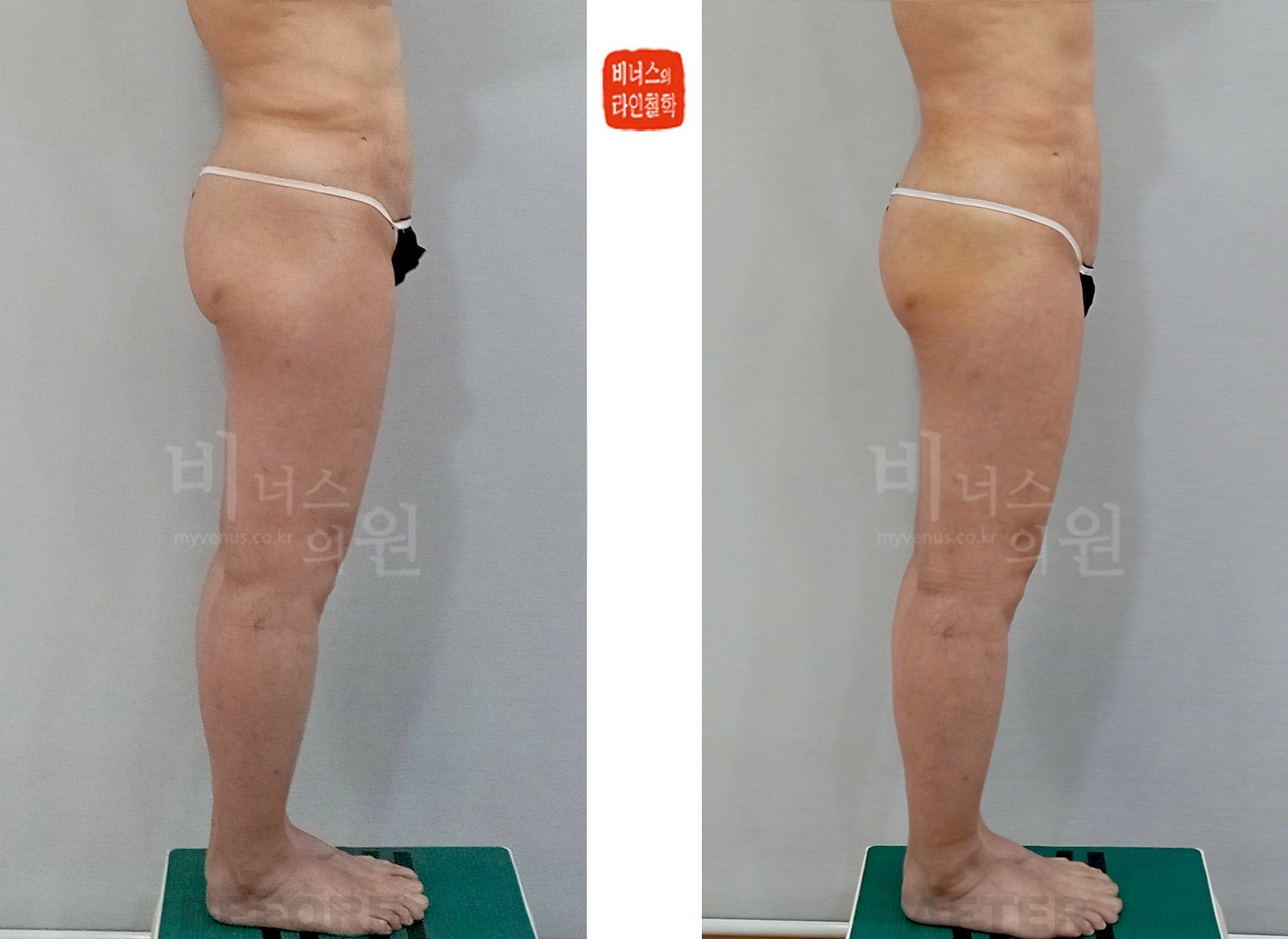
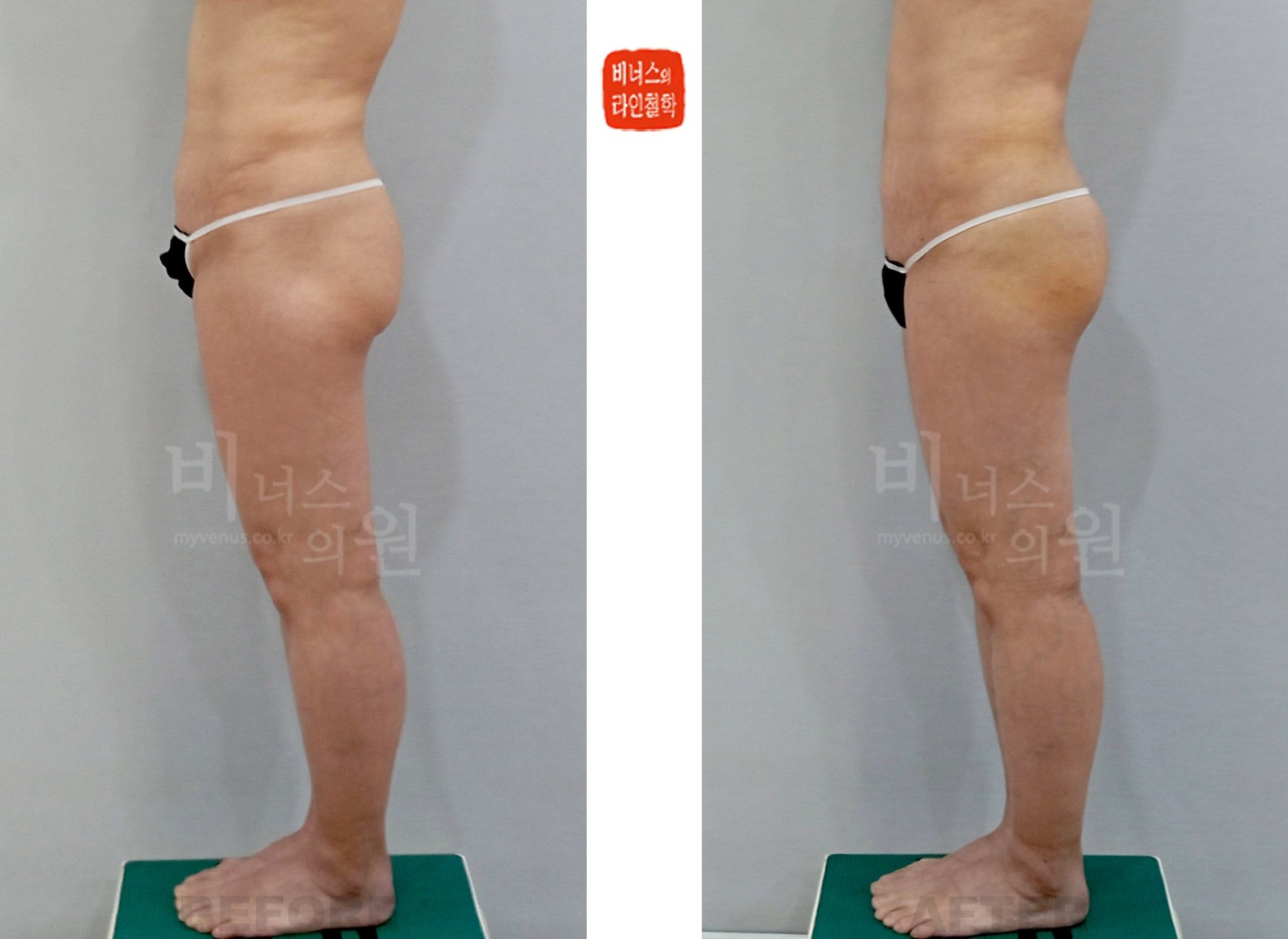
This is a case in which the buttocks became smaller and fat was removed from the hips and flanks, refining the outline. These are before-and-after photos of both sides. Before surgery, the volume accumulated in the hips, flanks, and buttocks made the outline below the waist look heavy. At one week after surgery, the buttocks have become smaller and fat has been removed from the hips and flanks, so the outline running from the waist past the pelvis to the thighs appears refined into a more balanced hourglass shape. Because swelling still remains at this stage, the outline may change a little more during recovery.
| Information on the Posted Liposuction Before-and-After Photos | |||
|---|---|---|---|
| - Same person | Surgery performed at Venus Clinic; same person | - Date taken | Taken around 2023; comparison at one week after surgery |
| - Same conditions | Edited to the same posture and size as closely as possible | - Side effects | https://en.myvenus.co.kr/should_know/38861 |
In Closing
How much the buttock rises after liposuction for buttock ptosis, and how much ptosis remains, depend on the amount of fat aspirated and the contractility of the skin. In a middle-aged woman with reduced skin elasticity, like the patient introduced today, mild ptosis may remain and the fold line may not be visible even though the buttocks become smaller and the side-to-side width of the sagging tissue shortens. At Venus Clinic, we explain these differences before surgery, and we focus on creating balance in the body shape as a whole by inducing skin contraction with superficial liposuction while planning the buttocks, hips, and sacral back together.

Dr. Hakjun Kim, Director, Venus Clinic