[Case Review] A Double Crease After Thigh Liposuction
In the clinic we sometimes hear patients say, "I had thigh liposuction and now there is an extra crease under my buttocks," or "The area between my buttocks and thighs looks folded in two layers, so I can't wear short clothes." When the thighs become slimmer but a new crease appears right below the buttocks, the thighs look shorter and the balance of the rear view is lost, which can be even more bothersome than before surgery.
Today, through the case of a patient who developed a double crease in the thigh just below the buttocks after thigh liposuction, we would like to explain why creases form under the buttocks, what role the ligaments that support the buttocks play, and how we corrected it by performing buttock liposuction and thigh fat grafting together. We will also cover what to be careful about after surgery so that the crease does not deepen again.

The Crease Under the Buttocks and the Banana Fold
Everyone has an infragluteal crease, the fold line between the buttocks and the thighs. Just below this crease, the upper back of the thigh bulges slightly outward; liposuction textbooks call this area the banana fold or banana roll because of its shape. Since this is where the rounded lower part of the buttocks meets the thigh when standing, the shape of this area determines how long the buttocks and the thighs appear from behind.
The Ligaments That Support the Buttocks
Within the fat layer of the banana fold area runs fibrous tissue known as the ligaments of Luschka. Liposuction textbooks describe fibrous strands that arise from the fascia beneath the gluteal muscles, cross the deep fat layer obliquely, and attach to the skin at the infragluteal crease; these fibers converge to form the crease line. This fibrous tissue connects the skin to the fascia below and acts like a net that supports the buttocks from underneath, preventing them from sagging down toward the thighs. The reason the infragluteal crease always forms in the same place is that this fibrous tissue holds the skin in position.
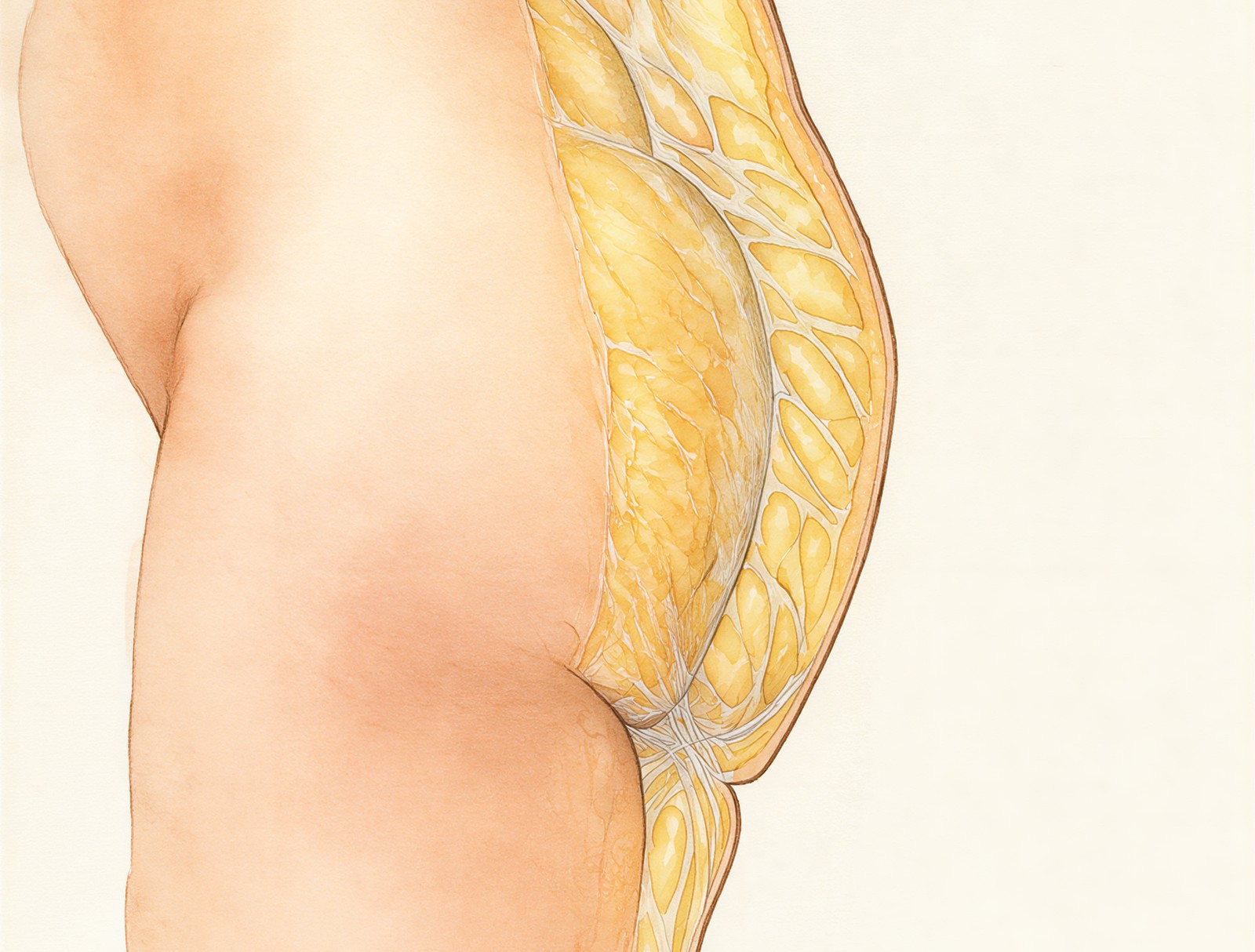
With the ligaments intact
The fibrous strands crossing the deep fat layer obliquely converge at a single point, the infragluteal crease, with the banana fold just below it.
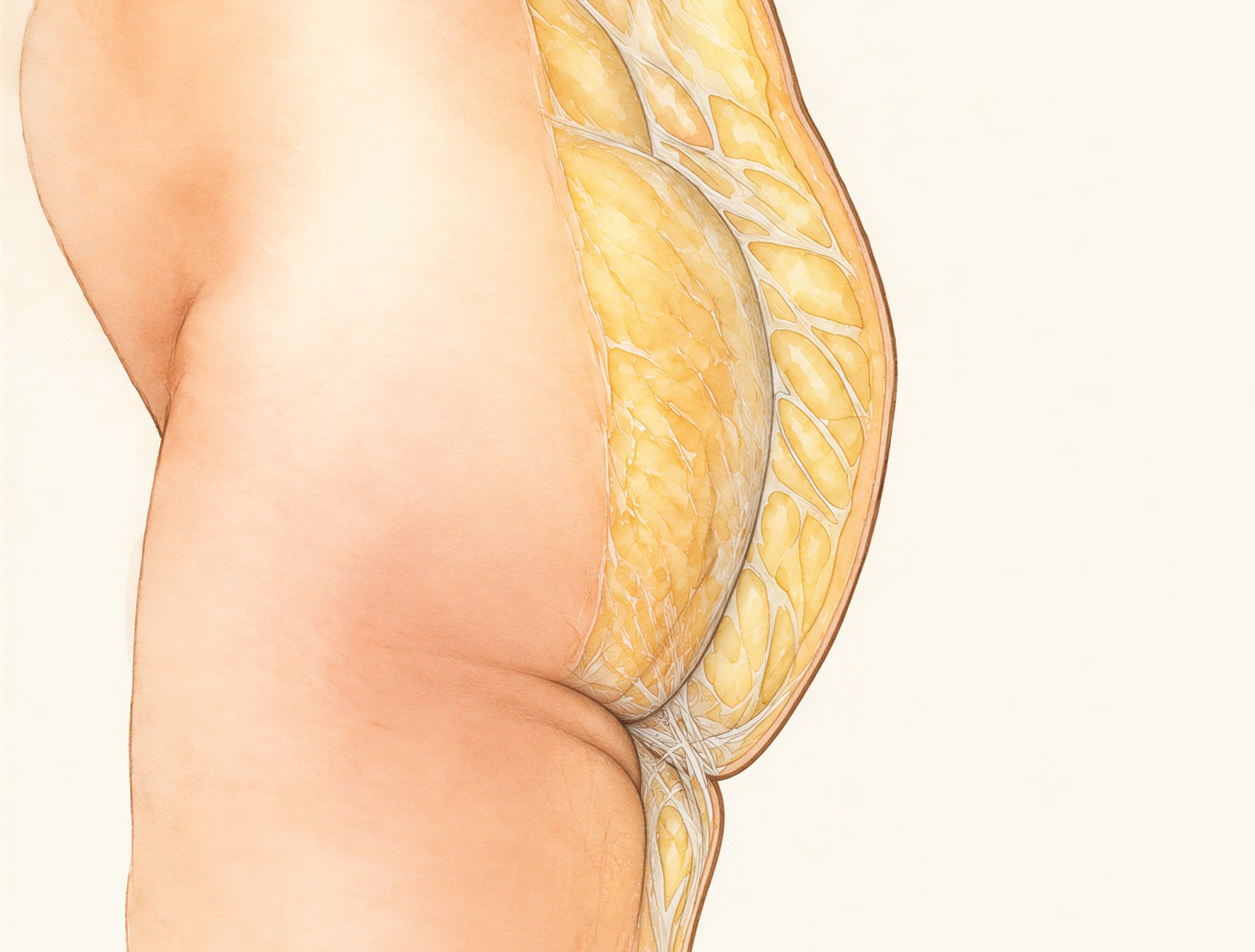
After excessive suction of the banana fold
The fat layer below the crease line is hollowed out and the fibrous strands are severed, so another crease forms below the original one.
The illustrations above show the buttock cut in cross-section from the side. Beneath the thin superficial fat just under the skin lies a thick deep fat layer, and the fibrous strands (ligaments of Luschka) that cross it obliquely converge at a single point below, the infragluteal crease. The bulge just below it toward the thigh is the banana fold. As shown on the right, if this area is suctioned deeply, the fibrous strands are severed and a second crease forms below the crease line.

Why a Double Crease Forms After Thigh Liposuction
Liposuction textbooks list the infragluteal crease as one of the zones of adherence, areas that must not be suctioned deeply. During thigh liposuction, if the upper back of the thigh, that is, the banana fold area, is suctioned deeply and excessively, this fibrous tissue is damaged. Once the supporting structure that held up the buttocks is severed, the buttocks descend, causing buttock ptosis (sagging), and another crease usually forms below the original crease line, resulting in a double crease. This is why at Venus Clinic we treat this area carefully, contouring only the superficial layer.
Types of Buttock Ptosis and Double Crease
At Venus Clinic, we classify cases that require revision buttock liposuction according to the presence of buttock ptosis and a double crease, as shown below.
| Type | Buttock ptosis | Double crease | Typical situation |
|---|---|---|---|
| Type 1 | Present | Absent | Only the thighs were suctioned, so the buttocks look relatively larger |
| Type 2 | Absent | Present | Ligament damage created a crease, but the buttocks did not sag |
| Type 3 | Mild (1 cm or less) | Present | Ligament damage caused a crease together with mild sagging |
| Type 4 | Moderate or greater (1 cm or more) | Present | Ligament damage caused a crease together with pronounced sagging |
Types 1 and 2 tend to allow a relatively large degree of improvement, while in Types 3 and 4, where sagging is added, some improvement is possible but restoring the original shape is difficult. This is why, in thigh liposuction, the most important thing is not to over-suction the banana fold area in the first place.
This Patient's Case — An Unusual Case of a Crease Without Sagging
The patient we are introducing today developed a crease in the thigh below the buttocks after thigh liposuction, but no buttock ptosis occurred. When the ligaments are damaged, sagging and a double crease usually appear together; in this patient, however, the buttocks had not descended and a crease had formed only in the thigh right below the buttocks, an unusual case corresponding to Type 2 in the table above. Because the shape of the buttocks had been preserved, the focus of the surgical plan was not to lift sagging buttocks but to make the crease shallower and restore the balance between the buttocks and the thighs.
Surgical Plan Combining Buttock Liposuction and Thigh Fat Grafting
At Venus Clinic, we performed two procedures on this patient in a single session. One was liposuction of the buttocks, and the other was fat grafting to the thigh area where the crease had formed.
Buttock Liposuction to Reduce the Weight of the Buttocks
The crease under the buttocks forms where the weight of the buttocks presses down on the upper thigh and the skin folds. By suctioning fat from the buttocks to reduce their size and weight, the force pressing on the crease decreases, and the size difference between the buttocks and the thighs, which had been slimmed by thigh liposuction, is reduced as well. At Venus Clinic, we do not suction the two sides differently; our principle is to leave the remaining fat layer at a consistent, uniform thickness. Liposuction is not a surgery that removes as much fat as possible, but one that leaves fat well in order to create a balanced body shape.
Fat Grafting to the Crease Area of the Thigh
The fat suctioned from the buttocks is purified and grafted into the depressed area of the upper thigh where the crease formed. Refilling the fat layer that had been thinned by excessive suction makes the groove of the crease shallower, and the line from the buttocks to the thigh connects smoothly as a single curve. Because part of the grafted fat is absorbed, the volume decreases somewhat over time compared with immediately after surgery, and the survival rate of the grafted fat varies by individual.

When reducing the size of the buttocks and filling the crease in the thigh are done together, the crease becomes less pronounced and the buttocks become smaller, so that the sizes of the buttocks and thighs come into balance. A rear view in which only the thighs were slim and the buttocks looked relatively large becomes a harmonious body shape connected in a single line.
The crease becomes shallower but does not disappear
The infragluteal crease is a fold that forms where the buttocks and thighs meet, depending on movement and posture. Fat grafting can make it shallower, but it cannot eliminate the crease itself, and results vary by individual.
Limitations — A Surgery That Makes Things "Similar and Shallower," Not "As They Were"
Once the ligaments are damaged, surgery cannot reconnect them as they originally were. This surgery reduces the weight of the buttocks and fills in the depressed area so that the crease is less visible; it does not completely remove the crease or restore the thighs to their pre-surgery state. In addition, if you gain weight, the weight of the buttocks increases again and the crease may deepen, and if you lose weight, the grafted fat decreases as well and the crease may reappear.
Precautions After Surgery — Do Not Tuck the Buttocks Forward
The crease between the buttocks and thighs is not a flaw in the skin itself but a fold created by muscle movement. When you clench the gluteal muscles or tuck the buttocks forward, the buttocks and thighs fold together and the crease deepens; conversely, when you stand upright, it becomes shallower. So even after fat grafting has made the crease shallower, if you repeatedly adopt a posture that tucks the buttocks forward after surgery, that area folds again and the crease may recur.

The Habit of Standing Straight, As If at Attention
After surgery, you should be careful not to tuck the buttocks forward, which creates the crease. Getting into the habit of standing straight with the pelvis upright, as if standing at attention, helps keep the crease from deepening while the grafted fat settles into place. In the early period after surgery, swelling and bruising cause the shape to keep changing, so it is best to judge the final shape after the swelling has gone down and the grafted fat has stabilized.
Before-and-After Photos
Below are photos of a patient who developed a double crease in the thigh below the buttocks after thigh liposuction and underwent buttock liposuction and thigh fat grafting together at Venus Clinic. All post-surgery photos were taken one week after surgery. Swelling and bruising are still present and the grafted fat has not yet stabilized, so these are not final results; the shape will change somewhat further as the swelling subsides. In each photo, the left side is before surgery and the right side is after.
Left Side View
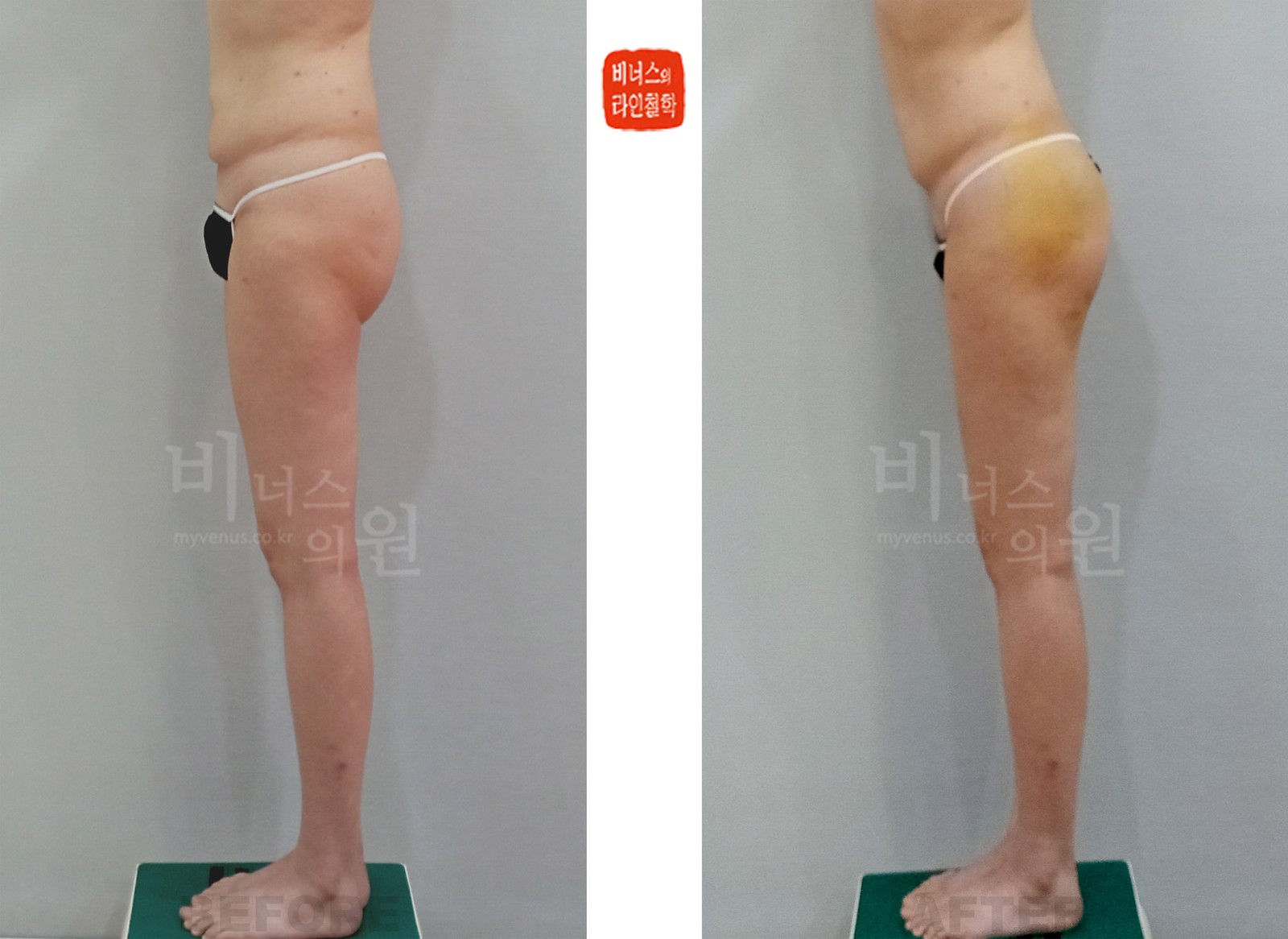
This is a case of a double crease in the thigh below the buttocks without buttock ptosis. Before surgery, the buttocks protrude backward and the area between the rounded lower buttocks and the thigh is folded inward. After surgery, the protrusion of the buttocks has decreased and the curve from the buttocks to the back of the thigh has become gentler. The yellowish discoloration visible on the buttocks is bruising fading around one week after surgery and disappears over time.
| Information on the Posted Liposuction Before-and-After Photos | |||
|---|---|---|---|
| - Same person | Surgery performed at Venus Clinic; same person | - Date taken | Taken around 2022; comparison at 1 week after surgery |
| - Same conditions | Edited to the same posture and size as closely as possible | - Side effects | https://en.myvenus.co.kr/should_know/38861 |
Rear View
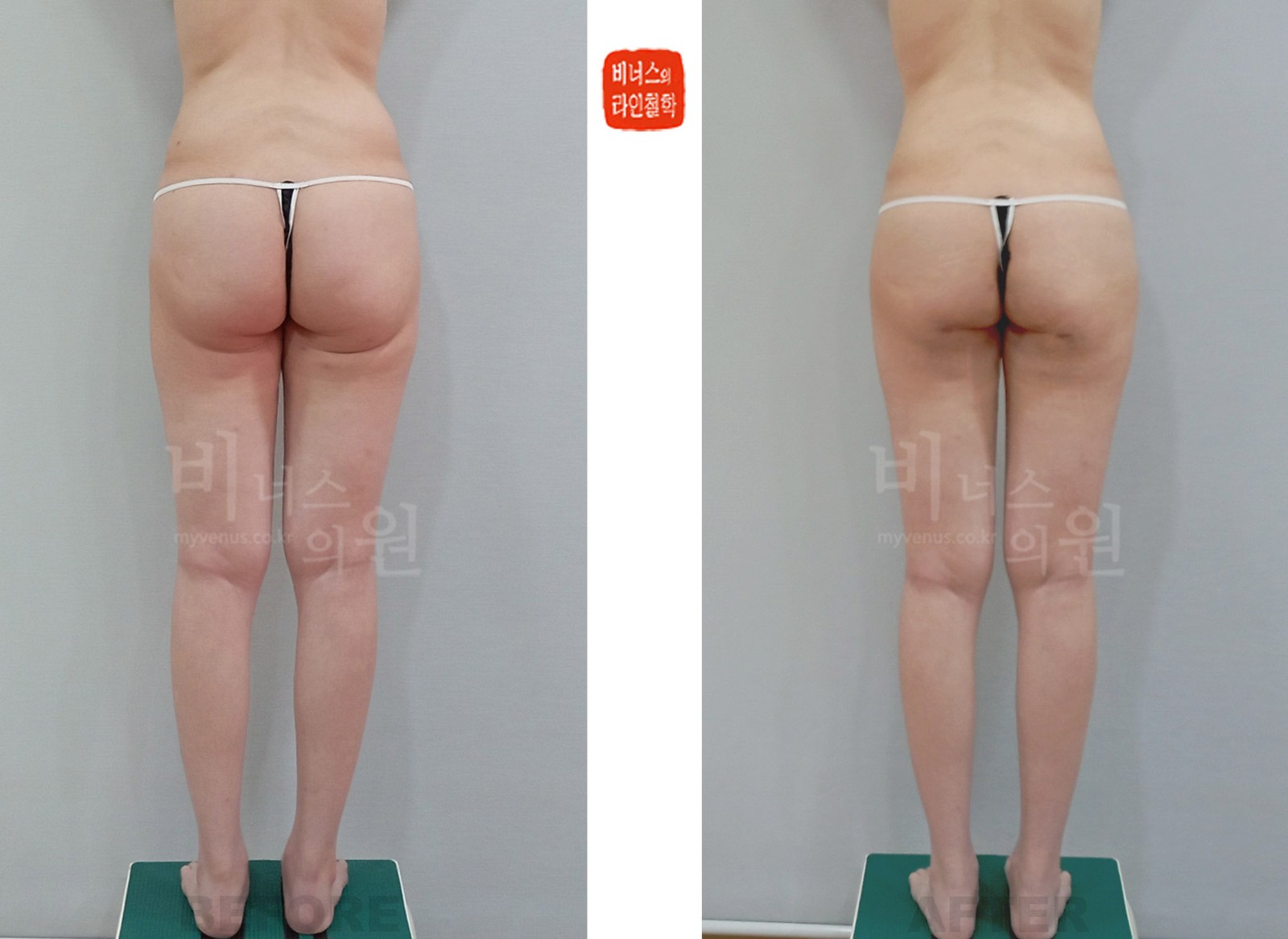
This is a case of a double crease in the thigh below the buttocks without buttock ptosis. In the rear view before surgery, another crease is visible on both sides in the upper thigh below the infragluteal crease, making the buttocks and thighs look folded in two layers. The buttocks themselves have not sagged, so their lower border sits above the crease line. After surgery, the width and size of the buttocks have decreased, narrowing the size difference with the slimmed thighs, and the lower crease in the upper thigh has become shallower, reducing the double-folded appearance.
| Information on the Posted Liposuction Before-and-After Photos | |||
|---|---|---|---|
| - Same person | Surgery performed at Venus Clinic; same person | - Date taken | Taken around 2022; comparison at 1 week after surgery |
| - Same conditions | Edited to the same posture and size as closely as possible | - Side effects | https://en.myvenus.co.kr/should_know/38861 |
Right Side View
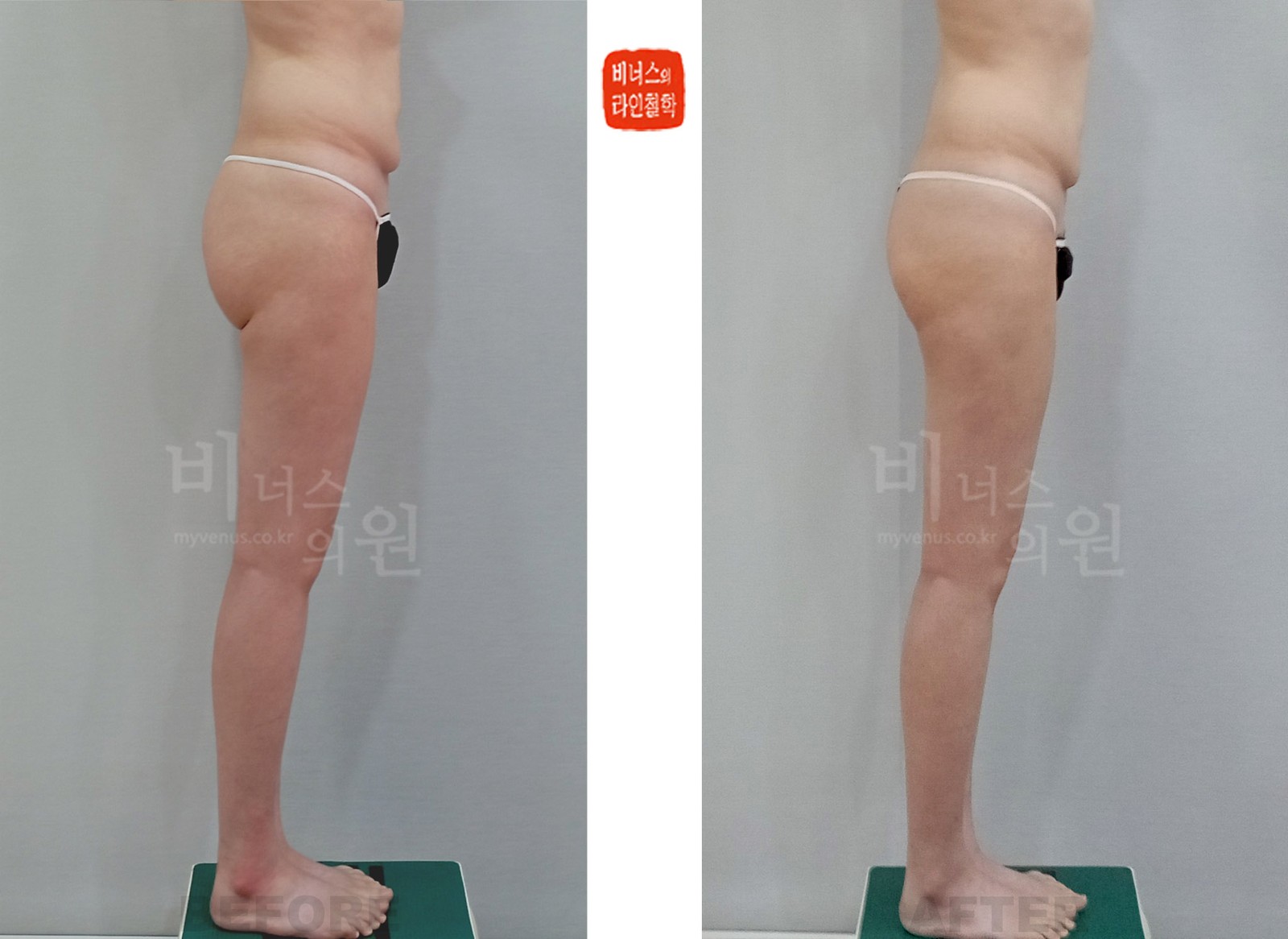
This is a case of a double crease in the thigh below the buttocks without buttock ptosis. From the opposite side as well, before surgery the buttocks protrude backward and the boundary with the thigh is deeply folded. After surgery, the volume of the buttocks has decreased so that the buttocks and thighs are better matched in size, and the line descending from below the buttocks to the thigh appears to connect as a single curve.
| Information on the Posted Liposuction Before-and-After Photos | |||
|---|---|---|---|
| - Same person | Surgery performed at Venus Clinic; same person | - Date taken | Taken around 2022; comparison at 1 week after surgery |
| - Same conditions | Edited to the same posture and size as closely as possible | - Side effects | https://en.myvenus.co.kr/should_know/38861 |
In Closing
A double crease after thigh liposuction occurs when the banana fold area is over-suctioned and the ligaments that support the buttocks are damaged. In cases like this patient's, where only a crease has formed without buttock ptosis, reducing the weight and size of the buttocks with buttock liposuction and grafting fat into the depressed area of the thigh to soften the crease can create a harmonious rear view with the buttocks and thighs in balance. At Venus Clinic, we combine liposuction and fat grafting in this way, and from the very first thigh liposuction we contour only the superficial layer right below the buttocks so that the ligaments are not damaged. However, since the crease under the buttocks is created by muscle movement, correct posture without tucking the buttocks forward remains important after surgery to protect the result.
References: Volume-Up Revision Liposuction for Buttock Ptosis (Sagging) and Double Crease Revision Liposuction of the Thighs and Buttocks
Dr. Hakjun Kim, Director, Venus Clinic