Risk Factors in Liposuction and How We Address Them

Last time, we explained that liposuction can fortunately be performed under local anesthesia alone, which makes it a much safer procedure than other operations that require general or spinal anesthesia.
However, for large-volume liposuction, where local anesthesia alone cannot provide sufficient anesthesia, liposuction is performed using systemic anesthesia such as general anesthesia, regional (spinal) anesthesia, or conscious sedation.
Of course, even when it is not large-volume liposuction in a patient with severe obesity, complete pain control can be difficult with local anesthesia alone, so sedation is sometimes combined with it to relieve the patient's anxiety and make the surgery more comfortable. Therefore, when liposuction is performed using systemic anesthesia, understanding the risk factors and eliminating them as much as possible is essential for safe liposuction.
So this time, despite the overall safety of liposuction, we would like to analyze the risk factors that may still arise and explain how we address them.
According to the causes of death from liposuction reported by the American Society of Plastic Surgeons in 1998, venous thromboembolism was the most common cause of death at 23.1%. Adding anesthesia-related deaths at 10% and fat embolism at 8.5%, a total of 41.6% of deaths can be considered related to anesthesia and venous thromboembolism.
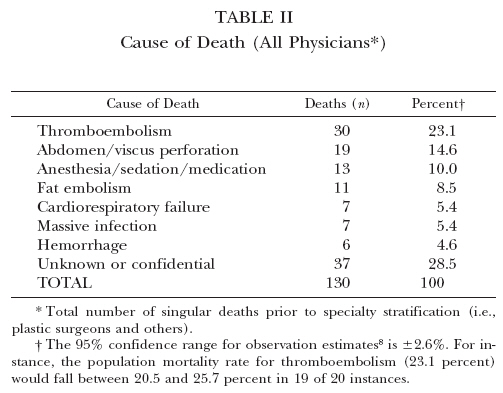
[Grazer FM, de Jong RH: Fatal outcomes from liposuction: Census survey of cosmetic surgeons. Plast Reconstr Surg 105:447?448, 2000]
Since most of the liposuction in this study was performed under general or intravenous anesthesia, this result seems only natural.
In addition, abdominal/visceral perforation during liposuction in people with abdominal obesity accounted for 14.6%. However, these deaths result from a lack of technical skill, so we believe this risk is very low in the hands of an experienced liposuction surgeon who knows the anatomy of the abdomen and has a feel for the fat layers. Therefore, for safe liposuction, general and spinal anesthesia should be avoided, and liposuction performed under local anesthesia alone can be regarded as largely safe.
When body tissue is injured, our body naturally tries to stop bleeding by forming clots (thrombi); as part of this protective defense mechanism, the coagulation system is activated. The problem is that coagulation can also be activated inside the veins, where it should not occur. A clot (thrombus) can form there, and if it blocks the blood vessels of the lungs, heart, or brain, it can lead to a fatal accident.
Risk factors for this kind of venous thromboembolism include:
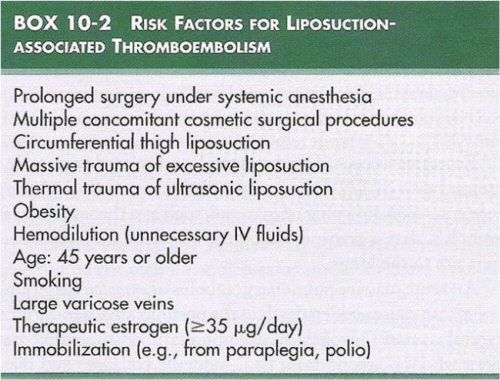
[Klein JA. Tumescent technique. st. Louis: Mosby, 2000:68.]
Therefore, to avoid the risk of venous thromboembolism, we need to limit excessive liposuction volume to avoid excessive tissue damage, keep the operating time as short as possible, use surgical methods that minimize bleeding (because excessive fluid replacement for blood loss causes hemodilution), avoid general and spinal anesthesia, which paralyze the vascular muscles, and raise the operating room temperature to prevent hypothermia.
For this reason, large-volume liposuction of more than 5,000cc involves more tissue damage and can be considered to carry a higher risk of complications. However, with Two-Doc Liposuction at our Venus Clinic, liposuction proceeds at more than twice the speed of conventional methods, so even large-volume liposuction can be completed faster than an average-volume liposuction, which makes it a favorable method from a safety standpoint.
Besides the risk of venous thromboembolism, liposuction covers a relatively large body surface area compared with other surgeries, so strict aseptic technique and thorough sterilization of the operating room and surgical instruments are essential to prevent infection. In tumescent liposuction, the local anesthetic lidocaine itself has an antibacterial effect, so the risk of infection is low. However, liposuction involves a large surgical area, and after surgery the treated areas become firm, which impairs blood circulation and lowers the body's defenses. We must remember that if an infection does occur, it can be fatal.
In general, the infection rate for clean-wound surgeries such as liposuction is reported to be about 1%. However, fatal infections such as necrotizing fasciitis and toxic shock syndrome have been reported after liposuction, so thorough infection control is necessary.
In conclusion, for safe liposuction, we can say that the procedure should be performed at a liposuction-focused clinic that maintains surgical aseptic technique, understands the risk of venous thromboembolism and is systematically prepared for it, and where surgery is performed by an experienced team and a skilled surgeon.
Liposuction is a surgical method with relatively few complications. Next time, we will talk about liposuction complications that are often confused with the natural healing process after surgery.
[ Dr. Jung, Director, Venus Clinic]