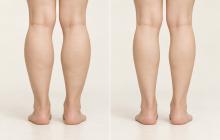
What Is an Hourglass Figure?
[Lee In-sik's Wonderful Science] The "Hourglass Figure": Waist : Hip = 0.7 : 1 - Lee In-sik, Director, Institute of Science and Culture (Korea)
A paper recently published in the Proceedings of the Royal Society of the United Kingdom confirmed that for 2,000 years men have consistently preferred women with slim waists. The author is Devendra Singh, an American of Indian origin. He is an evolutionary psychologist who became famous for studying the waist-to-hip ratio (WHR), the ratio of waist measurement to hip measurement, a figure that symbolizes the beauty of the female body.
In a survey of 200 Seoul women aged 13 to 43 conducted in August 2002, 72% of respondents said they envied women with a good figure more than women with a pretty face. It is considered entirely natural that modern women long for an hourglass-shaped figure. Women have therefore desperately tried to lose weight in order to achieve a beautiful figure. For example, Miss Americas of the 1980s were so thin that they were about twice as slender as the beauties of the 1940s. If weight keeps dropping at this rate, won't the female figure become stick-shaped? According to Singh's research, that will never happen. Singh found that the waist-to-hip ratio of beautiful women always falls within a certain range.

According to Singh, Miss Americas and the beauties who appear nude in Playboy magazine have become lighter over time, but their waist-to-hip ratio has stayed within the range of 0.68–0.72, then as now. Comparing the figures of Marilyn Monroe and Audrey Hepburn, film stars who dominated the 1950s, makes Singh's argument even more convincing. Monroe was the original voluptuous bombshell (36-24-34), while Hepburn was the symbol of innocent beauty (31.5-22-31), yet both had the same waist-to-hip ratio of 0.7. Today's American supermodels also have average measurements of 33-23-33, a waist-to-hip ratio of 0.7. A ratio of 0.7 is the most feminine, hourglass-shaped figure. Fertile premenopausal women have ratios of 0.67–0.80, and healthy men 0.85–0.95.
Singh surveyed men's preferences for the female figure in 18 cultures and found that the factor men find most sexually attractive is the waist-to-hip ratio rather than breast size. He also argued that the waist-to-hip ratio of beautiful women stays constant because men instinctively prefer a female body with large hips and a narrow waist. To show that this preference is a product of instinct rather than environment, Singh showed drawings of female bodies of various shapes and sizes to people in both the East and the West and examined their reactions.
First, in a survey of American men and women, the drawing that received the highest score as an attractive female body was, of course, the one with a low waist-to-hip ratio. A survey of Indonesian men and women who had just arrived in the United States as students produced the same result. Under strict Islamic law, they would rarely have seen magazines or films showing naked women, yet their responses were no different from those of Americans.
To further strengthen the theory he published in the early 1990s, Singh searched old texts from Britain, China, and India and analyzed descriptions of beautiful women's waists. For example, in India's two great epics, the Mahabharata and the Ramayana, the young beauties are uniformly described as having "ant waists." Singh concluded that throughout history, East and West, men have preferred women with a waist-to-hip ratio of 0.6–0.7, and published his paper in the Proceedings of the Royal Society.
British biologist John Manning argues that, from the standpoint of fertility, the waist-to-hip ratio is a product of evolution, because the lower the ratio, the higher the fertility. A woman with a narrow waist secretes more of the female hormone estrogen and is more likely to become pregnant. And wide hips mean the birth canal is not narrow, which is inevitably an advantage in childbirth. In short, a woman's slim "ant waist" signals the potential for many children and physical health, so men came to prefer it and it was favored by evolution. Women's fashion, too, from corsets and hip-cinching girdles to high heels, has developed with a focus on the waist.
As we age, this ratio changes, usually to 1:1 or higher. The reason is that as fat accumulates we gain weight, and even when we lose weight again, the fat cells in the flanks (which are actually properly called the "hips") do not shrink back.
That is why it is called "age fat." Even if the rest of the body is slim, it is an unavoidable phenomenon as we get older.
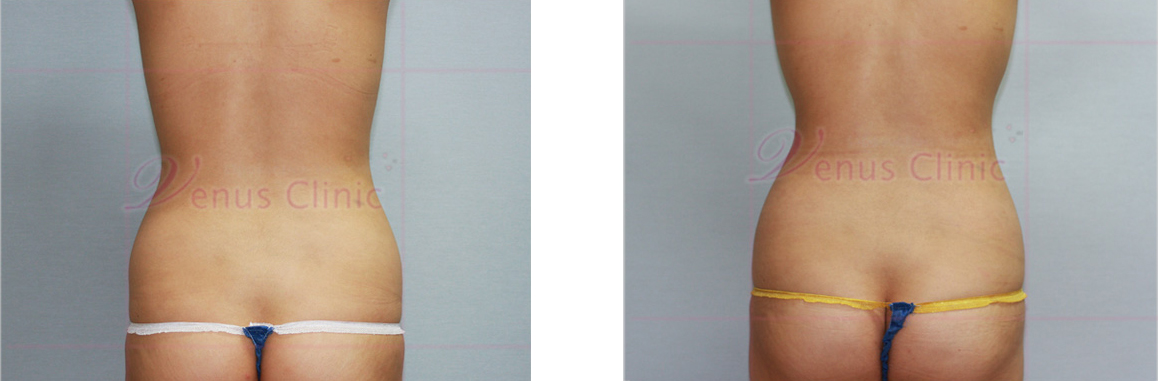
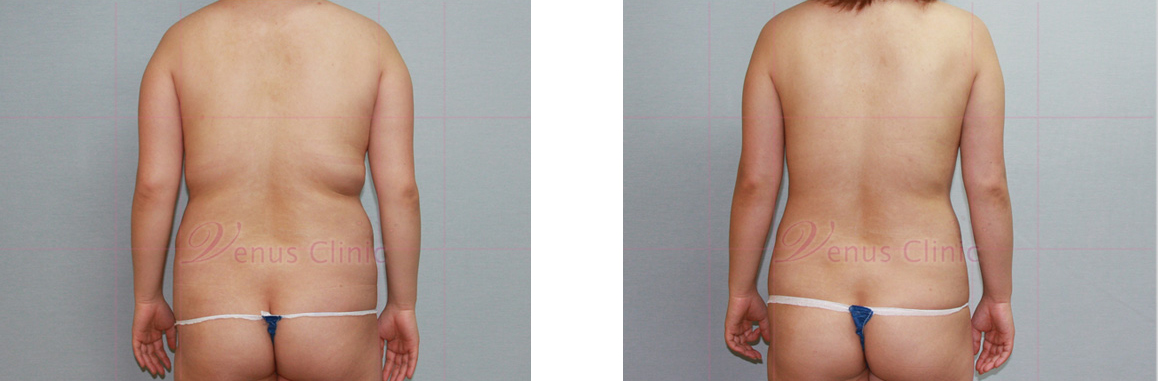
This area may realistically be addressed only with liposuction. Liposuction can help bring back the S-line you had when you were younger. I'm sorry to say, though, that if you didn't have a flank curve even when you were young, there's not much that can be done... (sob)
[ Dr. Jung, Director, Venus Clinic ]