On Liposuction of the Hips, Buttocks, and Thighs
The everyday names we use for different regions of the body are often confusing. I think this is especially true in Korea today, where English terms and Korean terms are used interchangeably.
For example, if you look up the word "hip" in the Naver English dictionary (a major Korean online dictionary), it gives "hip," "gluteal region," and "buttocks" as its meanings. Furthermore, a Korean encyclopedia describes it as follows:
That is, the area below the hips, the muscular part that touches the floor when you sit. Anatomically, it is called the gluteal region. The upper boundary of the buttock is the iliac crest, and the lower boundary is the gluteal fold, which runs across the lower edge of the bulge. Between the left and right buttocks is a deep groove that leads to the anus. The bulging flesh of the human buttock is due to the well-developed gluteal muscle group, especially the gluteus maximus.
When the lower limbs are fixed and the gluteus maximus is tensed, the pelvis is held vertical, so this muscle plays an important role in upright posture. Beneath the gluteus maximus lie the gluteus medius and gluteus minimus. The subcutaneous fat of the buttocks is especially abundant compared with other parts of the body, and women have more than men. The skin of the buttocks is also thicker in women than in men, averaging 2 cm in men and 3.5 cm in women. What is commonly called the "hips" in Korean refers to the upper area continuous with the buttocks.
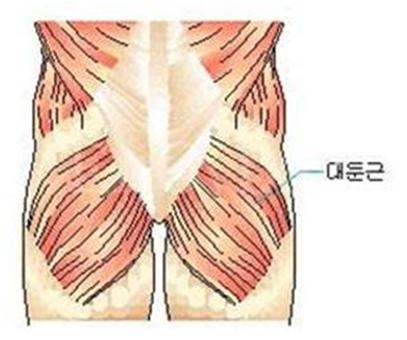
On the other hand, when you enter the keyword "Buttock" in Wikipedia, you get the following.
The buttocks are formed by the masses of the gluteal muscles or 'glutes' (the gluteus maximus and the gluteus medius) superimposed by a layer of fat. The superior aspect of the buttock ends at the iliac crest, and the lower aspect is outlined by the horizontal gluteal crease. The gluteus maximus has two insertion points: 1/3 superior portion of the linea aspera of the femur, and the superior portion of the iliotibial tractus. The masses of the gluteus maximus muscle are separated by an intermediate gluteal cleft or "crack" in which the anus is situated. The buttocks allow primates to sit upright without needing to rest their weight on their feet as four-legged animals do.
In other words, unlike Wikipedia, the Korean encyclopedia presents the hip as if it were the buttock.
In general, many people seem to use "hip" and "buttock" interchangeably. Strictly speaking, the hip refers to the subcutaneous tissue and muscle above the bony prominence at the top of the thighbone (the greater trochanter of the femur).
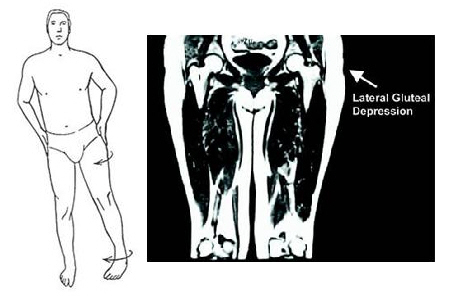
If you move as shown in the picture above, you can feel a protruding bone moving under your hand; that is the greater trochanter of the femur. Along the side line of the pelvis there is a slightly indented area, and the trochanter lies a little above it. Therefore, it would be correct to call the protruding muscle and fat below the upper rim of the pelvic bone (iliac crest) the hip.
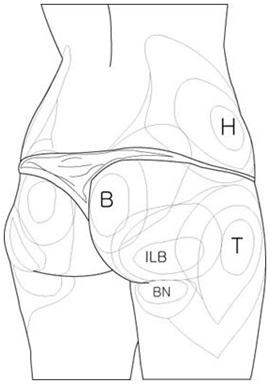
Another term that is often used loosely is "flank." The flank refers to the area between the ribs and the hip. In colloquial or slang usage, it is sometimes called the "love handle."
There is also the word "waist," which refers to the area between the navel and the ribs, the narrowest part of the torso. Some say that when it comes to the female figure, a waist-to-hip ratio of 0.7 is the most beautiful.
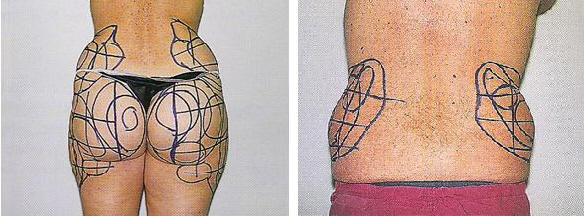
There are differences between the male and female figure. If we take the position of the waist to be the belt line, Dr. Klein, the originator of tumescent liposuction, sometimes calls the area below the belt line the hip, the middle area the waist, and the area above it the flank.
Accordingly, since in men the belt line sits just above the pelvic bone while in women it sits below the ribs, in women the hip and waist make up most of the side of the torso, whereas in men there is almost no hip or waist, and the flank, the area above the belt line, should be seen as making up most of the side of the torso.
One more thing: the female figure has a distinctive area that does not exist in men: the outer thigh bulge below the hip. It is also known as the "saddlebag."
And because the bulge of the hip combined with the bulge of the outer thigh resembles the shape of a violin, it is also called the "violin deformity."
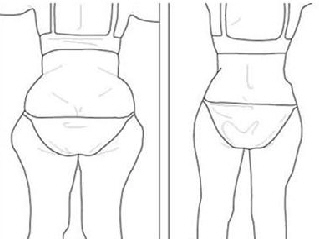
The picture above shows this violin shape alongside a natural, beautiful female silhouette shaped like an hourglass.
Many women want partial liposuction of the saddlebag area. However, the saddlebag bulge is often caused by the weight of the buttocks pressing it downward. For example, if, while standing, you contract your buttock muscles and the buttocks lift up and the saddlebags get smaller, the saddlebags can be considered to be influenced by the size and weight of the buttocks.
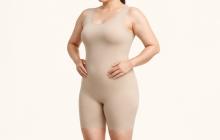
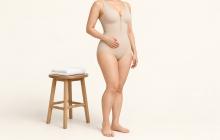
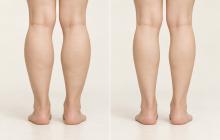
In such cases, liposuction of the saddlebags tends to give better results when it is combined with surgery to reduce the fat of the buttocks, especially the outer buttocks. For this reason, the hip, buttocks, and outer thighs of the pelvic region are sometimes referred to as a single cosmetic unit, and if you are having liposuction, we recommend treating these three areas together, as in the photo below.
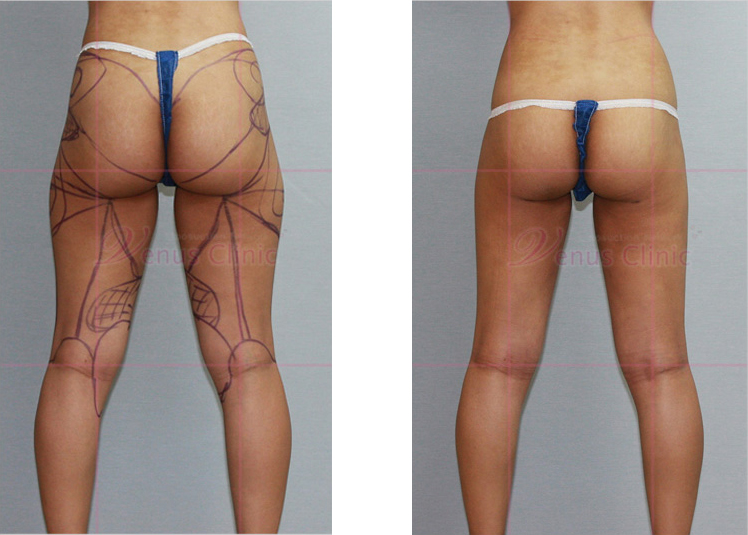
[ Dr. Jung, Director, Venus Clinic]
References
Apple-Line LiposuctionPremium Thigh and Buttock LiposuctionButtock Volume-Up