[Case Review] Abdominoplasty and Liposuction — Improving Ptosis of a Sagging Abdomen
During consultations, I often hear things like "I lost weight by dieting, but the skin on my belly has stretched and sags," or "My belly hangs down and folds over the top of my pants." Many people then go on to ask, "Isn't cutting away the skin the only option for a belly that has stretched like this?" Whether it is loose skin left after a diet or an abdomen that hangs down because a lot of fat has built up with obesity, most people believe that a sagging belly can only be improved by removing skin.
However, it is not widely known that in many cases liposuction alone allows the skin to contract, so that abdominal ptosis (sagging) disappears or improves sufficiently. Today I will first give you some background on abdominoplasty, a surgery that cuts away skin and fat, then explain how it differs from liposuction and how a sagging abdomen can be improved with liposuction, together with a case.

A Sagging Abdomen — What Exactly Has Stretched?
Three layers are involved when the abdomen sags: the skin, the fat layer beneath it, and, deepest of all, the muscle and fascia. The right surgery depends on which layer has stretched and by how much.
Skin, Fat, and Fascia — We Look at the State of All Three Layers
When a lot of fat builds up, its weight stretches the skin and makes it hang down. If there has been a pregnancy or a large change in body weight, there may also be rectus diastasis, in which the central abdominal muscles (the rectus abdominis) separate to both sides. When choosing a surgical method, we look together at the amount of fat, the amount and elasticity of the loose skin, and whether rectus diastasis or a hernia is present, and classify the abdomen into several types [1][2].
| Condition of the abdomen | Generally recommended approach |
|---|---|
| A lot of fat, but skin laxity is not severe and there is no rectus diastasis or hernia | Liposuction |
| A small amount of excess skin in the lower abdomen | Liposuction + minimal excision of lower abdominal skin (mini-abdominoplasty) |
| A large amount of excess skin and marked rectus diastasis | Abdominoplasty (excision of skin and fat + repair of the rectus muscles) |
| A lot of fat but no excess skin | Not a candidate for abdominoplasty |
This classification shows that "sagging belly = skin excision" is not the rule. Skin needs to be cut away when there is a large amount of excess skin and the fascia has also become lax; when there is a lot of fat and the skin has stretched under its weight, liposuction is considered first [1][2].
Background — How Abdominoplasty Is Done
Abdominoplasty (often called a "tummy tuck") is a surgery that cuts away the loose skin and fat of the abdomen and pulls the remaining skin taut. A standard abdominoplasty proceeds in the following order [3].
Surgical Steps
① A long horizontal incision is made across the lower abdomen above the pubic bone.
② The skin and subcutaneous fat are separated from the fascia and lifted widely, up to below the ribs.
③ The separated rectus muscles are stitched together (rectus plication).
④ The navel is left in place while the skin around it is separated.
⑤ The skin is pulled down, the excess skin and fat are cut away, a new opening is made for the navel to come through, and the wound is closed.
⑥ A drainage tube (drain) is placed so that fluid does not collect in the space under the skin.
The Scar — From Above the Pelvis to the Flanks
What abdominoplasty leaves behind most noticeably is a scar. The incision line runs across the lower abdomen just above the pubic bone to the front of both hip bones, and the more loose skin there is, the farther the incision must be extended to the sides [3]. Circular abdominoplasty (belt lipectomy), performed for people whose looseness extends to the flanks and back, involves an incision that goes all the way around the trunk [6]. On top of this comes the scar where the navel was brought out in its new position.
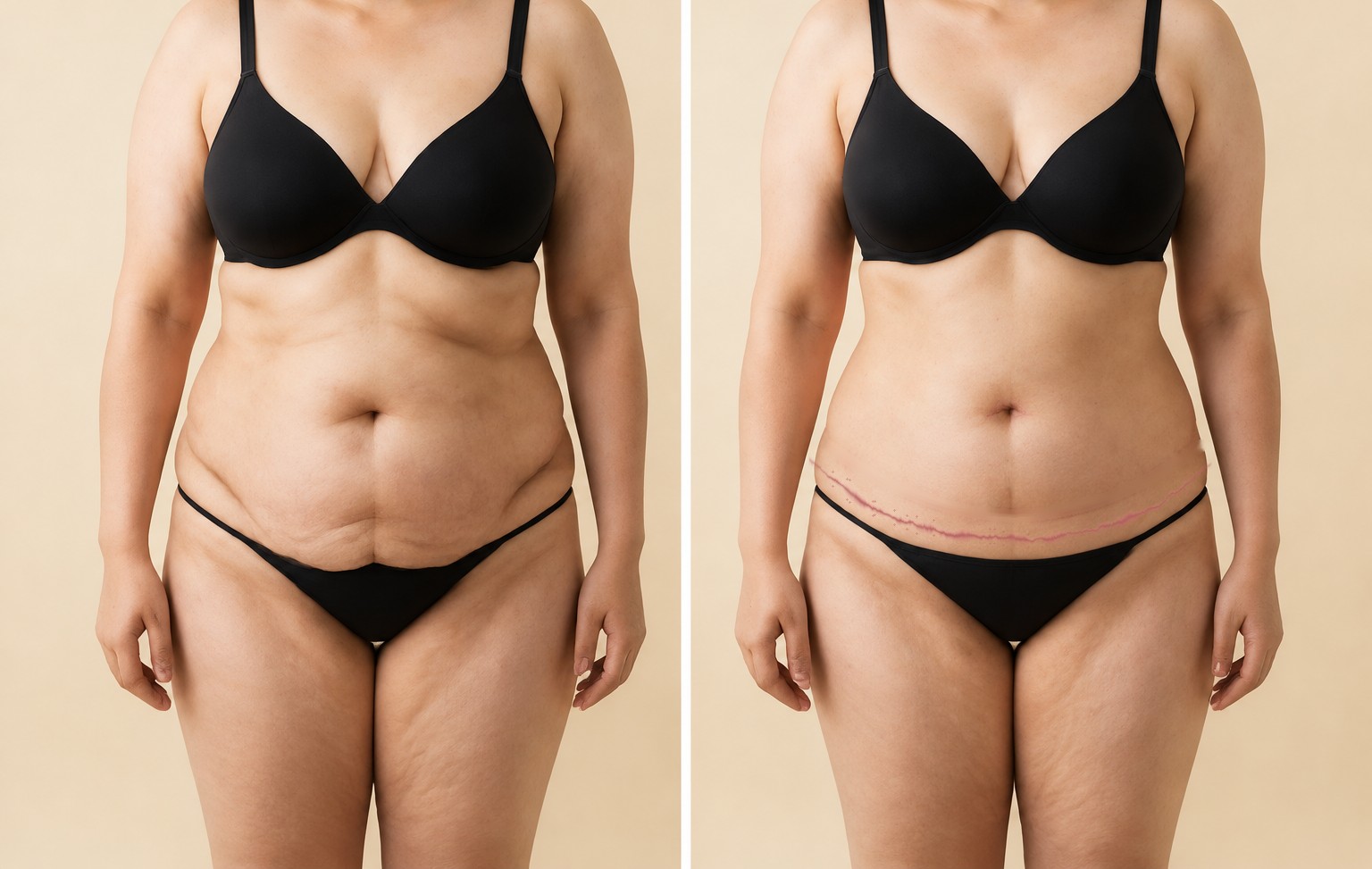
※ This is an illustrative (virtual) image. Actual results may vary from person to person.
Even when the scar is designed low so that it is hidden below the underwear line, a long scar running from above the pelvis across the lower abdomen to the flanks can easily show when wearing a swimsuit or low-rise bottoms. If a hypertrophic (thickened) scar develops, a revision surgery to refine the scar may be needed [3]. Even if the sagging belly improves, this long scar itself can become a new cosmetic concern — something you should know before deciding on surgery.
Complications · Wound Care · Cost
Because abdominoplasty lifts the skin over a wide area, pulls it taut, and closes it, there is a lot to manage after surgery. The main reported complications are seroma (fluid collecting under the skin), wound dehiscence (the wound opening up), wound infection, hematoma, and necrosis of the skin edges [3][4]. In one study reviewing 153 abdominoplasties, seromas that had to be drained with a syringe occurred in 6.5%, and the overall complication rate was 11.1% [5]. These complications are more common in smokers, people with diabetes or high blood pressure, and people with obesity [3]. The more your belly sags and the more you are considering surgery, the more carefully this point should be weighed.
Wound care is also a burden. To prevent seroma, a drain is left in place and must be managed until the drainage decreases, and if a seroma forms it may need to be drained repeatedly with a syringe or a drain may need to be placed again [3]. As this is a major surgery, measures to prevent blood clots in the leg veins (deep vein thrombosis) are also needed [3]. In addition, there are costs and recovery time related to the extent of surgery, anesthesia, and hospitalization. A study of patients over 40 also noted that although abdominoplasty may give somewhat better results when the skin and fascia are very lax, for most patients that difference may not be large compared with the added risks, recovery time, and cost [8].
Some Cases Do Require Abdominoplasty
When the amount of excess skin is very large, or when rectus diastasis or a hernia is marked and the fascia needs to be stitched, an abdominoplasty that removes skin is necessary [1][2]. Which surgery is right is decided by examining the condition of the skin, fat, and fascia in person.
The Difference Between Abdominoplasty and Liposuction
The two surgeries differ from the start in what they reduce. Abdominoplasty is a surgery that cuts away excess skin, while liposuction is a surgery that reduces the fat layer without cutting the skin, allowing the skin to contract on its own.
| Category | Abdominoplasty | Liposuction |
|---|---|---|
| What it does | Excises skin and fat, repairs the rectus muscles, creates a new position for the navel | Evenly reduces the fat layer under the skin to encourage skin contraction |
| Incision · scar | A long incision line across the lower abdomen (hip bones to flanks), scar around the navel | Only small incision points; no long incision line remains |
| Area of surgery | Mainly the front of the abdomen | 360 degrees around the trunk: abdomen, flanks, waist, and back |
| Post-op care | Drain care, seroma and wound care, blood clot prevention | Wearing a compression garment, managing swelling and bruising |
| Rectus diastasis | Can be corrected by stitching | Cannot be corrected |
It has been reported that liposuction, which does not cut away skin, does not leave a large scar, has fewer complications such as infection, wound dehiscence, and seroma than skin excision, and allows a faster recovery [7]. However, as the table shows, liposuction cannot stitch together separated rectus muscles. That is why it is important to check the degree of diastasis before surgery.
How Liposuction Improves a Sagging Abdomen
It is easy to assume that liposuction will make the skin sag even more, because the fat between the skin and the muscle is removed. In reality, the opposite is true.
Superficial Liposuction and Skin Contraction
With superficial liposuction, which evenly suctions fat right up to the shallow layer just beneath the skin, the skin contracts during recovery and re-adheres to the body. There is a report that a pendulous abdomen, which used to be treated only with skin excision, was treated with superficial liposuction alone with satisfactory results, and it is recommended especially for people with good skin quality, few stretch marks, and little rectus diastasis [7]. The idea that skin does not contract after liposuction in people over 40 is a misconception, and there is a study that confirmed skin contraction of the abdomen with liposuction alone [8].
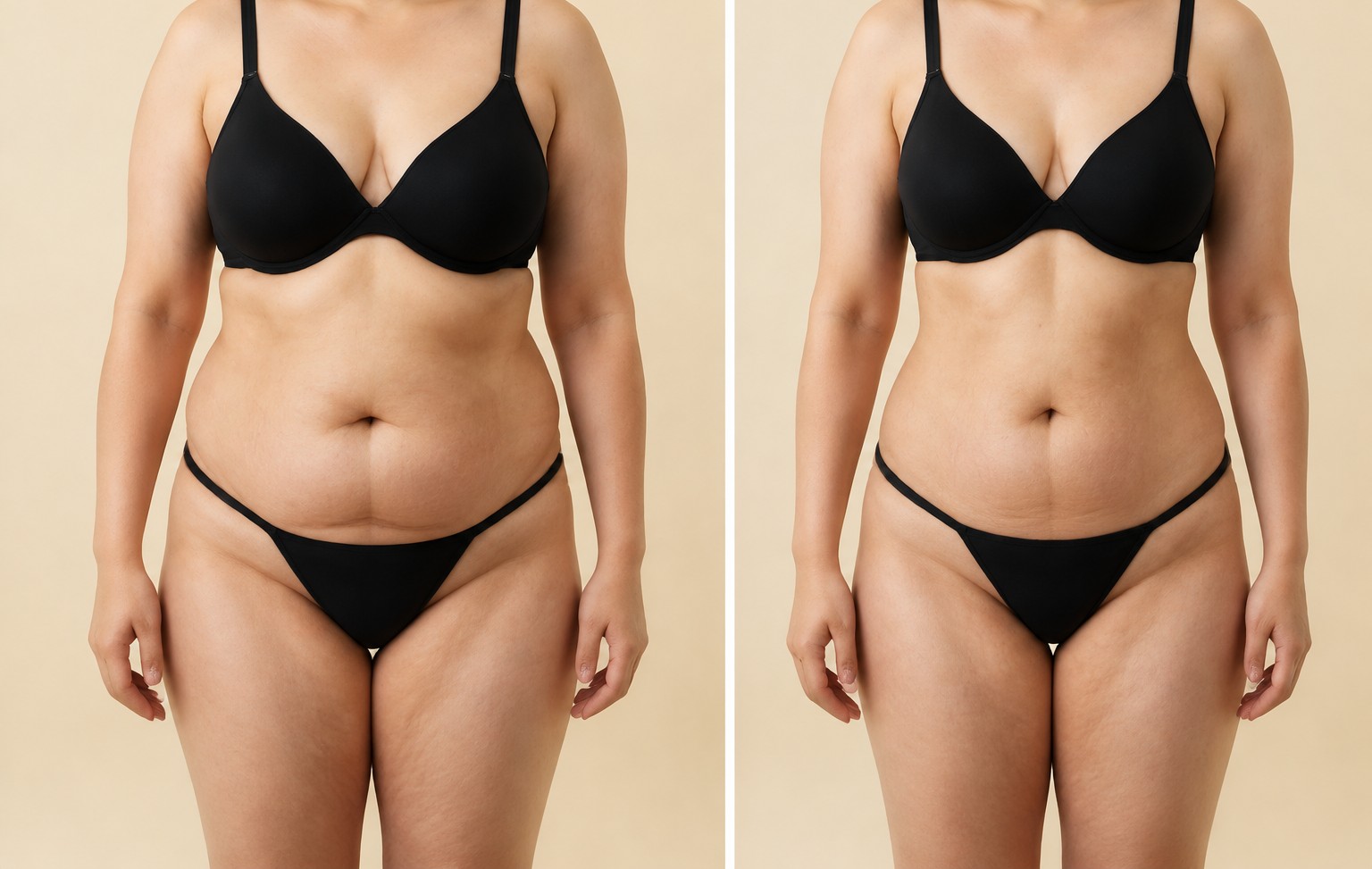
※ This is an illustrative (virtual) image. Actual results may vary from person to person.
The Lower Abdomen Contracts Well; the Upper Abdomen Less So
The fat of the lower abdomen is divided into two layers, superficial and deep, with a fibrous membrane called Scarpa's fascia between them, so even a hanging lower belly is an area where the skin tends to contract well after surgery. The upper abdomen, on the other hand, has no such membrane and its skin contracts less, so wrinkles are more likely to remain; it is therefore important to evenly refine the fat right up to the shallow layer beneath the skin (Circumferential (360-Degree) Liposuction for a Sagging Abdomen).
For a Sagging Belly, We Look at the Whole Trunk — 360-Degree Liposuction
When the belly sags this much, the fat is usually not only in the lower abdomen but spread widely over the whole trunk — the flanks, waist, back, and even above the ribs. If only the sagging belly is reduced and the surrounding areas are left, a boundary forms and the line of the trunk looks unnatural, so at Venus Clinic we plan a cylindrical (360-degree) circumferential liposuction that goes all the way around the trunk. Because the stretched fat layer does not flatten out on its own during surgery, an assistant smooths the skin flat by hand (MASST) while we suction evenly. We remove the fat that needs to be removed as thoroughly as possible, and smooth the lines so they are even rather than lumpy.
Limitations — Not All Sagging Skin Contracts
Evenly suctioning up to the superficial layer can encourage sagging skin to contract, but if skin elasticity was already greatly reduced before surgery, if there is a large amount of excess skin, or if stretch marks are severe, the skin may not contract enough and some wrinkles may remain. The upper abdomen in particular contracts less than the lower abdomen. Also, liposuction is not a weight-loss surgery but a body contouring surgery that refines the balance and lines of the trunk, so the result follows the shape of each person's own skeleton and muscles, and if body weight increases again after surgery, the remaining fat cells can grow and the lines can change. For this reason, it is more accurate to understand liposuction not as a surgery that makes a sagging belly "good as new," but as a surgery that eliminates or noticeably reduces sagging.
What Improvement Without a Long Incision Line Means
Improvement Alone Can Be a Good Cosmetic Result
People who come in about a sagging abdomen often have "a belly with no sagging at all" in mind as their goal. However, the cosmetic result is not determined by the degree of sagging alone. Even if a little sagging remains, if the lower belly that covered the underwear line is lifted and the line of the trunk flows smoothly, this can be more cosmetically satisfying than having a long scar from the lower abdomen to the flanks. Because liposuction eliminates or improves ptosis without leaving a long incision line, that improvement alone can be expected to give a good cosmetic result.
Less Burden in Recovery and Care
Because liposuction does not lift the skin over a wide area, there is less concern about drain care or the wound opening up; after surgery, you wear a compression garment and wait for the swelling and bruising to subside [7]. After large-volume liposuction, swelling and bruising usually last about 1–3 weeks; most of the result is seen at about 1 month, and full recovery, including the release of firmness and return of sensation, takes about 6 months.
References
- Shiffman MA, Di Giuseppe A (eds). Liposuction: Principles and Practice. Springer; 2006. Chapter 23, Liposuction and Dermolipectomy.
- Shiffman MA, Di Giuseppe A (eds). Liposuction: Principles and Practice. Springer; 2006. Chapter 24, The Modern Lipoabdominoplasty.
- Friedland JA, Maffi TR. Abdominoplasty. Plast Reconstr Surg. 2008;121(4 Suppl):1–11.
- Le Louarn C, Pascal JF. High superior tension abdominoplasty — a safer technique. Aesthetic Surg J. 2007;27:80–89.
- Kryger ZB, Fine NA, Mustoe TA. The outcome of abdominoplasty performed under conscious sedation: six-year experience in 153 consecutive cases. Plast Reconstr Surg. 2004;113:1807.
- Serdev N (ed). Body Contouring and Sculpting. 2016. Chapter 7, Circular Abdominoplasty (Belt Lipectomy) in Obese Patients.
- Planas J, Morais BB. New indications in the approach to the pendulous abdomen. Aesthetic Plast Surg. 1999;23:267–270.
- Bank DE, Perez MI. Skin retraction after liposuction in patients over the age of 40. Dermatol Surg. 1999;25:673–676.
Before-and-After Photos
This is the case of a patient whose abdomen hung down due to obesity, and all of the after photos were taken on day 12 after surgery. A lot of swelling still remains and the bruising is in the process of fading, so this is not the final result.
Case 1
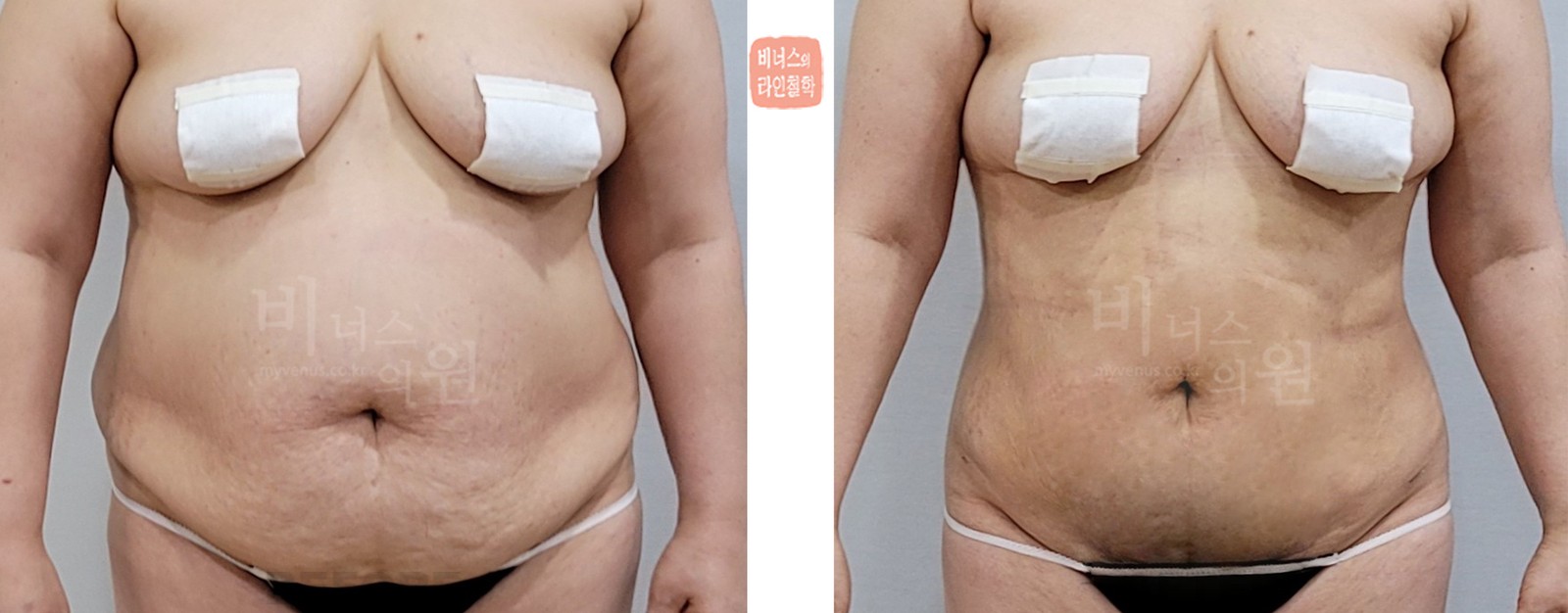
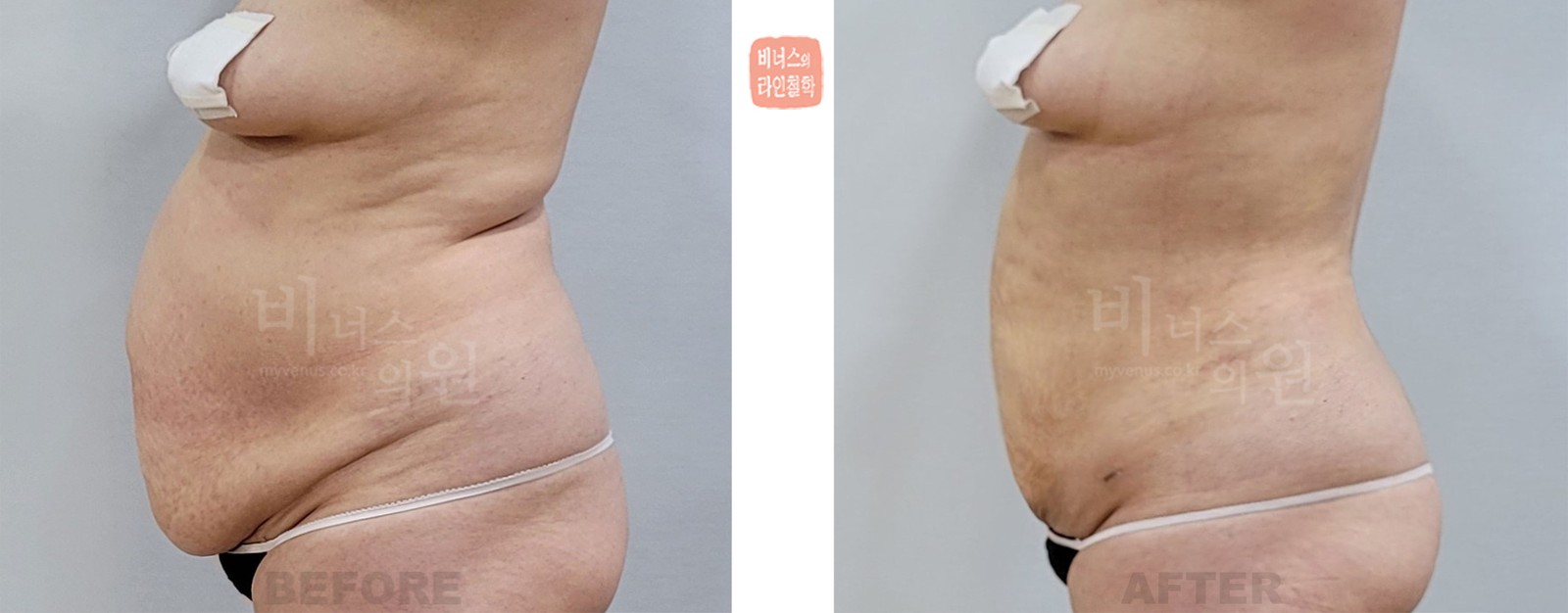
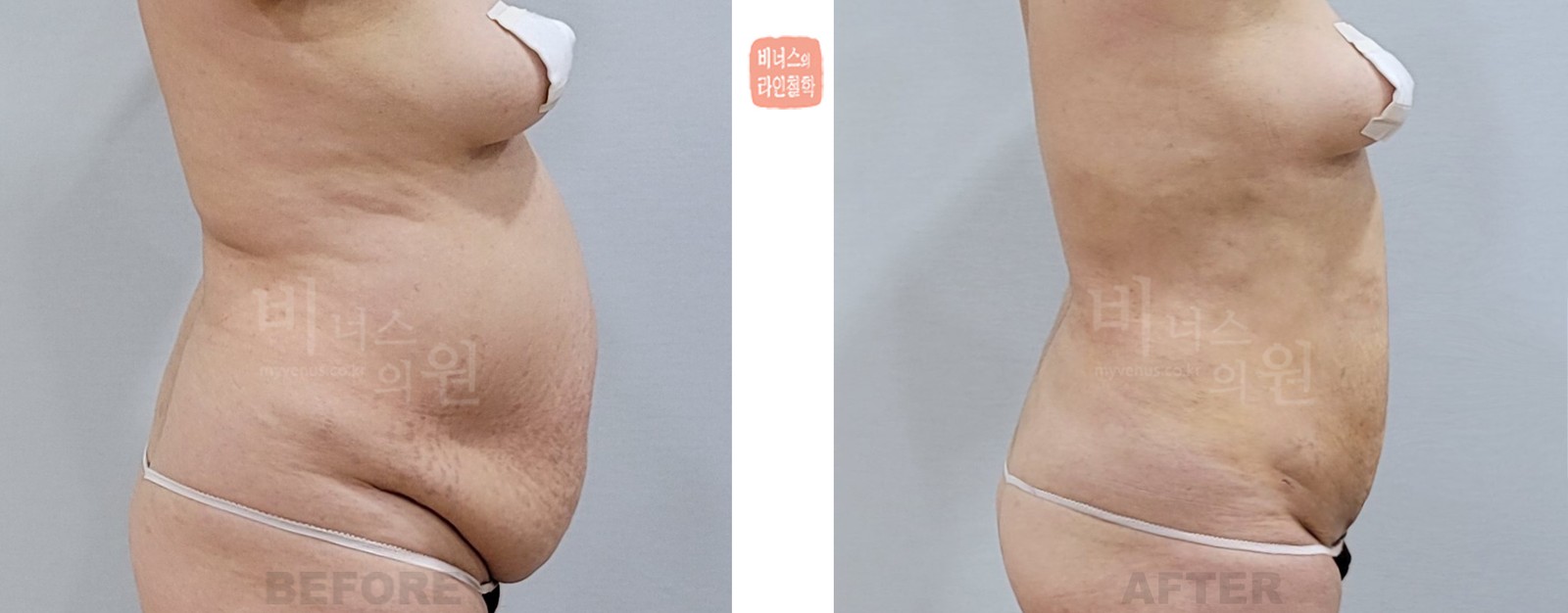
This is a case of an abdomen sagging due to obesity (abdominal ptosis). We performed 360-degree circumferential liposuction, suctioning the abdomen, flanks, waist, and back continuously all the way around the trunk. Before surgery, the lower belly hung down and covered the underwear line; from the side, the belly stretched forward and downward, and there were stretch marks on the lower abdomen. In the photos taken on day 12 after surgery, the sagging of the lower belly has decreased so that the previously covered underwear line is visible, and from the side, the forward and downward stretching of the belly has decreased, changing into a trunk line that flows continuously. Because no skin was excised, there is no long incision line across the lower abdomen. Some fine wrinkles are visible on the upper abdomen, and the yellowish tint of the skin is bruising in the process of fading. The lines will continue to change as the swelling subsides.
| Information on the Posted Liposuction Before-and-After Photos | |||
|---|---|---|---|
| - Same person | Surgery performed at Venus Clinic; same person | - Date taken | Taken around 10/2025; comparison at 12 days after surgery |
| - Same conditions | Edited to the same posture and size as closely as possible | - Side effects | https://en.myvenus.co.kr/should_know/38861 |
In Closing
Many people believe that a sagging abdomen can only be improved by cutting away skin, but when a lot of fat has built up and its weight has stretched the skin, liposuction alone — suctioning evenly up to the superficial layer — can allow the skin to contract so that the ptosis disappears or improves. Abdominoplasty is a surgery needed when there is a very large amount of excess skin or when the fascia must be stitched, but it comes with the burdens of a long scar from the lower abdomen to the flanks, complications, wound care, and cost. At Venus Clinic, we examine the condition of your skin, fat, and fascia in person and, during the consultation, check together with you how much improvement can be achieved without a long incision line.
References: Obesity and Large-Volume Liposuction Circumferential (360-Degree) Liposuction for a Sagging Abdomen Complications and Side Effects of Liposuction
Dr. Hakjun Kim, Director, Venus Clinic