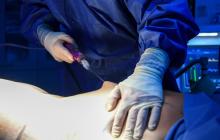
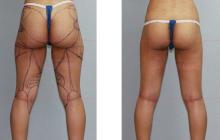
The word tumescent means swollen and firm (swollen & firm). Tumescent liposuction is a technique in which tumescent solution, in a volume roughly 2 to 3 times the amount of fat to be removed, is infiltrated into the area so that liposuction can be performed under local anesthesia alone, without general anesthesia or intravenous anesthesia.
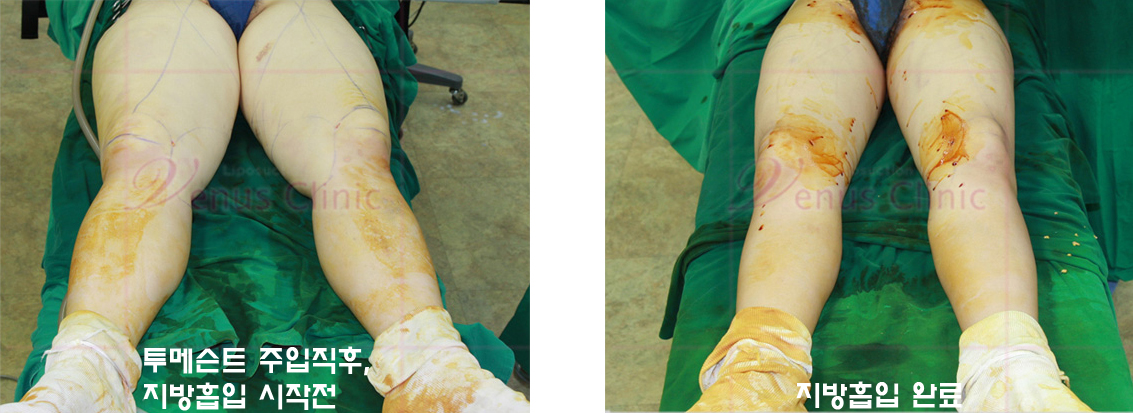
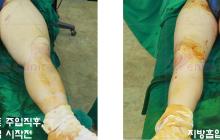
In the photo above, you can see that after tumescent solution was infiltrated into the thigh, the thigh became swollen and firm and the skin turned pale. When the surgical area is expanded with fluid in this way, and liposuction is performed with local anesthesia and vasoconstriction already in place, only the fat can be removed safely, without pain and without the risk of bleeding.
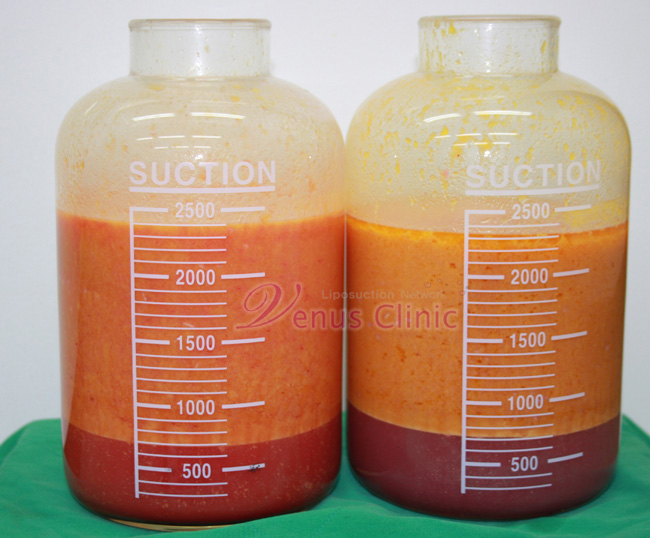
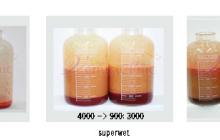
As the fat is removed, about 15 - 25% of the tumescent fluid comes out together with the fat, but most of the tumescent solution remains in the body and is metabolized in the liver. The photo above shows fat removed by tumescent liposuction; the yellow upper layer is the pure fat volume, and the lower layer is the aspirated tumescent fluid. When tumescent liposuction is performed properly, surgery can be carried out safely with almost no bleeding.
This surgical method was first presented to the world in 1986 by Jeffery A. Klein, an American dermatologist, who named it the Tumescent technique at the 2nd world congress of liposuction surgery.
The composition of tumescent solution is
normal saline, Lidocaine(2%), Epinephrine(1: 1.000), Bivon ( 8.45%), trimacinolone
as listed above.
- Lidocaine is a local anesthetic that allows surgery to be performed without pain. Among the nerves of the body, it blocks the nerves that sense pain, but it does not block the vibration or motor nerves, so during surgery the patient can feel the cannula moving and can still move the body (muscles).
- Epinephrine constricts blood vessels, reducing bleeding; it also delays the absorption of lidocaine into the bloodstream, prolonging the effect of the local anesthetic and allowing a larger amount of lidocaine to be used.
- Bivon is bicarbonate and is alkaline, so it eases the pain caused by the acidity of lidocaine and epinephrine when the tumescent solution is infiltrated into the fat layer.
- Triamcinolone is a steroid; it reduces the swelling and pain that occur after surgery and lowers the incidence of Postliposuction panniculitis, an inflammatory reaction that usually develops 5-8 days after surgery.
Modern liposuction has become safe and possible without bleeding because the liposuction method using tumescent solution was developed. As a result, liposuction can now be performed under local anesthesia alone, without general anesthesia. However, there is some pain when the tumescent solution is first infiltrated, and patients may complain of pain in the final stage of surgery, when meticulous finishing work is required. In addition, since patients' anxiety before surgery is considerable, a light sedation can be combined with tumescent local anesthesia liposuction so that you can undergo surgery comfortably.
I believe it is a doctor's duty to consider the patient's comfort as long as safety is not compromised. After you wake up, you do not need to worry about pain, because the local anesthetic remains in the surgical area. At the plastic surgery department of our Venus Clinic, we often perform tumescent liposuction together with additional sedation so that the procedure is comfortable.
Advantages of Tumescent Liposuction
- Minimal bleeding (Minimal blood loss)
- Because the local anesthetic remains in the fat layer after surgery, there is less postoperative pain (Long lasting anesthesia)
- Advantages that come from the patient being awake
- The desired position can be obtained easily, allowing the surgery to be performed well.
- Thrombosis and pulmonary embolism (Thrombophlebitis, pulmonary embolism) are less frequent
- The risks of general anesthesia can be avoided.
- Because the patient complains of severe pain when the abdominal wall is irritated, the risk of perforation of the abdominal cavity is lower.
Excessive surgery cannot be performed because of the allowable dose of lidocaine (Surgery limit by safe amount of lidocaine) Multiple procedures at once (Ancillary procedure) can be avoided. Because the aspirated volume is smaller and tissue damage is less, recovery and operating time are shortened. The antibacterial property of lidocaine (Antibacterial) lowers the risk of postoperative infection. Infiltrating 2-3 times more volume into the fat layer than the amount of fat aspirated has the effect of replacing intravenous fluids. (High volume solution provides fluid replacement ) Infiltrating a large volume of fluid into the fat layer softens the tissue (maximize tissue), making surgery possible with smaller cannulas and fewer incisions.
Pharmacology of Lidocaine
The most important property of lidocaine is its lipophilicity (Lipophilia). Therefore, when it is infiltrated into the fat layer, absorption into the systemic circulation (Systemic circulation) is slow. It is weakly alkaline, with a Pka : 7.9. The more alkaline it becomes, the greater its lipid solubility (lipid solubility), and the more readily it diffuses across the neuron cell membrane, so the anesthetic effect appears more quickly.
Its action is to block nerves (Neuronal blockage); at blood concentrations of about 0.5-4mg/L it shows antiarrhythmic ( antiarrhythimic) and antiepileptic (antiepileptic activity) effects, and at blood concentrations above 7.6 mg/L it can induce seizures (seizure). It also has an anti-inflammatory effect (Anti-inflammatory effect) and an antibacterial effect (Antibacterial effect), so infection rarely occurs when liposuction is performed with the tumescent technique.
Currently, the US Food and Drug Administration (FDA) states that a dose of 7mg per kilogram of body weight (7mg/kg) may be used.
Lidocaine is metabolized mostly in the liver, and less than 5% is excreted through the kidneys. Therefore,
- if you are taking medications that interfere with the metabolism of lidocaine in the liver (SSRI (Fluoxetine), EM, Ketoconazole, Fluconazole), blood concentrations will rise, so these must be stopped 1-2 weeks beforehand;
- if there is a condition in which hepatic blood flow (Hepatic blood flow) is reduced, that is, (shock, CHF , Propranolol ,Cimetidine), or
- if liver function is impaired (Impaired hepatic function), lidocaine may reach the toxic level (toxic level), so caution is required and the dose must be reduced.
When the dose of lidocaine becomes excessive,
nausea and vomiting occur, along with drowsiness, headache, tingling of the tongue, difficulty breathing, and localized muscle twitching. In severe cases, confusion sets in, vision becomes blurred, loss of consciousness and seizures occur, the heart rate drops, hypotension develops, and cardiac arrest may occur.
So how can an unimaginable dose of about 55mg per kilogram of body weight (55mg/kg) be used safely during liposuction?
Why liposuction can be performed with lidocaine (tumescent) local anesthesia alone.
As mentioned earlier, the US Food and Drug Administration (FDA) states that 7mg of lidocaine per kilogram of body weight (7mg/kg) may be used. This means that when lidocaine is injected into tissues with abundant blood flow, that is, intravenously, into the gums (gingival mucosa), into muscle (muscular), or into the spine (Spinal), it is rapidly distributed into the bloodstream, so no more than 7mg per kilogram of body weight should be used.
However, when lidocaine is infiltrated into the fat layer, it is absorbed slowly into the bloodstream and is metabolized in the liver as soon as it is absorbed. The reasons absorption occurs slowly when it is infiltrated into the fat layer are
- blood flow in fatty tissue is slow and limited;
- when fatty tissue is fully infiltrated with tumescent solution, the tissue becomes firm (firm) and compresses the capillaries;
- the volume of the fatty tissue increases because of the tumescent solution (swellen), so the physical distance to the absorbing blood vessels becomes greater;
- because diluted lidocaine is infiltrated, the concentration gradient between the fatty tissue and the blood vessels is small, so absorption into the vessels is slower;
- because epinephrine is administered at the same time, vasoconstriction occurs and absorption is delayed; and
- because of lidocaine's affinity for fat, absorption into the bloodstream is delayed.
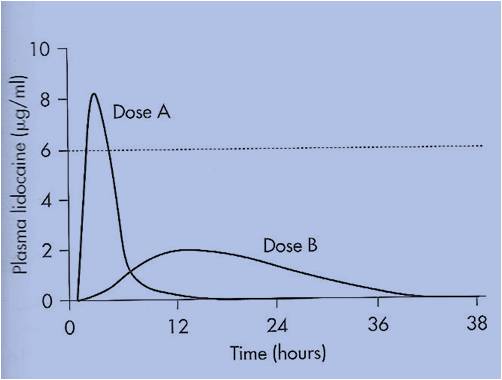
When 35mg/kg of lidocaine was administered into the body at different injection sites, graph A shows the change in blood concentration when lidocaine is injected into tissue with abundant blood flow, and graph B shows the change in blood concentration when lidocaine is infiltrated into fatty tissue.
In A, the blood concentration rises sharply within 2 hours of injection and easily exceeds the toxic level (toxic level) of 6mg/L. In B, however, the peak concentration (peak concentration) appears after 12 hours and does not reach the toxic level. It can therefore be considered safe. Complete metabolism in the body takes 36 hours.
Therefore, even a large dose of lidocaine is safe when infiltrated into the fat layer because absorption occurs slowly, and this is the basis for being able to perform surgery under local anesthesia.
Allowable Dose of Lidocaine Local Anesthetic in Liposuction
According to the paper by Dr. Klein, the founder of tumescent liposuction (Klein JA. Tumescent technique for regional anesthesia permits lidocaine doses of 35 mg/kg for liposuction. J Dermatol Surg Oncol. 1990 Mar;16(3):248-63. ), when lidocaine was used at 11.9-34.1mg/kg, the peak plasma lidocaine concentration (Peak plasma Lidocaine concentration) was 0.8-2.7 ㎍/ml at 12-14 hours, and the conservative estimate of the maximal safe dose (Conservative estimate of maximal safe dose) was reported as 35mg/kg.
When liposuction is performed after lidocaine administration, about 20% of the lidocaine is aspirated out of the body, so the safe maximum allowable dose ( A safe dose of tumescent lidocaine) is 50 mg/kg.
According to the guidelines of the American Society for Dermatologic Surgery published in 2000,
- Maximum aspiration volume: 5000cc or less
- Maximum allowable lidocaine dose: 55mg/kg or less
- Avoid other forms of anesthesia whenever possible
- Perform cardiac monitoring and oxygen saturation monitoring
- Keep the number of procedures performed at one time and the operating time as short as possible
- Facilities for emergency cardiopulmonary resuscitation must be available.
These are the stated requirements.
If the amount infiltrated into the fat layer is excessive, the concentration rises above the toxic level (6mg/L) around 12 hours after surgery, and once it rises it stays elevated for a long time, which can lead to an even more dangerous situation. Therefore, if a liposuction requires more than 55mg/kg, it would be safer to divide the surgery into sessions 3-4 weeks apart.
Drugs That Affect the Metabolism (Breakdown) of Lidocaine
Below are the drugs that must be stopped 1-2 weeks before liposuction. These are mostly drugs and foods that inhibit the body's hemostatic function and cause bleeding:
- Aspirin (Aspirin)
- Pain relievers (NSAID such as ibuprofen, naprosen, etc.)
- Anticoagulants (Vit. E or coumadin)
- Ginkgo leaf extract (Ginko biloba)
- Phytoestrogens (St. John’s wort)
- Ginger (Ginger)
- Ginseng (Ginseng)
- Antidepressant SSRI (Fluoxetine)
- Antibiotics (EM)
- Antifungals ( Ketoconazole, Fluconazole)
If any of these drugs have been used before surgery, the lidocaine dose should be reduced to about 35mg/kg or less. In addition, thyroid medication (Synthyroid) should be stopped 72 hours beforehand, and alcohol and smoking should be avoided for 1 week before and after surgery.