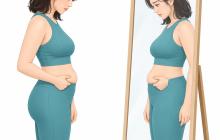
Posture After Liposuction — Even Skin Contraction Shapes the Result
Patients who have finished surgery and entered recovery often ask us, "I'm already wearing my compression garment — do I really need to watch my posture too?" or "Is it okay to sit for long periods?" Liposuction does not end with removing fat in the operating room. The final contour is completed by how the skin over the treated area contracts during the recovery period.
In this article, I will explain how the skin contracts after liposuction and why the skin contracts evenly only when the compression garment is worn flat and good posture is maintained. I will then go through the areas where posture easily causes creases — the lower abdomen, the arms and breasts, the thighs, and the double chin — one by one, and show a revision case of a patient who developed a horizontal crease across the lower abdomen because of poor care after a previous surgery.
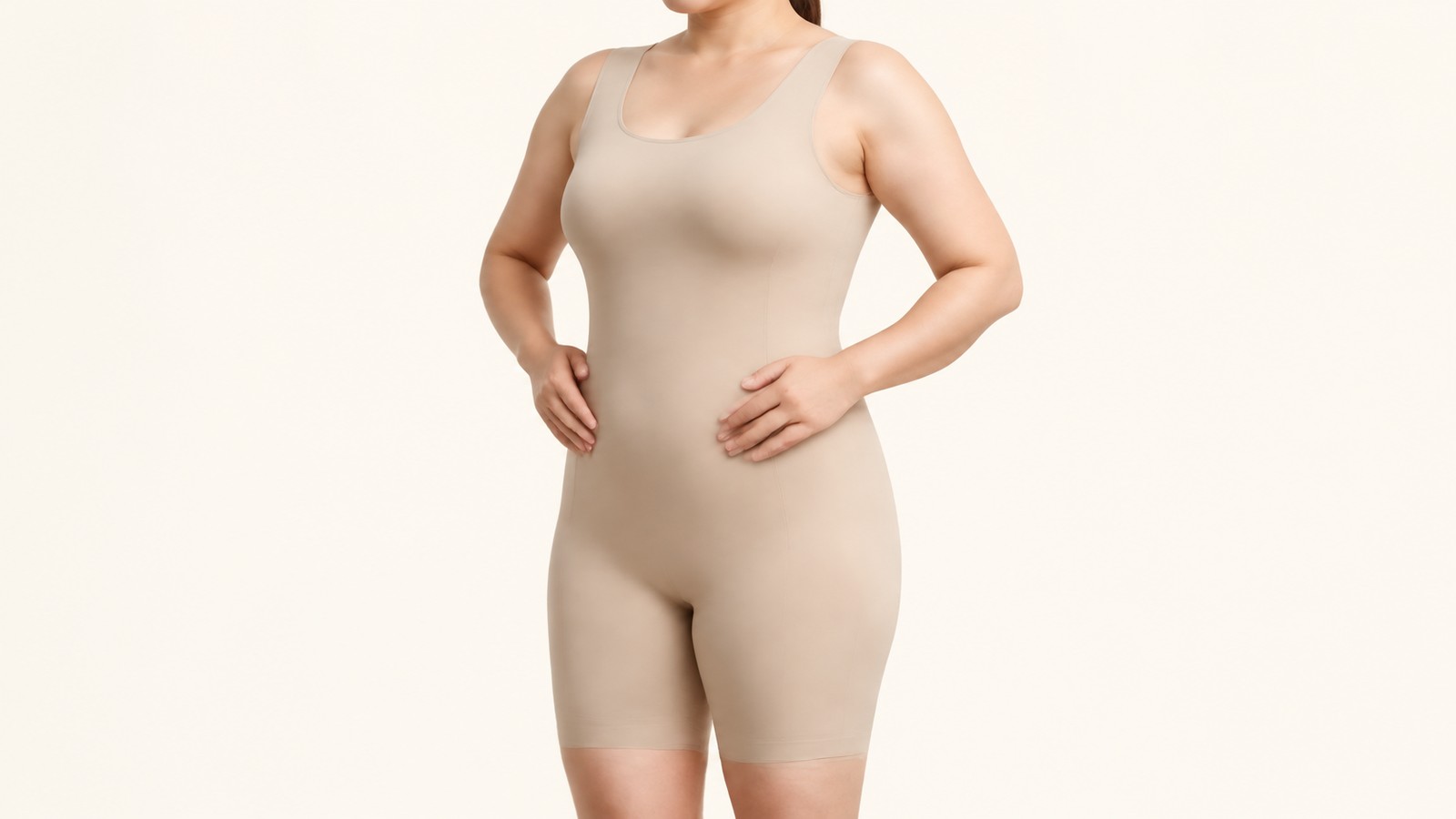
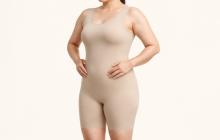
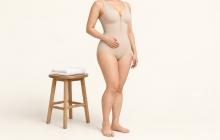
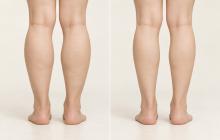
※ This is a simulated image. Actual results may vary from person to person.
How Does the Skin Contract After Liposuction?
Liposuction removes the fat layer that lies between the skin and the muscle. Right after the fat is removed, the skin is larger than the reduced volume beneath it — in other words, it is loose. The result of liposuction comes as this skin contracts again to fit the reduced volume and adheres to the underlying tissue, so that the area becomes smaller.
Skin Contraction Happens in Two Stages
Klein, author of the textbook on tumescent liposuction, explains that skin contraction after liposuction occurs through two actions: the normal elastic recoil of the dermis and contraction of the fibrous tissue in the subcutaneous fat layer[1]. In Shiffman's liposuction textbook, Fournier describes the same principle: right after surgery the elastic fibers of the skin contract immediately, and afterward the fibrous healing tissue that forms beneath the skin slowly contracts and changes the skin once more[2].
As noted in our Venus Clinic pre- and post-operative care guide, for up to 2–3 weeks after surgery the treated area goes through a healing process in which it becomes firm and lumpy, and because the skin contracts during this process, the area becomes smaller without sagging. The process of the skin adhering to the underlying tissue continues for up to 2–3 months after surgery[3][4]. The shape in which the skin is held during these few weeks of firming and contraction determines the final shape.
| Period | What happens in the skin |
|---|---|
| Right after surgery | The elastic fibers of the dermis contract immediately[1][2] |
| 2–3 weeks after surgery | The treated area becomes firm and the subcutaneous fibrous tissue contracts[2][3] |
| 2–3 months after surgery | The skin continues to adhere to the underlying tissue[3][4] |
The Compression Garment Guides Contraction "Evenly"
When a compression garment is worn over the loose skin, the skin contracts while being pressed evenly across the entire treated area. Klein's textbook shows case photos in which areas that received even compression had less bruising and swelling, while distinct bruising remained only where compression was weak[5]. Whether compression is even or not shows up directly as a difference in recovery. The same is true of contraction. When the compression garment wraps the skin flat, the skin and the remaining fat layer contract evenly along the body contour, without lifting or folding in any one spot[4].
Poor Posture Leads to Uneven Contraction
The problem arises when the skin contracts "while folded." If the compression garment rolls up or bunches to one side and is worn wrinkled, or if a bent posture is held for a long time, the folded area of skin sets in that folded shape, and the excess skin gathers above and below it. Skin contraction then cannot occur evenly, so the contour may look unnatural, or in severe cases dents or bulges may form in the treated area. The postures to be especially careful about, by area, are as follows.
Lower Abdomen — Sitting in a Chair for a Long Time
The area that needs the most care is the lower abdomen. If you sit in a chair for long periods after abdominal liposuction, your lower abdomen stays folded horizontally. If the skin contracts in this state, a horizontal crease forms and becomes a dent along the fold, while the skin above and below it gathers and bulges. In the end, instead of even skin, you get a body shape with a horizontal dented crease. If you work sitting down, stand up from time to time to straighten your back and walk, and when you sit, lean back so that your abdomen does not fold deeply. Klein's textbook also recommends light walking early on after abdominal liposuction rather than just lying in bed[6].
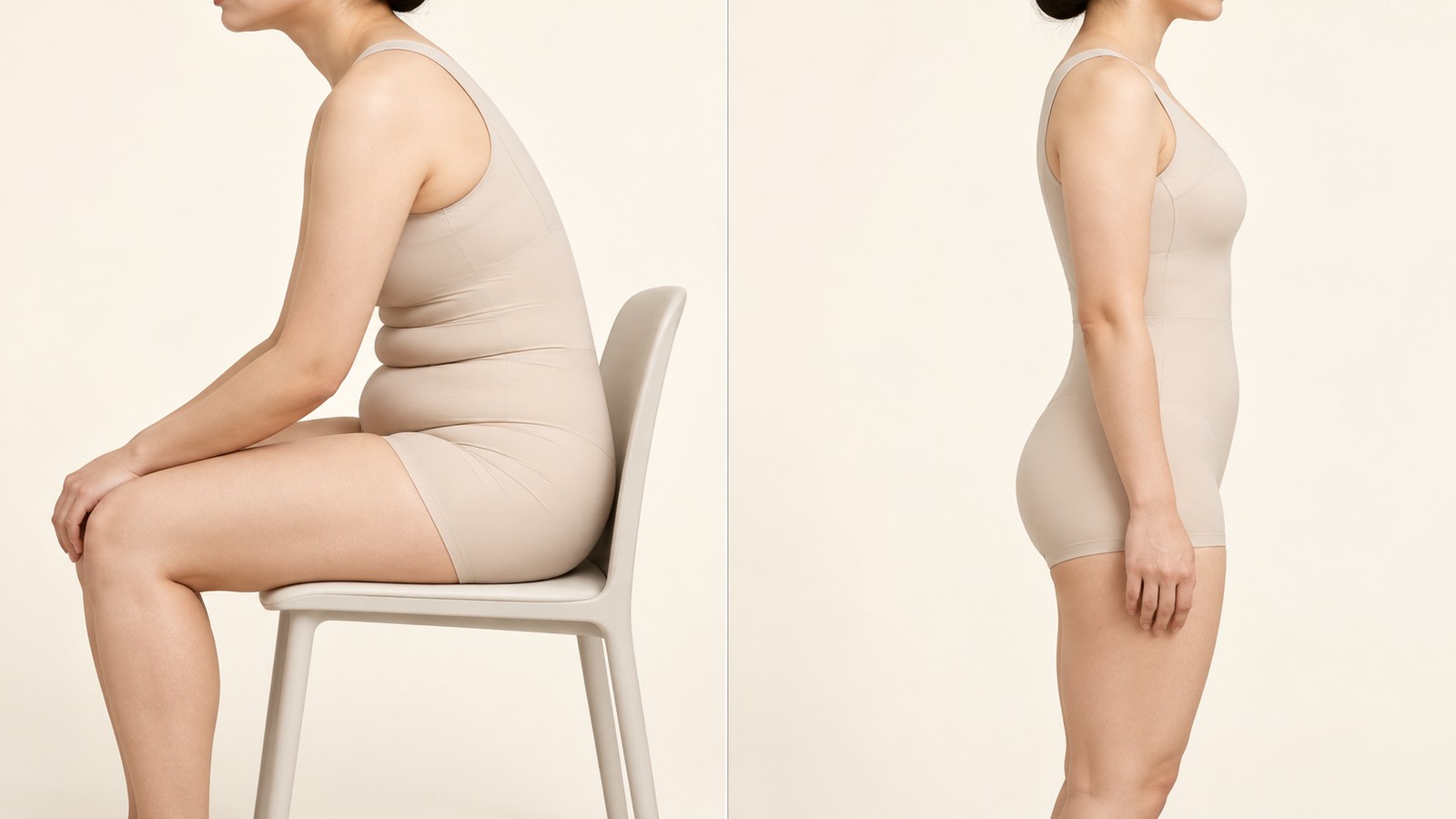
Left: sitting hunched for a long time with the lower abdomen folded · Right: standing upright
If the lower abdomen contracts unevenly during long periods of sitting like this, a horizontal depression can form from below the navel to the flanks, as if a swim ring were around the waist. In such cases, revision surgery refines the depressed area and the bulging areas above and below it to even out the lower abdomen. As an illustration, it looks like this.
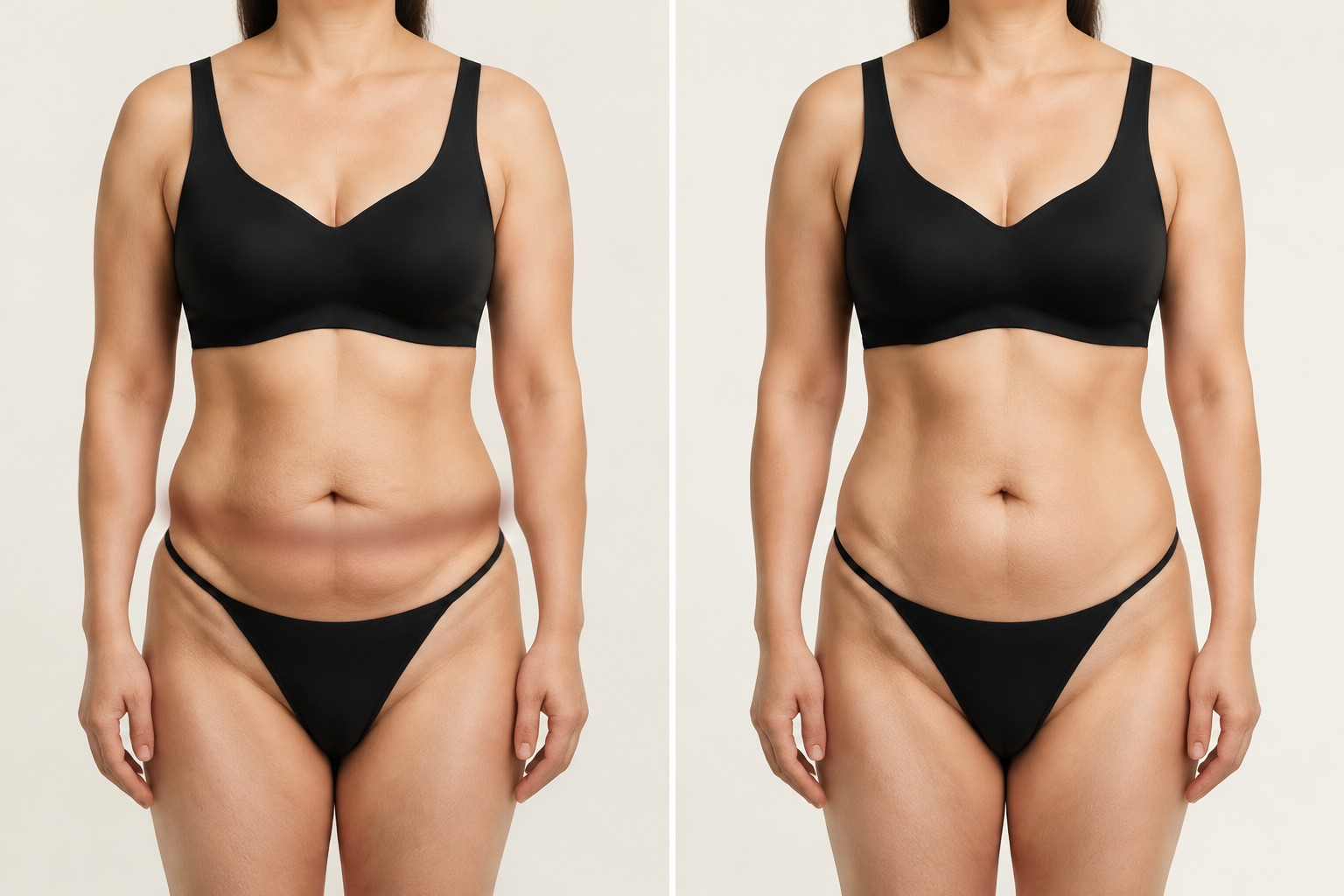
Left: a horizontal depression across the lower abdomen · Right: an evenly refined lower abdomen after revision surgery
Arms and Breasts — Keeping the Armpits Pressed Against the Body
After arm liposuction or breast liposuction, many patients keep their arms pressed tightly against their bodies because the armpit area feels sore and awkward. However, if you keep your armpits pressed against your body, the excess armpit skin contracts while folded, forming deep creases, and in some cases adhesions may develop to the point that it is hard to raise the arms. It is better to keep a little space at the armpits and, within the range your pain allows, slowly raise your arms often.
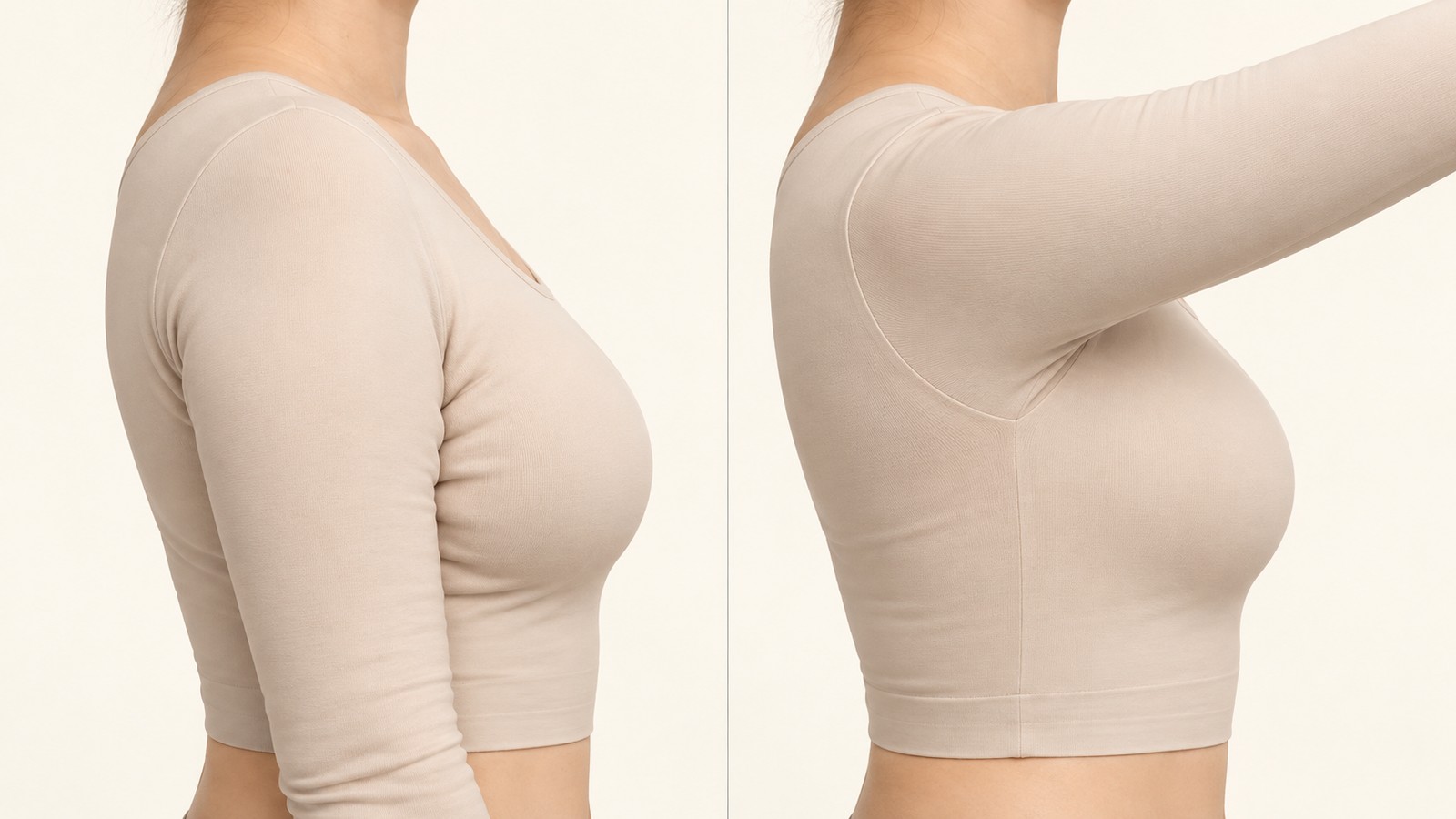
Left: arms pressed tightly against the body · Right: arms raised with the armpits opened
Thighs — The Inner Thigh Below the Groin and the Crease Below the Buttocks
After thigh liposuction, creases can sometimes form on the inner thigh just below the groin. This area folds easily if you sit for a long time with your legs pressed together, so please be careful. In addition, if you stand with your hips tucked forward, the buttocks rise and the existing crease below the buttocks becomes exposed and deeper, so that it can look like a double crease. The crease between the buttocks and thighs deepens or becomes shallower with muscle movement: when the hips are tucked forward, the buttocks and thighs fold and the crease deepens, and when you stand upright it becomes shallower[7]. Please make a habit of standing upright with your pelvis set straight, as in standing at attention.
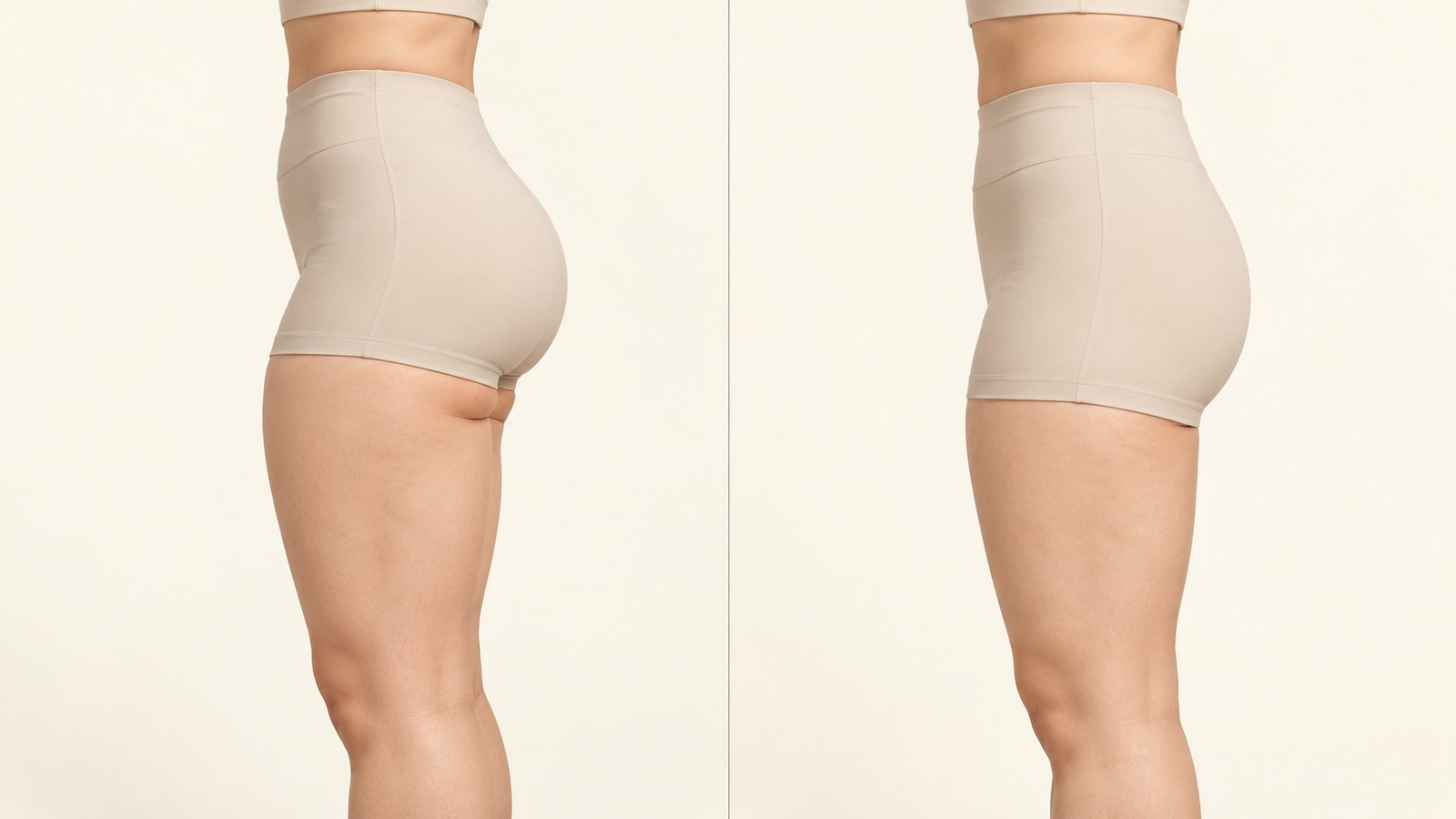
Left: hips tucked forward · Right: standing upright with the pelvis set straight
Thighs — Pull the Compression Garment Up When You Put It On
Along the crease below the buttocks, fibrous tissue running from the fascia beneath the gluteal muscles to the skin is gathered, supporting the buttocks from below like a net and keeping them from sagging toward the thighs[7]. After thigh liposuction, this area goes through a recovery period while the fat in the thigh just below the buttocks has been reduced.
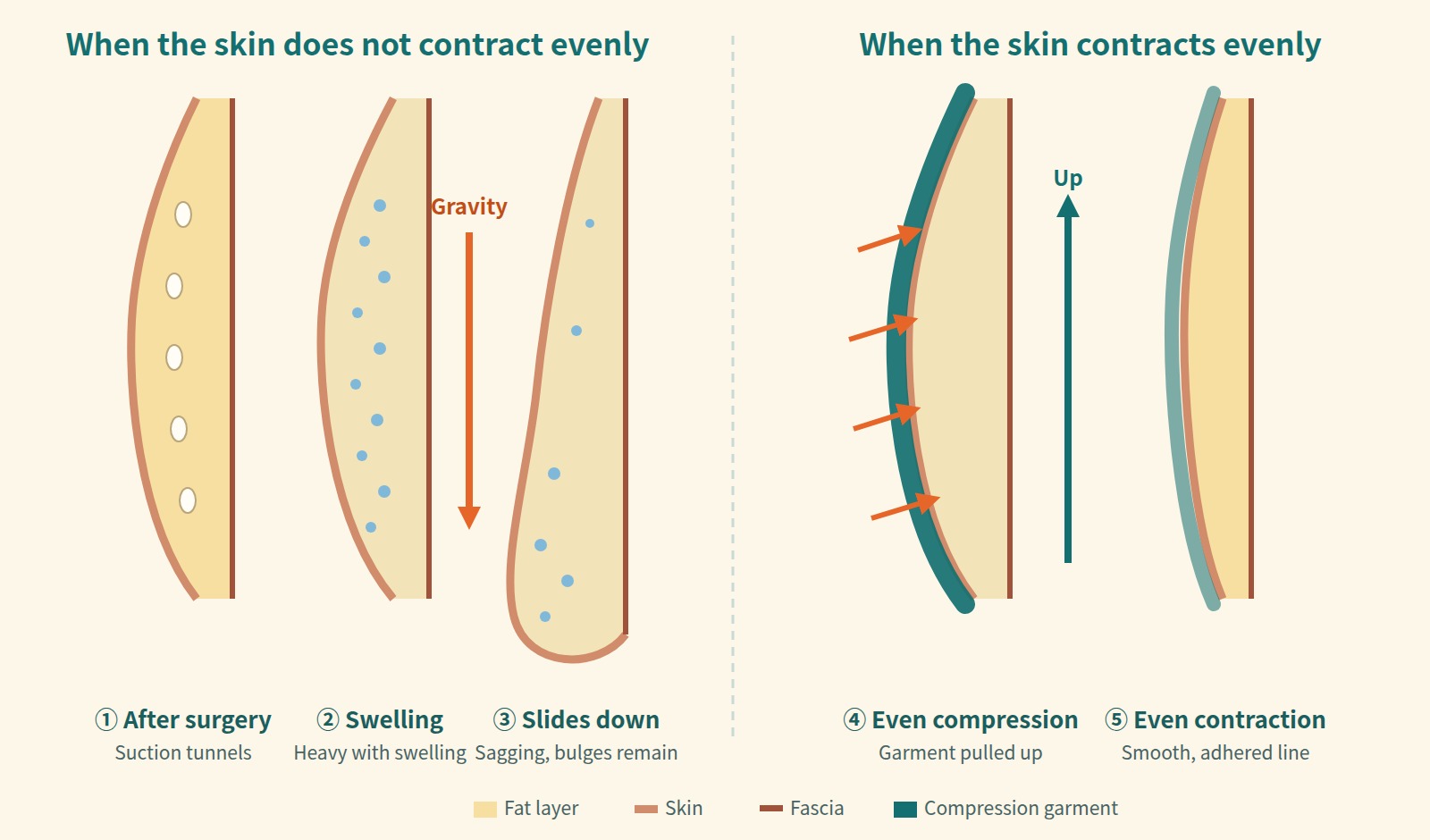
Right after surgery, the subcutaneous tissue is heavy with swelling and not yet firmly attached to the underlying tissue, so it tends to slide downward with gravity. If the compression garment has slipped down or is loose below the buttocks at this time, the tissue at the lower buttocks contracts in a sagging position. The area may then settle into a sagging buttock shape, in which the lower edge of the buttocks covers the crease and the back of the thigh looks thick.
The diagram below shows this process as a cross-section of the skin, fat layer, and fascia. The treated area, heavy with swelling, tends to shift downward, and if it contracts in this state, the upper part becomes thin while sagging and bulging remain in the lower part. Conversely, when the compression garment supports the entire treated area from below and presses it evenly, the skin does not shift to one side but contracts evenly, adhering into a smooth line. This is why the result of liposuction is completed not only by "how much was reduced" but also by "how evenly the skin contracted."
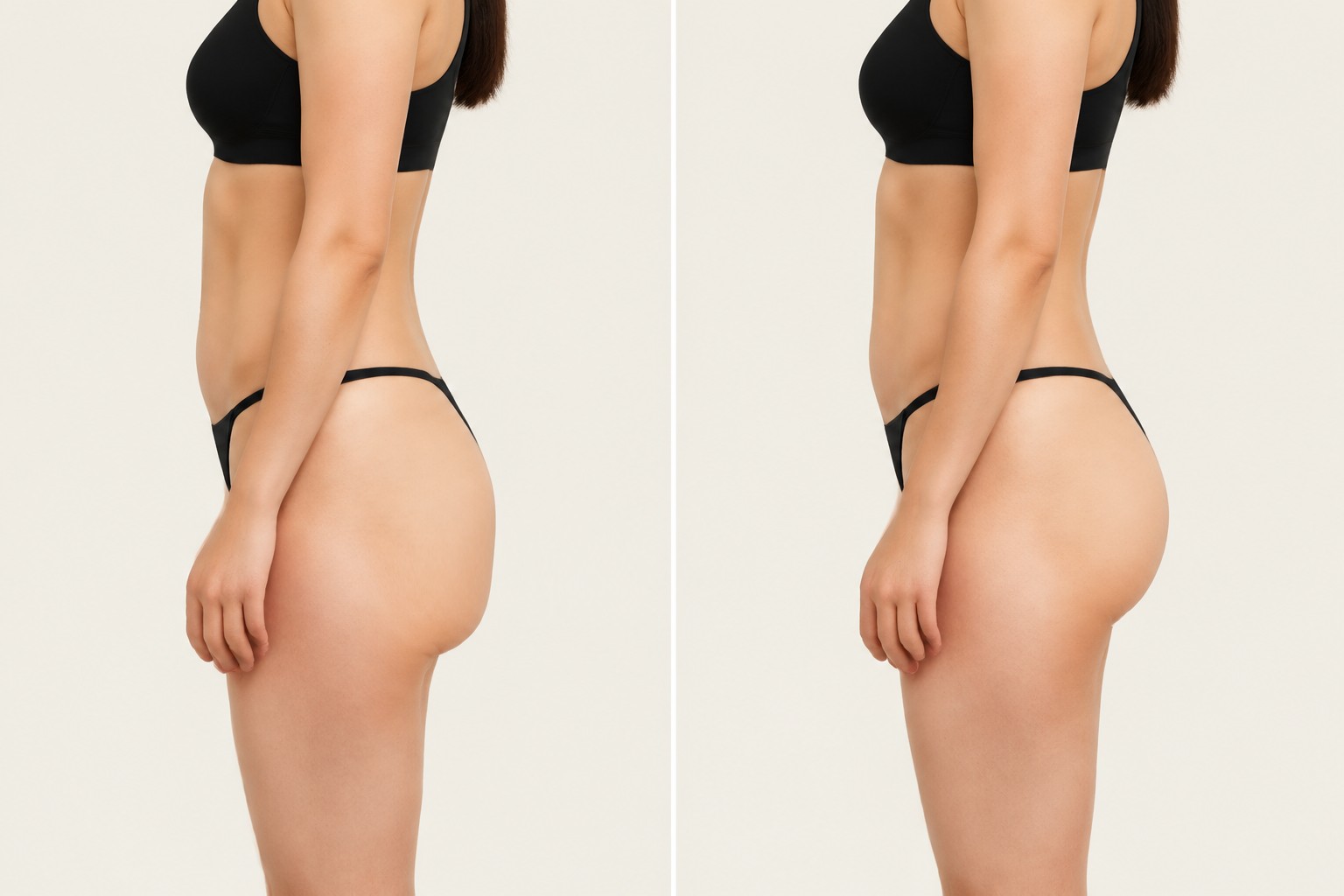
Left: lower buttock tissue sagging and covering the crease · Right: supported from below with the crease visible
For this reason, after thigh liposuction you wear a compression garment that covers both the buttocks and the thighs[8]. When putting it on, pull it up from the thighs so that the garment supports the buttocks from below. After using the restroom or after getting up from sitting for a long time, check in a mirror that the garment has not slipped down and wrinkled below the buttocks, and pull it back up. Proper compression is important for preventing swelling and contour irregularities after surgery, but compressing the arms or legs too tightly can actually cause venous thrombosis, so you should wear a garment that fits your body[9].
Double Chin — Keeping the Head Bowed for a Long Time
After double chin liposuction, if you keep your head bowed for long periods while looking at your phone or a book, the skin under the chin and on the neck contracts while folded, and horizontal creases on the lower neck can form. Raise your phone to eye level, and check frequently that the face, chin, and neck compression garment is not lifting or rolling under the chin.
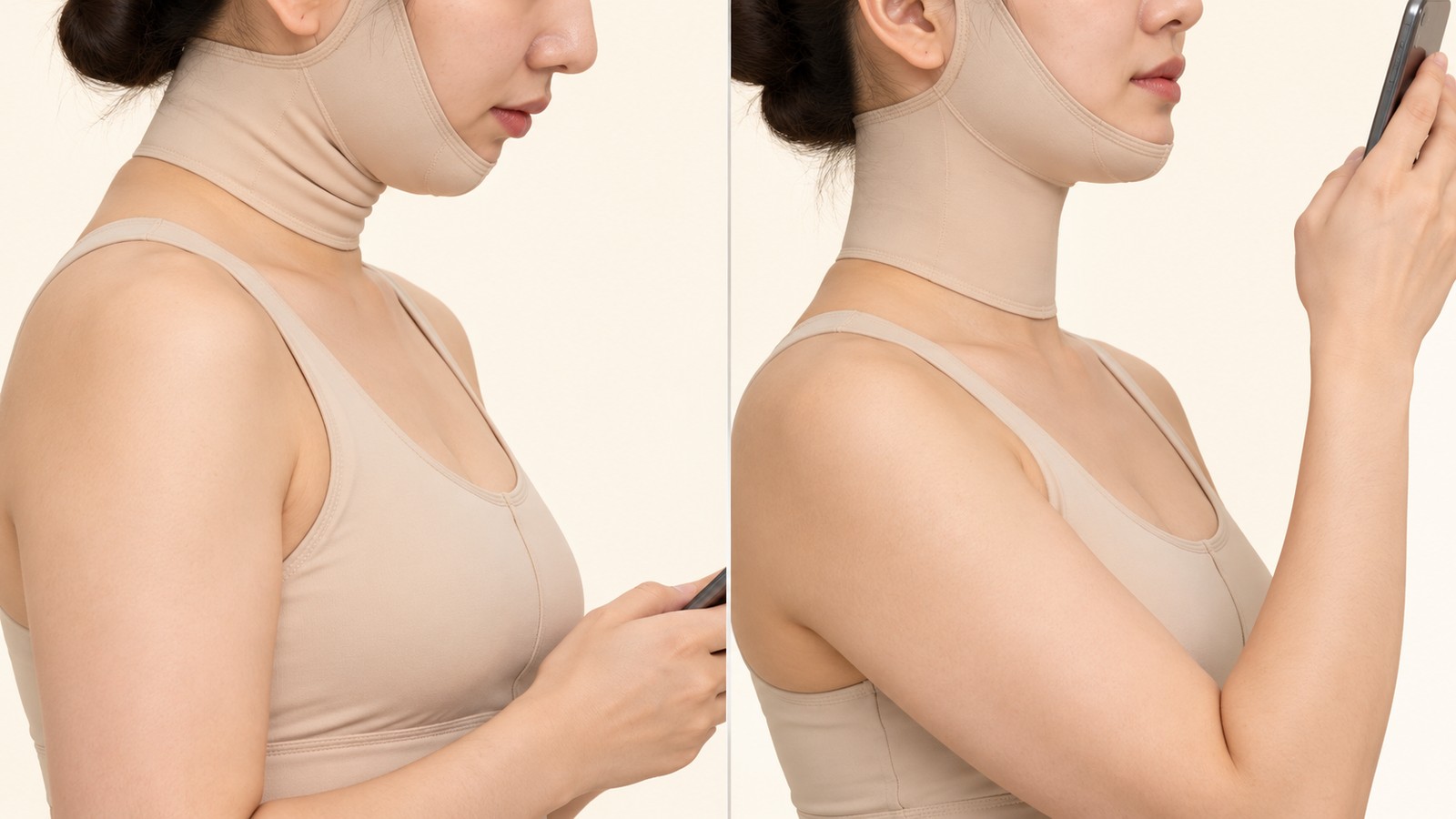
Left: head bowed for a long time · Right: phone held at eye level
Wear the Garment Flat, Keep Your Posture Upright
The areas differ, but the principle is the same. An even result comes when the skin contracts while spread flat, without folding. Here is a summary of what we at Venus Clinic advise during the recovery period[3][4].
| Care item | What to do |
|---|---|
| Wearing the compression garment | In most cases, 24 hours a day for 2 weeks after surgery, then only during the day once it feels comfortable · We recommend wearing it for at least 1 month |
| Condition of the garment | Check often in a mirror that it is not rolled up or bunched to one side, and wear it smoothed flat |
| Sitting | Avoid sitting for long periods; get up and walk from time to time · Do not let your abdomen fold deeply when you sit |
| Arms and armpits | Do not keep your arms pressed against your body all the time; keep a little space at the armpits |
| Thigh compression garment | Pull it up from the thighs so it supports the buttocks from below, and check often that it has not slipped down |
| Standing | Do not tuck your hips forward; stand upright with your pelvis set straight |
| Head | Hold your phone or book at eye level and avoid bowing your head for long periods |
What Posture Care Can and Cannot Do
Good posture and the compression garment are care measures that help the skin contract evenly; they do not replace the surgical result. The degree of skin contraction varies from person to person depending on skin elasticity and the degree of sagging, so if skin elasticity was already considerably reduced before surgery, some slight creasing may remain even with good care. Also, swelling subsides slowly over 3–6 months after surgery, so it is best to judge the final shape after that[3]. The size of the compression garment and how long to wear it may vary depending on the extent of surgery and your recovery, so please follow the instructions we give you at your appointments.
References
- Klein JA. Tumescent Technique: Tumescent Anesthesia & Microcannular Liposuction. Mosby; 2000. Chapter 28 (Surgical Technique: Microcannular Tumescent Liposuction).
- Fournier PF. Reduction Syringe Liposculpturing. In: Shiffman MA, Di Giuseppe A, eds. Liposuction: Principles and Practice. Berlin: Springer; 2006. Chapter 30.
- Dr. Jung. Precautions for Pre- and Post-Operative Care. Venus Clinic. https://myvenus.co.kr/cautions
- Venus Clinic. The Compression Garment That Completes Your Liposuction Result. Doctor's Column. https://myvenus.co.kr/column/578967
- Klein JA. Tumescent Technique: Tumescent Anesthesia & Microcannular Liposuction. Mosby; 2000. Chapter 30 (Postliposuction Care: Open Drainage and Bimodal Compression).
- Klein JA. Tumescent Technique: Tumescent Anesthesia & Microcannular Liposuction. Mosby; 2000. Chapter 31 (Abdomen — Postoperative Care).
- Kim H. When a Double Crease Forms After Thigh Liposuction. Venus Clinic Doctor's Column. https://myvenus.co.kr/column/578365
- Klein JA. Tumescent Technique: Tumescent Anesthesia & Microcannular Liposuction. Mosby; 2000. Chapter 33 (Female Hips and Back and Male Flanks).
- Shiffman MA. Prevention and Treatment of Liposuction Complications. In: Shiffman MA, Di Giuseppe A, eds. Liposuction: Principles and Practice. Berlin: Springer; 2006. Chapter 50.
Before-and-After Photos
The patient below developed a horizontal dented crease across the lower abdomen after a previous abdominal liposuction and underwent abdominal revision surgery at Venus Clinic. All post-operative photos were taken 2 weeks after surgery. Swelling and bruising are still present at this stage, so these are not the final results.
Revision Case: Abdomen, Flanks, and Back
In this revision, liposuction was performed on the abdomen together with the flanks and waist and the back above the bra line. The front, side, and back views are shown in order.
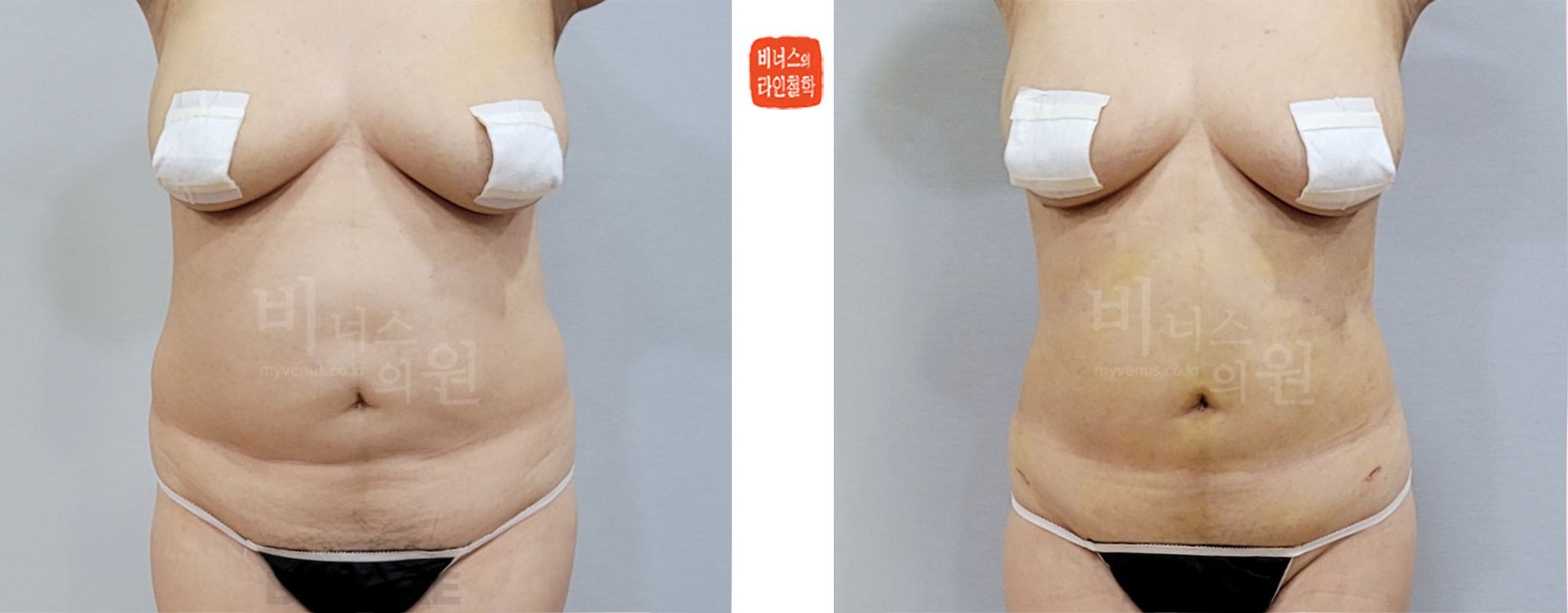
This is a case in which a horizontal dented crease formed across the lower abdomen after a previous surgery. In the pre-operative front photo, there is a deep crease across the lower abdomen, and the areas above and below it bulge, so the abdomen looks as if it were divided into upper and lower mounds. Because skin contraction did not occur evenly during care after the previous surgery, the abdomen took on this shape with a crease and bulges above and below it. In the post-operative photo after revision surgery at Venus Clinic, you can see that the horizontal dented crease is no longer visible and the lower abdomen has become flat.
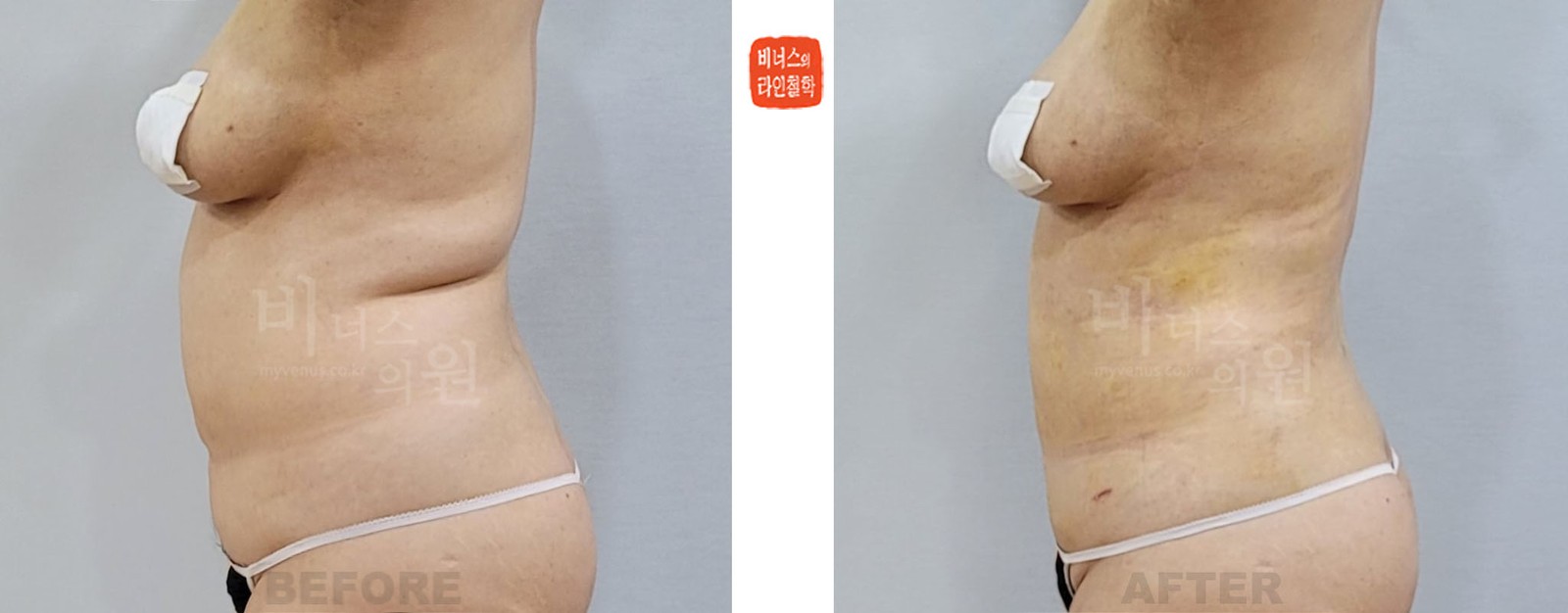
From the side as well, the lower abdomen protruded forward before surgery, but after surgery the line running from below the ribs to the lower abdomen has been made flat. The yellowish discoloration visible on the skin is bruising that is fading around 2 weeks after surgery, and it disappears over time.
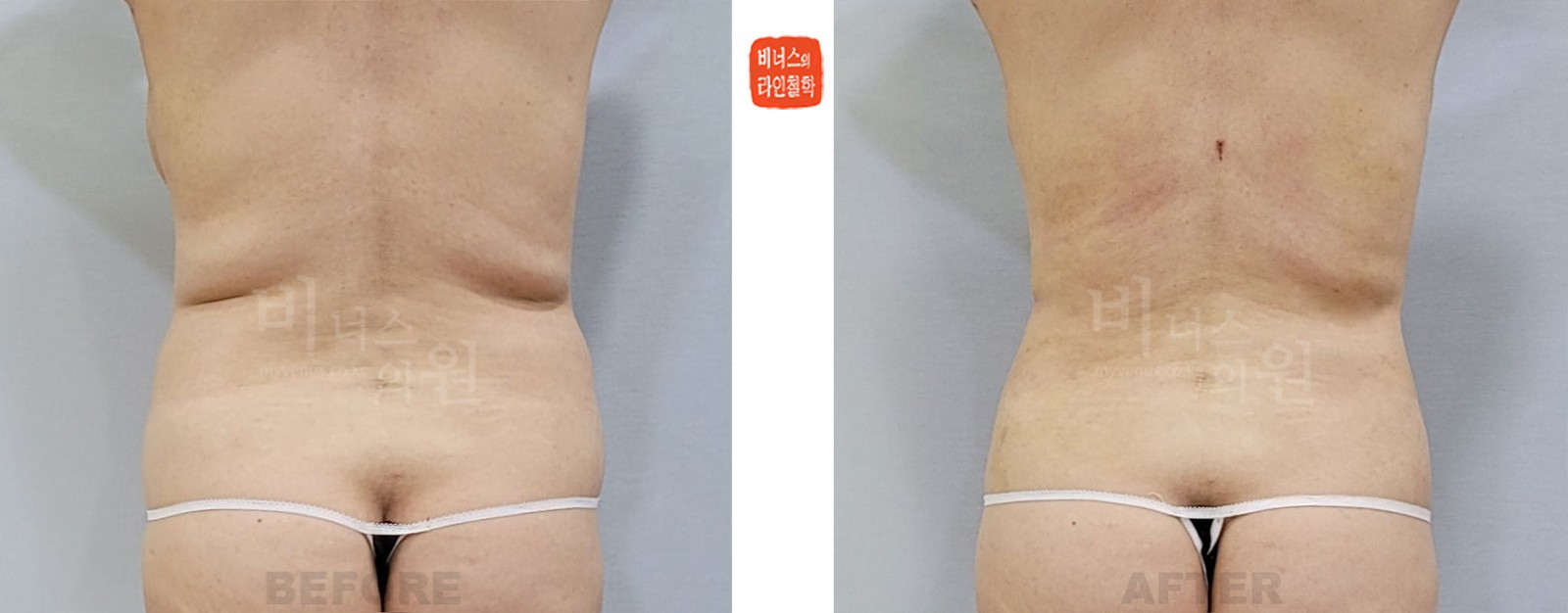
The back view shows the waist and the back above the bra line, which were treated at the same time. The rolls that had been folded on both sides of the waist and on the back before surgery have been reduced, and the line from the waist to the back has become smooth. We also advised this patient to wear the compression garment flat during recovery and to avoid sitting for long periods so that the lower abdomen would not fold.
| Information on the Posted Liposuction Before-and-After Photos | |||
|---|---|---|---|
| - Same person | Surgery performed at Venus Clinic; same person | - Date taken | Taken around 2025; comparison at 2 weeks after surgery |
| - Same conditions | Edited to the same posture and size as closely as possible | - Side effects | https://en.myvenus.co.kr/should_know/38861 |
In Closing
After liposuction, the skin — loosened by the amount of fat removed — contracts over several weeks and settles into the new contour. During this time, wearing the compression garment flat and keeping a good posture in which the skin does not fold allows even skin contraction, so that a good cosmetic result can be expected. At Venus Clinic, we remove the fat that needs to be removed as thoroughly as possible and refine the contour so that it is smooth rather than uneven. To help that refined contour settle as it is, we also guide you on the compression garment suited to the treated area and on posture during recovery.
References: Precautions for Pre- and Post-Operative Care The Compression Garment That Completes Your Liposuction Result
Dr. Hakjun Kim, Director, Venus Clinic