The Compression Garment That Completes Your Liposuction Result
During consultations, we are often asked, "Do I really have to wear a compression garment after surgery?" and "It feels tight—how long do I need to wear it?" Once surgery is over, a compression garment can easily feel like nothing more than an uncomfortable piece of clothing. At Venus Clinic, however, we think of the compression garment as an extension of the surgery itself, because it is what helps the contours shaped in the operating room settle into place during recovery.
In this article, we explain the three jobs a compression garment does after liposuction. First, bimodal compression helps stop bleeding and supports hemostasis; second, it helps the skin contract evenly after surgery for a better cosmetic result; and third, it holds and protects the skin to ease pain. We then go over the principles of compression described in the textbooks and, depending on the treated area, how far each type of garment—face, chin and neck; upper-body; thigh; and calf—provides compression.
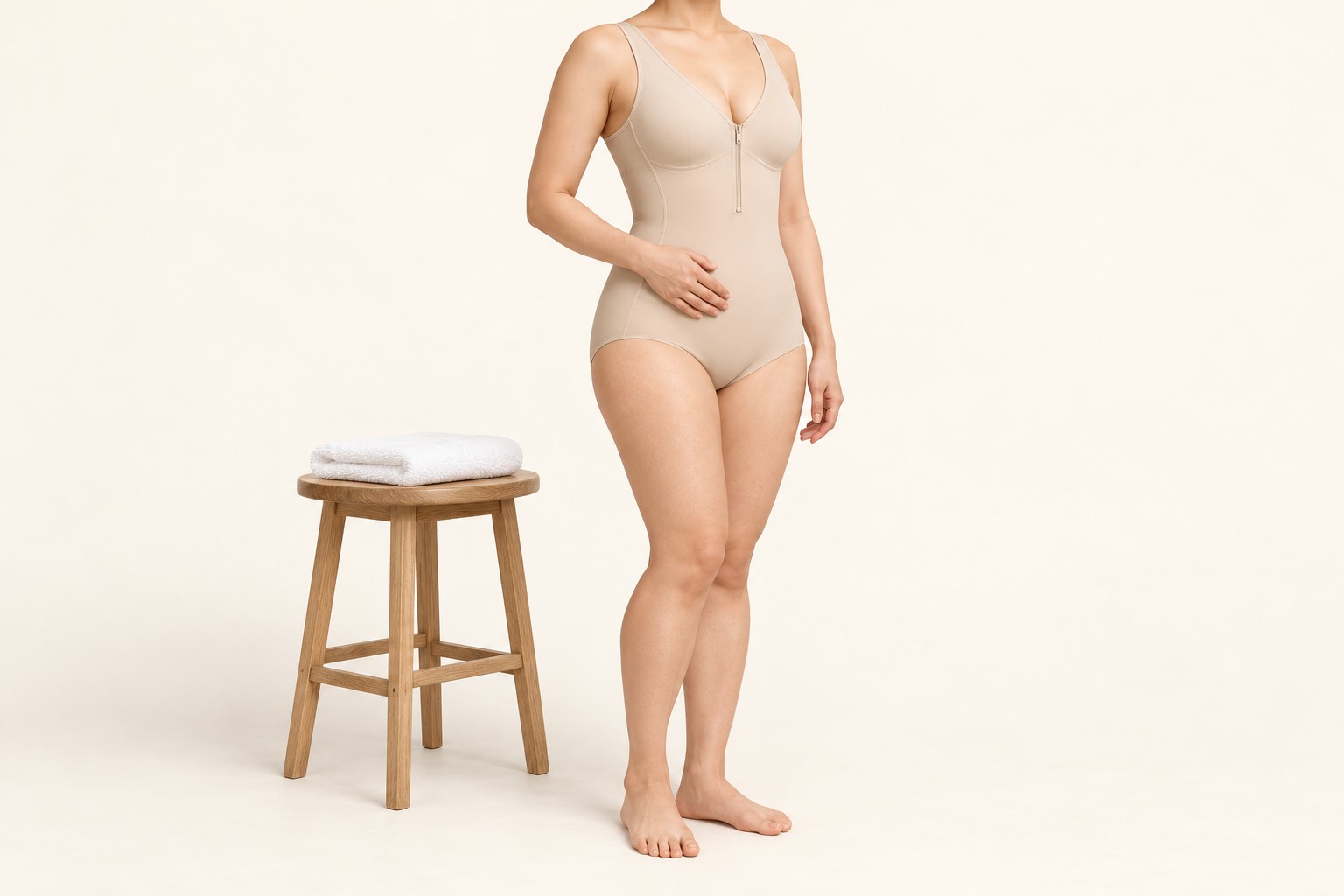
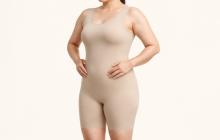
Upper-body compression garment — abdomen & back type
What Happens Inside the Tissue After Surgery
Tumescent liposuction is a method in which a generous amount of tumescent anesthetic solution is infused into the fat layer, and the fat is then removed through a thin cannula. After surgery, the spaces where fat was removed contain leftover tumescent solution mixed with a small amount of blood, and this fluid drains out through the small incisions over several days. As noted in Venus Clinic's pre- and post-operative care guide, even though the fluid may look red, the blood in it is only about 1%, which is very little and not an abnormal finding[1].
Klein, the author of the textbook on tumescent liposuction, explains that liposuction creates small bleeds within the subcutaneous tissue and damages the lymphatic vessels beneath the skin. When these two overlap, large molecules such as proteins become trapped in the tissue, so swelling lasts longer and pain and bruising increase[2]. That is why the key to post-operative care is draining the remaining fluid well (drainage) and applying even pressure to the treated area (compression). A compression garment does both.
The Origin of Compression Garments — Leg Swelling and Blood Clot Prevention
Compression garments were originally made for medical purposes—especially to reduce leg swelling (lower-limb edema), support blood circulation and prevent blood clots. When the legs swell because of venous disease, graduated compression stockings are used for treatment and prevention; they press hardest at the ankle, at 30 mmHg or more, and the pressure decreases further up the leg[2]. According to a review in a plastic surgery journal, graduated compression stockings support the function of the venous valves, reduce stretching of the vein walls and increase the speed of venous blood flow, thereby preventing deep vein thrombosis (DVT); in general surgery patients, they have been reported to reduce deep vein thrombosis by about 50–64%[3]. However, compression stockings alone are not enough, and they work better when combined with other measures such as early walking[4].
Compression garments worn after liposuction also have this function. In addition to reducing swelling in the treated area as described above, they also help prevent blood clots after surgery. The InTech liposuction textbook names deep vein thrombosis and pulmonary embolism as the complications to watch for most carefully in liposuction, and explains that early walking during the first 24 hours after surgery (starting 6–8 hours after surgery) and wearing a compression garment are essential[5]. Shiffman's liposuction textbook likewise states that appropriate early walking after surgery prevents venous blood from pooling and shortens the recovery period[6]. However, the same textbook warns that squeezing the arms or legs too tightly can actually cause venous blood clots[7]. This is why a compression garment must fit the body and apply only the intended amount of pressure.
Why Thromboembolism After Liposuction Matters
Thromboembolism refers to a blood clot formed in a deep vein of the leg (deep vein thrombosis) breaking loose, traveling through the blood vessels to the lungs and blocking the pulmonary vessels (pulmonary embolism). Klein's textbook names pulmonary embolism as the leading cause of liposuction-related deaths[8]. In a survey of deaths after liposuction among American cosmetic surgeons, thromboembolism was also the most common cause among deaths with a known cause, at 23.1%[9].
Klein explains that nearly 90% of pulmonary embolisms start from deep vein thrombosis in the legs, and that deep vein thrombosis often passes without obvious symptoms, making it easy to miss. Untreated deep vein thrombosis in the thigh can lead to pulmonary embolism in at least 50% of cases[8]. That is why, in care after liposuction, keeping blood from pooling in the leg veins matters more than anything else.
| Cause of death after liposuction | Deaths | Percentage |
|---|---|---|
| Thromboembolism | 30 | 23.1% |
| Abdominal / visceral perforation | 19 | 14.6% |
| Anesthesia / sedation / drugs | 13 | 10.0% |
| Fat embolism | 11 | 8.5% |
| Cardiopulmonary failure | 7 | 5.4% |
| Severe infection | 7 | 5.4% |
| Hemorrhage | 6 | 4.6% |
| Unknown / undisclosed | 37 | 28.5% |
| Total | 130 | — |
Survey of liposuction deaths among American cosmetic surgeons (Grazer & de Jong, 2000)[9]
Conditions That Make Blood Clots More Likely
Klein's textbook organizes the risk factors for liposuction-related thromboembolism into surgical factors and patient factors[8]. In particular, it explains that general anesthesia reduces blood flow in the legs by about 50% and makes the blood clot more easily, and that surgery under general anesthesia lasting more than 30 minutes greatly increases the risk of pulmonary embolism. It also notes that the more areas and the larger the volume treated, the greater the surgical trauma and the longer the period of immobility after surgery, so the risk rises as well[8].
| Category | Risk factors |
|---|---|
| Surgery / anesthesia | Long surgery under general anesthesia · Combining several surgeries on the same day · Treating an excessive number of areas and volume at once · Blood dilution from unnecessary IV fluids |
| Patient | Personal or family history of blood clots · Obesity · Age 45 or older · Smoking · Large varicose veins · High-dose estrogen (35 μg or more per day) · Conditions requiring prolonged bed rest |
Swelling of the legs is also important. Klein explains that when liposuction is performed around the entire circumference of the thigh, inflammation blocks lymphatic and venous flow, causing the calves and feet to swell, and that this swelling and venous stasis can increase the risk of blood clots[10]. He also writes that if excessive leg swelling remains even after drainage has ended, deep vein thrombosis is more likely to develop[2]. This is also why, after lower-body surgery, the compression garment evenly compresses below the treated area—down to the ankle, and down to the foot after calf surgery—so that swelling does not pool lower down.
Principles for Preventing Blood Clots — Even Compression and Early Walking
Klein's textbook presents the following measures to prevent thromboembolism after liposuction[8]. First, keep drainage open and use bimodal compression to reduce post-operative inflammation. Second, avoid treating an excessive number of areas or volume in one day to reduce surgical trauma. Third, reduce post-operative pain and encourage early walking so that the patient does not stay lying down for long. Fourth, stop high-dose estrogen and check for a personal and family history of blood clots, oral contraceptive use and pregnancy. Fifth, encourage the patient to quit smoking. In addition, anyone with a history of blood clots, or with family members who have had blood clots, must tell the doctor before surgery[8]. According to Venus Clinic's care guide, patients go home with a companion 1–2 hours after surgery and can usually return to daily life within 1–2 days after surgery[1]. Wrapping the legs evenly with a compression garment and moving early—these two things are the basics of blood clot prevention.
The Three Jobs of a Compression Garment
① Bimodal compression helps stop bleeding, supports hemostasis and promotes drainage. ② It guides the skin contraction that begins 1–2 weeks after surgery so that it happens evenly. ③ It holds the skin in place and protects it from external impact, easing pain. On top of this, it helps reduce swelling and prevent blood clots after surgery.
First, Bimodal Compression — Helping Stop Bleeding
Klein's textbook describes compression after tumescent liposuction as bimodal, meaning compression applied in two consecutive stages. The first stage is the drainage period, and the second stage is the period after drainage has ended[2].
Stage 1 — Firm Compression During Drainage
Right after surgery, relatively firm pressure is applied evenly. Even compression helps the fluid remaining in the treated fat layer drain out through the incisions into absorbent pads, and reduces post-operative swelling. With drainage kept open and compression applied, drainage usually stops within 24–72 hours, although it may continue for a few more days in widely treated areas such as the abdomen or thighs[2]. In addition, pressing the skin evenly narrows the gaps between the collagen fibers of the dermis, which keeps red blood cells from spreading toward the skin surface, so less bruising forms. Conversely, the textbook explains that bruising tends to be darker where compression is insufficient[2]. For areas where bleeding control is especially important, such as right after breast liposuction, it states that firm compression—as much as the patient can tolerate—is best for hemostasis[2].
At Venus Clinic as well, once surgery is finished, we place absorbent pads and firmly compress the treated area with elastic bandages to aid drainage; the next day, patients visit the clinic for treatment and then put on their compression garment[1].
Stage 2 — Light Compression After Drainage
Once drainage has stopped, light compression is enough. From this point on, the only route for clearing the remaining swelling from the tissue is the lymphatic vessels, and continuing compression that is too strong can squeeze the fine lymphatic vessels under the skin and actually hinder the swelling from going down[2]. The textbook explains that once the pressure in the tissue exceeds about 1 mmHg, lymphatic flow is already at its maximum, so pressing harder does not make lymph flow any faster[2]. Starting firm and continuing light—this is bimodal compression.
| Stage | Degree of compression | Purpose |
|---|---|---|
| Stage 1 (drainage period) | Relatively firm and even | Promote drainage · Reduce bleeding and bruising · Support hemostasis |
| Stage 2 (after drainage) | Light | Avoid squeezing the lymphatic vessels so swelling can go down well |
Second, Even Skin Contraction — Shaping the Cosmetic Result
When liposuction thins the fat layer, the skin above it has to contract again to fit the reduced volume. As noted in Venus Clinic's care guide, for up to 2–3 weeks after surgery the treated area goes through a recovery process in which it becomes firm and lumpy, and as the skin contracts through this process, the area becomes smaller while sagging is kept to a minimum[1]. This contraction begins in earnest around 1–2 weeks after surgery. Shiffman's textbook also explains that a light compression garment worn after drainage has ended helps shape the contour while the skin contracts over the weeks after surgery[11].
If the compression garment wraps the entire treated area evenly at this time, it can guide the skin and remaining fat layer to contract naturally along the body's shape, without lifting or folding in any one spot. The InTech liposuction textbook also explains that a compression garment that fits closely to the body after surgery helps reduce swelling and helps the skin settle onto its new contour (skin re-draping)[12]. Even if the fat layer is shaped evenly during surgery, those contours are hard to reveal if the skin does not contract evenly during recovery. That is why we consider the compression garment the final step in completing the cosmetic result.
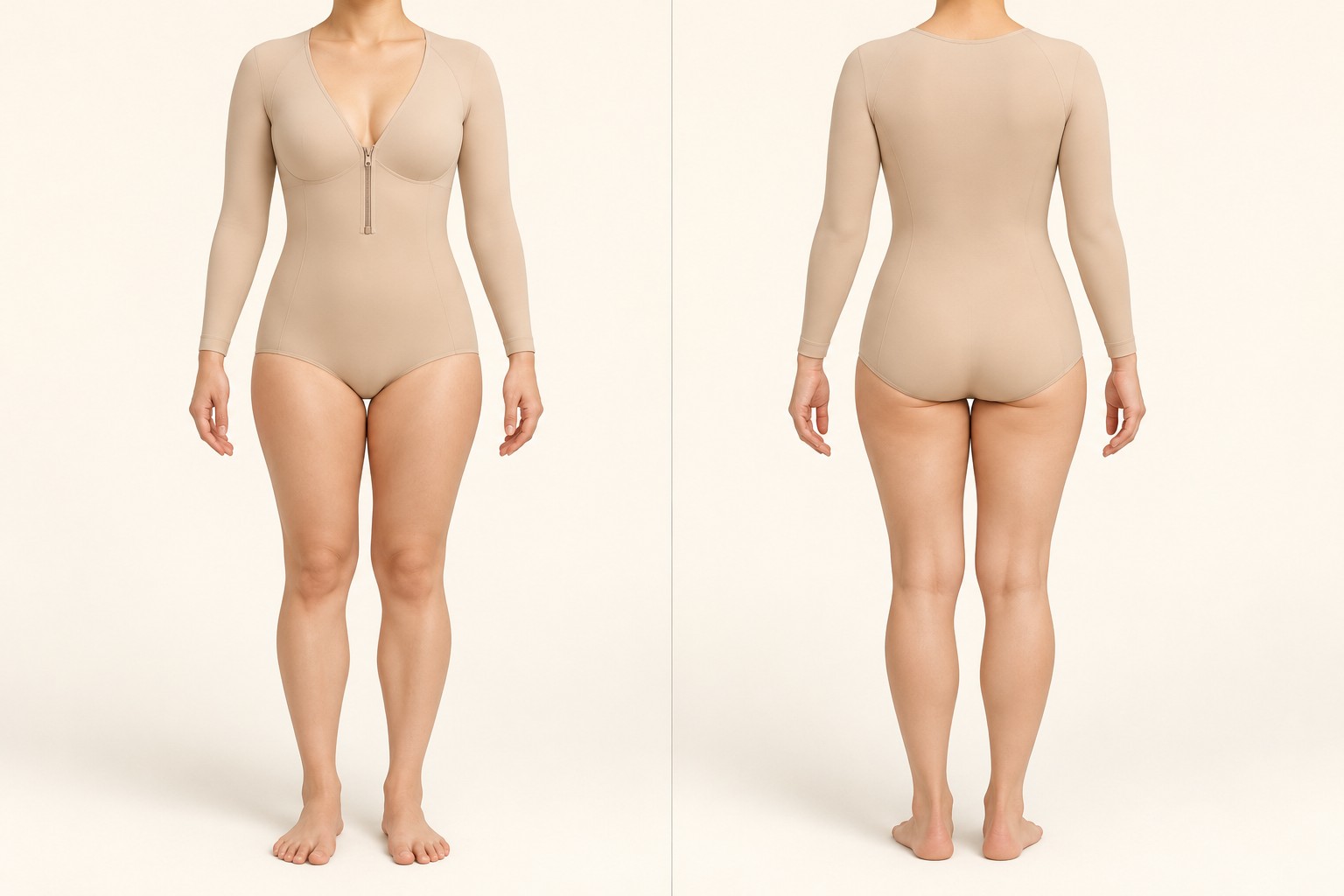
Upper-body compression garment — arms & breasts type
Third, Holding and Protecting the Skin — Easing Pain
In a treated area, the skin and the tissue beneath it are not yet firmly attached, so the skin moves with every movement and even a small impact can easily cause pain. A compression garment holds this skin in place and wraps and protects the treated area from external impacts, such as bumping into clothing or furniture. Klein's textbook also explains that the purpose of a compression garment is to deliver even pressure to the subcutaneous tissue to push out the remaining solution, and that once this solution drains out, post-operative swelling and tenderness are greatly reduced[13]. In other words, the better the drainage, the less swelling, pain and bruising there will be[2]. The textbook adds that because light compression makes the body feel comfortable during the first few weeks, some patients want to wear their compression garment even longer[2].
How Painful Is It After Surgery?
According to Venus Clinic's care guide, post-operative pain is usually manageable with the prescribed pain medication, gradually improves and mostly disappears after about 3 weeks. However, the degree of pain felt may differ from person to person[1].
Types of Compression Garments — Face, Chin and Neck · Upper-Body · Thigh · Calf
Because a compression garment must evenly cover every treated area, Venus Clinic uses four types depending on the area of surgery: face, chin and neck; upper-body; thigh; and calf.
Upper-Body Compression Garments — Abdomen & Back Type and Arms & Breasts Type
The upper-body type is further divided into the abdomen & back type and the arms & breasts type. Both cover the upper body, including the genital and pubic area, but do not include the buttocks or thighs. The difference is whether the arms and armpits need compression. For surgery that does not require compression of the arms and armpits, such as the abdomen, flanks and back, patients wear the sleeveless abdomen & back type (the picture at the top of this article); for surgery that requires compression of the arms and armpits, such as the arms, breasts or armpits, they wear the arms & breasts type with sleeves down to the wrists (the picture in the "skin contraction" section above).
| Type | Main areas of surgery | Area of compression |
|---|---|---|
| Upper-body (abdomen & back type) | Abdomen · Flanks · Back — when the arms and armpits do not need compression | Upper body down to the genital and pubic area · Sleeveless · Does not include the buttocks or thighs |
| Upper-body (arms & breasts type) | Arms · Breasts · Armpits — when the arms and armpits need compression | Upper body down to the genital and pubic area · Sleeves to the wrists · Does not include the buttocks or thighs |
| Thigh type | Lower body, including the thighs, genital area, pelvis and buttocks | From the lower abdomen through the buttocks, thighs and calves down to the ankles (feet excluded) |
| Calf type | Lower legs, including the calves, ankles and knees | Lower abdomen, buttocks, thighs and calves, and down to the feet (only the toes are exposed) |
| Face, chin and neck | Face · Chin (double chin) · Neck | From the top of the head past the cheeks and jawline to under the chin and the neck · The front of the face, crown, back of the head and ears are left open |
Thigh Compression Garment
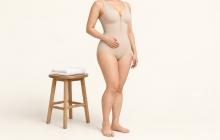
This compression garment is worn after lower-body surgery such as the thighs, genital area or pelvis. It starts at the lower abdomen, wraps the buttocks and entire thighs, and continues past the calves to compress down to the ankles. It has the same shape as the calf type, but only the feet are left out.
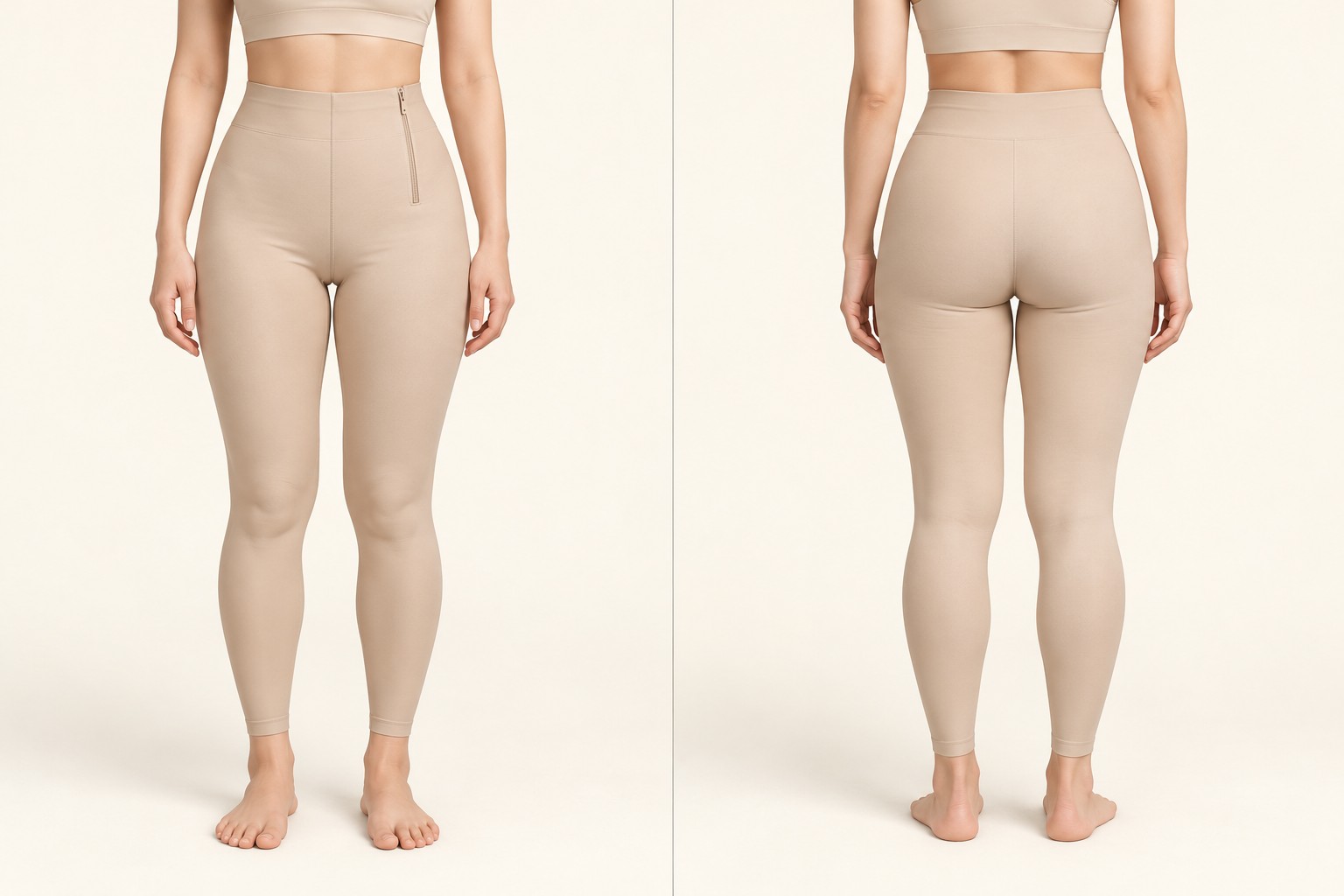
Thigh compression garment — thigh & buttock type
Calf Compression Garment
This compression garment is worn after surgery on the calves and ankles. In addition to the lower abdomen, buttocks, thighs and calves, it wraps and compresses down to the feet, with only the toes exposed. This is to press the treated calves and ankles evenly, all the way to the lower end, without any gaps.
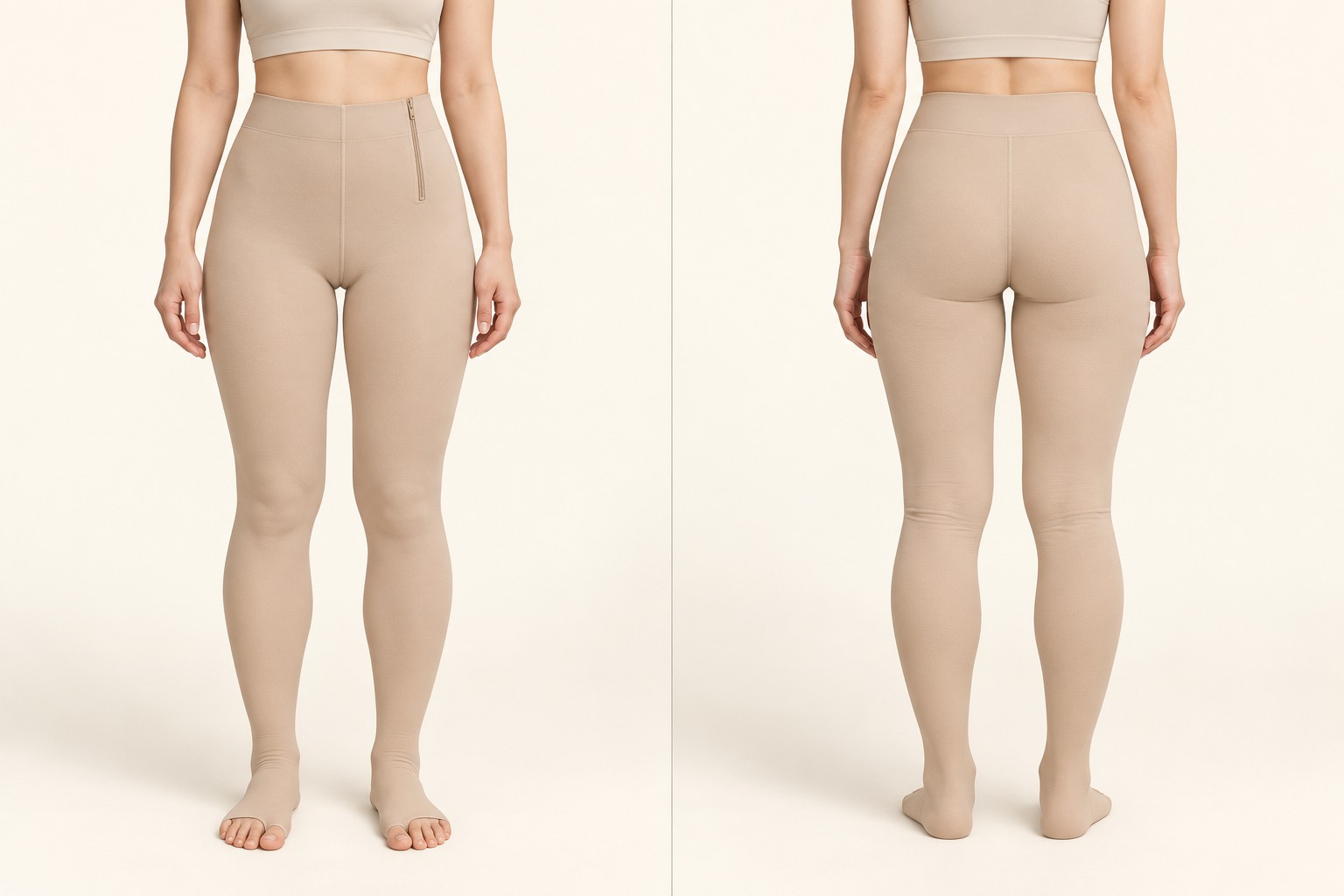
Calf compression garment — knee & calf type
Face, Chin and Neck Compression Garment
After liposuction of the face, chin and neck, patients wear a compression garment worn on the head. It broadly covers the top of the head, the temples and the sides of the face, and passes over both cheeks and the jawline to wrap and compress under the chin and the entire neck, leaving only the front of the face—forehead, eyes, nose and mouth—open in an oval shape. The crown, back of the head and ears are left open, and the neck portion fastens at the back of the neck. Like other compression garments, it presses evenly on and holds the treated skin under the chin and on the neck.
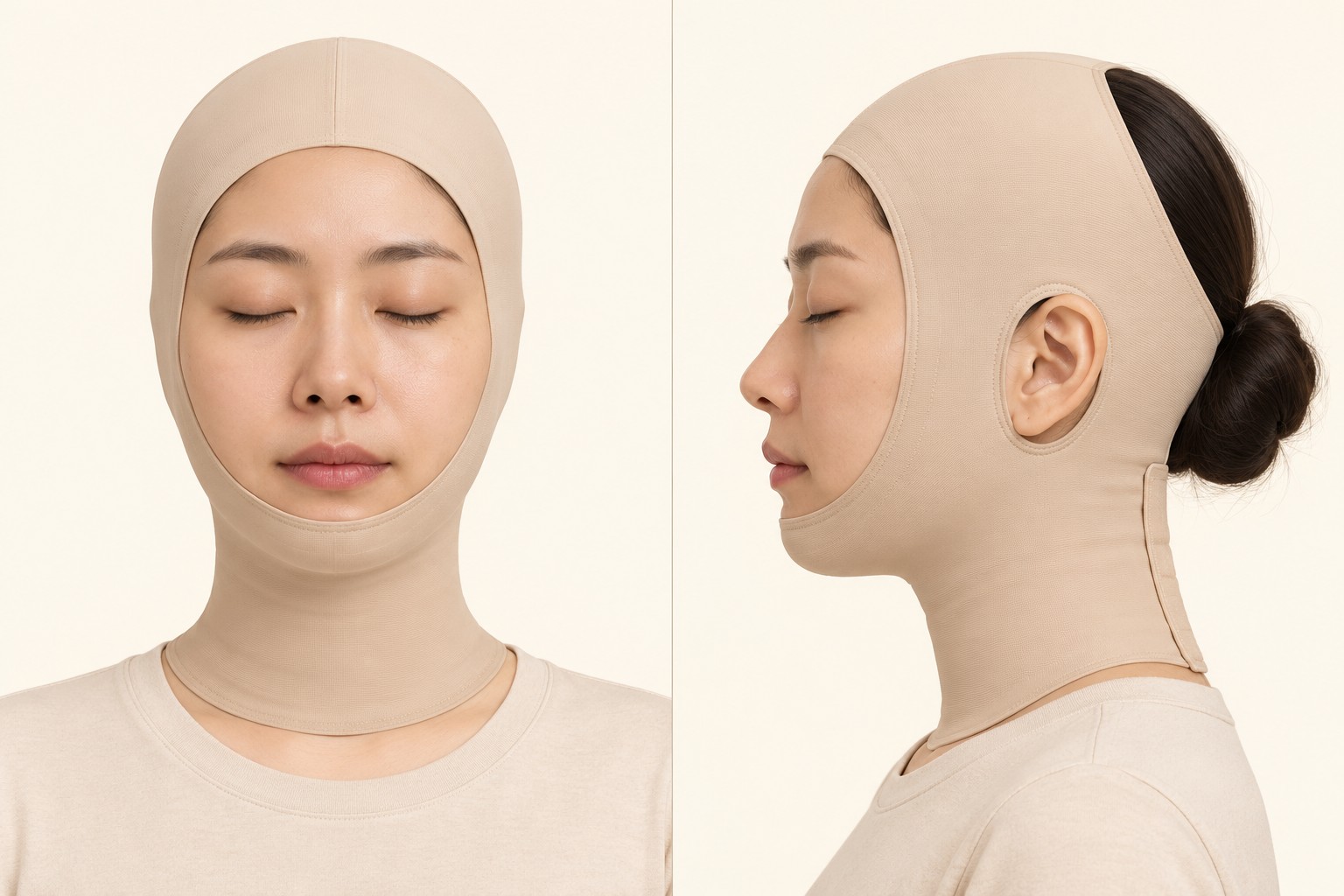
Face, chin and neck compression garment
How Long and How Should I Wear It?
Venus Clinic's care guidelines are as follows[1]. In most cases, the compression garment is worn 24 hours a day for 2 weeks after surgery, and after that, once it feels comfortable, during the daytime only. However, because the skin continues to adhere to the underlying tissue for 2–3 months after surgery, we recommend wearing the compression garment for at least 1 month. You may shower from 3 days after surgery; after showering, you should put the compression garment back on as soon as possible, and you can wash and dry the garment while you shower and then put it back on.
Tips for Caring for Your Compression Garment
Because a compression garment is worn all day, keeping it clean is also important. Usually, you can hand-wash the compression garment in cold water while you shower, remove the water with a spin dryer, then dry it with cool air from a hair dryer or fan and put it right back on. Please avoid hot water and hot air, as they can reduce the garment's elasticity. This way, the garment is washed and dried while you shower, and compression can continue without a long break after your shower.
What a Compression Garment Cannot Do
A compression garment does not replace the surgical result; it is a garment that helps the contours created by surgery settle well. Wearing it longer or tighter does not make the result proportionally better. As mentioned earlier, continuing excessively strong compression after drainage has ended can squeeze the lymphatic vessels and actually make swelling last longer[2]. Also, swelling goes down slowly from 2–3 weeks to 3–6 months after surgery, so even if you wear the compression garment well, it takes about 6 months to see the final result[1]. The size of the compression garment and how long to wear it may vary depending on the extent of surgery and your recovery, so please wear it as instructed during your visits.
References
- Dr. Jung. Precautions for Pre- and Post-operative Care. Venus Clinic. https://myvenus.co.kr/cautions
- Klein JA. Tumescent Technique: Tumescent Anesthesia & Microcannular Liposuction. Mosby; 2000. Chapter 30 (Postliposuction Care: Open Drainage and Bimodal Compression).
- Seruya M, Baker SB. MOC-PSSM CME Article: Venous Thromboembolism Prophylaxis in Plastic Surgery Patients. Plast Reconstr Surg. 2008;122:1.
- Friedland JA, Maffi TR. MOC-PSSM CME Article: Abdominoplasty. Plast Reconstr Surg. 2008;121:1.
- Serdev N, ed. Advanced Techniques in Liposuction and Fat Transfer. InTech; 2011. Chapter 13. Complications of Liposuction (Deep venous thrombosis and pulmonary embolism).
- Jackson RF. Liposuction Practitioner Profile and Current Practice Standards and Patient Safety. In: Shiffman MA, Di Giuseppe A, eds. Liposuction: Principles and Practice. Berlin: Springer; 2006. Chapter 56.
- Shiffman MA. Prevention and Treatment of Liposuction Complications. In: Shiffman MA, Di Giuseppe A, eds. Liposuction: Principles and Practice. Berlin: Springer; 2006. Chapter 50.
- Klein JA. Tumescent Technique: Tumescent Anesthesia & Microcannular Liposuction. Mosby; 2000. Chapter 10 (Thrombosis and Embolism).
- Grazer FM, de Jong RH. Fatal outcomes from liposuction: census survey of cosmetic surgeons. Plast Reconstr Surg. 2000;105:436.
- Klein JA. Tumescent Technique: Tumescent Anesthesia & Microcannular Liposuction. Mosby; 2000. Chapter 32 (Lateral Thighs) and Chapter 34 (Medial Thighs, Knees, and Anterior Thighs) — Circumferential Thigh Liposuction.
- Iyer S, Raskin BI. Liposuction with Local Tumescent Anesthesia and Microcannula Technique. In: Shiffman MA, Di Giuseppe A, eds. Liposuction: Principles and Practice. Berlin: Springer; 2006. Chapter 10.
- Serdev N, ed. Advanced Techniques in Liposuction and Fat Transfer. InTech; 2011. Chapter 7. Gynoid Lipodystrophy Treatment and Laser-Assisted Liposuction (Post-operative care).
- Klein JA. Tumescent Technique: Tumescent Anesthesia & Microcannular Liposuction. Mosby; 2000. Chapter 31 (Abdomen — Elastic Compression Garments).
Before-and-After Photos
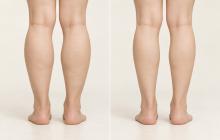
The patient below underwent liposuction of the knees, calves and ankles at Venus Clinic; we show two front views and one back view in order. All post-operative photos were taken 1 week after surgery. Since swelling still remains at this stage, these are not the final results.
Case 1
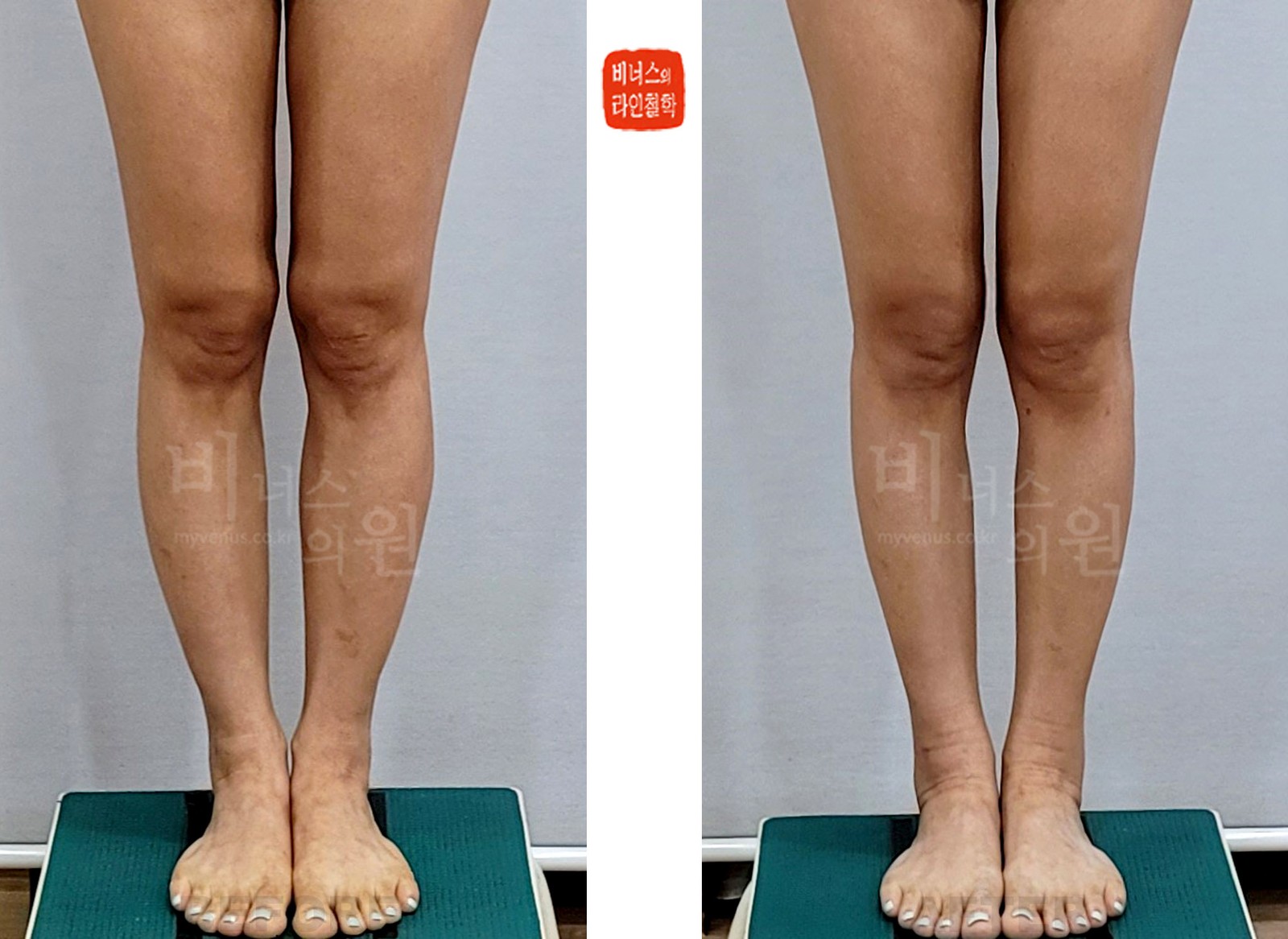
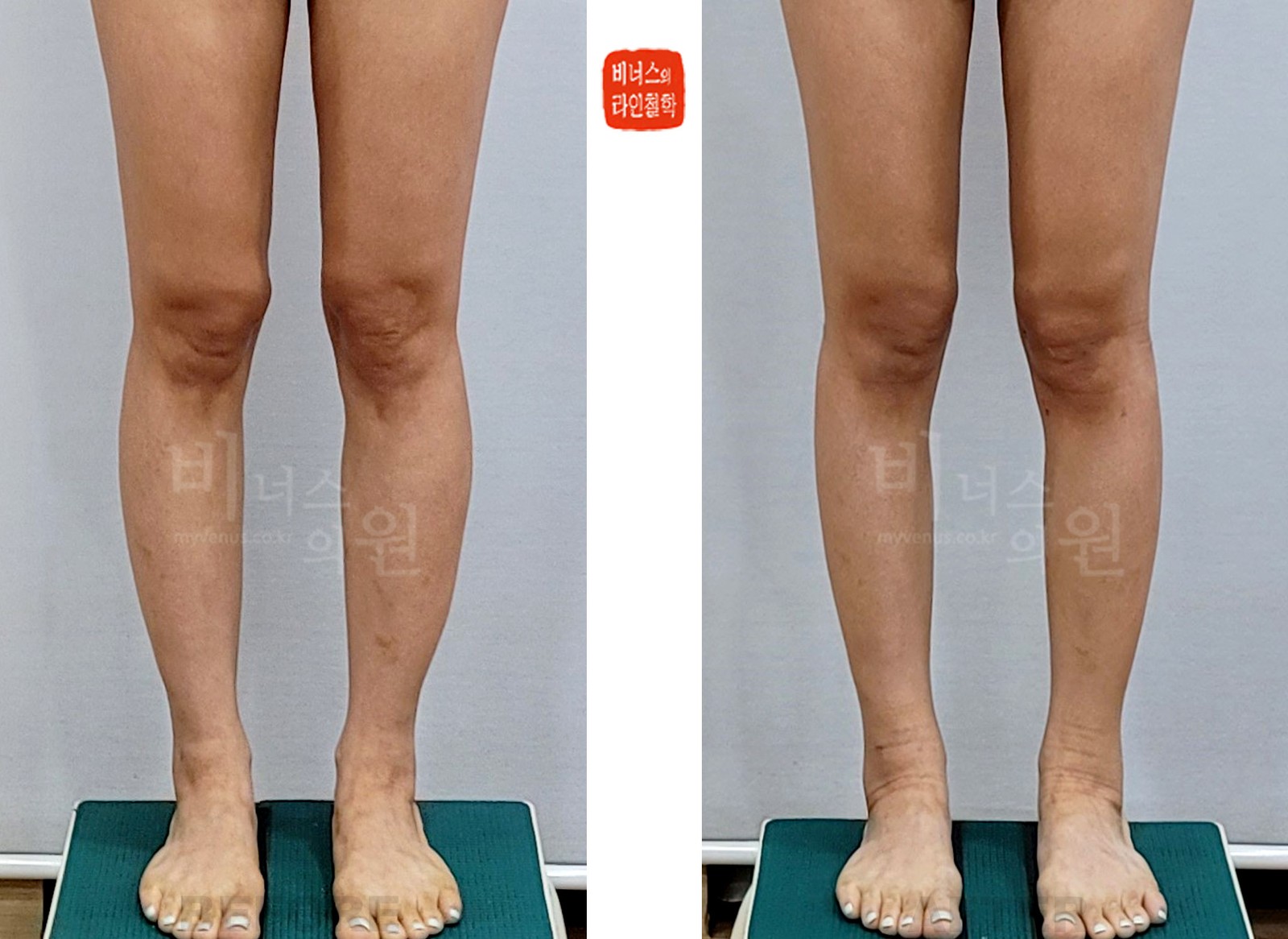
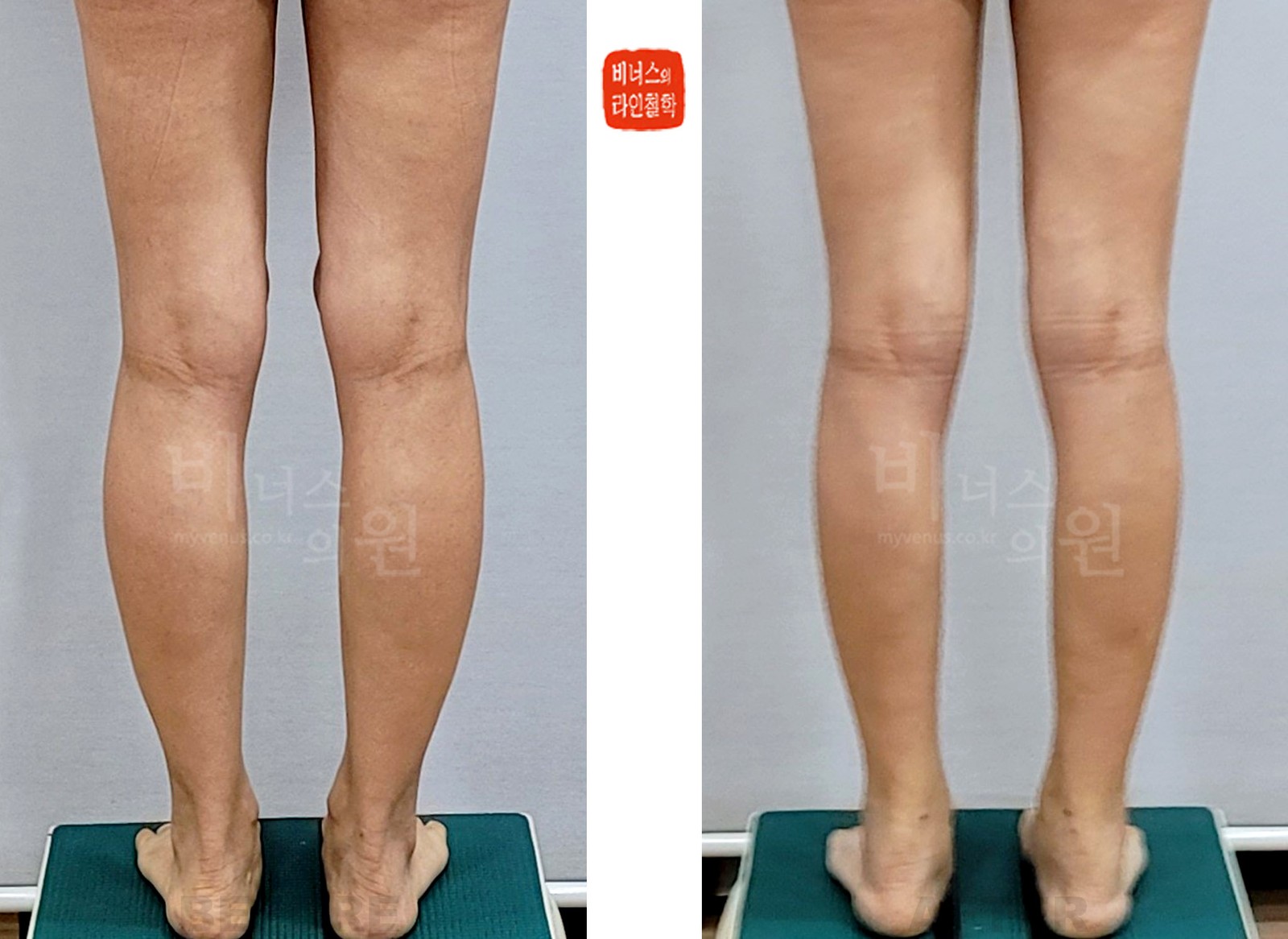
This is a case in which the knees, calves and ankles were treated together. Liposuction was performed circumferentially around the calves, together with the area above the knees and the inner knees. From the front, you can see that the circumference around the knees and calves has decreased, and from the back, that the volume of the calves has decreased. Because this surgery also included the area above the knees (the lower thighs) and the inner knees, if you look closely at those areas in the front photos, you can see that the line from above the knee to the calf has been refined, giving an overall balanced appearance of the knees and calves. However, if you look at the ankles in the back photo, the Achilles tendon is not yet clearly visible in the post-operative photo. This is because the photo was taken 1 week after surgery, and swelling still remains around the ankles. As the swelling subsides, the ankle line becomes more refined.
| Information on the Posted Liposuction Before-and-After Photos | |||
|---|---|---|---|
| - Same person | Surgery performed at Venus Clinic; same person | - Date taken | Taken around 2026; comparison at 1 week after surgery |
| - Same conditions | Edited to the same posture and size as closely as possible | - Side effects | https://en.myvenus.co.kr/should_know/38861 |
In Closing
The result of liposuction does not end in the operating room; it is completed by how the skin contracts during recovery. A compression garment first presses firmly to reduce bleeding and swelling, and then wraps lightly to help the skin contract evenly along the body's shape. At Venus Clinic, we choose the compression garment that suits the treated area and guide you on how to wear it according to each stage of recovery.
References: Precautions for Pre- and Post-operative Care
Dr. Hakjun Kim, Director, Venus Clinic