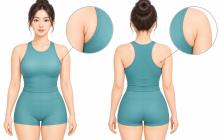
What Is Disharmonious Obesity?
Early postoperative complications and side effects have been described in many papers. These early complications include bleeding or abnormal bruising, seroma, infection, skin necrosis, fat embolism, and perforation of major organs or blood vessels.
Long-term complications, however, are not as well reported. One of them is disharmonious obesity, a term for a secondary state of obesity after liposuction in which the overall balance and proportions of the body shape have been lost.
Fat cells form when preadipocytes differentiate into fat cells as surplus calories accumulate, and during malnutrition they can dedifferentiate back into preadipocytes. After adolescence, new fat cells are generally not formed, but with excessive weight gain, and especially during pregnancy, fat cells can be produced from these stem cells.
Larson et al. reported that visceral fat compensates by increasing the average size of fat cells, whereas subcutaneous fat compensates by increasing the number of fat cells. In other words, even in an area that has been treated with liposuction, excess energy intake can cause subcutaneous fat cells to differentiate and the area can gain fat.
Larson KA, Anderson DB. The effects of lipectomy on remaining adipose tissue depots. Growth 1978;42:469-477
Meanwhile, Yun et al. reported breast enlargement in 13 of 73 patients after liposuction.
Yun PL, Bruck M, Felsenfeld L, Katz RE: Breast enlargement observed after power liposuction. Dermatol Surg 2003;29:165-167
If weight is gained after surgery, the treated areas have relatively fewer fat cells than untreated areas, so they store less fat. As a result, the breasts may become relatively larger after abdominal liposuction. Part of this is simply that the breasts look bigger because the abdomen has become smaller, but when weight increases, the breast tissue, which contains relatively more fat tissue, enlarges more. This phenomenon is what we call disharmonious obesity.
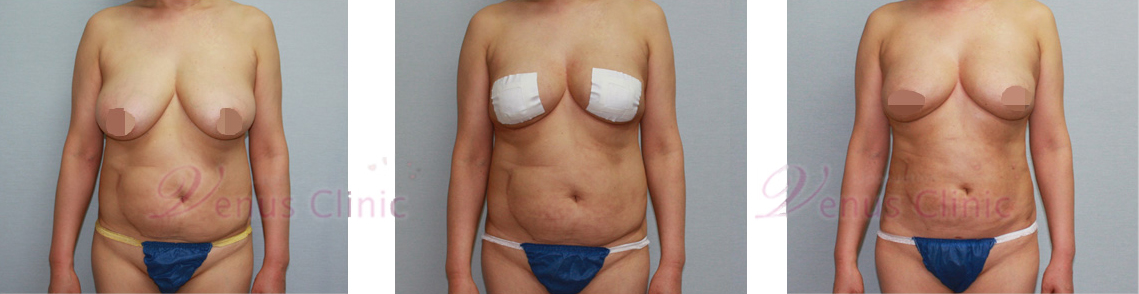
Conversely, photos of a patient whose abdomen looked larger after breast reduction liposuction and then looked natural after abdominal liposuction
The reason has been shown to be as follows: if, for example, fat is removed from the outer flanks, an area governed by female hormones, the amount of female hormone circulating in the blood does not change before and after surgery. The fat cell receptors remaining in the breasts are therefore relatively more affected, and the remaining fat cells also become more sensitive to the hormones.
Another example of disharmonious obesity: when someone who has had partial liposuction gains weight, the untreated fat areas gain much more, so the treated area can actually look sunken and the body shape can look awkward.
The figure below shows that when liposuction is done only on the inner and outer thighs, the front and back of the thighs become relatively thicker after surgery. If weight is gained later in this state, the front-to-back diameter of the thighs increases much more, which can lead to disharmonious obesity of the thighs.
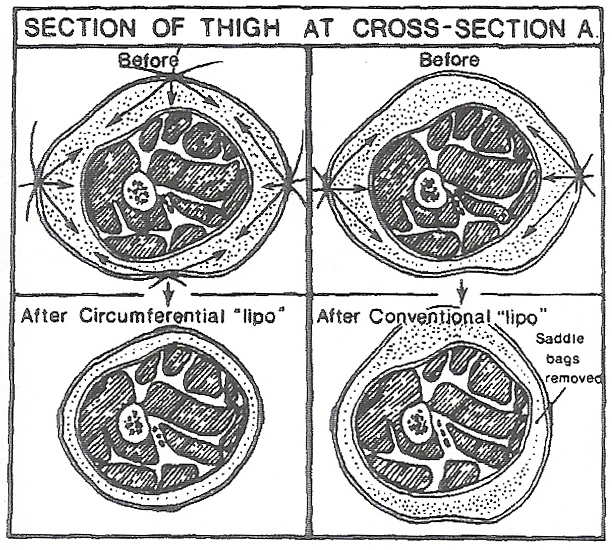
It is therefore important to understand that, in partial liposuction, fat must be removed so that the difference in fat layer thickness compared with untreated areas does not become too great. The same applies when fat tissue is deliberately left uneven to create an artificial-looking body shape; if obesity develops later after liposuction, the body may change into an odd shape.
In general, people with localized fat deposits can achieve a satisfying body shape with local liposuction (mini liposuction) alone. However, even when a more comprehensive procedure is needed, some people, for various reasons, have only a local procedure or split the surgery into several sessions. In such cases, the uneven thickness of the fat layer makes disharmonious obesity more likely to appear later.
At Venus Clinic, we aim for even liposuction in order to create a natural, balanced, and attractive body shape, and we often treat the whole region at once while considering its proportions with other areas. This is to create a natural, harmonious, balanced figure, and also to keep disharmonious obesity from appearing even if weight is gained later.
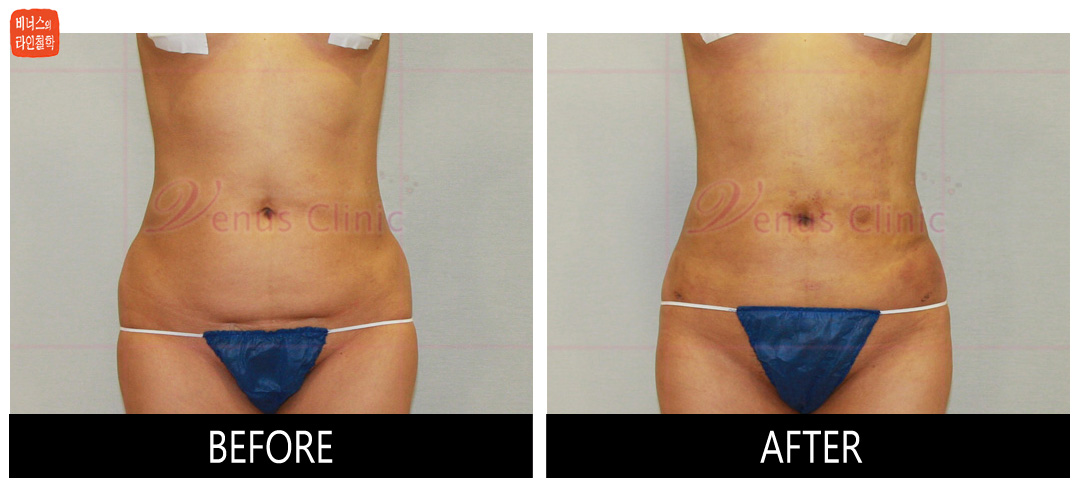
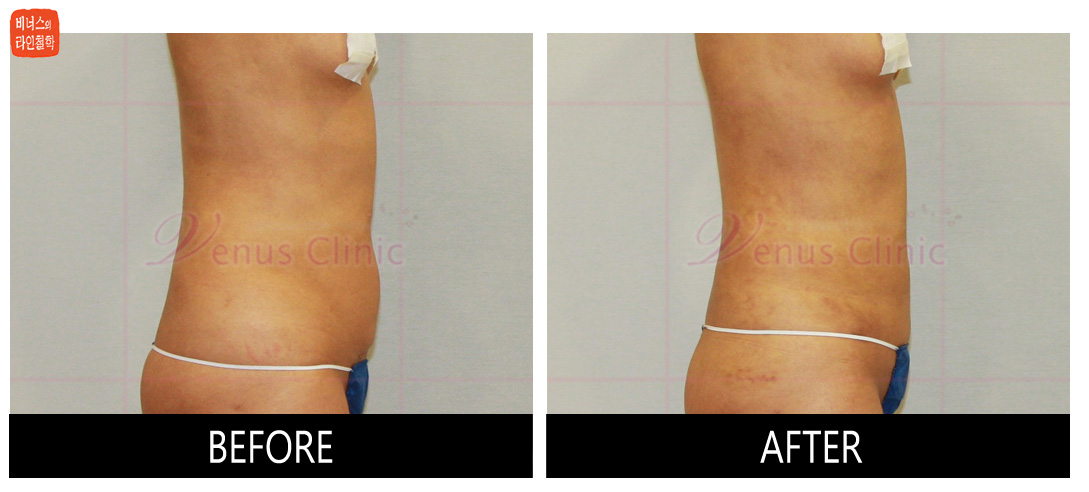
In the abdomen, a disharmonious shape appears when liposuction removes only the fat at the waist, without removing the flank fat above the pelvis, in order to emphasize the waist. In this case too, at first only the waist becomes relatively slimmer and the side profile of the abdomen looks attractive, but with weight gain only the waist area becomes sunken, the balance of the abdomen is lost, and it takes on an awkward shape.
The photos below show a patient who had liposuction of only part of the flanks at another clinic. After one year, she complained of an unbalanced shape in which only the waist portion of the flanks looked sunken compared with the flanks above the pelvis and the front of the abdomen. She visited us wanting revision surgery of the entire abdomen to improve its unnatural appearance. These photos were taken one week after revision surgery at Venus Clinic and show a more natural, balanced abdomen.
Another common form of disharmonious obesity occurs when only the thighs, or only the outer thighs, are treated without the buttocks. When weight changes later, the buttocks look even larger, and even though the thighs have become slimmer, the buttocks sag, the legs look shorter, and the lower body can look out of balance.
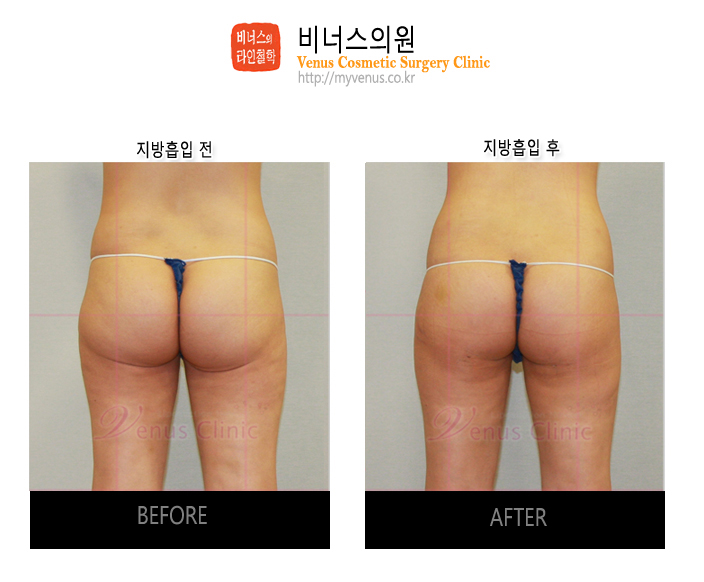
The photo below shows a patient who visited us after thigh-only liposuction at another clinic because her relatively larger buttocks looked saggy. She had a separate revision procedure on the buttocks only at Venus Clinic.
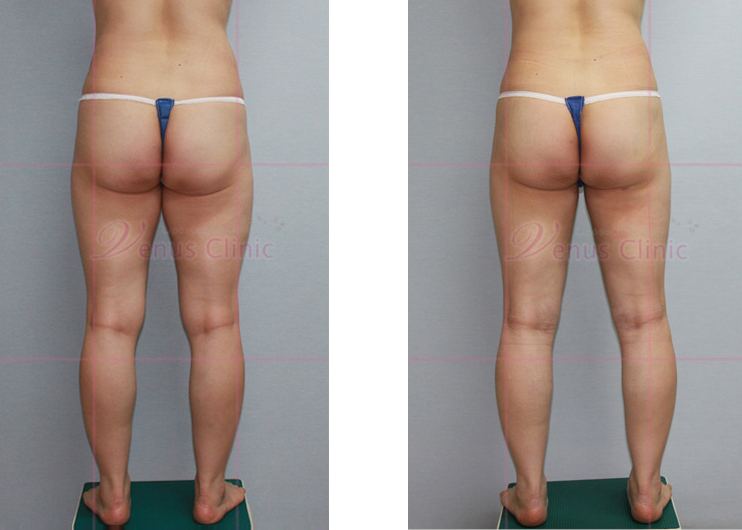
The photos below show a patient who had the thighs, buttocks, and knees treated at the same time at Venus Clinic. Because the procedure was performed evenly overall, the result looks natural.
There is some variation, but the body shape decreased in size while keeping a similar form, so the size change may not look dramatic in the photos. In reality, however, compared with the pelvis size and calf thickness, which do not change after surgery, the thighs and buttocks are considerably smaller. A sufficient amount of fat was removed in this case: 2,400 cc of pure fat alone.
Even if her weight changes later, she should be able to maintain a consistent body shape.
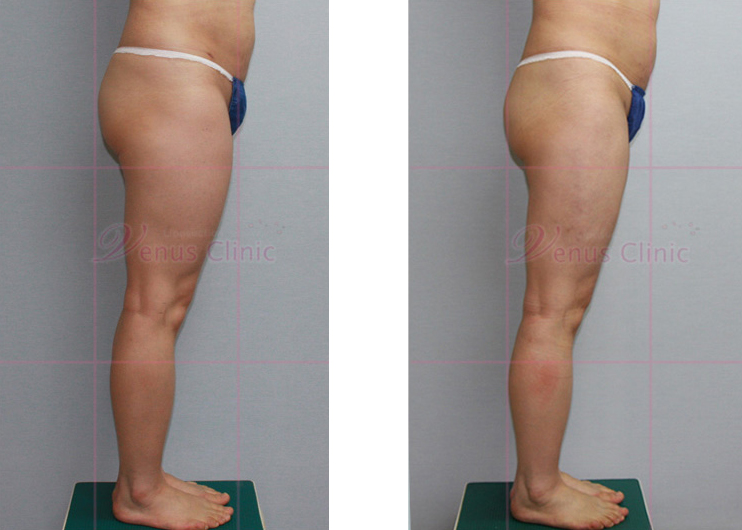
For thigh liposuction, a typical case is when the thighs have been shaped into the so-called "11" shape (two straight parallel lines). This happens after mini liposuction of only the inner and outer upper thighs. In this case, the fat layer of the upper thigh becomes thinner while the fat layer of the lower thigh and knee remains as it was, so in the early period after surgery the legs take on an "11" shape and look relatively slim. But with weight gain later, the lower thighs thicken and the fat around the knees sags, and the thighs no longer look attractive.
In the photos above, the proportion between the thickness of the upper and lower thigh was preserved before and after surgery. In other words, a fat layer of even thickness was left in both the upper and lower thigh.
The figure below shows areas with a potential for hypertrophic fatty deposits. These local fat deposit areas can become hypertrophic after liposuction.
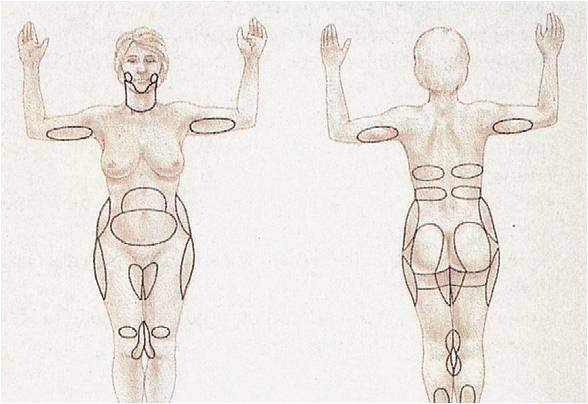
In addition, fat cells exist not only in the subcutaneous tissue but also within muscles and internal organs. If weight management fails after surgery, especially after large-volume liposuction, muscles can enlarge and visceral obesity can develop, which may harm your health.
In conclusion, the disharmonious obesity described above can occur when an artificial body shape is created, or when partial liposuction removes fat from only some areas, leaving uneven fat layer thickness overall. That is why the goal should not simply be removing fat to reduce size, but having surgery that creates a balanced body shape. And if you have already had partial liposuction, the importance of weight management after surgery for maintaining a balanced figure cannot be overstated.
[ Dr. Jung, Director, Venus Clinic ]