Understanding the Complications of Liposuction

Every surgery carries a risk of complications. I believe it is the physician's duty to understand complications in advance, to check preoperative preparation thoroughly, and to prevent complications from occurring — and it is to fulfill this duty that doctors research, test, and develop new techniques.
Even so, complications can arise in unexpected places, and they do arise. Because humans cannot be gods, we cannot produce only perfect results; it seems we must therefore always remain humble about our results and keep a mindset of continual study.
There are many published reports on complications related to liposuction. Because the procedure has been performed so widely, and still is today, it has been well studied.
After liposuction, the body recovers through a characteristic healing process.
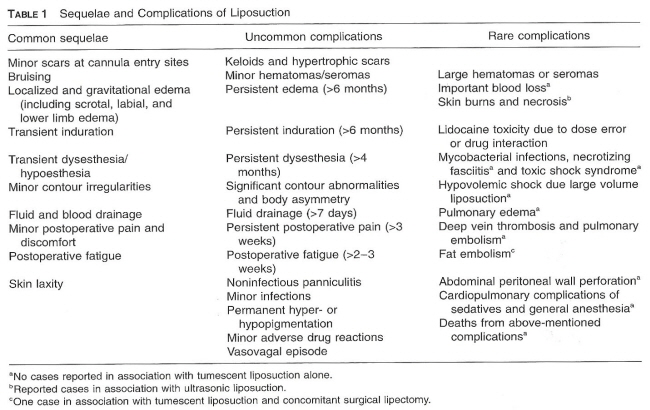
[Tremblay JF, Wrone DA, Moy RL, Shafa B. Lposuction complication. In:Narins RS, eds. Safe liposuction and Fat transfer. New York: Marcel Dekker, 2003:345.]
Bruising, swelling (edema), pain and discomfort, temporary firmness (induration), incision scars, temporary altered sensation (dysesthesia), and surface irregularities may occur. These are natural parts of the healing process (sequelae), and to lessen the degree of this healing response and reduce how often it occurs, doctors carry out research, sometimes use new equipment, and counsel patients on recovery tips so that aftercare goes well. However, it must be understood that excessive liposuction can turn this normal recovery process into complications that cause serious harm to the body.
In general, bruising (ecchymoses) is uncommon, but when it occurs it lasts about 3 weeks, and swelling (edema) lasts about 6 weeks. Lumpiness and mild altered sensation (mild dysesthesia) usually last 1–3 months. A wavy skin surface (waviness) can occur where the skin is loose, and darkening at the incision sites (hyperpigmentation) fades naturally over a year or more.
However, drainage from a wound for more than a week; swelling (edema) or firmness (induration) lasting more than 6 months; excessive pain persisting for more than 3 weeks; altered sensation (dysesthesia) at the surgical site lasting more than 4 months; a keloid forming and enlarging at a scar; signs of inflammation (infection) at the surgical site; a seroma, in which plasma collects in an empty space at the surgical site; a hematoma, in which blood collects; and, from a cosmetic standpoint, surface abnormalities (skin slough) and asymmetry caused by severe depressions — these and similar conditions are regarded as serious complications, and they require analysis of the cause along with treatment.
If the doctor follows sound principles and refrains from excessive liposuction, and the patient fully understands the liposuction healing process and pays a little more careful attention to the surgery and aftercare, complications of this kind should rarely occur after liposuction.
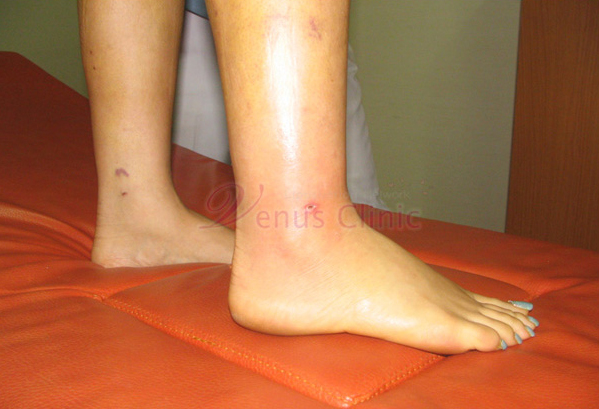
Inflammation at the wound site two weeks after calf liposuction
In the past, liposuction used thick cannulas, was performed under general anesthesia without the tumescent technique, and relied on devices such as ultrasonic machines that affected not only fat tissue but also blood vessels and skin. This led to truly serious complications and seems to be what created the perception that liposuction is a dangerous procedure.
Complications seen during that period included excessive bleeding (hemorrhage), large hematomas or seromas, skin necrosis, necrotizing fasciitis, hypovolemic shock, pulmonary edema, deep vein thrombosis, pulmonary emboli, fat embolism, abdominal wall perforation, and cardiopulmonary complications from general anesthesia — for the most part, serious complications.
There is a saying that failure is the mother of success. In the field of liposuction, these complications gave rise to new techniques and led to the standardization of the procedure.
The standard of modern liposuction — called the "gold standard" for roughly the past 10 years, recognized by the academic community and practiced by most surgeons — is tumescent local anesthesia combined with microliposuction using micro-cannulas.
Tumescent liposuction and microliposuction, the methods we use at Venus Clinic, are performed under local anesthesia with very little bleeding, so large volumes of intravenous fluid are not needed. As a result, hematomas and seromas are less common, and the risk of hypovolemic shock, pulmonary edema, venous thrombosis, and similar problems is greatly reduced.
In addition, because the patient is awake, the abdominal wall stays tense, so the chance of abdominal wall perforation is low. Fine micro-cannulas not only leave the skin surface smoother after surgery but also make it possible to remove fat safely and thoroughly even from the layers close to the skin — known as full-thickness or superficial liposuction. This promotes skin contraction and reduces post-operative skin sagging, and surgical results have improved as well.
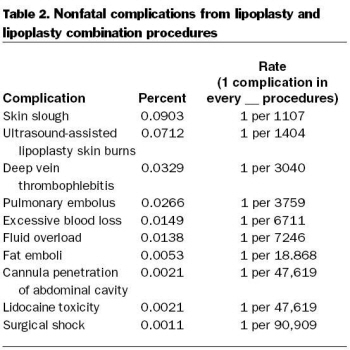
[Hughes, C. E., III. Reduction of lipoplasty risks and mortality: An ASAPS survey. Aesthetic Surg. J. 21: 120, 2001.]
The table above, from a 2001 paper by Hughes reported through the American Society for Aesthetic Plastic Surgery (ASAPS), covers patients who mostly underwent general anesthesia and ultrasonic liposuction, and shows high complication rates for irregularities and skin injury.
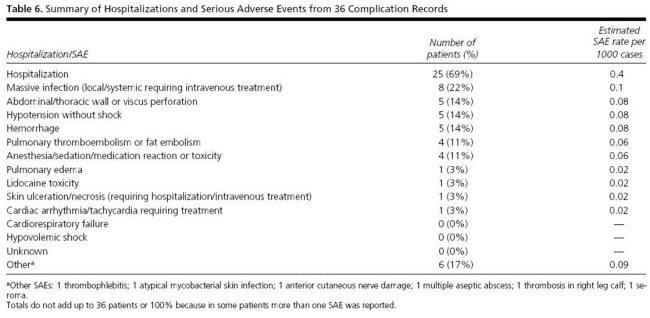
[Housman TS, Lawrence N, Mellen BG, George MN, Filippo JS, Cerveny KA, DeMarco M, Feldman SR, Fleischer AB. The safety of liposuction: results of a national survey. Dermatol Surg. 2002 Nov;28(11):971-8.]
The table above comes from a paper by Housman et al. reporting the results of a 2000 survey of the American Society for Dermatologic Surgery (ASDS). Physicians who mainly perform liposuction under tumescent local anesthesia reported almost no complications. These results can be seen as reflecting surgery performed mainly with the tumescent technique.
In conclusion, because liposuction can be performed under tumescent local anesthesia, it is relatively safe compared with many other surgeries, and its complication rate is low. However, because the treated area is large, it is recommended that thorough sterile technique be used and that the procedure be performed in a surgical facility equipped to monitor cardiopulmonary function.
Of course, the experience and skill of the operating doctor are important for a successful liposuction result, but before that, appropriate selection of patients who can manage post-operative care well, together with explanation and understanding of the characteristics of liposuction, is needed so that proper aftercare can follow. As mentioned earlier, doctors in particular must always remember the fact that most liposuction complications result from excessive liposuction.
[Dr. Jung, Director, Venus Clinic]