The Safety of Liposuction - A Comparison with Other Operations
Is liposuction a dangerous operation? When performed properly, liposuction is a generally safe procedure.
It is fair to say that modern liposuction began after Dr. Klein developed tumescent liposuction in 1987. Tumescent liposuction refers to a method in which tumescent fluid — made by mixing the local anesthetic lidocaine and the vasoconstrictor epinephrine into an IV solution — is injected into the fat layer to swell and firm it, after which the fat is suctioned out through a cannula.
Before tumescent liposuction was developed, liposuction was performed under systemic anesthesia such as general anesthesia, spinal (regional) anesthesia, or sedation (conscious sedation), so there was a lot of bleeding and many complications, and it was considered a dangerous procedure.
In recent times, however, tumescent liposuction has made it possible to operate safely under local anesthesia alone, and that is why modern, safe liposuction has become widely performed.
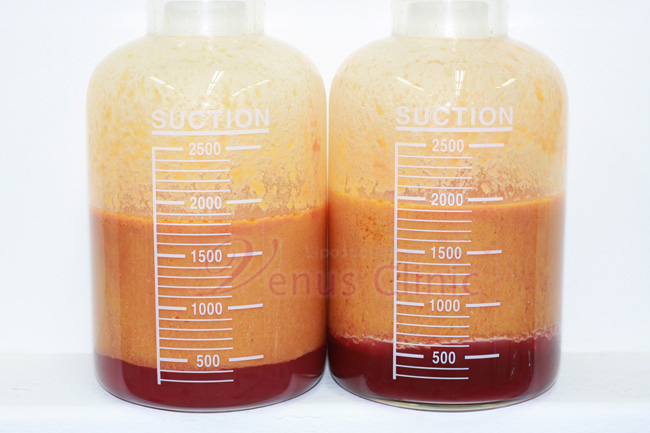
[ This is fat removed by tumescent liposuction at Venus Clinic. With tumescent liposuction, blood loss is about 1–4 cc per liter of fat removed, so liposuction can be performed with minimal bleeding.]
Before discussing the safety of liposuction itself, I would like to mention the risks of anesthesia. Even today, large-volume liposuction cannot be done under local anesthesia alone, so tumescent liposuction must be combined with general, spinal, or sedation anesthesia. Even in routine liposuction, sedation is often added to control pain more fully and to relieve the patient's anxiety.
Lunn et al. and Keenan et al. reported deaths purely related to anesthesia at 1:10,000 in 1982 and 1985, respectively, and Forrest et al. once shocked the world in 1990 by reporting anesthesia-related deaths of 1.11:1,000. On the other hand, Eichhorn et al. reported in 1989 that there were no deaths at all in 319,000 general anesthesia cases. So the risk of anesthesia itself remains a subject of much debate.
Dr. Klein, the founder of tumescent liposuction, emphasizes that doctors customarily believe anesthesia is safe, but in reality it is very difficult to identify and separate the portion of surgery-related deaths attributable to anesthesia itself, so the risks caused by anesthesia tend to be overlooked in reports, and that it is not appropriate to use general anesthesia for a procedure that can be performed under local anesthesia alone.
Looking at recently published papers on liposuction-related deaths, the American plastic surgeon Grazer et al. reported in 2000 a mortality rate of 1 in 5,000 for liposuction performed under systemic anesthesia, i.e., general, spinal, or sedation anesthesia. (See the table below.)
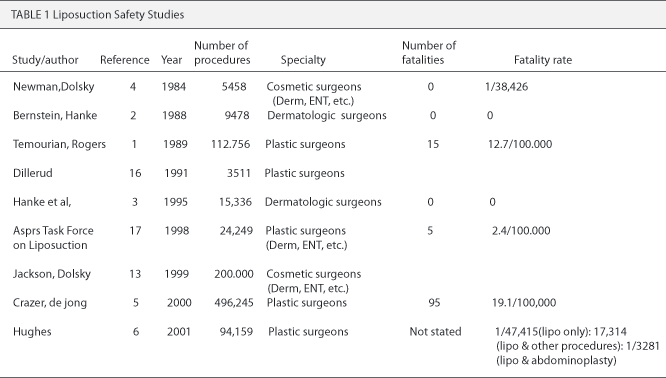
[Hanke CW, Safety of liposuction. In:Narins RS, eds. Safe liposuction and Fat transfer. New York: Marcel Dekker, 2003:355.]
However, Housman et al. reported in 2002 that there were no liposuction-related deaths when liposuction was performed under local anesthesia, supporting the safety of tumescent liposuction.
So from the standpoint of liposuction safety, I sometimes think the development of tumescent liposuction may have been a timely and important invention that allows those of us living today to undergo liposuction comfortably and without undue burden.
Even setting aside the anesthesia-related issues mentioned above, if we compare the risk of liposuction with other operations, hysterectomy has a reported mortality rate of 1:1,000 (Sloan, 1986) and mastectomy 1:333 (Sloan, 1986). Compared with these procedures for diseases that are treated surgically, liposuction is a relatively safe procedure.
Compared with other cosmetic surgeries, face lift has been reported at 1:5,000 (Baker, 1997) and abdominoplasty at 1:600 (Grazer, 1977). So liposuction is a relatively safe procedure, and when performed under local anesthesia alone, deaths are extremely rare.
In conclusion, liposuction is fortunately a procedure that can be performed under local anesthesia alone, and from this point of view it is comparatively safer than many other procedures. Besides this safety profile, liposuction also has relatively few complications.
Next time, I would like to analyze the risk factors that arise during liposuction surgery and look at how to address them.
[Dr. Jung, Director, Venus Clinic]