About Liposuction Complications
Wouldn't it be wonderful if there were surgery without complications? Even childbirth carries an infection risk of about 2.6%. Wound infection at the suture site after a cesarean section is reported at 3-15%. Doctors know about these complications and work hard to avoid the risks of complications from such surgeries, but...,
Among cosmetic complications, the most common are bruising, swelling, and an uneven (lumpy) skin surface. Bruising and swelling tend to depend on postoperative care, but they usually heal well, so they are not a cause for worry.
Liposuction, of course, also has complications, such as those listed below.
| Common complications | Uncommon complications | Rare complications |
|---|---|---|
| Small scars at the incision sites Bruising Localized swelling (perineum, lower legs) Temporary redness, flushing Temporary abnormal sensation, reduced sensation Slight skin irregularity Drainage of anesthetic solution and blood Mild pain and discomfort after surgery Skin laxity |
Keloids or hypertrophic scarring Small hematoma, seroma Persistent swelling (>6 months) Persistent redness (>6 months) Persistent abnormal sensation (>4 months) Significant irregularity and asymmetry Persistent drainage (>7 days) Persistent pain (>3 months) Postoperative fatigue (2-3 weeks) Non-infectious skin redness Mild infection Persistent hypopigmentation or hyperpigmentation Mild drug side effects Fainting (vasovagal) |
Large hematoma or seroma Heavy bleeding Skin burns, necrosis Lidocaine toxicity due to dosage or interaction with other drugs Bacterial infection, necrotizing fasciitis, toxic shock syndrome Hypovolemic shock from large-volume liposuction Pulmonary edema Venous thrombosis, pulmonary embolism Fat embolism |
Broadly speaking, the complications in the table above can be divided into direct, life-threatening complications and cosmetic complications.
Direct complications
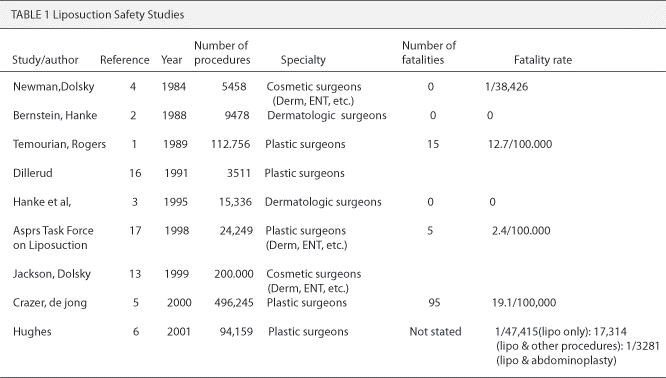
The table above summarizes published papers on the safety of liposuction. The mortality rate of the superwet technique, mainly used by plastic surgeons, is about 1 in 5,000, while no deaths were reported in studies using the tumescent technique.
In the group that mainly used general or intravenous anesthesia (Grazer FM, de Jong RH. Fatal outcomes from liposuction: census survey of cosmetic surgeons. Plastic and Reconstructive Surgery 105:436-446, 2000.), 95 deaths were reported among 475,000 liposuction procedures from 1994 to 1998,
while in the group performing tumescent liposuction (Housman TS, Lawrence N, Mellen BG, George MN, Filippo JS, Cerveny KA, DeMarco M, Feldman SR, Fleischer AB. The safety of liposuction: results of a national survey. Dermatol Surg. 2002 Nov;28(11):971-8. ), no deaths were reported among 65,000 liposuction procedures from 1994 to 2000.
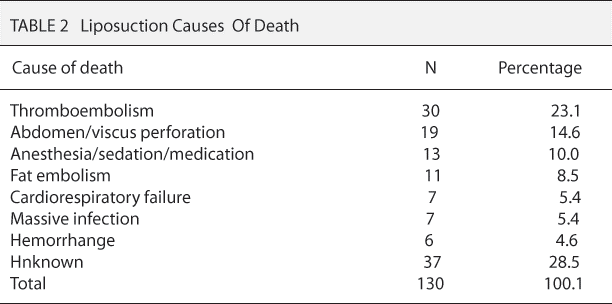
Looking at the analysis of causes of death reported by the plastic surgery society in the table above, you can see that the most common cause is venous thromboembolism.
We can also see that venous thromboembolism is caused by prolonged general or intravenous anesthesia, excessive surgery, and the resulting tissue damage. The reasons general or intravenous anesthesia increases mortality are
- Performing several operations at once (Multiple surgery)
- Long operating time (Prolonged surgery time)
- Removing an excessive amount of fat in one session (Removal excessive amount of fat during single session)
- Excessive intravenous fluids (Iv fluid overload)
- Excessive dose of lidocaine used together with general anesthesia (toxic dose)
and so on.
In conclusion, if liposuction is performed with the tumescent technique rather than general anesthesia, and appropriate safety guidelines are followed, we can say it is a safe procedure.
Cosmetic complications
Among cosmetic complications, the most common are bruising, swelling, and an uneven (lumpy) skin surface. Bruising and swelling tend to depend on postoperative care, but they usually heal well, so they are not a cause for worry.
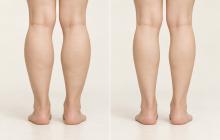
Skin surface irregularities can mostly be avoided these days by operating meticulously with microcannulas, which are small, thin tubes. They can also be corrected to some extent with a secondary surgery.
According to Chang et al. (2002), contour deformity (unevenness) is the most common postoperative complication after liposuction, reported in up to about 20% of patients.
I believe that achieving a satisfying reduction in size through sufficient fat removal, while also creating a natural and smooth skin surface, depends above all on the surgeon's balance of wisdom, virtue, and physical strength: that is, knowledge and skill, careful and attentive technique, and the stamina to support them.
As a result, mild skin surface irregularities improve naturally once swelling and induration (hardening) resolve, but severe cases may require procedures such as revision liposuction, fat grafting, or skin and fat excision.
Localized over-suction (lipotrop): This occurs particularly in areas with soft fat, such as the inner thighs, where fat is suctioned too easily.
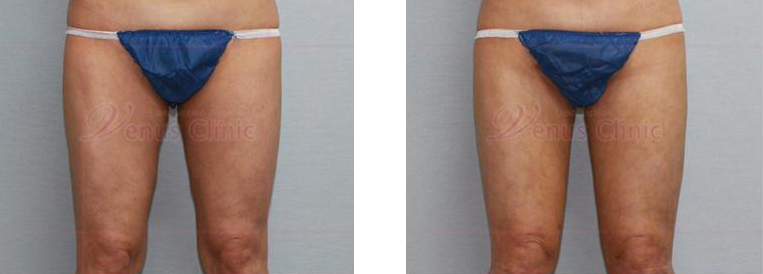
< Over-suction of the inner thighs corrected with fat grafting >
Localized insufficient suction (liponut): Attempting to remove all the fat over a wide area so that the skin directly contacts the fascia inevitably leaves small, thin pockets of fat behind, which become obvious later if weight is gained.
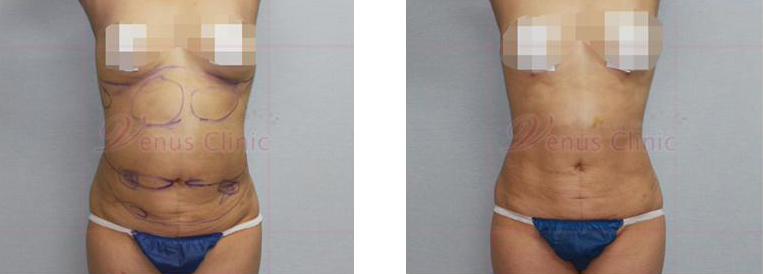
< Overall insufficient liposuction (especially the upper abdomen) and localized over-suction, corrected with liposuction >
An inverted smile shape, caused when fat from above slides down due to insufficient suction of the upper abdomen
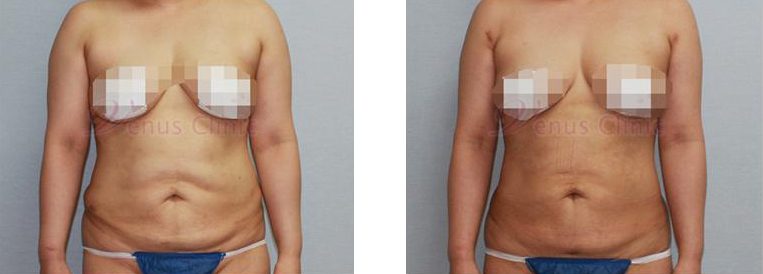
< Sagging above the navel (inverted smile appearance) due to insufficient liposuction of the upper abdomen, corrected with revision liposuction >
Infection rarely occurs with liposuction because of the antibacterial properties of lidocaine, the local anesthetic used during the procedure. It is generally reported at 0.5% or less.
[Dr. Jung, Director, Venus Clinic]