Toward Safer Liposuction
A doctor who perforated below the fat layer while performing abdominal liposuction on a woman in her 60s, causing her death from peritonitis, has been sentenced to six months in prison. On the 11th, Criminal Single-Judge Division 2 of the Seoul Western District Court (Judge Seok Hyun-su) sentenced Dr. Lee (37) to six months in prison and a fine of 2 million won (roughly US$2,000 at the time) on charges of professional negligence resulting in death, for failing to exercise due care while performing abdominal liposuction on Ms. Kwon (female, 63), who died of peritonitis.
According to the ruling, Dr. Lee performed abdominal liposuction on Ms. Kwon on August 30 of last year at M Hospital in Samseong-dong, Gangnam-gu, Seoul. The instrument used, called a "cannula," must be kept parallel to the patient's abdomen, and because Ms. Kwon was elderly and had thin skin, particular care was required. However, Dr. Lee misused the cannula and pierced below the fat layer, leaving 11 holes in Ms. Kwon's abdomen. Ms. Kwon died of peritonitis the following day.
[ Source: Chosun Ilbo (a Korean daily newspaper)] : Read the article
In fact, liposuction is one of the lower-risk procedures among the many medical procedures, and cases resulting in death are very rare.
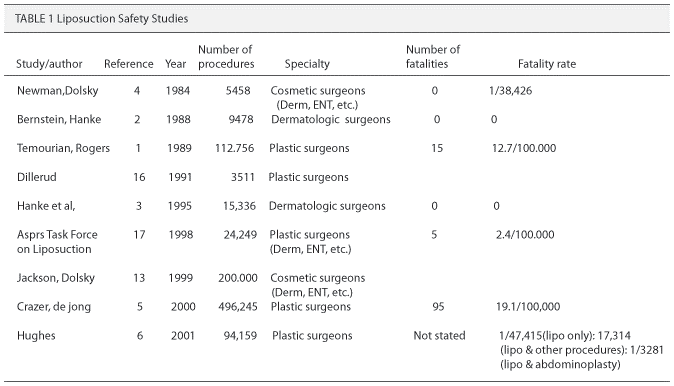
According to recent reports, the death rate for liposuction performed under general anesthesia has been reported at about 1 in 5,000, whereas with the tumescent technique that is now most widely used, deaths have been reported so rarely that it has become a considerably safer procedure.
Admittedly, if the abdominal cavity is perforated during liposuction, the perforation can be masked by the pain in the treated area, so diagnosing abdominal perforation after surgery can be difficult. Even so, this death caused by abdominal perforation is truly regrettable, and I believe it must never happen again.
If liposuction is performed under local anesthesia alone, the patient feels severe pain when the peritoneum is irritated, so the doctor can easily tell where the cannula is. In addition, because abdominal muscle strength is maintained, perforation does not occur easily.
Liposuction can be performed under local anesthesia alone, but because patients still experience some anxiety and pain, surgery is sometimes performed under sedation. Under sedation, however, spontaneous breathing is preserved, the strength of the limb and abdominal muscles is maintained, and the muscle tone of the blood vessels is also maintained, so it can be considered almost as safe as local anesthesia.
Moreover, when the duration of sedation is shorter, less medication is used, recovery is even faster, and the risk of deep vein thrombosis, a complication that can arise from prolonged surgery, is reduced, making the procedure safer still. In this respect, I believe a short operating time is extremely important.
When liposuction is performed under general anesthesia, however, the abdominal muscles are paralyzed and relaxed, so perforation can occur more easily; because the patient cannot report pain, the likelihood of perforation increases; the possibility of abdominal perforation may be overlooked even after surgery; and prompt treatment may be delayed.
Beyond the risk of abdominal perforation, general anesthesia slows metabolism, lowers body temperature, and weakens vascular muscle tone so that blood flow slows; intravenous fluids given to maintain blood pressure can dilute the blood; and because general anesthesia makes it more likely that several additional procedures will be combined at once, the total operating time becomes longer and more tissue is damaged, which can greatly increase the risk of deep vein thrombosis, in which blood clots form in the veins.
I also believe that a doctor who performs liposuction must know the anatomy of the abdominal muscles and fascia well and must be able to sense the position of the cannula with his or her fingertips. Indeed, only when the surgeon trusts the feel of his or her own fingertips can deep fat be removed and a smooth, thorough liposuction be achieved.
These days, vibrating cannulas may be used to speed up liposuction, and there are also methods that use lasers or ultrasound, which break down tissue easily; unfortunately, these can increase the risk of abdominal perforation during liposuction. Furthermore, because they can be even more dangerous when used by surgeons new to liposuction, it may be better not to use such devices until one can fully trust the feel of one's own fingertips.
At Venus Clinic, we use sedation to minimize patients' anxiety and pain, and because we have shortened the operating time by more than half compared with conventional operating times, we can reduce the dose of sedative, which makes the procedure safer and recovery faster. In addition, because we do not use powered devices and instead proceed while feeling the cannula directly by hand, the procedure can be considered safer.
[ Dr. Jung, Director, Venus Clinic]
References
Liposuction Is a Dangerous Operation? Analysis of Risk Factors in Liposuction and How We Address Them Understanding the Complications of Liposuction