Beautiful Buttock Shape and Buttock Ptosis — Liposuction and Fat Grafting That Treat the Hips, Buttocks, and Saddlebags as One Unit

In consultations, I often hear comments like "My buttocks spread out to the sides and sag, so my legs look short," "A long crease has formed under my buttocks, so I can't wear shorts," and "The sides of my pelvis are hollow, so clothes don't fit well." Even with the same buttock concern, the problem may be size for one person, shape for another, and sagging for someone else, so the solutions differ as well.
Today I will first explain the standards of a beautiful buttock, the various buttock shapes, and how buttock ptosis (sagging) is assessed. Then I will explain why we at Venus Clinic operate on the hips, buttocks, and saddlebags as one cosmetic unit, and describe hip dip (dell) fat grafting and banana fold and double crease fat grafting, which we use to help prevent double creases and buttock ptosis.
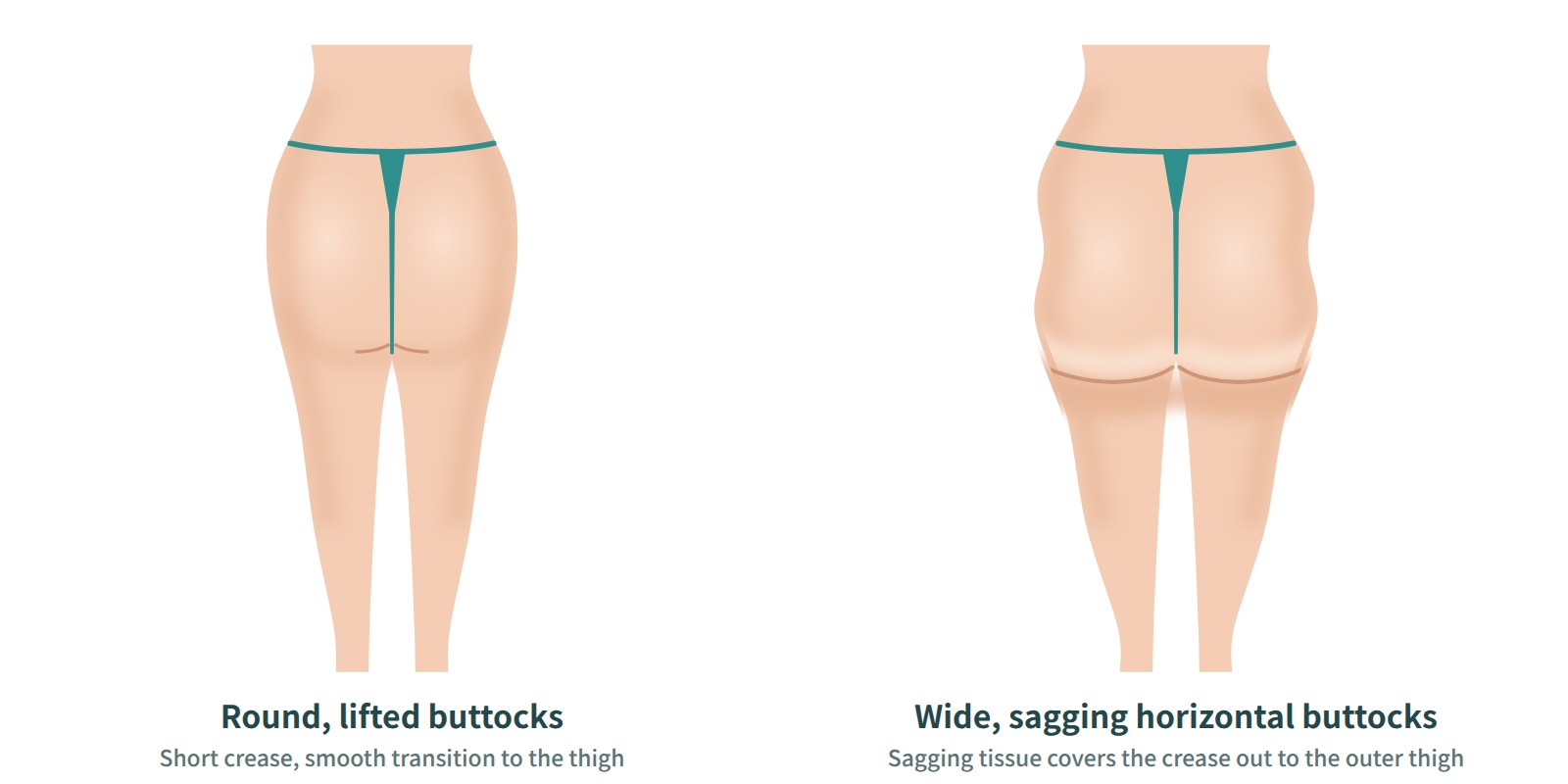
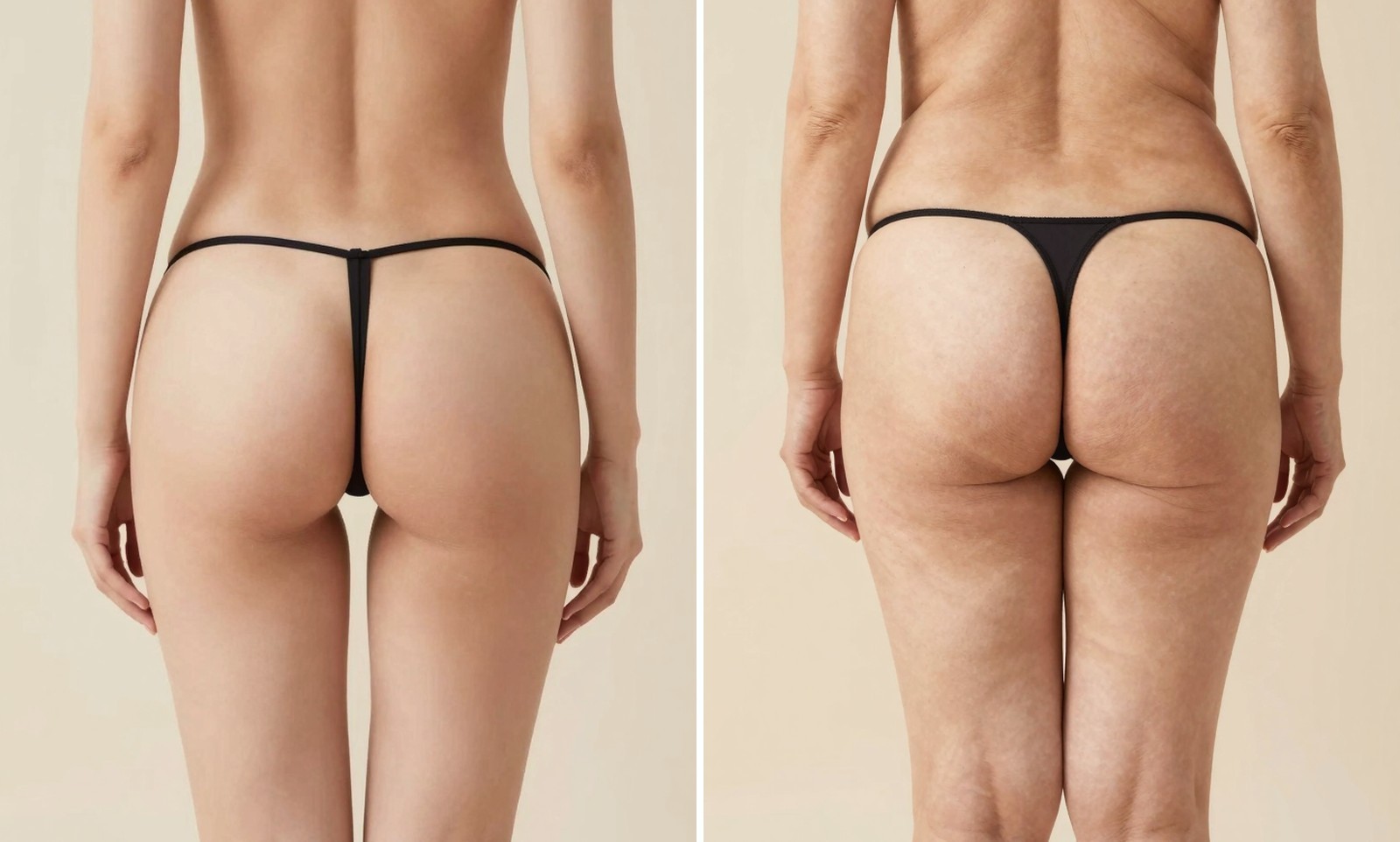
Left: round, lifted buttocks · Right: wide, horizontal-type buttocks that spread to the sides and sag
※ All illustrations of people in this article are virtual images created to aid understanding. Actual results may vary from person to person.
Standards of a Beautiful Buttock
Buttock surgery starts from a standard of "what kind of buttock is beautiful." A surgeon needs his or her own aesthetic standard, but that alone is not enough. The core of a consultation is understanding the shape the patient wants and realistically bringing the two standards together. [1] This is why, at Venus Clinic, we carefully ask about the shape you want, with photos, before surgery.
The Waist-to-Hip Ratio
The buttocks do not look beautiful on their own; they look beautiful in relation to the waist. When the waist circumference divided by the hip circumference (the waist-to-hip ratio) is close to 1, the waist and buttocks look like one straight line; when it drops to around 0.7, the waist looks slim and the buttocks stand out. In the comparison photos from a paper on buttock shape classification, a torso with a ratio of 0.97 showed no visible waistline, while a torso with a ratio of 0.73 showed a clear curve from the waist to the buttocks. [5] So to improve the shape of the buttocks, we need to look not only at the buttocks but also at the waist, flanks, and hips together.
Where the Most Projecting Point Lies
For the round volume of the buttocks, position matters as much as size. The most projecting point should be in the upper two-thirds or the middle of the buttock, and in the lower third the buttock should blend smoothly into the thigh. Viewed from the side, a pleasing position is one where an imaginary horizontal line at the level of the upper pubic area meets the most projecting point of the buttock. [1] Conversely, when the volume drops and the lower buttock covers the back of the thigh, the buttocks look long and low and the legs look short.
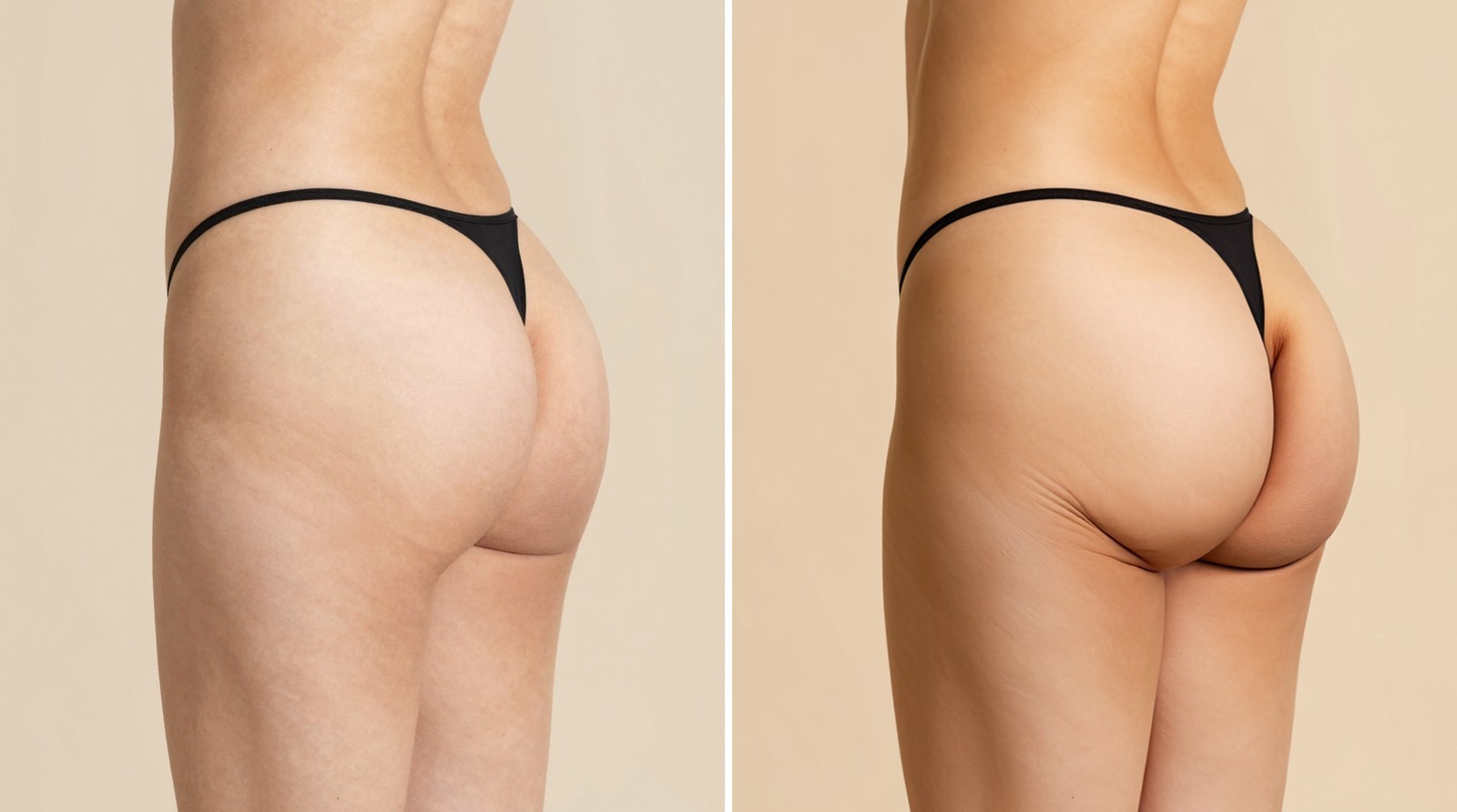
Left: the most projecting point is upper/middle · Right: the volume has dropped and covers the back of the thigh
A Hollow on the Side — the Hip Dip
If you follow the outer contour of the pelvis downward from behind, there are two projections. The upper one is the hips, where the pelvis sticks out to the side below the waist, and the lower one is the saddlebags, the upper outer thigh attached to the buttock. Between these two projections there is an indented spot. Liposuction textbooks call this spot the dell (lateral gluteofemoral dell) between the hip and the outer thigh, and explain that it lies at the level where the outer side of the gluteal muscle is most indented. [2] It is commonly called the hip dip.
The more the hips and saddlebags stand out, the deeper the dell between them looks, so the contour of the pelvis becomes a violin shape — bulging above and below and narrow in the middle. This can look natural in men, but in women a deep hollow here makes the buttock look split in two from the side. [1] So a beautiful buttock has little or no such hollow, and the pelvic contour flows as one round curve.
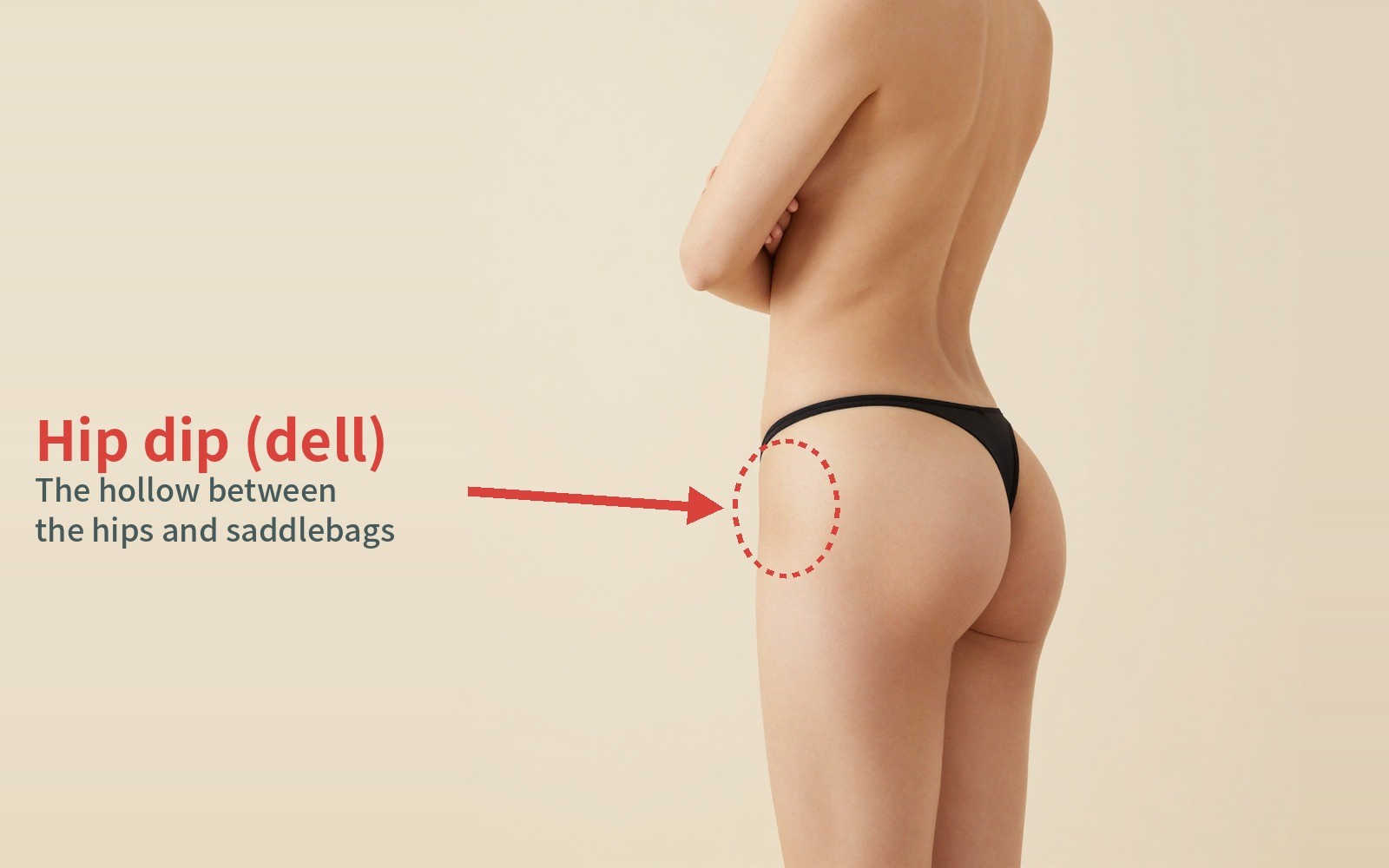
Dotted line and arrow: the indented spot between the hips and saddlebags (hip dip, dell)
The Various Buttock Shapes
Seen from behind, the outline of the pelvis differs from person to person. The square type is a body shape in which both the hips and the saddlebags project. From there, if the flanks and hips project more to the sides, it becomes the V-shape (abdominal type — a flat-buttocked shape resembling a male pelvis), and if the saddlebags project more, it becomes the A-shape (thigh type — a female type with prominent saddlebags). And the round shape is the desirable one. Depending on how three points on the contour relate to each other — the hips (A) at the top, the dell (C) in the middle, and the saddlebags (B) at the bottom — buttocks can be broadly divided into four types. [5] Because the areas to reduce and the areas to fill differ by type, surgical planning begins with reading this shape.
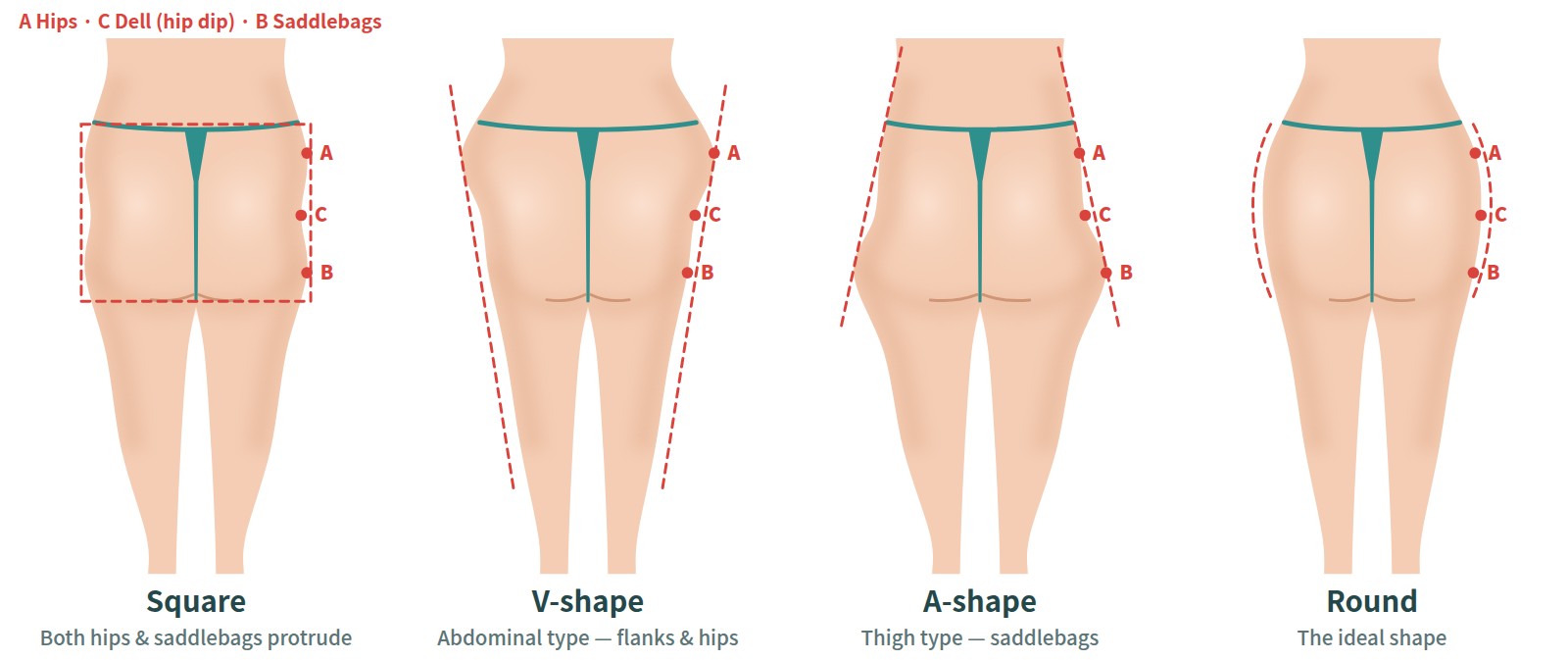
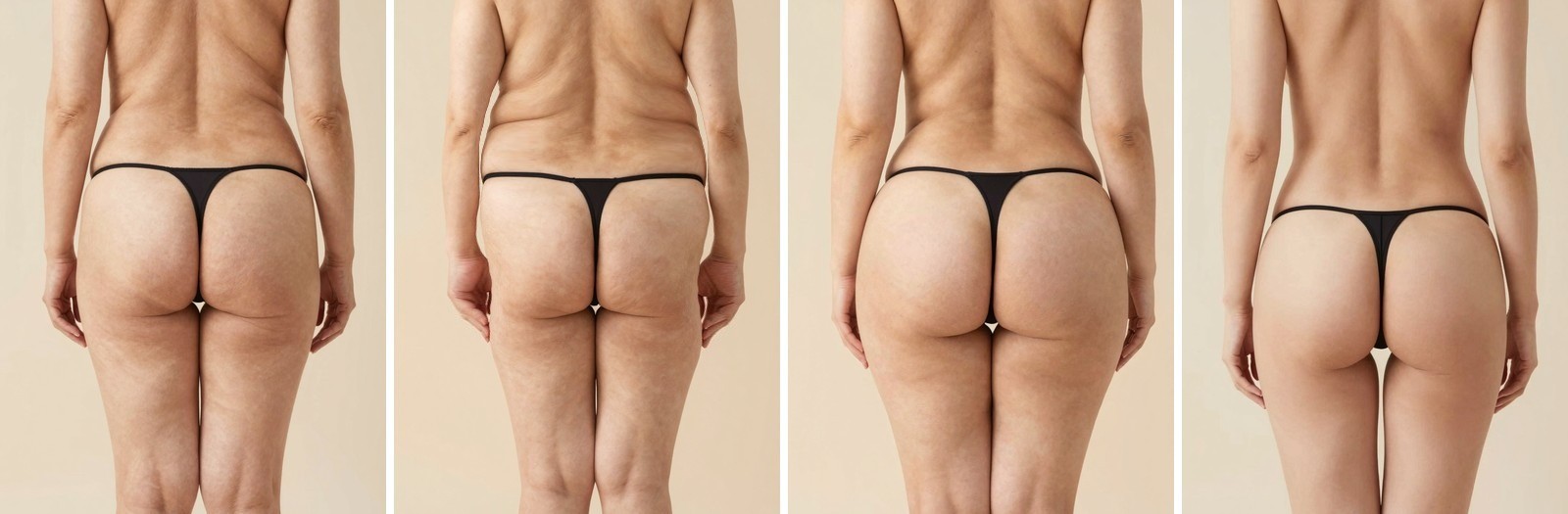
From left: square · V-shape · A-shape · round (same order as the diagram above)
| Type | Shape | Main areas addressed in surgery |
|---|---|---|
| Square | A body shape in which both the hips (A) and saddlebags (B) project. With both upper and lower points sticking out, the contour looks like an angular square and the buttocks look short | Reduce the hips and saddlebags together and fill the dell (C) |
| V-shape | The abdominal type. Fat on the flanks and hips (A) makes them project more to the sides while the buttocks are flat, so the contour narrows straight downward — a shape resembling a male pelvis | Reduce the flanks, hips, and lower back and fill the dell (C) |
| A-shape | The thigh type, a female body shape with prominent saddlebags (B). The saddlebags project more than in the square type, so the contour widens downward | Reduce the saddlebags and lower outer buttock and fill the dell (C) |
| Round | The desirable shape. The hips (A) and saddlebags (B) do not project excessively and the dell (C) is not hollow, so the contour flows in a round line | The shape that cosmetic unit surgery aims for |
Three Zones: Upper, Middle, and Lower
Viewed from the side, the buttock is divided into three zones: upper, middle, and lower. The impression of the buttock changes depending on which zone projects the most: when the volume is concentrated in the lower zone, the buttock looks saggy, and when it is in the upper zone, it looks lifted. [5] Even for buttocks of the same size, reducing fat in the lower zone shifts the center of volume upward, giving the impression of a lifted buttock.
How Is Buttock Ptosis (Sagging) Assessed?
Buttock ptosis is a condition in which the skin and fat of the buttock descend past the infragluteal crease toward the thigh; it usually starts on the inner side and progresses outward. [3] The most important indicator for assessing ptosis is the length and depth of the infragluteal crease. [3] Slim young people may have no crease at all, and even when there is one, a beautiful buttock is one where the crease does not extend past the middle of the thigh when viewed from behind. A long, distinct crease is seen in buttocks with some degree of ptosis. [1]
Degrees of Ptosis
Textbooks grade ptosis by how far the infragluteal crease extends when viewed from behind and whether there is sagging tissue below the crease. The references for this are two vertical lines, the T line and the M line. [1][3]
The T Line and M Line
Both lines are set with the patient standing comfortably upright without pushing the buttocks forward or backward, and with the doctor standing parallel to the back of the body so that the entire back of the thigh is visible. [1]
Two Vertical Lines
T line — a vertical line dropped from the ischial tuberosity (the bone that touches the seat when sitting), found by palpation below the buttock. It is the inner dotted line in the figure, and the blue dot is the ischial tuberosity.
M line — a vertical line parallel to the T line that passes through the midpoint of the back of the thigh. It is the outer dotted line in the figure.
The textbook calls it "ptosis" only when buttock tissue has descended below the crease at the M line, and calls the earlier stages "pre-ptosis." From true ptosis (Degree 4) on, the amount of tissue that has descended over the thigh at the M line is measured and recorded in centimeters (e.g., 0.5, 1, 2 cm). [1][3]
| Degree | Condition |
|---|---|
| Degree 0 | No ptosis — there is no crease, or if there is one, it reaches only the T line. This is neither ptosis nor pre-ptosis |
| Degree 1 | Mild pre-ptosis — the crease passes the T line but does not reach the M line. There is no sagging tissue at the T line |
| Degree 2 | Moderate pre-ptosis — the crease reaches the M line, and there is sagging tissue at the T line |
| Degree 3 | Borderline — the crease extends slightly past the M line, but there is not yet sagging tissue at the M line. This is the border between pre-ptosis and ptosis, and from this stage many people feel that "my buttocks have sagged" |
| Degree 4 | True ptosis — there is sagging tissue at the M line, and buttock tissue descends past the crease and covers the thigh. The descended amount is measured in centimeters |
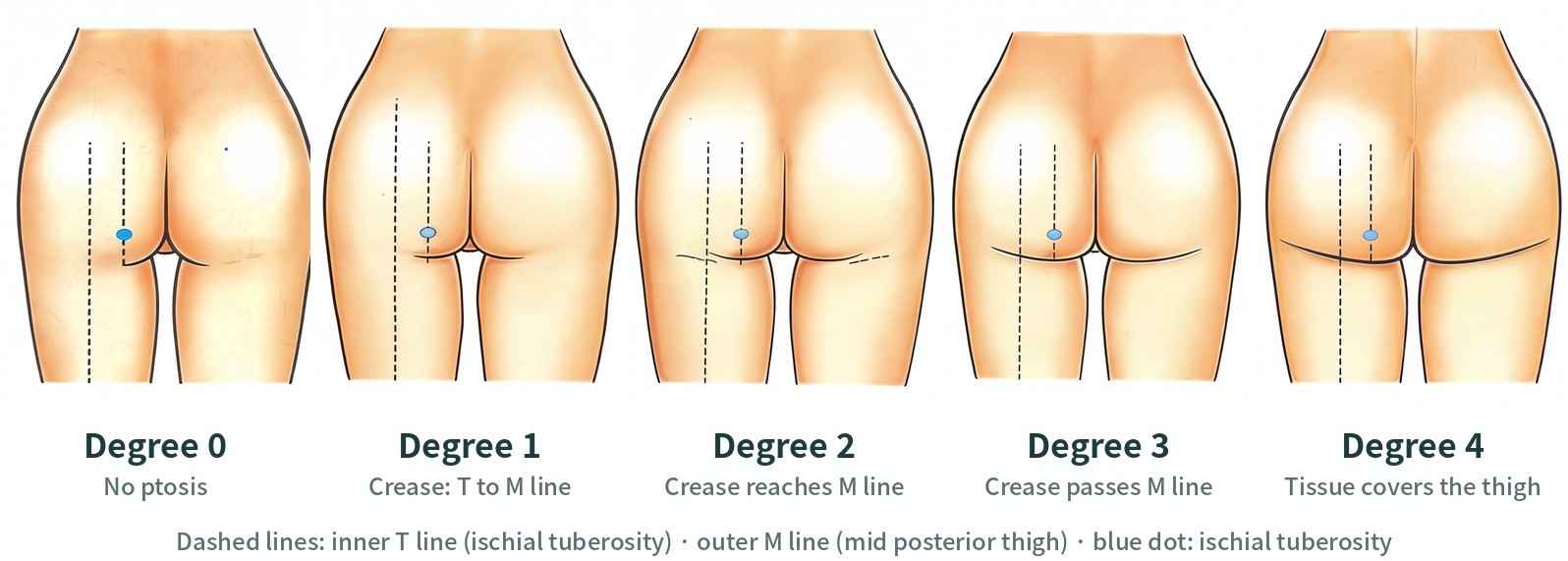
From left: Degree 0 · 1 · 2 · 3 · 4 — the infragluteal crease lengthens from the T line to the M line and beyond, and at Degree 4 sagging tissue covers the thigh
The Lower Border of the Buttock — From Mountain to Plain to Valley
The lower border of the buttock seen from behind is easy to understand if you compare it to a roof. In snowy regions roofs are shaped like steep mountains, in regions with little snow they are shaped like gentle mountains, and when they become even flatter they are flat like a plain. Likewise, if we take the center near the anus as the mountaintop, the lower border of a buttock without ptosis is shaped like a steep mountain; when ptosis begins it becomes a gentle mountain, and as it progresses further it becomes horizontal like a plain. When ptosis becomes severe, this plain deepens into a valley with a sunken center, and the sagging tissue covers the crease line.
The Line That Looks Like a "Crease" Is the Buttock Fold
When people with significant ptosis say "the crease under my buttocks is long," the line they actually see is not the original infragluteal crease but the lower edge of the buttock fold, where loose buttock tissue (skin and fat) has folded down. This is because the sagging tissue covers and hides the original crease between the buttock and the thigh. When ptosis progresses horizontally, this sagging edge extends long toward the outer thigh, creating a horizontal-type buttock that looks spread out to the sides and low. From the side as well, the angle of the buttocks increases as ptosis progresses. The textbook illustration explains that it is desirable for the angle formed by the gluteal protuberance with the posterior plane of the body to be 45° or less, that up to 90° is considered acceptable, and that beyond 90° sagging buttock tissue becomes visible below the crease (see the figure below). [1] As a different criterion, the photo classification in the a paper on buttock shape classification also divides the angle of ptosis seen from the side into three stages: 0–10°, 10–30°, and more than 30°. [5]
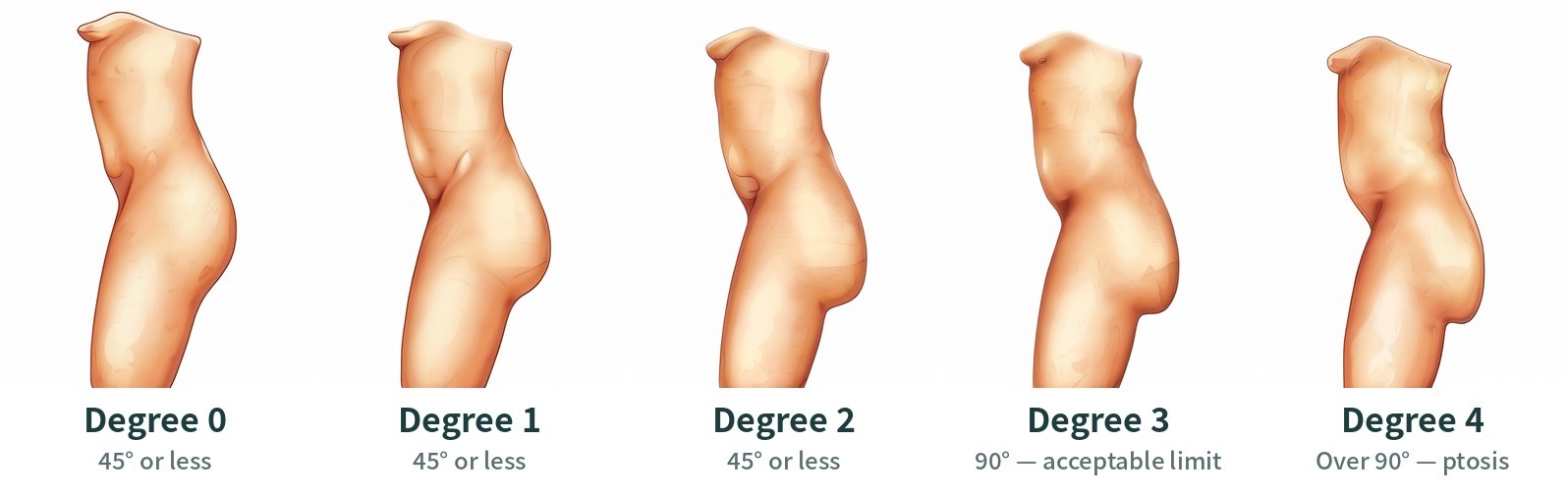
Side view, Degree 0–4: an angle between the buttock and the plane of the back of 45° or less, as in Degrees 0–2, is desirable; up to 90°, as in Degree 3, is within the acceptable range; beyond 90°, as in Degree 4, sagging buttock tissue descends below the crease line
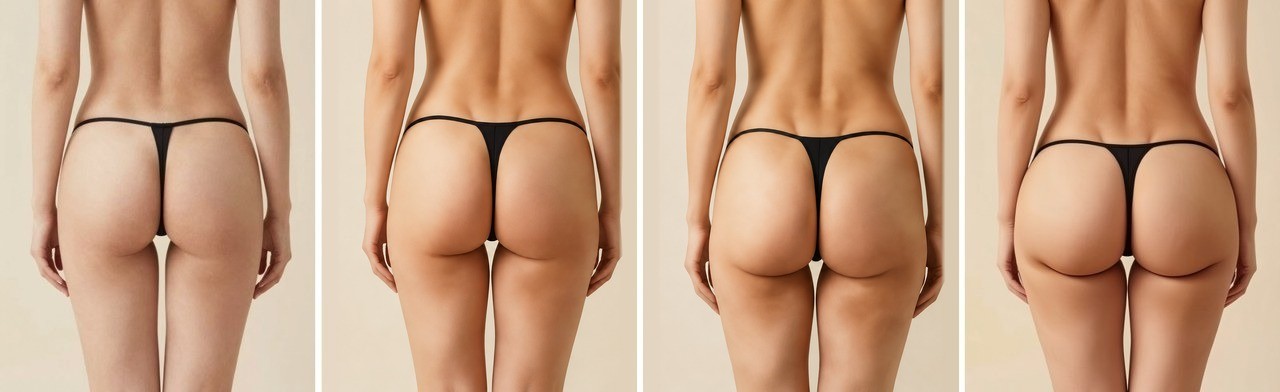
Progression of ptosis seen from behind — as the buttocks sag, the infragluteal crease lengthens from the inner side outward, and finally sagging tissue covers the thigh
Sagging Buttocks Can Also Look Like Saddlebags
When the lower buttock becomes heavy and sags, tissue from the lower outer buttock is pushed out toward the outer thigh, so the saddlebags can appear to stick out even when there is not much saddlebag fat. Conversely, the saddlebag area can stand out more because of sagging buttocks. Textbooks call this a "false saddlebag" and distinguish it from a true saddlebag: if the bulge decreases when the patient squeezes the buttocks, it is regarded as a false saddlebag caused by the weight of the buttocks. [4][6] So when evaluating saddlebags, buttock ptosis must be considered as well.
The Hips, Buttocks, and Saddlebags Are One Cosmetic Unit
At Venus Clinic, we operate on the hips, buttocks, and outer thighs (saddlebags) as one cosmetic unit. This is because the contour that starts at the hips — the upper pelvis below the waist — and continues to the buttocks and then to the outer thighs is what creates the distinctively feminine curve. Liposuction textbooks also explain that the hips are connected to the buttocks and outer thighs, so they are often treated together on the same day, and that the combination of the hips, outer thighs, and lower outer buttock is among the most commonly combined treatment areas. [2]
The Goal of Cosmetic Unit Surgery — From a Violin Shape to a Round Shape
Cosmetic unit surgery reduces projecting areas and fills hollow areas at the same time. The hips above and the saddlebags below are reduced with liposuction, and fat is grafted into the dell (hip dip) that is indented between them. Because the two projecting areas come in and the one hollow area is filled, the pelvic contour that was narrow in the middle changes from a violin shape to a round shape. If only the hips and saddlebags are reduced and the dell is left as it is, the irregularity of the contour remains; conversely, if only the dell is filled, the overall width increases. That is why the three areas are planned together as one unit.
Saddlebags Together with the Lower Outer Buttock
The saddlebags are the upper part of the middle outer thigh, attached beside the outer end of the buttock crease. When there is a lot of fat in the lower outer part of the buttock (the lower outer buttock), that fat pushes the saddlebags out toward the outer thigh, so if only the saddlebags are treated, tissue from the lower outer buttock comes back down and the reduction is hard to see. Therefore, at Venus Clinic, when we treat the saddlebags we also treat the lower outer buttock, and we call this Buttock Apple Line surgery. Reducing fat on the outer and lower parts of the buttock gathers the buttocks toward the center and makes the legs look longer.
Treating the Hips and Lower Back Together Lifts the Buttocks Further
When buttock liposuction reduces volume, the skin contracts and the lower border of the buttock moves upward. If the hips and lower back (just above the buttocks, below the waist) are treated at the same time, the skin above the buttocks also contracts and pulls the buttocks upward, so the buttocks are lifted further. To draw out as much skin contraction as possible, we also perform superficial liposuction, evenly refining the shallow layer close to the skin. At Venus Clinic, we remove the fat that needs to be removed as thoroughly as possible and smooth the line so that it is not uneven.
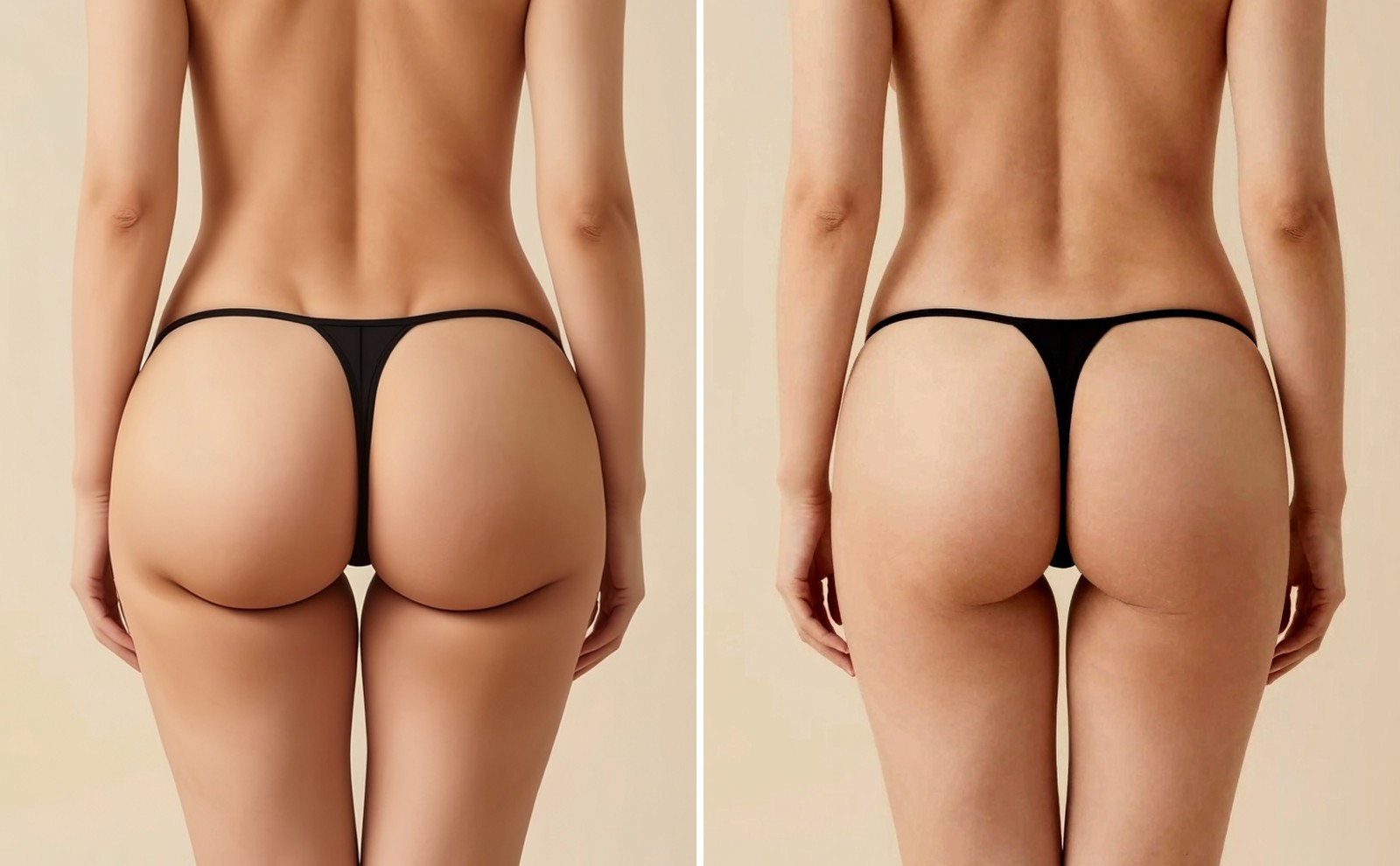
Left: the sagging buttock fold covering the infragluteal crease · Right: volume reduced and skin contracted, so the lower border of the buttock has risen and the original crease is visible
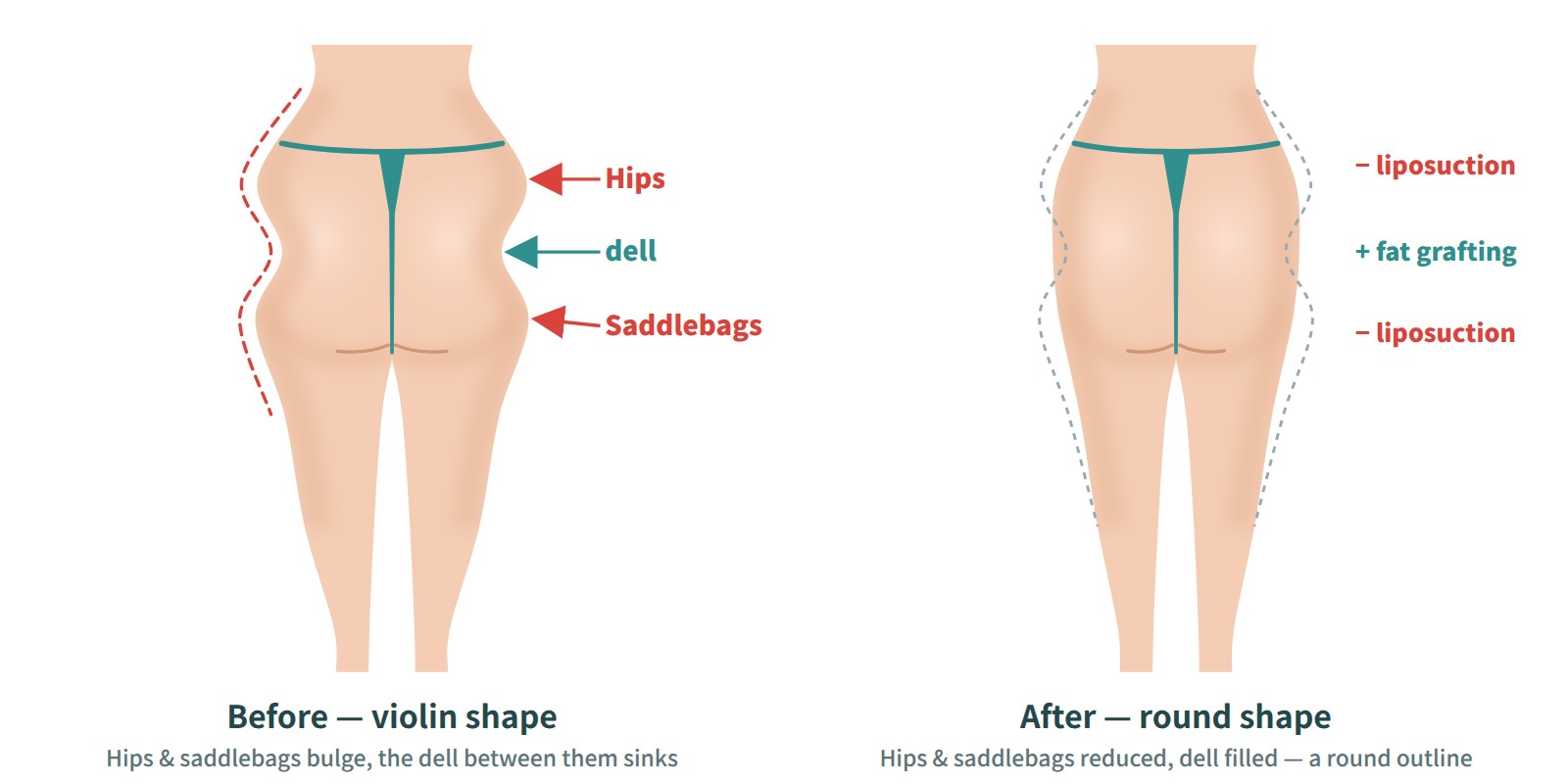
Hip Dip (Dell) Fat Grafting
A hollow on the side such as a hip dip is corrected not by removing fat but by filling it. Textbooks explain that in buttocks that have lost elasticity, fat accumulates in the lower third and a depression forms on the side of the buttock (the trochanteric area), and they describe grafting fat into this depression while suctioning the flanks and outer thighs. [4] They also note that grafting fat into the trochanteric area creates the effect of a lifted-looking buttock. [4]
At Venus Clinic, fat obtained from liposuction of the hips, buttocks, and saddlebags is purified and grafted in portions into the dell (hip dip) between the hips and saddlebags. Because the hips above and the saddlebags below are reduced and the hollow between them is filled, the pelvic contour that was violin-shaped flows into one round curve. On the other hand, excessive suction of fat over the greater trochanter can actually leave this area sunken [2], so we plan this area for filling rather than suction.
The Banana Fold and Double Crease — Fat Grafting to Help Prevent Ptosis
The slightly bulging area just below the infragluteal crease, at the upper back of the thigh, is called the banana fold in textbooks, after its shape. When the buttocks become heavy, fat accumulates here and the banana fold becomes prominent. [4] Within the fat layer of the banana fold run fibrous tissues (ligaments) that support the buttock from below; these fibrous tissues create the infragluteal crease and hold the buttock so that it does not droop toward the thigh.
Deep Suction Can Cause a Double Crease and Ptosis
Excessive suction of the banana fold fat creates a double crease — another horizontal crease below the original crease — and a large double crease is difficult to correct. [2] Deep suction cuts the fibrous tissue that holds the buttock, lengthening the infragluteal crease; in other words, ptosis develops. [4] That is why textbooks recommend treating this area very conservatively, only in the shallow layer, and suctioning at an angle (about 45 degrees) to the crease. [2][4]
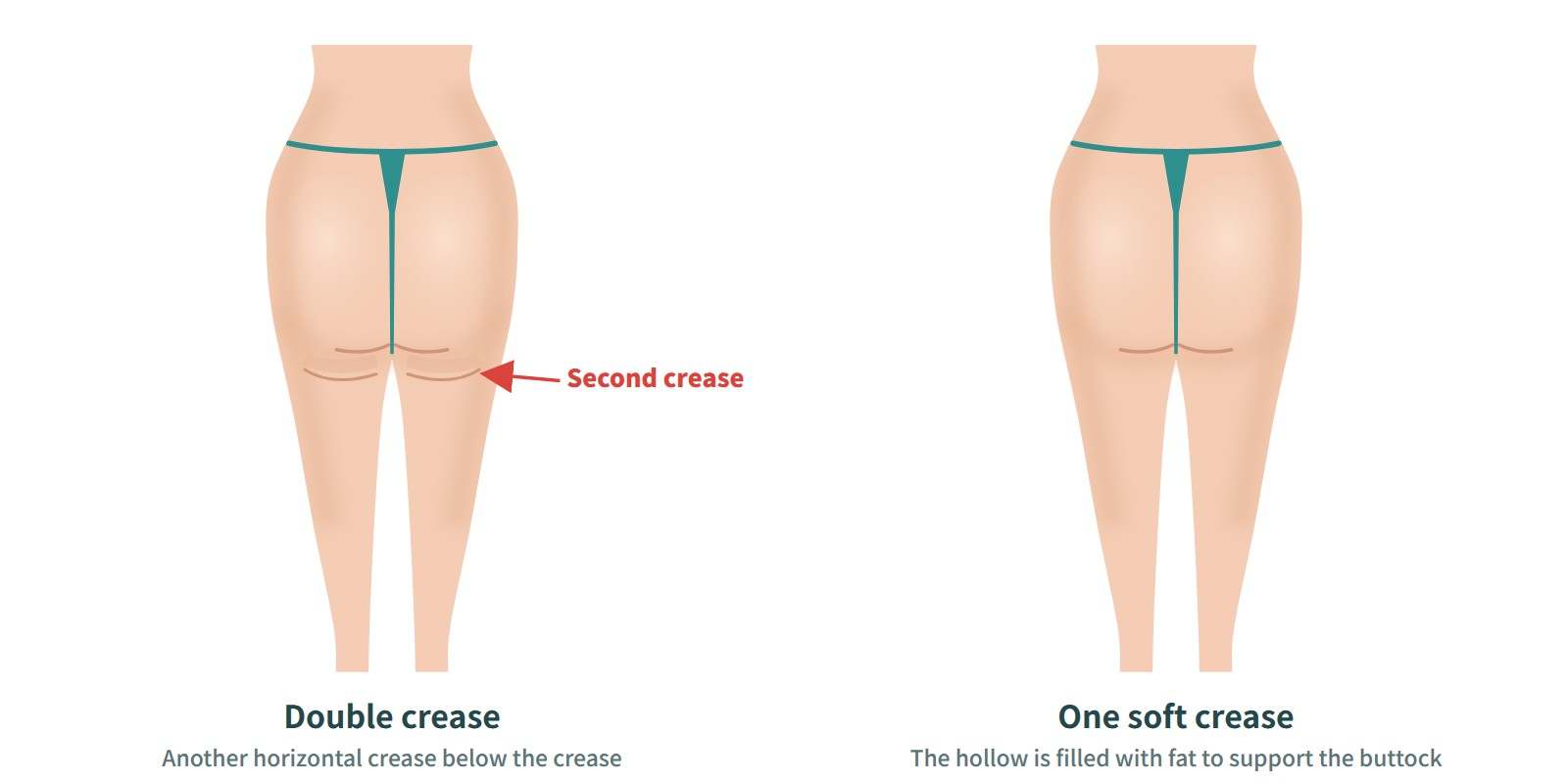
Our Approach at Venus Clinic — Banana Fold and Double Crease Fat Grafting
At Venus Clinic, when operating on the buttocks and thighs, we carefully refine only the shallow layer of the banana fold to preserve the fibrous tissue that supports the buttock. Then, to help prevent buttock ptosis and double creases, when necessary we purify the suctioned fat and graft it into the banana fold and double crease areas. Textbooks also explain that fat can be grafted into the banana fold when it has been over-suctioned. [4] Supporting the lower buttock with fat makes the groove of the crease shallower, and the line from the buttock to the thigh flows smoothly as a single line. We have been using this combined approach of liposuction and fat grafting at Venus Clinic with favorable outcomes.
The Crease Becomes Shallower but Does Not Disappear
The infragluteal crease forms where the buttock and thigh fold, depending on muscle movement and posture. Fat grafting can make it shallower, but it cannot remove the crease itself. Some of the grafted fat is absorbed, and how much of it survives differs from person to person.
Limitations — Surgery That "Reduces Ptosis and Brings It Closer"
Reducing the size of the buttocks and filling hollow areas with liposuction and fat grafting improves ptosis, but it does not remove all excess skin. The degree of skin contraction varies from person to person depending on skin elasticity and the degree of ptosis, and when elasticity is significantly reduced, some ptosis may remain. After the buttocks are lifted, the original crease that had been hidden by sagging tissue becomes visible, and when the buttocks rise well above the original crease, a new boundary between the buttock and the thigh may form above it, with the original crease remaining below as a faint trace. In either case this appearance results from the buttocks being lifted, and it is different from a double crease, in which a second crease forms below the original crease. If the original bone structure and muscles differ between the left and right sides, the shape will follow them after surgery as well. Weight gain can make the buttocks heavy again, and repeatedly standing with the buttocks tucked forward after surgery can deepen the crease, so the habit of standing upright is important.
References
- Gonzalez R. Buttocks Reshaping: Posterior Contour Surgery — A Step-by-Step Approach. Rio de Janeiro: Indexa; 2006.
- Klein JA. Tumescent Technique: Tumescent Anesthesia & Microcannular Liposuction. Mosby; 2000. Chapter 32, 33, 36.
- Serdev N, ed. Advanced Techniques in Liposuction and Fat Transfer. InTech; 2011. Chapter 1, Application of the Liposuction Techniques and Principles in Specific Body Areas and Pathologies (Gonzalez classification of gluteal ptosis).
- Toledo LS. Refinements in Liposculpture of the Buttocks and Thighs. In: Shiffman MA, Di Giuseppe A, eds. Liposuction: Principles and Practice. Springer; 2006. Chapter 20. / Raskin BI, Iyer S. Microcannula Liposuction. Same book, Chapter 27. / Fournier PF. Reduction Syringe Liposculpturing. Same book, Chapter 30.
- Mendieta CG. Classification system for gluteal evaluation. Clin Plast Surg. 2006;33(3):333-346.
- Dixit VV, Wagh MS. Unfavourable outcomes of liposuction and their management. Indian J Plast Surg. 2013;46(2):377-392.
Before-and-After Photos
The photos below show a patient whose buttocks had spread and sagged horizontally and who underwent buttock and thigh liposuction at Venus Clinic. All after photos were taken one week after surgery. Swelling and bruising remain, so these are not the final results, and the shape will change somewhat further as the swelling subsides. In each photo, the left is before surgery and the right is after surgery.
Back View
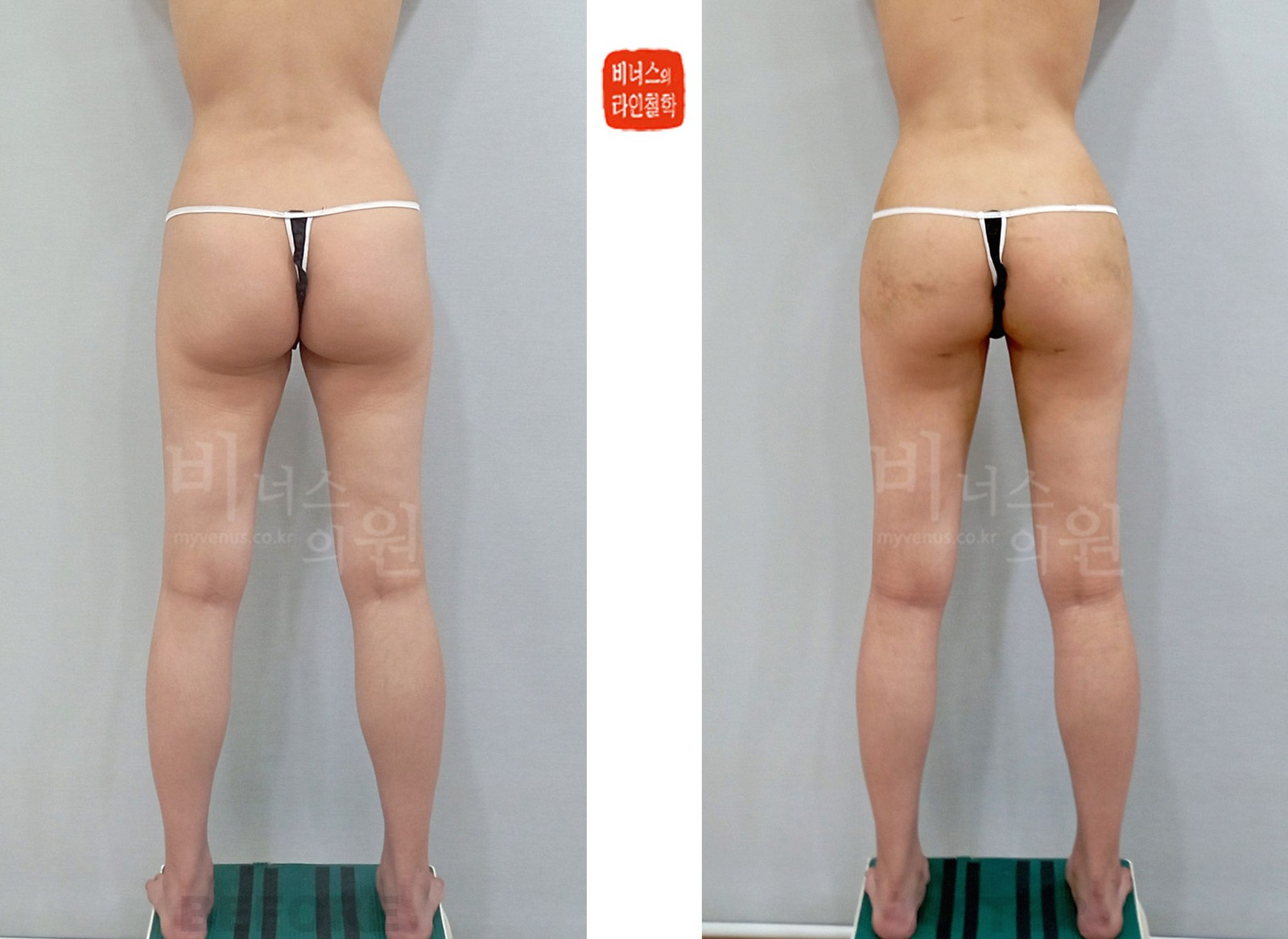
A case of horizontally sagging buttocks. Before surgery, the buttocks were spread wide to the sides, and tissue from the lower buttock had descended toward the thigh, covering the border between the buttock and thigh, so the buttocks looked long and low. After surgery, the width and size of the buttocks decreased so the buttocks gathered toward the center, and as the lower border moved upward, the sagging appearance covering the thigh is no longer seen. As the buttocks have risen, the thighs look longer. The discoloration visible on the buttocks and below the waist is bruising at about one week after surgery and fades over time.
| Information on the Posted Liposuction Before-and-After Photos | |||
|---|---|---|---|
| - Same person | Surgery performed at Venus Clinic; same person | - Date taken | Taken around 2023; comparison at 1 week after surgery |
| - Same conditions | Edited to the same posture and size as closely as possible | - Side effects | https://en.myvenus.co.kr/should_know/38861 |
Side View
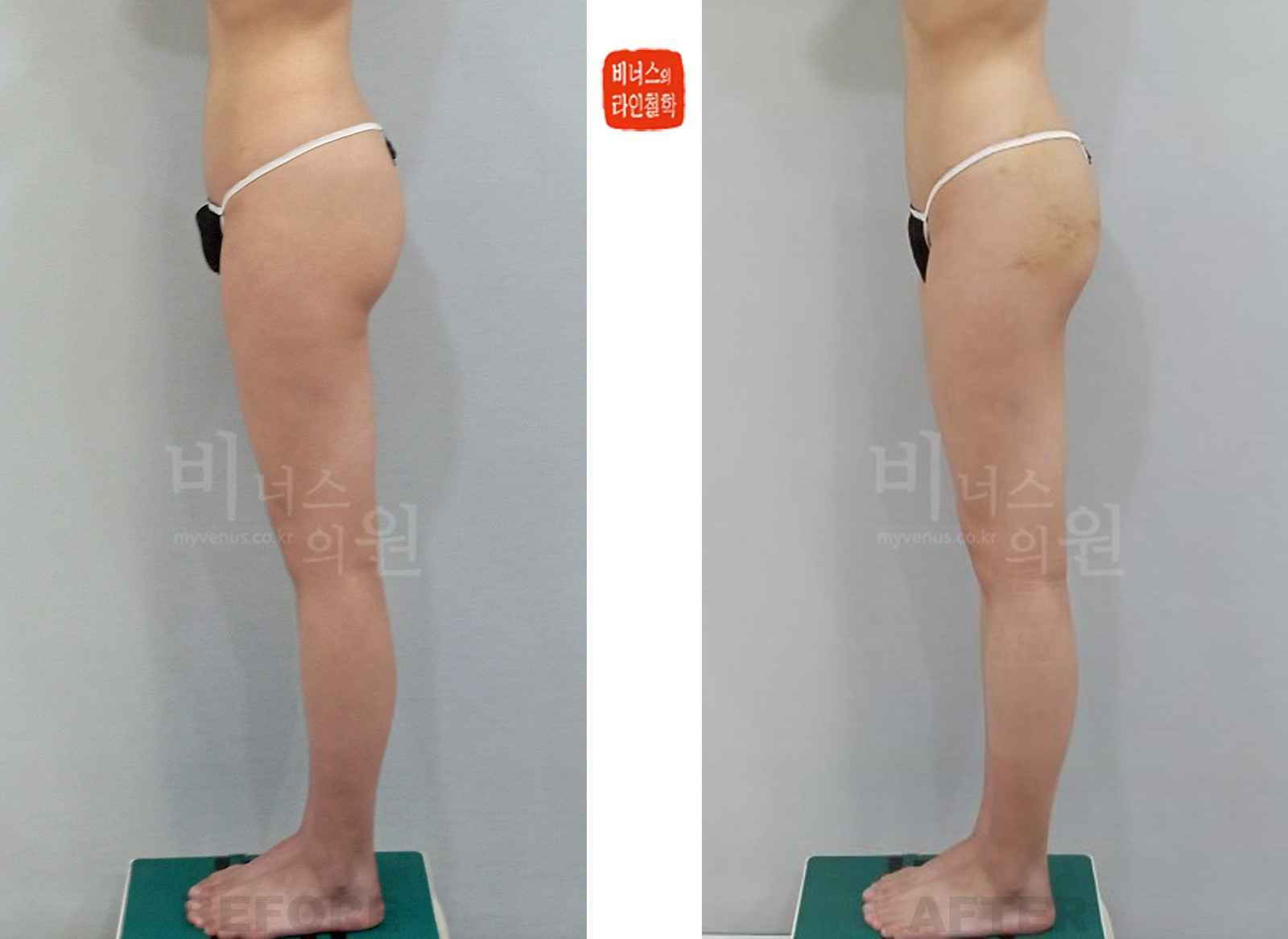
A case of horizontally sagging buttocks. In the side view before surgery, the lower buttock bulged backward and downward, touching the upper back of the thigh. After surgery, the volume of the lower buttock decreased, so the curve from the buttock to the back of the thigh became gentler, and the back of the thigh also flows smoothly.
| Information on the Posted Liposuction Before-and-After Photos | |||
|---|---|---|---|
| - Same person | Surgery performed at Venus Clinic; same person | - Date taken | Taken around 2023; comparison at 1 week after surgery |
| - Same conditions | Edited to the same posture and size as closely as possible | - Side effects | https://en.myvenus.co.kr/should_know/38861 |
Front View
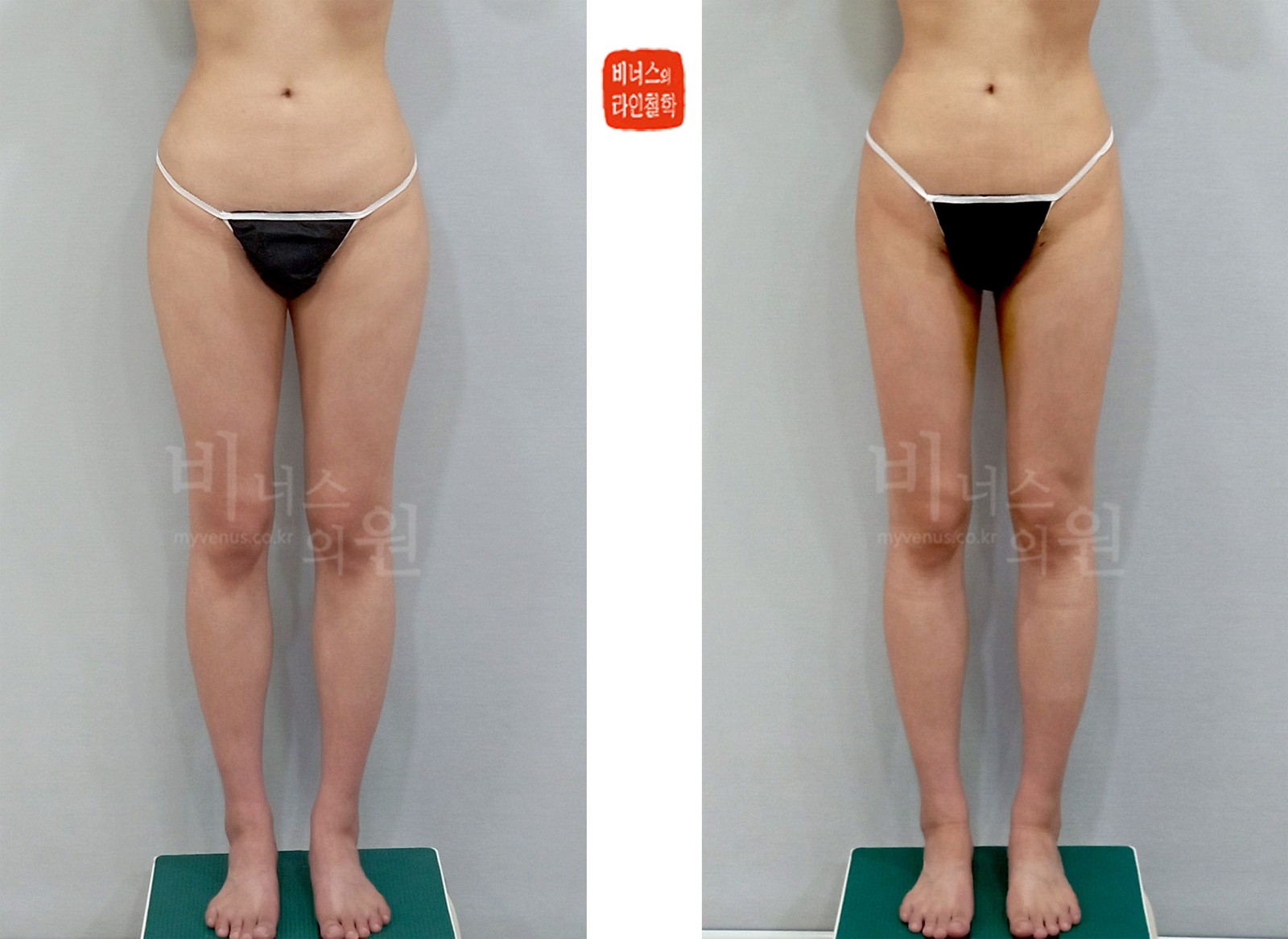
A case of horizontally sagging buttocks. From the front, before surgery the upper outer thigh below the pelvis bulged out to the side, but after surgery the projection of the outer thigh decreased, so the leg line from the pelvis down to the knee runs straight.
| Information on the Posted Liposuction Before-and-After Photos | |||
|---|---|---|---|
| - Same person | Surgery performed at Venus Clinic; same person | - Date taken | Taken around 2023; comparison at 1 week after surgery |
| - Same conditions | Edited to the same posture and size as closely as possible | - Side effects | https://en.myvenus.co.kr/should_know/38861 |
In Closing
A beautiful buttock is created not only by its size but also by its ratio to the waist, the position of its most projecting point, the curve of its sides, and a lower border without ptosis. At Venus Clinic, we first read the shape of the buttocks and the degree of ptosis, then treat the hips, buttocks, and saddlebags as one cosmetic unit: we reduce the hips and saddlebags and graft fat into the dell (hip dip) between them to change the violin-shaped pelvic contour into a round shape, while gathering the buttocks toward the center and raising the lower border. We also graft fat into the banana fold and double crease areas to support the buttocks from below and help prevent ptosis and double creases.
Dr. Hakjun Kim, Director, Venus Clinic