A Closer Look at Suctioned Fat
Liposuction is a cosmetic procedure that suctions out fat to create the body shape you want, and it is also called liposculpture. In fact, what deserves attention in liposuction is the fat that remains, not the fat that is suctioned out.
The amount of fat that can be removed varies from person to person, with body shape and constitution, and with the extent of surgery; under the same conditions, we believe there is almost no difference in the amount of fat removed that depends on the doctor. What this means is that how, and how much, of the fat layer is left behind is more important, because it determines the cosmetic result of the surgery and is where the doctor's skill shows.
Even so, this fat removed by liposuction is sometimes used for fat grafting, and recently there have also been reports that suctioned fat contains many stem cells, so that stem cells obtained through liposuction are being applied in cosmetic surgery. So it seems only natural that people take an interest in the suctioned fat.
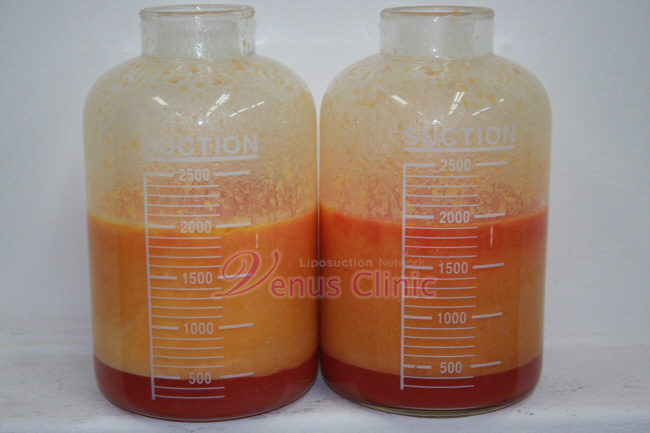
When liposuction is performed, the fat is collected as in the picture above. The yellow material in the upper layer is fat, and what has settled in the lower layer is tumescent fluid mixed with blood components. The upper layer is called the supranatant fat, and the lower layer the infranatant fluid.
Generally, when we say a certain number of cc were removed by liposuction, we mean only the supranatant fat in the upper layer; in the case shown above, we would say 1,900 cc of pure fat was removed.
People tend to think liposuction involves a lot of bleeding, but with the tumescent technique, blood loss is known to be about 1% of the aspirated volume, so in the case above there would have been only a small amount of bleeding, about 19 cc.
In general,
- Small-volume liposuction: under 100 cc,
- Medium-volume liposuction: 100- 1500 cc
- Large-volume liposuction: 1500 - 4000 cc
- Extra-large-volume liposuction: 4000 -7000 cc
- Mega-volume liposuction: over 7000 cc
is one way of classifying it. In most cases, about 1,500 cc - 4,000 cc is removed, and for safety it is recommended not to remove more than 5,000 cc.
Suctioned fat also differs in its characteristics.
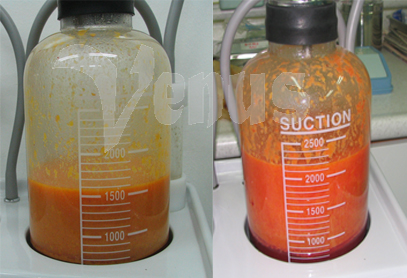
In the picture above, the fat on the left is yellow with almost no bleeding, while the fat on the right is orange in color and contains somewhat more blood. In conclusion, the fat on the left can be described as fat with a lot of fibrous tissue.
Fibrous tissue tends to be abundant in the following cases:
- In men
- After many injections or weight-loss treatments into the fat layer,
- After gaining weight and then losing it through dieting,
- In revision liposuction,
- In superficial liposuction
- When almost all of the fat tissue has been removed, that is, toward the end of surgery
and so on. In fact, when there is a lot of fibrous tissue, liposuction involves more bleeding and takes more effort on the doctor's part.
[ Dr. Jung, Director, Venus Clinic ]