Step-Offs After Liposuction: Why We Operate Along Continuous Lines, Not Isolated Areas
During consultations we often hear requests like "I just want a little taken off my lower belly" or "My flanks are fine, please just do the sagging part of my stomach." It may seem enough to reduce only the spot that bothers you most in the mirror, yet some patients come to us after liposuction saying, "The treated area went in, but the area right next to it seems to bulge out," or "It feels like there is a ledge at the edge."
Today I would like to explain why a step-off (a contour step between treated and untreated areas) forms, and why we at Venus Clinic plan liposuction along continuous lines rather than by separate areas. I will also cover feathering, which blends the edges smoothly, the principle of leaving an even layer of fat, and the limits of what liposuction can change.
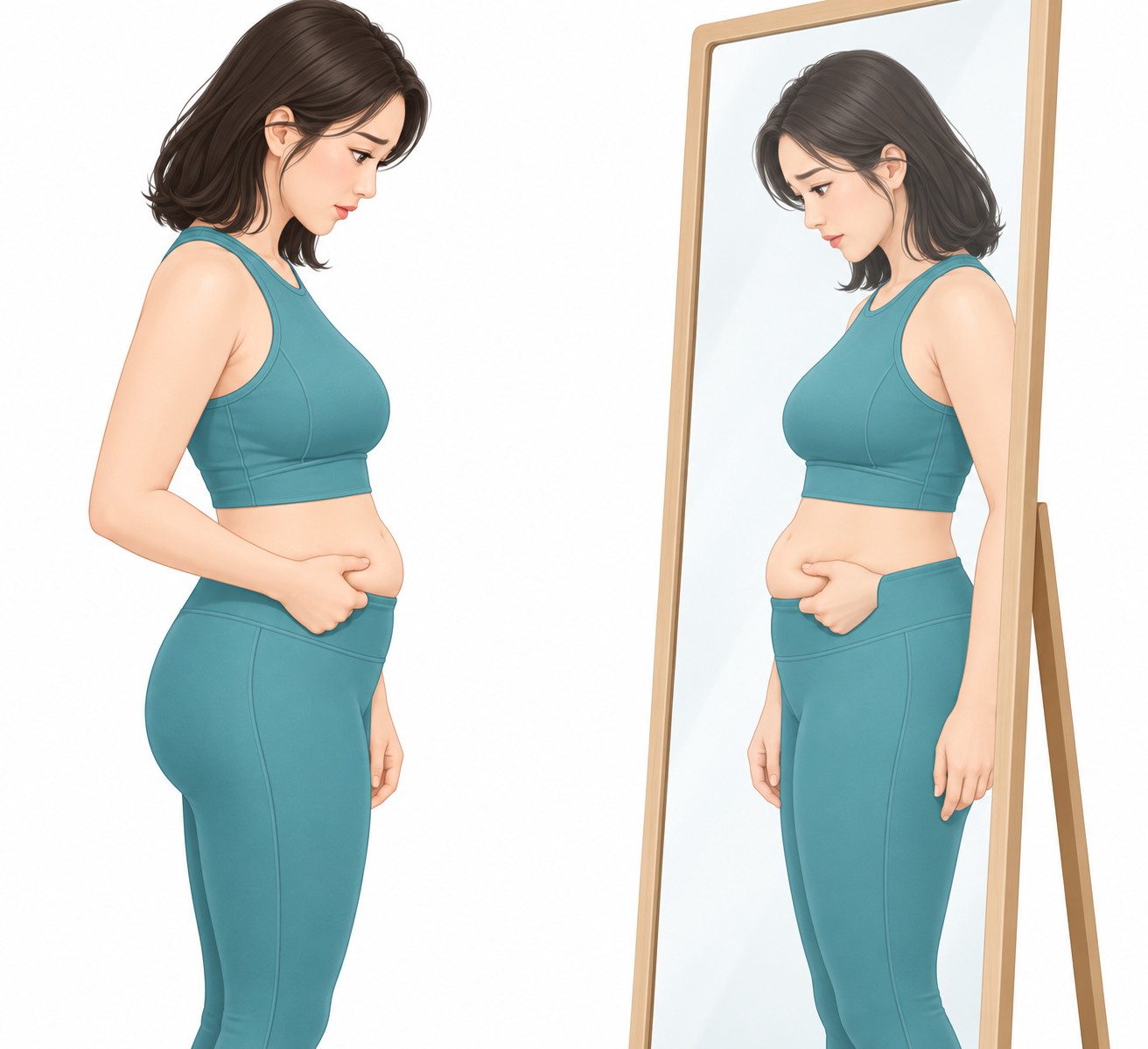
Step-Offs Form at the Border
Most step-offs after liposuction appear not "inside" the treated area but at the "border" where treated and untreated tissue meet. When one area becomes thinner while the area right next to it keeps its original thickness, a difference in height forms between the two.
Reducing Only the Sagging Belly Leaves the Surroundings Behind
If the abdomen sags downward, the fat is usually not confined to the lower belly; in most cases it has built up thickly and widely across the whole trunk. Reducing only the sagging belly while leaving the surrounding areas creates a border that actually makes the trunk contour look unnatural. In particular, fat over the upper ribs and along the bra line stays toward the chest when you lie down, but when you stand, gravity pulls it down so that it hangs over the abdomen and waist and forms folds. If this area is neglected, no matter how well the lower belly is shaped, the upper abdomen and waist will look as if there is a ledge.
We Plan Along Continuous Lines, Not by Area
That is why at Venus Clinic we do not think of the "abdomen" or the "flanks" as separate areas; instead, we plan the entire connected line as one unit. For the trunk, this means contouring all the way around (360 degrees): the abdomen and flanks in front, the waist, and the back. Shaping the front, back, and sides together keeps sagging fat from being left behind on one side and folding over, creating a trunk contour that flows continuously from any angle. Liposuction textbooks also explain that because the flanks and waist are part of an hourglass-shaped torso, good results usually require treating the hips as well, and the back when needed. Although it varies with body type, treating the trunk continuously without gaps requires at least three incisions.
The Edges Are Blended by Feathering
Even when liposuction is planned along lines, the suctioning has to end somewhere. How that edge is handled decides whether a step-off is left behind or the contour blends smoothly.
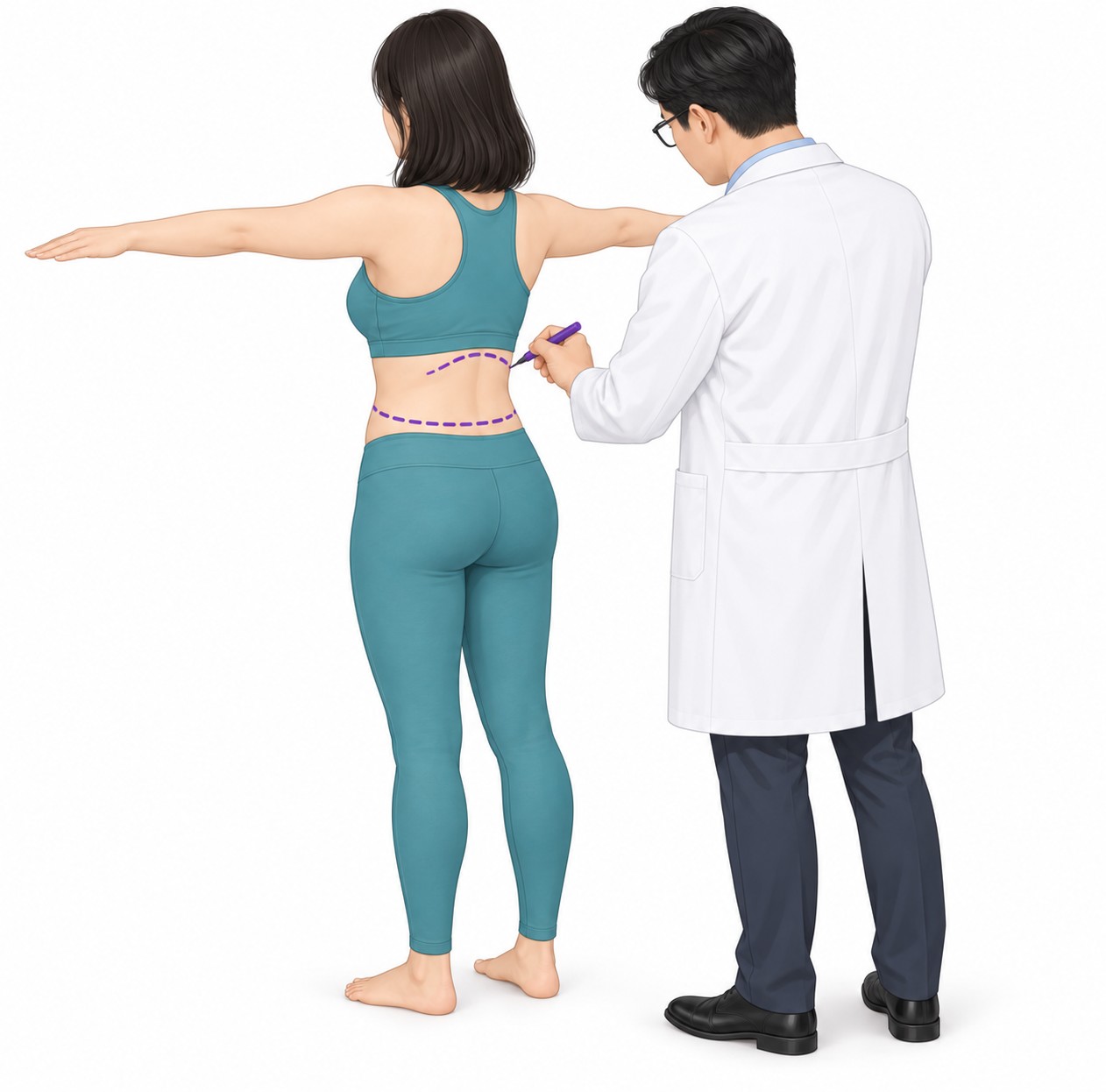
Marking Like Contour Lines in the Standing Position
Preoperative markings are made with the patient standing. Lying down shifts the fat in the direction of gravity and changes its shape, and once tumescent solution is infused the tissue swells, making it hard to tell where and how thick the fat was. Textbooks compare these markings to the contour lines of a topographic map. The thickest area of fat is marked as the central ring, concentric rings are drawn outward, more fat is removed where the rings are closer together, and the outer margin is marked separately as a feathering zone so that it blends evenly with the surrounding tissue. [1][2]
Suctioning Progressively Less Toward the Edges
Feathering, like the tip of a feather that gradually tapers, is a technique in which the amount of fat removed is reduced little by little toward the edges so that the treated area blends naturally into the untreated area. Stopping suction abruptly at the border leaves a cliff-like ledge, while tapering it gradually creates a gentle slope. Textbooks describe inserting cannulas through different incisions to suction in a crisscross pattern, and finally passing a fine cannula once more to feather irregularities at the border. During surgery, we keep checking by sight and by touch that the fat has been removed sufficiently and evenly. [2]

Leaving an Even Layer of Fat
The most important principle in reducing step-offs and irregularities is not "how much was removed" but "how evenly fat was left". I believe liposuction is not about removing a lot of fat, but about leaving fat well.
The Thickness Left Behind Is the Standard
Our principle at Venus Clinic is to leave the remaining fat layer at a consistently uniform thickness. Illouz recommended leaving a fat layer of at least 5 mm, and Dr. Giorgio Fischer taught, "Some subcutaneous fat must always be left. What matters is not what you remove, but what you leave behind." [3] When the remaining thickness is even, there is less room for height differences both within the treated area and at its edges.

Over-Suctioning Only the Deep Layer or One Spot Causes Irregularities
Textbooks warn that suctioning too close to the dermis causes permanent defects, and that suctioning only the deep layer over a wide area causes obvious irregularities. [2] Most surface irregularities after liposuction are also due to "uneven, excessive fat removal". This includes over-suctioning one spot, or trying to remove every bit of fat over a wide area and ending up leaving small, thin pockets here and there.
| Type | How it forms | How it looks |
|---|---|---|
| Localized over-resection | Occurs when fat in soft areas such as the inner thighs is suctioned out too easily | A sunken, hollow spot |
| Localized under-resection | Small, thin pockets are left behind while trying to remove all the fat over a wide area | Leftover bulges stand out with weight gain |
| Upper abdominal under-resection | The upper abdomen is not suctioned enough, so the upper fat sags | An inverted-smile-shaped crease above the navel |
Under-resection of the upper abdomen is the same story as "reducing only the sagging belly" described above. The lower abdomen becomes flat, but fat from the untreated upper abdomen drops down and forms a crease line at the border.
Contour Irregularity Is the Most Common Complication
In 2002, Chang et al. reported that the most common complication after liposuction is skin contour irregularity related to over-resection (grooves, rippling, and depressions), occurring in up to about 20% of patients. [3] Adhesions and fibrosis, improper positioning or compression garments after surgery, and laxity of the remaining skin can also be causes.
We Do Not Suction the Two Sides Differently
For the same reason, at Venus Clinic we do not suction the left and right sides differently, except in special cases such as correcting breast asymmetry where the two breasts differ in size. Trying to match the sides by removing more from one side makes the remaining fat layers differ in thickness and tends to create asymmetry instead. The basic rule is to remove an appropriate amount for the body type while keeping the remaining thickness the same on both sides.
Untreated Areas Stand Out More Later
The border problem does not exist only right after surgery. The number of fat cells decreases in areas treated with liposuction, but fat cells remain intact in untreated areas. So if you gain weight after surgery, more fat builds up in the areas that were not treated, and the treated areas may look sunken in comparison, making the body contour look unnatural.
Selective Fat Hypertrophy
Textbooks describe this phenomenon as "selective fat hypertrophy, which occurs as the number of fat cells decreases in areas treated with liposuction and fat accumulation increases in the remaining fat areas," and treat the later enlargement of untreated or under-treated fat deposits as one of the sequelae of liposuction. [4]
15 of 125 Patients (12%)
Fulton and Kerendian reviewed the records and photographs of 125 patients who had undergone liposuction over the previous five years and found that 15 of them showed a noticeable increase in fat in untreated or under-treated areas. That is 12%. There were 31 enlarged areas in total, an average of two per person (31 ÷ 15 ≈ 2.1), and the most common sites were the chest, upper back, and flanks. [4]
In other words, surrounding areas left untreated may not look very different right after surgery, but the difference can widen with weight gain. This is another reason we plan along continuous lines from the start.
Why the Initial Plan Matters
Once a step-off has formed, it is not easy to reverse. Minor irregularities, such as the lumps that can be felt early after surgery, often improve on their own during recovery, but when a distinct step-off remains, procedures such as revision liposuction, fat grafting, or skin-fat excision (dermolipectomy) may be needed.
Hard to Correct Even with Revision Surgery and Fat Grafting
An area that has already been thinned is difficult to make thick again. In the past, attempts were made to correct irregularities after liposuction by grafting fat from other areas, but the results were inconsistent, and there are reports that large volumes of fat transferred into the unfavorable bed left after suctioning do not survive well. [5] That is why, rather than correcting a step-off after it forms, properly planning the extent, the edges, and the remaining thickness at the first operation matters above all.
Limits: The Result Follows Your Original Bone and Muscle Structure
Even with line-based planning and an evenly preserved fat layer, the only thing liposuction can change is the thickness of the fat under the skin. As the fat layer becomes thinner, the shape of the muscles and bones beneath it shows through, so the result of liposuction ultimately follows the bone and muscle structure a person originally has. If the pelvis, ribs, or muscles differ between the left and right sides to begin with, that difference will remain after surgery. In addition, if you gain a lot of weight after surgery, the remaining fat cells enlarge and the contour can change. It is more accurate to understand liposuction as a plan that "reduces" the chance of step-offs and irregularities, not as surgery that creates a new body shape.
References
- Klein JA. Tumescent Technique: Tumescent Anesthesia & Microcannular Liposuction. Mosby; 2000. Chapter 28.
- Shiffman MA, Di Giuseppe A, eds. Liposuction: Principles and Practice. Berlin: Springer; 2006. Chapter 18·20·23, etc.
- Venus Clinic. Complications and Side Effects of Liposuction. https://en.myvenus.co.kr/should_know/38861 (cited from Illouz, Fischer, and Chang 2002)
- Fulton JE Jr, Kerendian F. Disharmonious Obesity Following Liposuction. In: Shiffman MA, Di Giuseppe A, eds. Liposuction: Principles and Practice. Berlin: Springer; 2006. Chapter 51, p.342–346.
- Serdev N, ed. Advanced Techniques in Liposuction and Fat Transfer. InTech; 2011. Chapter 10.
Before-and-After Photos
This is a revision surgery case in which irregularities left after a previous liposuction were corrected with liposuction at Venus Clinic.
Case 1
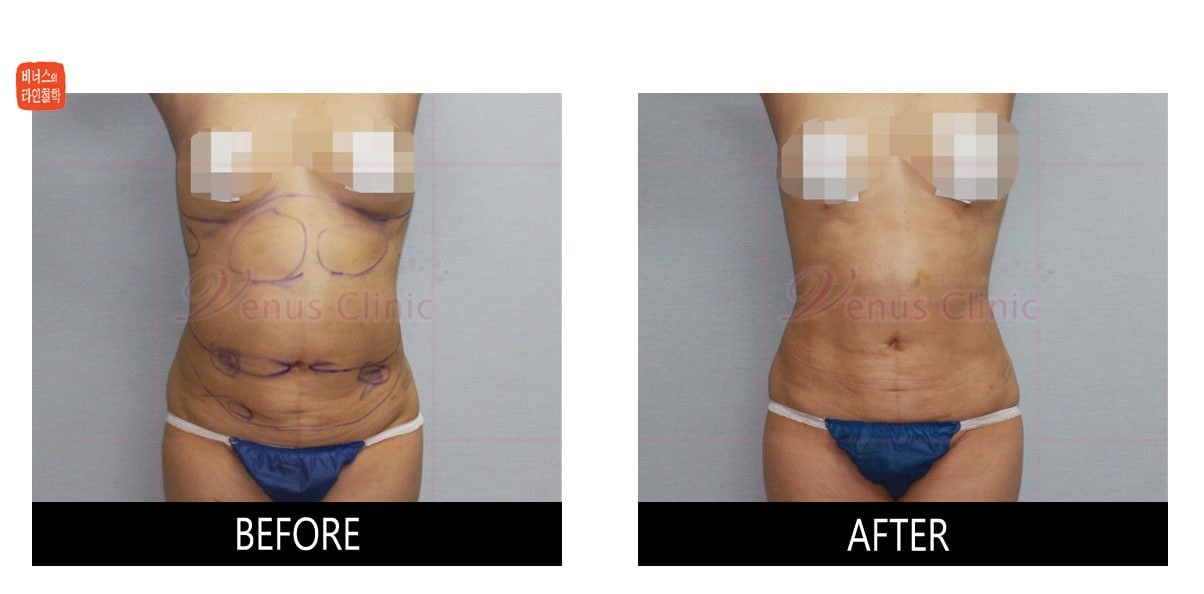
These are photos of revision surgery in which overall insufficient liposuction (especially of the upper abdomen) and localized over-resection were corrected with liposuction. In the before photo, areas of the upper abdomen that were under-suctioned in the previous surgery are mixed with over-suctioned spots, leaving height differences across the whole abdomen. After surgery, the height differences across the abdomen were reduced and the surface became more even.
| Information on the Posted Liposuction Before-and-After Photos | |||
|---|---|---|---|
| - Same person | Surgery performed at Venus Clinic; same person | - Date taken | Revision surgery case at Venus Clinic (date of photography not recorded) |
| - Same conditions | Edited to the same posture and size as closely as possible | - Side effects | https://en.myvenus.co.kr/should_know/38861 |
In Closing
Step-offs after liposuction form at the border between treated and untreated areas, become more noticeable with weight gain, and are hard to correct once they appear. That is why at Venus Clinic our principle is to plan the entire connected line rather than the single area that bothers you, to blend the edges smoothly with feathering, and to keep the remaining fat layer at an even thickness. I believe that what you leave, and how you leave it, determines the result of liposuction more than what you remove.
References: 360-Degree Liposuction for a Sagging Abdomen Complications and Side Effects of Liposuction Y-Zone Liposuction for Disproportionate Obesity
Dr. Hakjun Kim, Director, Venus Clinic