Ultrasonic Lipolysis and Ultrasound-Assisted Liposuction
Many diet programs have been developed these days, and it is common to see TV shows where people take on diet challenges. Dieting is not only hard, but weight often comes back after a successful diet (the yo-yo effect), so there is no doubt that obesity remains a difficult problem for people today.
However, some people push themselves into strict diets even when they don't really need to, and end up losing both their figure and their health. For many people, correcting body shape rather than chasing a number on the scale can create a balanced, healthy kind of beauty.
If liposuction feels like too much in terms of cost and treatment area, if you need body contouring more than weight loss, or if you are a middle-aged woman whose body has become resistant to dieting and you would like to remove at least a small amount of fat, ultrasonic lipolysis may be worth considering. Please read on.....
Ultrasonic Lipolysis
This method uses the VASER (Vibration Amplification of Sound Energy at Resonance) device, a third-generation ultrasound-assisted liposuction system, and dissolves fat with a fine titanium ultrasound probe only 1.2 mm (18 gauge) in diameter.
Because it uses tumescent local anesthesia, the procedure can be performed with minimal discomfort. Instead of the incisions used in liposuction, a small entry point is made with an 18G needle, and a needle-sized ultrasound probe or cannula is inserted into the fat tissue to dissolve the fat. It can be described as a partial lipolysis procedure that leaves minimal visible marks.
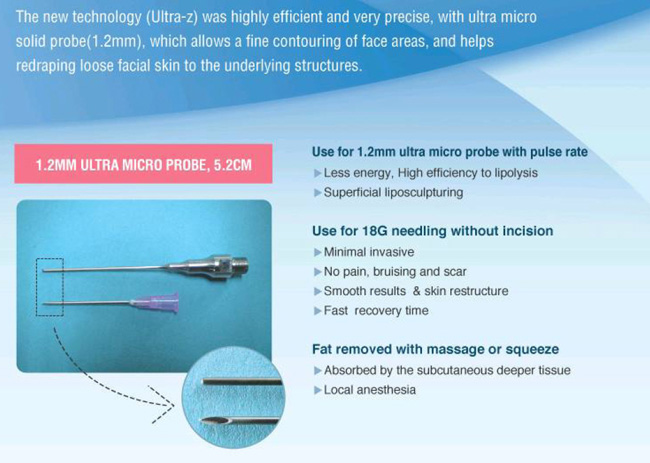
It resembles non-surgical lipolysis such as the fat-dissolving injection known as HPL in that it uses a needle and leaves minimal scarring. However, rather than destroying fat tissue with drugs as HPL injections do, it uses more direct ultrasound energy to emulsify the fat tissue, so it can be described as "partial lipolysis."
The procedure takes about 30 minutes, although this varies with the size of the treatment area. Patients can go home right after the procedure, and it causes little disruption to daily life.
- When the amount of fat is too small for liposuction,
- When the fat is localized and a mini liposuction would be appropriate,
- When long-term fat-reduction injections have had little effect,
- When you have had side effects from the drugs used in HPL injection lipolysis, or want a more noticeable result in a single session,
- When you feel reluctant about liposuction
— in these cases, this can be one option for localized fat deposits that have not responded to dieting or fat-reduction injections.
It works well on the lower abdomen, upper abdomen, upper arms, inner thighs, outer thighs, inner knees, and other areas. Because it uses a needle like HPL and leaves minimal scarring, it can also be used on areas of the body that are usually exposed.
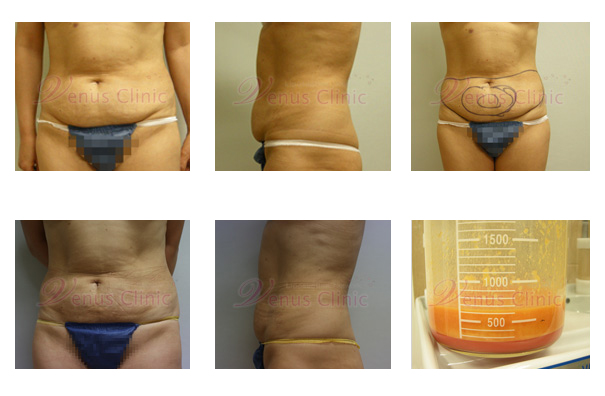
▲ Lower abdomen treatment area
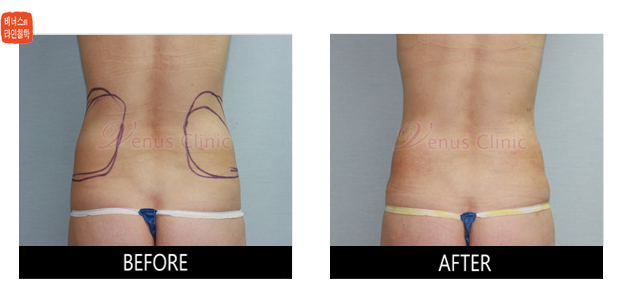
▲ Hip and waist treatment areas
Ultrasound-Assisted Liposuction
How Ultrasound-Assisted Liposuction (UAL) Works
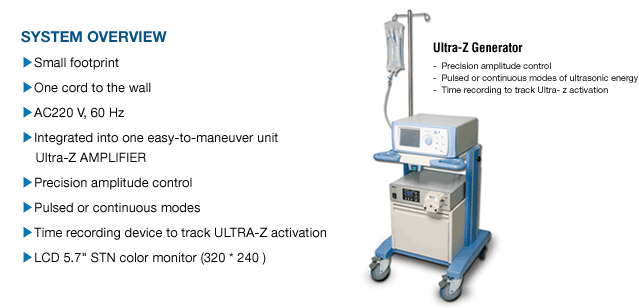
Quartz has piezoelectric properties: it generates an electric charge under pressure, and when charged it produces a steady vibration. This vibration can be transmitted efficiently as ultrasonic energy through a cannula (titanium probe) attached to a piezoelectric transducer. At the tip of the titanium probe, the vibrational energy is converted into circular sound waves and emitted, and within the tissue the ultrasonic energy is carried by water.
The emitted ultrasound creates microbubbles in the fat tissue through the cavitation effect. As these bubbles repeatedly go through compression and rarefaction, the fat cells implode, which leads to emulsification.
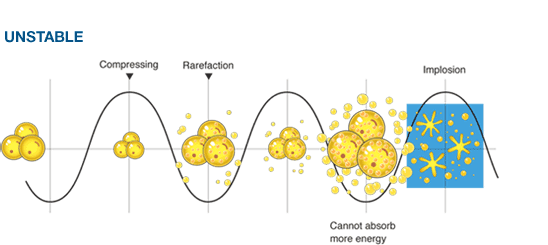
The ruptured, emulsified fat cells and fat components (triglycerides, free fatty acids) can be suctioned out with a syringe or cannula; if they are not suctioned out, they are absorbed by the tissue.
The Evolution of Ultrasound-Assisted Liposuction (UAL -> VAL)
Early ultrasound-assisted liposuction was developed by Zocchi in Italy in the early 1990s, and it spread rapidly thanks to ultrasound's remarkable ability to dissolve fat at about 100 cc per minute. However, excessive ultrasound energy caused complications such as seroma in the fat tissue, skin burns, and skin damage, and as criticism grew its use gradually declined. Still, ultrasound's strong fat-dissolving ability crossed over to the United States and developed into second-generation ultrasound-assisted liposuction. This used an ultrasound cannula that dissolved and suctioned fat at the same time, but complication rates were again high, and many doctors went on to criticize the ultrasound approach.
Nevertheless, doctors who were drawn to ultrasound continued to develop the technique. They reported that complication rates are higher when the procedure is performed by doctors unfamiliar with ultrasound-assisted liposuction, and that doctors using these machines need to acquire skilled technique.
More recently, a technology was developed that reduces these complications while keeping ultrasound's ability to dissolve fat. This is called third-generation ultrasound, or VASER (Vibration Amplification of Sound Energy at Resonance).
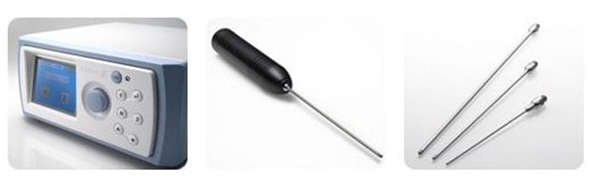
How VASER differs from second-generation ultrasound:
It moved away from the hollow cannula, which dissolved and suctioned fat at the same time, to a solid titanium probe that only performs implosion-based dissolution. This made it possible to reduce the probe diameter (small-diameter solid probes, 2.2–3.7 mm), allowing finer control and use on localized areas.
Pulsed delivery of ultrasonic energy divides the exposure into intervals, minimizing the amount of ultrasound energy that needs to be emitted.
The tip of the titanium probe has two or three grooves (grooved probe design), so ultrasound energy is emitted not only from the tip but also from the sides. Energy that used to travel only forward is spread front, back, up, and down, preventing energy concentration, which lowers the risk of complications while increasing efficiency.
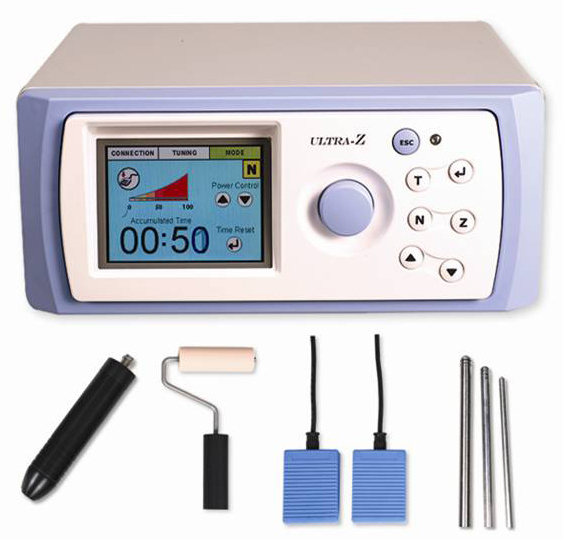
The VASER-Assisted Liposuction (VAL) Procedure
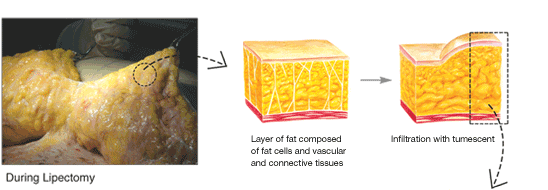
Infiltration of tumescent fluid: The tissue is swollen with fluid so that ultrasound energy can be transmitted through water. This also provides pain relief and helps control bleeding.
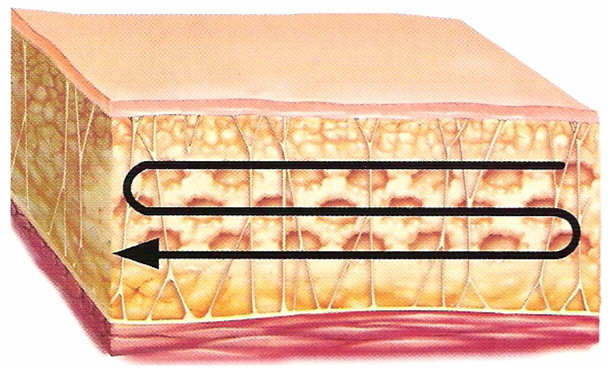
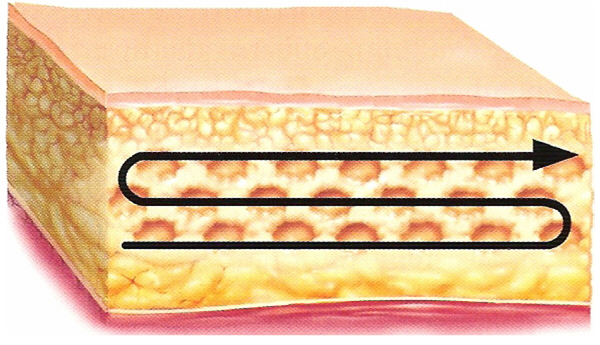
Ultrasound treatment: A titanium probe 2.2–3.7 mm in diameter is moved through the tissue so that ultrasound energy is applied evenly.
Suction of the liquefied fat tissue: The gently emulsified fat is suctioned out and removed using the negative pressure of an aspirator or syringe.
Use of VASER-Assisted Liposuction (VAL)
In 1999 and 2001, Cimino published objective parameters for the appropriate ultrasound energy needed for VASER to be safe and effective, and in 2002 Jewell et al. reported that in 77 VAL procedures no complications occurred and effective results were achieved.
In 2001, DiGiuseppe et al. also published a paper on the usefulness of ultrasound in liposuction of the chin and breasts, areas where skin retraction is needed.
So why was VAL needed? Why go to the trouble of improving the ultrasound approach (UAL), which had been pushed out of the liposuction field because it caused serious complications such as burns and skin necrosis, and bring it back into use?
Although older ultrasound had serious complications, it was excellent at dissolving fat, and it also stimulates the production of collagen, which gives skin its elasticity, and has a notable effect on skin retraction. This makes it useful for face contouring, breast mastopexy, areas where liposuction is difficult because of dense fibrous tissue such as the back and the male upper abdomen, and revision liposuction where there is a lot of adhesion and fibrous tissue. That is why it evolved into VASER, an improved form that can reduce the complications of the ultrasound method.